AWS IoT SiteWise Native Anomaly Detection for Predictive Maintenance
Quick summary: SiteWise multivariate anomaly detection (GA July 2025) is the Lookout for Equipment exit ramp before the 2026-10-07 sunset. July 2026 refresh — when native ML fits, when SageMaker still wins.
Key Takeaways
- SiteWise multivariate anomaly detection (GA July 2025) is the Lookout for Equipment exit ramp before the 2026-10-07 sunset
- July 2026 refresh — when native ML fits, when SageMaker still wins
- Engagement shape (anonymized): process plant, ~40 rotating assets prioritized for PdM, Lookout-for-Equipment pilot retiring before the 2026-10-07 Lookout sunset
- Path 2 handles newer IoT-enabled sensors
- Path 3 handles integration with existing manufacturing execution systems (MES) or industrial historians (OSIsoft PI, Wonderware, FactoryTalk)
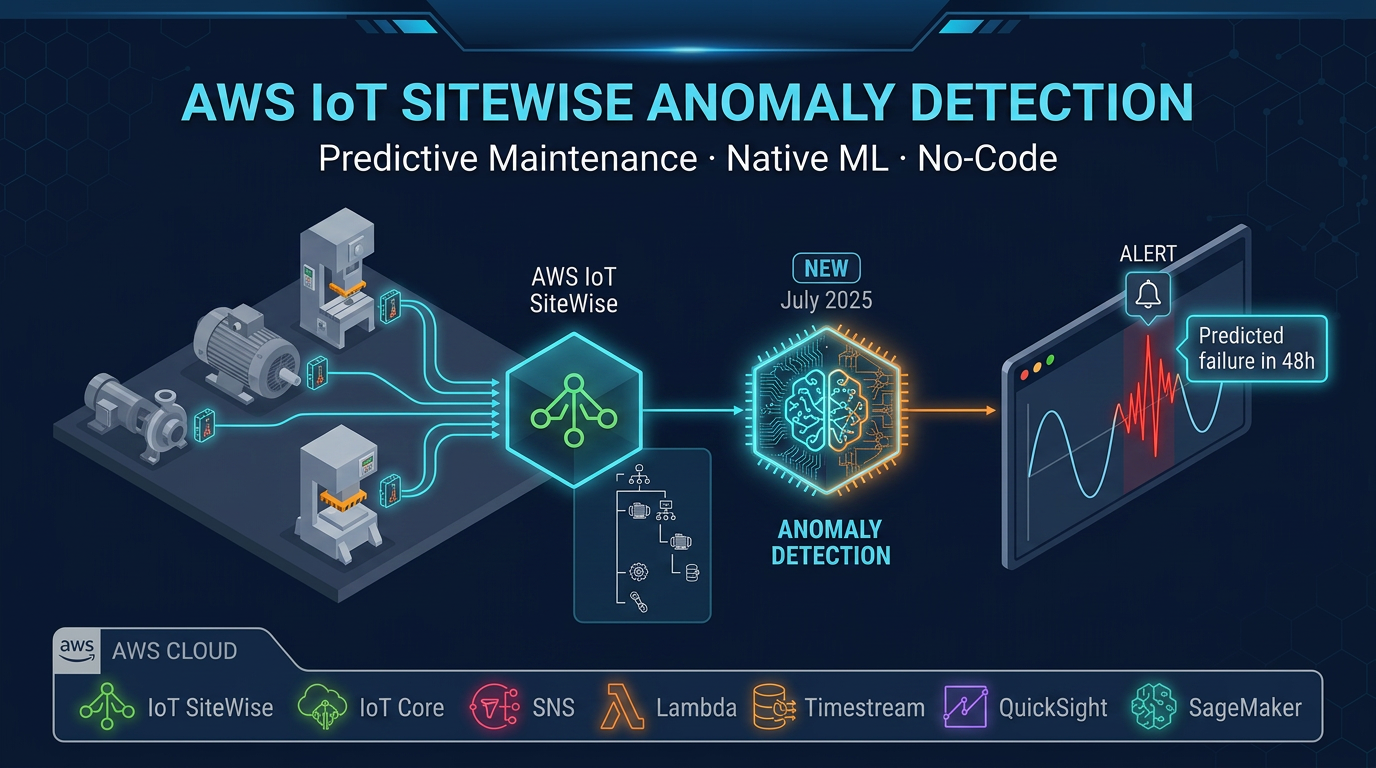
Table of Contents
Unplanned downtime still dominates plant P&L. Public industry studies (e.g., Aberdeen-style downtime cost research) commonly place major industrial outages in the hundreds of thousands of dollars per hour when lost production, emergency labor, and expedited parts stack — treat any single figure as directional and calibrate to your line’s contribution margin.
Engagement shape (anonymized): process plant, ~40 rotating assets prioritized for PdM, Lookout-for-Equipment pilot retiring before the 2026-10-07 Lookout sunset. As of July 2026, SiteWise native multivariate anomaly detection (GA July 2025) is the default no-code path; Amazon Managed Grafana for dashboards; SageMaker only when you need RUL / failure-mode classes.
Reproduce this: gateway checklist · OEE baseline CSV · TwinMaker overlay path
The Industrial Data Problem SiteWise Solves
Factory equipment generates sensor data in a context that raw time-series databases do not naturally support. A temperature reading of 87°C has a different meaning depending on whether it comes from the inlet or outlet of a heat exchanger, whether the machine is in startup warm-up or steady-state production, and whether it is on Press Line 1 or Press Line 3.
SiteWise addresses this with an asset model framework that gives sensor readings manufacturing context.
Asset Models
An asset model defines a class of equipment — its properties, their data types, and their relationships. Think of it as a template:
Asset Model: Hydraulic Press
├── Measurements (raw sensor readings)
│   ├── oil_temperature  (double, unit: Celsius)
│   ├── hydraulic_pressure (double, unit: bar)
│   ├── cycle_count (integer, unit: cycles/min)
│   └── motor_current (double, unit: Amps)
├── Transforms (calculated properties)
│   ├── oil_temp_f = oil_temperature * 9/5 + 32
│   └── load_ratio = hydraulic_pressure / 250 (% of rated pressure)
├── Metrics (time-series aggregations)
│   ├── avg_oil_temp_1h = avg(oil_temperature, 1h)
│   └── max_pressure_15m = max(hydraulic_pressure, 15m)
└── Attributes (static properties)
    ├── manufacturer = "Schuler AG"
    ├── rated_pressure_bar = 250
    └── installation_date = "2019-03-15"
Assets
Assets are instances of asset models. HydraulicPress_Line1_Station3 is an asset of type Hydraulic Press. You can create asset hierarchies — PlantA > Line1 > HydraulicPress_Line1_Station3 — and SiteWise queries respect the hierarchy, letting you roll up KPIs from individual machines to line-level to plant-level.
Why Modeling Matters for Predictive Maintenance
Native anomaly detection operates on asset model properties. You configure anomaly detection at the model level and it applies to every asset of that type. When you add a new hydraulic press to the plant, it automatically inherits the anomaly detection configuration from its model — no manual setup per machine.
Data Ingestion Architecture
SiteWise supports multiple ingestion paths depending on your equipment and network topology:
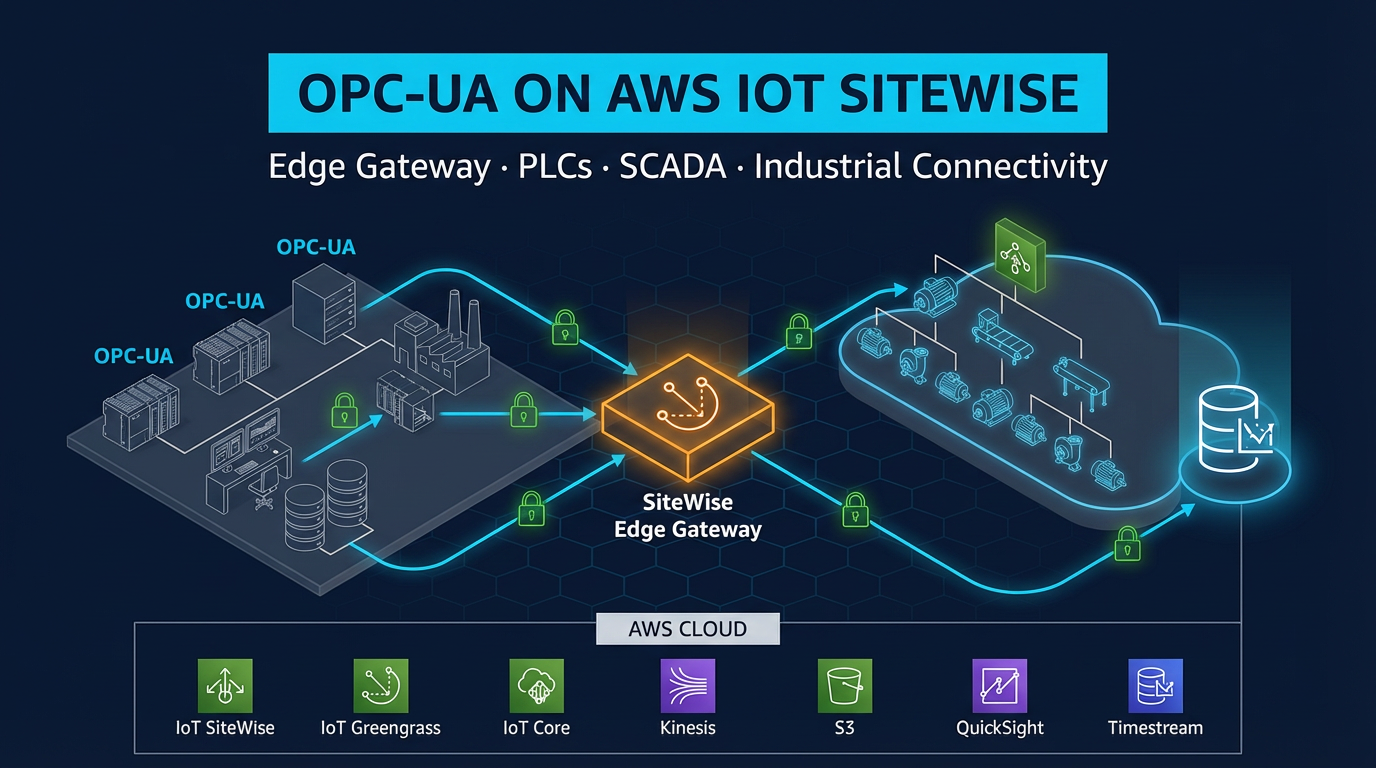
Path 1: Factory PLCs (OPC-UA)
  PLC / SCADA ──OPC-UA──→ SiteWise Edge (Greengrass v2 gateway) ──→ AWS IoT SiteWise

Path 2: Smart sensors (MQTT)
  Smart sensor ──MQTT──→ AWS IoT Core ──Rule Engine──→ SiteWise

Path 3: Custom systems (API)
  MES / Historian ──HTTPS──→ SiteWise BatchPutAssetPropertyValues API

Path 4: IoT rules engine
  IoT Core MQTT message ──Rule──→ SiteWise action (property alias mapping)
For most manufacturing environments, Path 1 (OPC-UA via SiteWise Edge) handles the bulk of equipment data collection. Path 2 handles newer IoT-enabled sensors. Path 3 handles integration with existing manufacturing execution systems (MES) or industrial historians (OSIsoft PI, Wonderware, FactoryTalk).
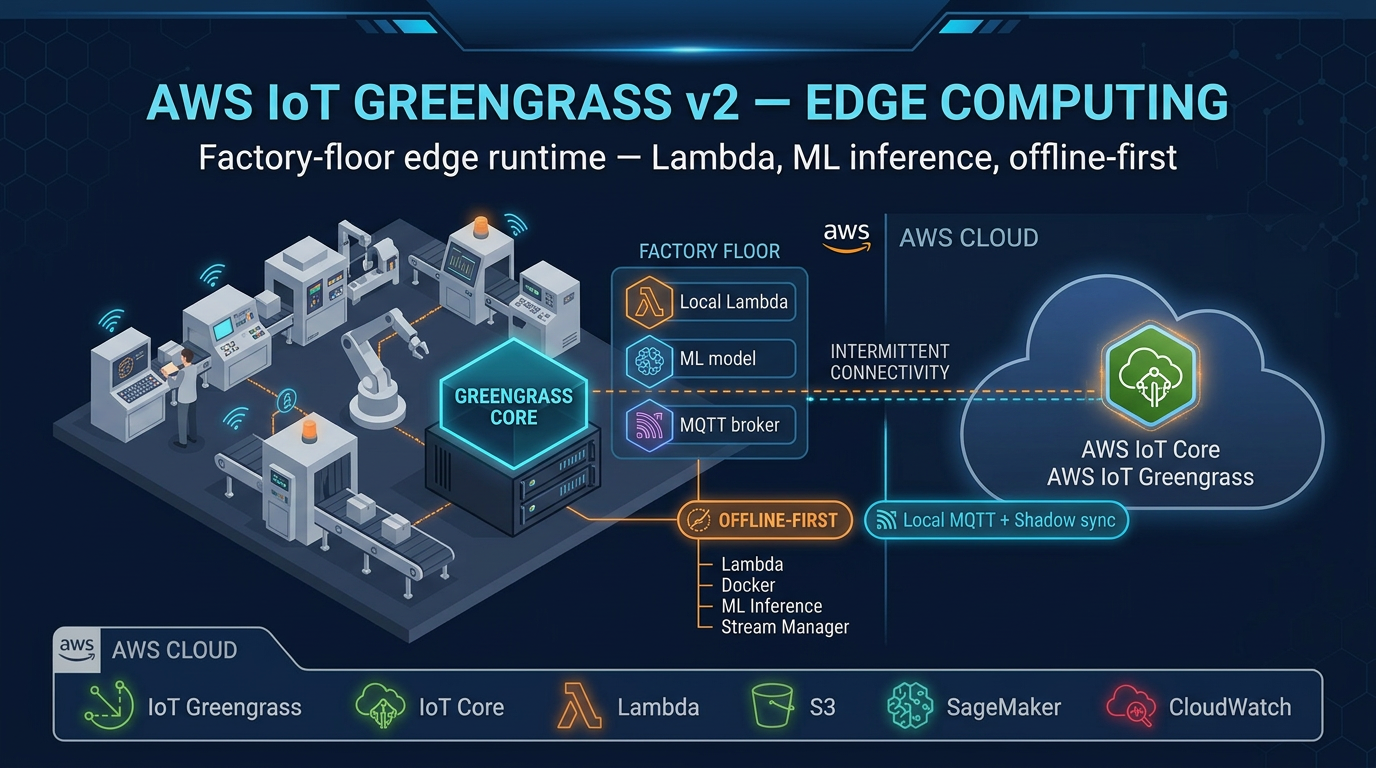
SiteWise Edge on Greengrass v2
SiteWise Edge is not a separate product — it is a set of Greengrass v2 components (aws.iot.SiteWiseEdgeCollectorOpcua and aws.iot.SiteWiseEdgePublisher) that run on your factory-floor gateway hardware. The collector reads from OPC-UA servers on the factory network. The publisher forwards structured data to the cloud SiteWise service.
Edge processing provides two operational benefits. First, the gateway buffers data locally when WAN connectivity is lost — no data gaps during network outages. Second, local alarming works without cloud connectivity — SiteWise Edge can evaluate alarm conditions on the gateway and trigger local outputs (relay closures, local HMI alerts) without waiting for cloud round-trips.
SiteWise Native Anomaly Detection: How It Works
AWS launched native anomaly detection for IoT SiteWise in July 2025. Before this launch, the recommended pattern for SiteWise-based anomaly detection required integrating a separate service. The July 2025 launch made anomaly detection a first-class capability within the SiteWise asset model framework — no external service, no custom code.
The Technical Mechanism
SiteWise native anomaly detection uses a multivariate anomaly detection model. The distinction from univariate (single-sensor) approaches is important in manufacturing: most equipment failures produce correlated anomalies across multiple sensors simultaneously. A failing bearing raises vibration AND temperature AND current draw. A univariate approach on any single sensor generates more false positives and misses subtler multi-sensor degradation patterns.
How the model works:
Training data preparation. SiteWise uses the historical measurement values for the selected properties to prepare a training dataset. Minimum requirement: 14 days of historical data. More data (30–90 days covering normal operating variations) produces a more accurate model.
Model training. SiteWise trains the multivariate anomaly detection model on the prepared dataset. Training typically completes in 2–8 hours for most equipment configurations. You can monitor training status in the SiteWise console.
Inference. After training, the model generates an anomaly score (a value between 0 and 1) for each asset at the configured monitoring frequency. A score near 0 indicates normal behavior. A score near 1 indicates the sensor combination looks significantly different from the training baseline.
Score persistence. The anomaly score is stored as an asset property in SiteWise — queryable via the SiteWise API, displayable in Amazon Managed Grafana, and alarmable via SiteWise alarms.
Continuous retraining. The model retrains on a rolling window of new data, allowing it to adapt to legitimate operational changes (planned maintenance that changes baseline vibration, seasonal temperature variations in non-climate-controlled facilities).
Configuring Anomaly Detection: Step-by-Step
Step 1: Navigate to the asset model in SiteWise console.
Go to IoT SiteWise → Models → select your asset model (e.g., Hydraulic Press) → Anomaly configuration tab.
Step 2: Add anomaly detection configuration.
Click “Add anomaly configuration”. Select the measurement properties to include. For a hydraulic press, select: oil_temperature, hydraulic_pressure, motor_current, cycle_count. Selecting correlated sensors produces the most sensitive detection.
Step 3: Set monitoring frequency.
Options: 1 minute, 5 minutes, 15 minutes, 1 hour. Shorter intervals detect anomalies faster but increase SiteWise API call costs. For most predictive maintenance use cases, 5–15 minutes is the right balance — anomaly degradation typically evolves over hours, not seconds.
Step 4: Enable and wait for training.
Click “Enable”. SiteWise begins training. Monitor training status in the console. After training completes, the anomaly score property (aws/anomaly-result/score) appears on each asset of that model type.
Setting Up Anomaly Alarms
SiteWise alarms evaluate property values and trigger actions when thresholds are crossed. Configure two alarms on the anomaly score property:
Warning alarm (score > 0.7):
Alarm name: HydraulicPress_AnomalyWarning
Property: aws/anomaly-result/score
Threshold: 0.7
Comparison: GREATER_THAN
Severity: 2 (Warning)
Notification: SNS topic → maintenance-team@plant.com
Action: Lambda function → create "Monitor" work order in CMMS
Critical alarm (score > 0.9):
Alarm name: HydraulicPress_AnomalyCritical
Property: aws/anomaly-result/score
Threshold: 0.9
Comparison: GREATER_THAN
Severity: 1 (Critical)
Notification: SNS topic → maintenance-supervisor@plant.com + SMS
Action: Lambda function → create "Urgent" work order in CMMS + page on-call engineer
The Lambda function triggered by the alarm receives the asset ID, alarm state, property value, and timestamp. Use these to call your CMMS API (SAP PM, Maximo, ServiceMax, UpKeep) to create the work order automatically — no manual dispatch required.
Amazon Managed Grafana for SiteWise Dashboards
AWS IoT SiteWise Monitor entered maintenance mode on November 7, 2025 and is no longer available to new customers. For new dashboard deployments, the recommended solution is Amazon Managed Grafana with the native SiteWise data source plugin.
Setting Up Amazon Managed Grafana
Step 1: Create a Managed Grafana workspace.
Go to Amazon Managed Grafana → Create workspace. Configure IAM Identity Center (SSO) for user authentication. Select the IAM role for workspace — it needs iotsitewise:* read permissions.
Step 2: Add SiteWise data source.
In the Grafana workspace, navigate to Configuration → Data Sources → Add data source → AWS IoT SiteWise. Select the region. Grafana uses the workspace IAM role to authenticate — no API keys required.
Step 3: Build the equipment health dashboard.
A production-ready predictive maintenance dashboard includes:
- Anomaly score trend panel — time series of
aws/anomaly-result/scorefor each asset. Plot against a 0.7 warning threshold line. - Active alarms table — current alarm states across all assets in the line. Color-coded: green (normal), yellow (warning), red (critical).
- Sensor readings panel — the individual measurements (temperature, pressure, current) for the currently selected asset. Use Grafana’s variable feature to switch between assets.
- Alarm history timeline — alarm state changes over the past 7 days. Useful for correlating maintenance events with anomaly score spikes.
Step 4: Configure Grafana alert rules.
Managed Grafana supports alert rules independent of SiteWise alarms. Configure a Grafana alert that fires when the anomaly score exceeds your threshold and routes to Slack, PagerDuty, or your on-call system. This provides redundant alerting — SiteWise alarm (SNS/Lambda) for CMMS work order creation, Grafana alert for engineer notification.
Example SiteWise Query in Grafana
The SiteWise data source uses the SiteWise API directly. Query example (JSON panel query):
{
  "assetId": "${asset_id}",
  "propertyId": "aws/anomaly-result/score",
  "timeOrdering": "ASCENDING",
  "maxResults": 250
}
Pair this with a SiteWise asset property query for the raw measurements to show correlated sensor values alongside the anomaly score.
Cost Model for SiteWise Predictive Maintenance
Understanding the cost structure helps right-size your monitoring configuration.
AWS IoT SiteWise pricing (us-east-1, April 2026):
| Charge | Rate |
|---|---|
| Data points ingested (measurements) | $0.10 per 100,000 data points |
| Transforms and metrics computed | $0.01 per 100,000 computations |
| Anomaly detection (per property-hour monitored) | ~$0.004 per property-hour |
| SiteWise data storage (hot tier, 30 days) | $0.10 per GB/month |
Example cost for a 10-machine hydraulic press line:
- 4 measurements per machine × 10 machines = 40 properties
- At 1 reading per second: 40 × 86,400 = 3.45M data points/day → ~$3.45/day → ~$103/month for ingestion
- Anomaly detection on 4 properties × 10 machines, at 5-minute intervals: 40 properties × 8,760 hours × $0.004 = ~$1,402/year → ~$117/month
- Total SiteWise cost: ~$220/month for 10 machines
Compare that to the cost of one unplanned downtime event at $260,000/hour. A single prevented failure pays for years of monitoring.
Amazon Managed Grafana: $9 per active editor/month, $5 per active viewer/month. A team of 5 maintenance engineers and 20 operators = $45 + $100 = $145/month.
Custom ML with SageMaker: When Native Detection Is Not Enough
SiteWise native anomaly detection handles the majority of predictive maintenance use cases. For scenarios requiring more than the built-in model offers, Amazon SageMaker provides the path to custom ML.
Use cases that benefit from SageMaker custom models:
- Physics-informed ML — incorporate equipment physics (bearing degradation equations, thermodynamic models) as features alongside sensor data
- Remaining useful life (RUL) prediction — not just “is something wrong” but “how many hours until failure” — requires LSTM or Transformer architectures trained on run-to-failure datasets
- Multi-asset correlation — detect when an anomaly on one machine predicts failures in downstream machines (common in connected production lines)
- Class-specific anomaly — distinguish between different failure modes (bearing wear vs. seal leak vs. hydraulic pump degradation) rather than a single anomaly score
Integration pattern:
SiteWise (historical data) ──→ S3 (export via SiteWise API) ──→ SageMaker training job
                                                                    ↓
SiteWise asset (computed property) ←── Lambda ←── SageMaker endpoint (real-time inference)
The Lambda function runs on a schedule or triggered by new SiteWise data events. It fetches recent sensor values from SiteWise, calls the SageMaker endpoint, receives the RUL prediction, and writes it back to SiteWise as a computed property. That property is then queryable, alarmable, and displayable in Grafana — same as any other SiteWise property.
When this advice fails
- Highly variable / batch recipes with mode chaos — native models expect relatively stationary equipment; label modes or use SageMaker with mode features.
- You need remaining useful life or failure-mode classes — escalate to SageMaker; native scores are “abnormal vs normal,” not RUL.
- Sparse history / frequent rebuilds — training prerequisites will fail; start with thresholds + more history collection.
What this post doesn’t cover
Lookout data export tooling specifics and CMMS vendor adapters — treat Lambda → CMMS as engagement-specific.
What to do Monday morning
- Inventory Lookout for Equipment resources; plan cutover before 2026-10-07.
- Pick one asset class (pumps/motors) with clean SiteWise history; train native anomaly detection.
- Wire alarms to SNS/Lambda; review sensor-contribution diagnostics before paging ops.
- Dashboards in Amazon Managed Grafana — not new SiteWise Monitor portals.
- Verify pricing for ingestion + anomaly inference on the SiteWise pricing page (sample line economics above are illustrative).
- Next: Greengrass v2 factory edge · manufacturing reference.
Frequently asked questions
What is AWS IoT SiteWise native anomaly detection?
How does SiteWise native anomaly detection work technically?
What replaced Amazon Lookout for Equipment?
What is AWS IoT SiteWise Monitor and is it still available?
How long does SiteWise anomaly detection model training take?
Can I set up alerts when SiteWise detects an anomaly?
How does SiteWise Edge work for data collection?
What data sources does AWS IoT SiteWise support for ingestion?

AWS Cloud Architect & AI Expert
AWS-certified cloud architect and AI expert with deep expertise in cloud migrations, cost optimization, and generative AI on AWS.