
Real Estate & PropTech
AWS for Real Estate & PropTech
AWS for PropTech startups, brokerages, and real estate platforms — geo-search at scale, AI valuations, MLS pipelines, and image-cost optimization that survives spring-buying-season traffic.
- + MLS Feeds Supported
- 500
- ms Median Property Search Latency
- 50
- % Image Storage Cost Reduction
- 60
- x Spring-Season Traffic Handled
- 10
Last updated:
Where we start in Real Estate & PropTech
Here we start with AWS engineering: security, compliance, cost, and the platform an agent would later run on.
AWS for real estate and PropTech — geo-search at scale, AI valuations, MLS data pipelines, and image-cost optimization for property platforms from an AWS Select Tier Partner.
- AWS partner tier
- Select Tier Services Partner
- Procurement
- AWS Marketplace seller
- On staff
- 50+ AWS certifications

4 ways we work in Real Estate & PropTech
Each one is a delivery offer with its own page. Most engagements combine two or three.


AWS lifecycle notice (June 30, 2026) — SageMaker GeoSpatial enters maintenance for new customers after 30 July 2026. Do not start new AVM or parcel-feature work on GeoSpatial. Keep OpenSearch geo queries and Rekognition condition scoring. Full matrix: lifecycle roundup.
Why Real Estate & PropTech Builds on AWS
The real estate industry generates enormous volumes of data — property listings, transaction records, market trends, satellite imagery, and consumer behavior. PropTech companies that can process, analyze, and act on this data faster than competitors win market share. AWS provides the scalable infrastructure that modern real estate platforms need:
- Elastic compute — Property search traffic varies dramatically with market conditions, interest rate changes, and seasonal cycles. AWS scales automatically without over-provisioning.
- Data processing at scale — S3, Glue, and Athena handle terabytes of MLS data, public records, and market analytics without managing Hadoop clusters
- AI/ML services — Bedrock, SageMaker, and Rekognition enable automated property valuations, image analysis, and natural language property descriptions
- Global CDN — CloudFront delivers property images and virtual tours with low latency across all markets
AWS powers many of the largest real estate platforms — Zillow, Redfin, Compass, CoStar, and thousands of regional brokerages and PropTech startups.
Common Real Estate Architectures on AWS
Property Search Platform
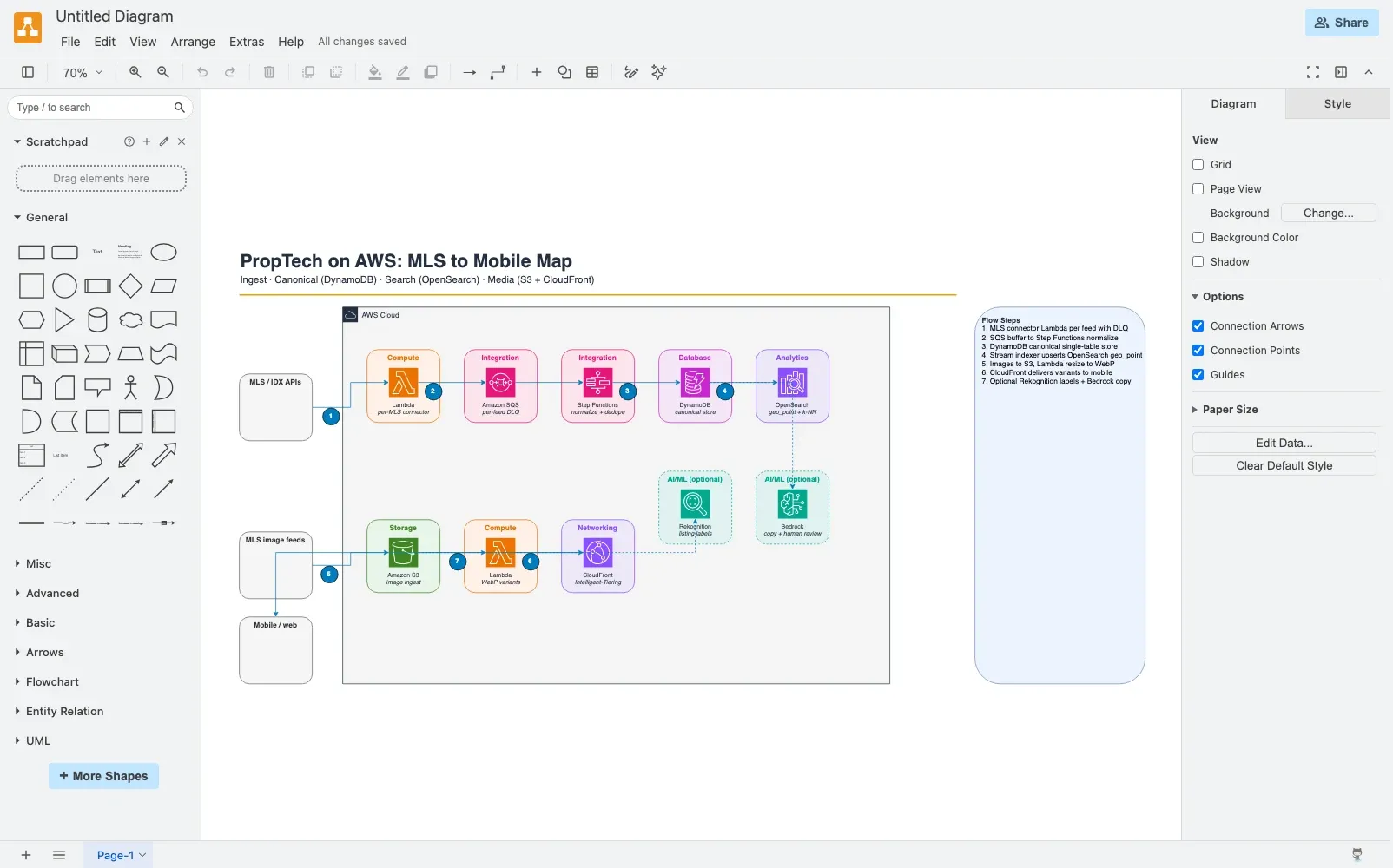
Figure: MLS ingest, DynamoDB canonical listings, OpenSearch geo search, and image CDN. Open draw.io
MLS Feeds → Lambda (ingestion, normalization):
    ├→ DynamoDB (listing data, status updates)
    ├→ OpenSearch (full-text + geo search)
    ├→ S3 (property images, documents)
    └→ ElastiCache (hot search results cache)
         ↓
    API Gateway → Search API:
        - Full-text search with facets (beds, baths, price, type)
        - Geo-spatial queries (draw-on-map, radius, polygon)
        - Saved search alerts (EventBridge → SES)
    CloudFront → Property images (WebP, responsive)
Key design decisions:
- OpenSearch for property search — supports geo-spatial queries (geo_shape, geo_distance), faceted filtering, and relevance scoring that DynamoDB cannot provide
- DynamoDB for listing state management — single-digit millisecond reads for property detail pages and status checks
- ElastiCache Redis for caching popular search results and recently viewed properties — reduces search latency from 200ms to 20ms
- Lambda for MLS feed processing — normalize data from multiple MLS systems with different schemas into a unified format
AI-Powered Property Valuation
Property Data → S3 (features: location, size, age, condition):
    ├→ SageMaker (AVM - Automated Valuation Model)
    ├→ Public Records (comparable sales, tax assessments)
    ├→ Market Indicators (interest rates, inventory levels)
    └→ Satellite/Street View (Rekognition: property condition scoring)
         ↓
    Valuation API → CMA Reports, Instant Offers, Portfolio Analysis
    Bedrock → Natural language valuation explanations
Automated Valuation Models (AVMs) are the core IP of many PropTech companies. SageMaker provides the ML infrastructure to train, deploy, and continuously improve valuation models using gradient-boosted trees, neural networks, and ensemble methods.
Virtual Tour & Image Processing
Agent Upload → S3 (raw images/video) → Lambda:
    ├→ Rekognition (room detection, quality scoring, auto-tagging)
    ├→ Image Processing (resize, WebP conversion, watermarking)
    ├→ Bedrock (generate property descriptions from images)
    └→ MediaConvert (virtual tour video processing)
         ↓
    S3 (processed assets) → CloudFront → Listing Pages
    DynamoDB (image metadata, tags, room labels)
Property images are the most viewed content on real estate platforms. Automated image processing ensures consistent quality, proper tagging (kitchen, bedroom, bathroom, exterior), and optimized delivery across devices.
Property Data Processing at Scale
Real estate platforms ingest data from dozens of sources — MLS systems, public records, tax assessors, permit databases, and third-party data providers. The complexity is real: there are 500+ MLS systems in the US alone, each with slightly different schemas, update frequencies, and access methods. AWS analytics infrastructure consolidates that messy reality into a unified, query-ready property data model.
Data Lake Architecture
Data Sources:
    ├→ MLS Feeds (RETS/RESO Web API) → Lambda → S3
    ├→ Public Records (county assessor) → Glue Crawler → S3
    ├→ Market Data (interest rates, demographics) → S3
    ├→ User Behavior (searches, views, favorites) → Kinesis → S3
    └→ Third-Party (Walk Score, school ratings, crime stats) → Lambda → S3
         ↓
    Glue Catalog → Unified Property Data Model
    Athena → Ad-hoc market analysis
    QuickSight → Market dashboards for agents and brokers
    SageMaker → Valuation models, demand prediction
The pattern that holds at scale: one Lambda per MLS connector with its own retry/error handling, Step Functions to orchestrate full-sync vs incremental-update workflows, DynamoDB for cross-MLS deduplication, and S3 versioning for historical snapshots used in market trend analysis and compliance.
Seasonal Traffic Patterns
Real estate traffic follows predictable seasonal patterns — spring and summer are peak home-buying seasons, with traffic 2-3x higher than winter months. Market events (interest rate changes, policy announcements) can cause sudden traffic spikes:
| Period | Traffic Pattern | Infrastructure Approach |
|---|---|---|
| Spring/Summer (peak) | 2-3x baseline | Auto-scaling, DynamoDB on-demand |
| Fall/Winter (off-peak) | Baseline | Reduced capacity, cost optimization |
| Rate change announcements | 5-10x spike (hours) | Lambda burst scaling, CDN caching |
| New listing alerts | Predictable daily spikes | Scheduled scaling, SQS buffering |
Serverless architecture is ideal for real estate platforms because you pay only for actual search queries, listing views, and data processing — not for idle servers during off-peak months.
AI Applications in Real Estate
Generative AI is creating new capabilities for real estate platforms:
- Property descriptions — Bedrock generates compelling, unique listing descriptions from property features and images, saving agents 30 minutes per listing
- Market reports — AI-generated market analysis reports for specific neighborhoods, price ranges, and property types
- Chatbot assistants — Natural language property search (“Show me 3-bedroom homes near good schools under $500K”) powered by Bedrock with structured property data
- Predictive analytics — Forecast days-on-market, optimal listing price, and buyer intent signals using SageMaker
Email & Lead Nurturing
Real estate is a high-touch business where timely communication drives conversions. Amazon SES powers the notification infrastructure:
- Saved search alerts — Automated emails when new listings match a buyer’s criteria, with property images and direct links
- Price change notifications — Instant alerts when watched properties reduce price
- Open house reminders — Scheduled notifications with calendar integration
- Drip campaigns — Automated lead nurturing sequences for buyers and sellers at different stages of the transaction cycle
SES delivers these emails with high deliverability rates (98%+) at a fraction of the cost of marketing email platforms — critical when sending millions of property alerts daily.
Cost Optimization for Real Estate Platforms
Real estate platforms can optimize AWS costs significantly given their seasonal traffic patterns. Our cost optimization approach focuses on:
- Image storage optimization — Property images account for 60-80% of storage costs. WebP conversion, intelligent resizing, and S3 Intelligent-Tiering for sold/expired listings reduce costs by 40-60%
- Search infrastructure right-sizing — OpenSearch domains sized for peak traffic waste money during off-seasons. Reserved instances for baseline + on-demand for peaks
- CDN cost management — CloudFront cache optimization for property images (high cache hit ratio for popular listings) reduces origin requests by 80%+
- Serverless for variable workloads — MLS feed processing, image processing, and email delivery scale to zero during off-hours
For a 2026 PropTech reference architecture — MLS ingest, DynamoDB canonical listings, OpenSearch geo search, and image CDN cost control — see Real Estate PropTech on AWS (2026).
Where to Start with PropTech on AWS
Successful real estate platforms balance three pressures: search performance, data freshness, and cost efficiency across highly variable traffic. The teams that win invest in event-driven architectures that process MLS updates in real time, serve search results with sub-second latency, and scale automatically with market activity.
Whether you are a PropTech startup launching a property search platform, a brokerage modernizing the technology stack, or a real estate data company running market analytics at scale, our team brings the AWS depth and real estate domain awareness to deliver scalable, cost-efficient infrastructure.
Delivered AWS work in other industries
We have no published Real Estate & PropTech case study yet. These are shipped engagements from neighbouring industries. None is an AI-agent case study.
See all case studies- 8 weeksHealthcareto a HIPAA-compliant telehealth platform in production
- −70%Fintechcardholder data environment scope in a PCI DSS migration
- −32%SaaSmonthly AWS spend, from $85k to $58k, without performance trade-offs
- −40%Manufacturingunplanned downtime with IoT predictive maintenance
- 200M+Retailmarketing emails a month on Amazon SES for TargetBay


Real Estate & PropTech on AWS: common questions
- How do you deduplicate listings across multiple MLS feeds?
- Run each MLS connector as an independent Lambda with its own retry and error handling, normalize the records into a unified schema, and key on a composite of (apn, address-hash, mls-id) inside DynamoDB so cross-MLS duplicates collapse to a single canonical record. Step Functions orchestrate full-sync vs incremental-update workflows, and S3 versioning keeps historical snapshots for audit and trend analysis. We have run this pattern across 500+ MLS systems without losing canonical-record integrity.
- How do AVMs (Automated Valuation Models) on SageMaker compare to traditional CMAs?
- A SageMaker AVM trained on local comparables, public records, and condition signals from Rekognition typically lands within 5–8% MAPE of sale price in stable markets — competitive with traditional CMAs and orders of magnitude cheaper at scale. The accuracy edge comes from continuous retraining: as new transactions close, the model retrains weekly. Combine with Bedrock for natural-language valuation explanations so agents can defend the number to clients.
- How do we serve fast geo-spatial property search at scale?
- OpenSearch with geo_shape and geo_distance queries handles draw-on-map, radius, and polygon search efficiently, while DynamoDB serves listing-detail reads with single-digit millisecond latency. Front the search API with ElastiCache for popular queries, push images and tour assets through CloudFront, and use Lambda for MLS normalization. Most well-tuned PropTech search APIs respond in under 50ms median, with sub-200ms at p99.
- How do we keep property image and CDN costs under control?
- Property images dominate storage cost on real estate platforms — typically 60–80% of S3 spend. Convert uploads to WebP/AVIF on the way in, generate responsive size variants with Lambda or MediaConvert, watermark in-flight, and route old/sold listings to S3 Intelligent-Tiering. CloudFront with a tuned cache key (URL + variant) takes the cache hit ratio over 80% on popular listings, cutting origin requests and egress sharply. Combined, these moves typically cut image-related cost by 40–60%.
Run real estate on AWS that holds up in spring buying season.
Geo-search at scale, AI valuations, and image-cost optimization — built by an AWS Select Tier Partner with PropTech depth.
Pictures:Row houses, corner of N and Union Streets S.W., Washington, D.C. LCCN2017877961, Louise Rosskam (Public domain). Via Wikimedia Commons.