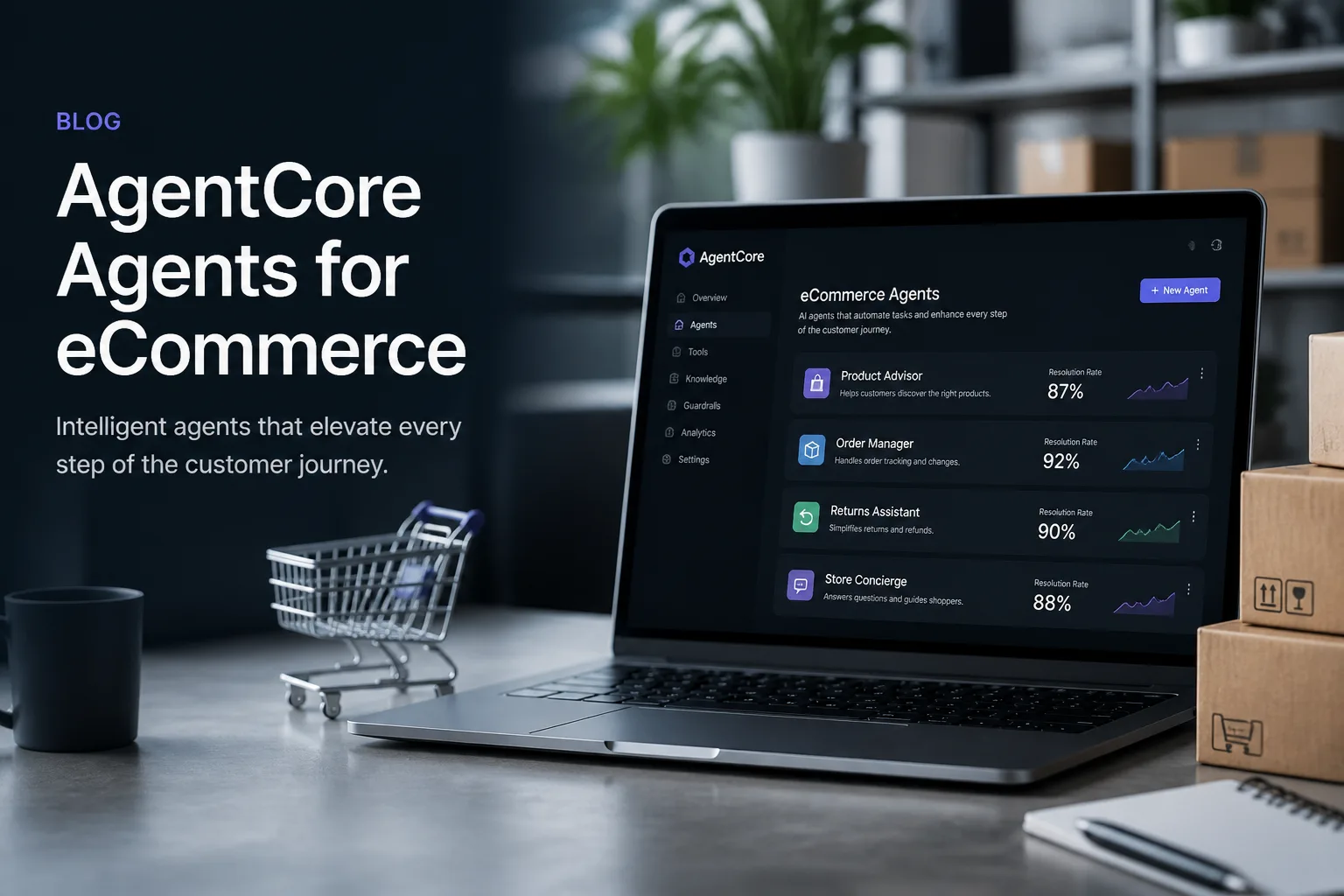





AWS architecture for eCommerce AI agents running on Amazon Bedrock AgentCore

Agentic Commerce on AWS

Your next customer is an AI agent.
So is your next best operator.

We build production eCommerce agents on AWS — support, inventory, merchandising, margin, returns — and make your catalog legible to the agents that now do the shopping. Tool boundaries on every write, evals before launch, and a human on anything that moves money.

5.0 Rating|AWS Select Tier Partner|100+ Clients Served

Why teams choose FactualMinds

AWS Select
Tier Services Partner
64
Part Field Guide
124
Free AWS Calculators
100+
Clients Served
SOC 2
Security Aligned

Why agents die between the demo and the checkout

A demo is a prompt. Production is everything around it.

The model is rarely the hard part. What breaks in production is an agent with unbounded write access, no way to measure whether it is right, and no ceiling on what it costs when traffic triples. We build the boring parts first.

Evals before launch, not after the incident

A golden dataset per agent and a pass bar it clears before it ever faces a customer.

Tool boundaries on every write

Cedar authorization on anything that mutates an order, a price, or a customer record.

A human on anything that moves money

Refunds, price changes, and purchase orders route to approval by design — not by exception.

Cost caps that still hold at peak

Token budgets and per-conversation ceilings, so Black Friday does not arrive as an inference bill.

An honest list

What we don’t do.

  • Agent demos that fall over the first time real money moves.
  • Autonomy on writes with no human, no evals, and no audit trail.
  • Strategy decks that never reach production.
  • Generic monthly retainers that grow without delivering.
  • Vendor lock-in masquerading as 'best practices'.

We say no to the engagements that don’t fit so we can say yes to the ones that do.

What We Have Published

Proof you can read before you call us

We would rather be judged on work that is already public than on a case study you cannot verify.

0

Part Field Guide

A part-by-part guide to building eCommerce agents on AWS, with copyable artifacts.

0

Free AWS Calculators

Cost and readiness tools, including Bedrock AgentCore pricing. No email gate.

0+

AWS Certifications

Deep, cross-domain AWS expertise across our consulting team.

0+

Clients Served

Enterprises, SaaS companies, and startups across 12+ industries.

Clients We've Helped

TargetBay
InboxEagle
Little Sponges
Wonderfeel

What Our Clients Say

We wanted to integrate generative AI into our product search experience, but model costs were skyrocketing. FactualMinds built a secure, cost-aware GenAI stack using Amazon Bedrock Agents Classic that reduced our inference costs by 40% while keeping all data within our AWS environment.


Megan Lawrence

VP of Digital Innovation — TargetBay

After a customer audit revealed gaps in our cloud posture, we turned to FactualMinds. Their AWS security assessment uncovered misconfigured IAM roles and open endpoints. In just two weeks, they remediated every risk and gave us a security baseline aligned with SOC 2 and ISO 27001.


Chris Delaney

CTO — Wonderfeel

Deploying GenAI in a HIPAA-regulated environment felt daunting until FactualMinds stepped in. They designed a privacy-first AI workflow using Amazon Bedrock with custom encryption layers. The result: a secure clinical documentation tool that cuts case summary time in half without touching patient data.


Dr. Nila Rao

Chief Innovation Officer — Little Sponges

How We Work

From readiness check to a fleet that runs itself

One agent in production beats five in a slide deck. We ship in that order.

Readiness

We check whether your data, systems, and approval paths can support an agent at all — the failure mode that kills most eCommerce AI projects before the model is even chosen.

Scope One Agent

We pick the single workflow with the clearest ROI, define its tool catalog and write boundaries, and agree the human approval gate before a line of code exists.

Ship With Evals

Built on AgentCore with a golden dataset, a pass bar, cost caps, and an audit trail. It goes live when it clears the bar — not when the sprint ends.

Expand the Fleet

Add the next agent against the same guardrails, then the supervisor layer that coordinates them. Your team owns the IaC and the runbooks when we leave.

Common Questions

Agentic Commerce — Frequently Asked Questions

Answers to what eCommerce and engineering leaders ask most before starting an agent engagement.

What is agentic commerce?
Agentic commerce covers two shifts happening at once. First, AI agents run parts of the store — answering WISMO tickets, flagging what to reorder, investigating refunds. Second, AI agents shop on behalf of customers, which means your catalog now has to be readable by a model rather than only by a person. Open standards have started to formalise the second half: the Agentic Commerce Protocol (OpenAI and Stripe) and the Universal Commerce Protocol (led by Google with Shopify, Etsy, and Walmart). Most merchants are working on the first half and have not started the second.
Which AI agent should we build first?
Whichever one has a clear owner, clean data behind it, and a decision a human already makes the same way every time. In practice that is usually customer support and WISMO, because the questions repeat, the data is in your order system, and the escalation path already exists. We publish the scoring method we use — volume, data readiness, blast radius if it is wrong, and effort — in the AI Agent ROI guide, so you can run it yourself before talking to us.
How do you stop an AI agent from doing something expensive or wrong?
Four controls, in this order. A tool catalog that defines exactly which actions the agent can take. Cedar authorization on every write, so mutating an order or a price is a permission decision rather than a prompt decision. A human approval gate on anything that moves money — refunds, price changes, purchase orders. And an eval suite with a golden dataset and a pass bar the agent has to clear before it goes live. Guardrails and token budgets sit on top of all four.
What does it actually cost to run an eCommerce AI agent on AWS?
It depends on conversation volume, how many tool calls each conversation makes, and which model you route to. The dominant costs are usually model inference and the AgentCore runtime, not storage or compute. We publish a free Amazon Bedrock AgentCore pricing calculator so you can model your own numbers before committing, and we set per-conversation cost ceilings in every build so a traffic spike cannot become an inference bill.
Does this work with our platform, or do we need to be on Shopify?
Platform is not the constraint — data access is. Agents talk to your storefront, ERP, CRM, and warehouse systems through a tool layer, so what matters is whether those systems expose the reads and writes an agent needs, and whether your order, customer, product, and inventory records share reliable join keys. We check that in the readiness assessment before anything gets built, because missing join keys is the failure that stops most eCommerce AI projects before a model is even chosen.
Why does AWS matter if the agent is just calling a model?
Because the model is the easy part. What breaks in production is everything around it: peak-season traffic, a PCI-scoped checkout path the agent must not wander into, inference costs with no ceiling, and an audit trail your finance team will eventually ask for. FactualMinds is an AWS Select Tier Services Partner with AWS-validated practices in RDS, CloudFront CDN migration, and S3 and CloudFront image delivery — the infrastructure work that makes an agent survive Black Friday rather than merely demo well.
What does AWS Select Tier Partner status mean?
AWS Select Tier is an official AWS designation awarded to partners who meet validated technical competency standards, maintain certified engineers, and demonstrate successful customer deployments. It means AWS has reviewed our delivery practices and customer references — it is validation, not endorsement.
Do you offer fixed-price or time-and-materials engagements?
Both. Readiness assessments and first-agent builds are fixed-scope with a locked price, because those are the engagements where scope creep does the most damage. Ongoing optimization, fleet expansion, and managed operations run as retainers. You own the infrastructure-as-code and the runbooks either way.

Four entry points into the field guide: the automation map, the architecture brief, the ROI priority score, and the readiness check.

Ready to put an agent in production?

Start with a readiness check. We will tell you which agent to build first — and which one you are not ready for yet.