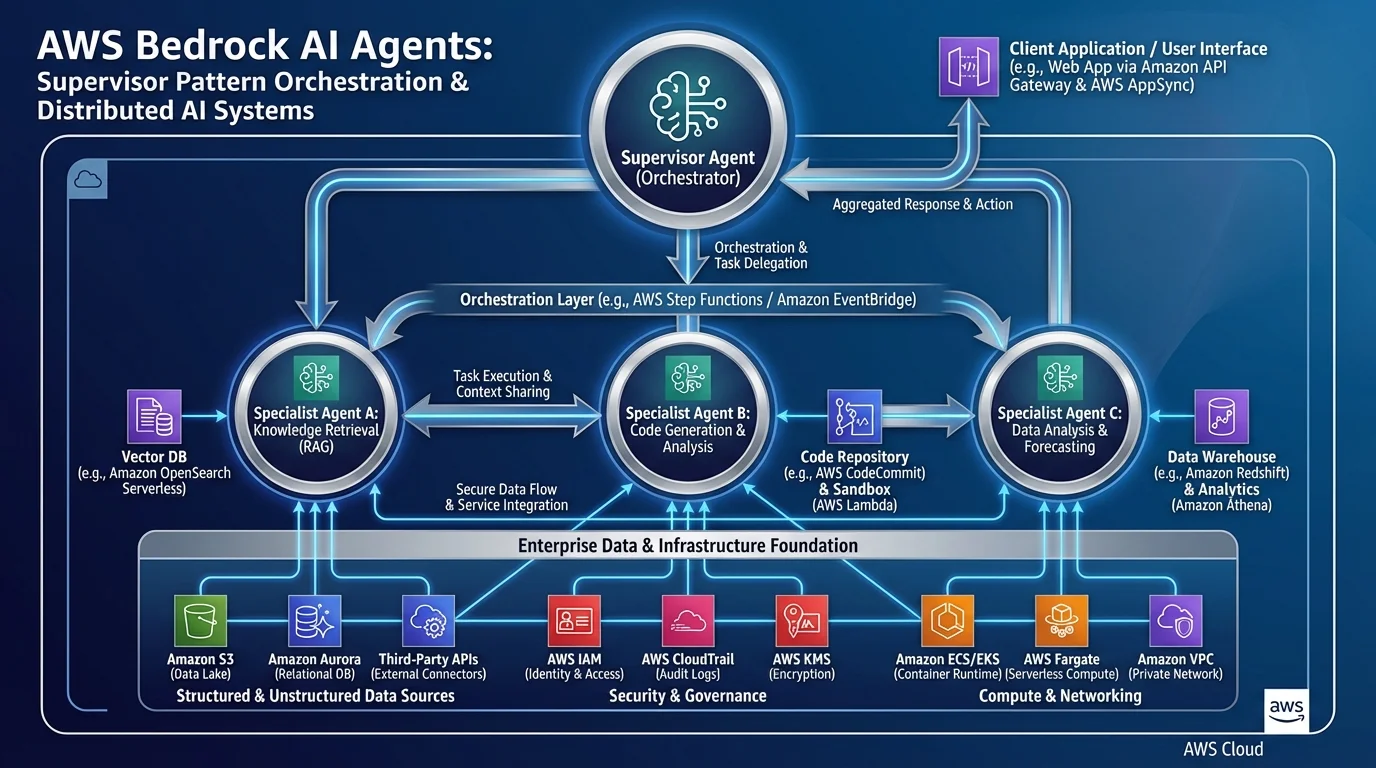
Amazon Nova Canvas and Reel: Enterprise Multimodal Content Generation on AWS
Quick summary: July 2026: Nova Canvas (images) and Nova Reel 1.1 (video up to 2 minutes in 6s shots on Bedrock) — Guardrails, C2PA, async pipelines, and a production checklist. Confirm model lifecycle before locking UX.
Key Takeaways
- July 2026: Nova Canvas (images) and Nova Reel 1
- 1 (video up to 2 minutes in 6s shots on Bedrock) — Guardrails, C2PA, async pipelines, and a production checklist
- import { Image } from 'astro:assets'; A mid-market e-commerce company with 50,000 SKUs needs lifestyle imagery for every product
- A professional photo shoot costs \$2,000–5,000 per day and produces 200–300 usable images
- At that rate, photographing the full catalog takes 167–250 shoot days and \$334,000–\$1,250,000
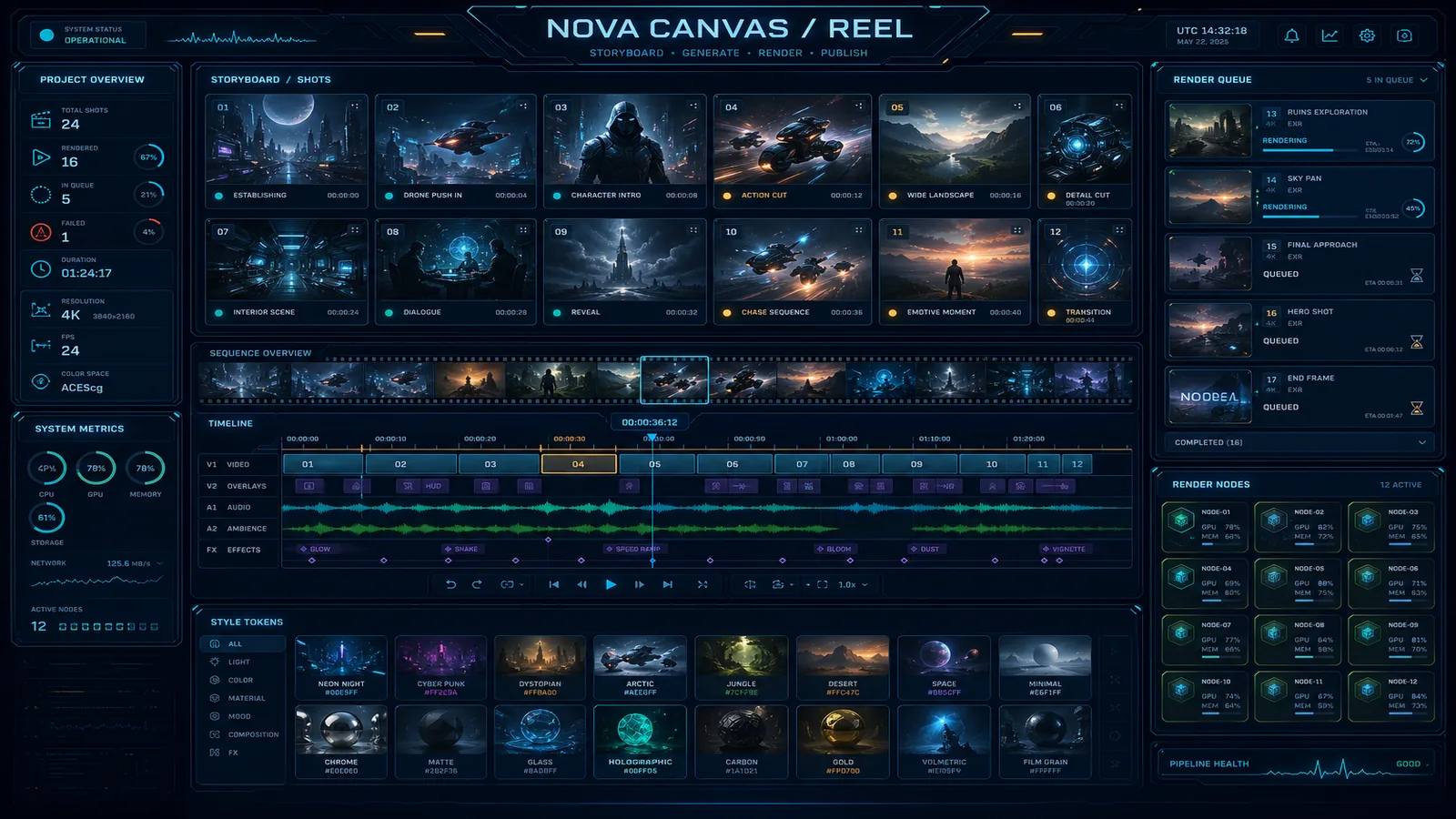
Table of Contents
A mid-market e-commerce company with 50,000 SKUs needs lifestyle imagery for every product. A professional photo shoot costs $2,000–5,000 per day and produces 200–300 usable images. At that rate, photographing the full catalog takes 167–250 shoot days and $334,000–$1,250,000. Most companies solve this by photographing their top 500 sellers and using stock for everything else — accepting that 99% of the catalog has generic imagery.
As of July 19, 2026, Nova Canvas and Nova Reel still run through Amazon Bedrock. Confirm model IDs, regional availability, pricing, and lifecycle before locking UX — Bedrock model cards list Canvas lifecycle dates (verify the current EOL / successor path in-console; do not assume this post’s pins forever). Nova Reel 1.1 (amazon.nova-reel-v1:1) generates video in 6-second increments up to two minutes at 1280×720 / 24 fps; longer than 6s requires that model ID. Reel 1.1 availability is narrower than Reel 1.0 — check the Nova video generation guide.
Order-of-magnitude economics (verify Nova pricing / Bedrock): Canvas often lands around ~$0.06–0.08 per image; short Reel clips around ~$0.80 per 6s shot — multi-minute jobs scale with shot count. Neither replaces a creative-director brand shoot. Both are viable for the long tail of SKUs where stock or blank slots used to win.
Reproduce this — Pipeline checklist:
examples/architecture-blog-2026/nova-multimodal/canvas-reel-pipeline-checklist.md
Nova Canvas vs. Nova Reel: Capabilities, Input Formats, and Output Specs
| Capability | Nova Canvas | Nova Reel |
|---|---|---|
| Primary modality | Image generation | Video generation |
| Input types | Text prompt, reference image | Text prompt, reference image |
| Operations | Text-to-image, image-to-image, inpainting, outpainting, background removal, image variation | Text-to-video, image-to-video, multi-shot sequences |
| Max output resolution | 2048x2048 | 1280x720 (HD) |
| Output duration | N/A | 6s increments; up to 120s on Reel 1.1 (amazon.nova-reel-v1:1) |
| Frame rate | N/A | 24 fps |
| Output format | PNG or JPEG | MP4 (H.264) |
| Generation latency | 5-20 seconds | Minutes-scale (async; grows with duration) |
| API pattern | Synchronous InvokeModel | Asynchronous (StartAsyncInvoke + polling or EventBridge) |
| S3 output bucket | Optional (base64 in response) | Required (mandatory S3 destination) |
| Approximate cost | Verify Bedrock/Nova pricing (~$0.06–0.08/image common) | Verify pricing; ~$0.80/6s shot is a planning heuristic |
| Model ID (verify) | amazon.nova-canvas-v1:0 | amazon.nova-reel-v1:1 for >6s / multi-shot |
| Content watermarking | C2PA invisible watermark | C2PA invisible watermark |
| Negative prompts | Supported | Supported |
| Brand color conditioning | Supported (hex palette) | Not available |
| Inpainting mask | Supported (mask image) | Not applicable |
| NSFW filtering | Built-in + Bedrock Guardrails | Built-in + Bedrock Guardrails |
| Max aspect ratios | Multiple (square, landscape, portrait) | 16:9 only |
Latency matters for architecture: Nova Canvas’s synchronous API (5-20 seconds) is suitable for near-real-time use cases like product preview generation on user-triggered events. Nova Reel’s asynchronous model (1-5 minutes) requires job-queue architecture — you submit a job, store the job ID, poll for completion or use EventBridge, and deliver the result when ready. Do not design a Nova Reel integration assuming synchronous behavior.
Enterprise Use Cases
Use Case 1: E-Commerce Product Imagery Pipeline
The highest-ROI application for Nova Canvas in retail: automated lifestyle imagery generation for product catalog.
Workflow:
- Input: Product metadata (name, category, color, material, key features) from your PIM system
- Prompt construction: Template-based prompt combining product attributes with brand style guidelines
- Text-to-image generation: Nova Canvas generates 4-6 variations per product
- Background removal: Nova Canvas background removal operation isolates the product on transparent background
- Scene inpainting: Recompose the isolated product into a lifestyle background using Nova Canvas inpainting
- Quality filtering: Rekognition Content Moderation validates brand safety; custom Lambda checks composition quality metrics
- Human review queue: Flag low-confidence outputs for human review; auto-approve high-confidence outputs
- CDN delivery: Approved images stored in S3, served via CloudFront
import boto3
import json
import base64
from io import BytesIO

bedrock = boto3.client('bedrock-runtime', region_name='us-east-1')
s3 = boto3.client('s3')
rekognition = boto3.client('rekognition', region_name='us-east-1')

def generate_product_image(
    product_name: str,
    product_category: str,
    color: str,
    style_prompt: str,
    output_bucket: str,
    output_key: str,
) -> dict:
    """Generate a product lifestyle image via Nova Canvas."""

    prompt = (
        f"Professional product photography of {product_name}, {color}, "
        f"{style_prompt}, soft studio lighting, white background, "
        f"e-commerce style, high resolution, 4K quality"
    )

    request_body = {
        "taskType": "TEXT_IMAGE",
        "textToImageParams": {
            "text": prompt,
            "negativeText": "blurry, distorted, watermark, text overlay, cartoon, illustration",
        },
        "imageGenerationConfig": {
            "numberOfImages": 1,
            "height": 1024,
            "width": 1024,
            "cfgScale": 8.0,
            "seed": 42,
        },
    }

    response = bedrock.invoke_model(
        modelId='amazon.nova-canvas-v1:0',
        body=json.dumps(request_body),
        contentType='application/json',
        accept='application/json',
    )

    result = json.loads(response['body'].read())
    image_data = base64.b64decode(result['images'][0])

    # Store in S3
    s3.put_object(
        Bucket=output_bucket,
        Key=output_key,
        Body=image_data,
        ContentType='image/png',
    )

    return {'s3_key': output_key, 'size': len(image_data)}


def remove_background(source_bucket: str, source_key: str, output_key: str) -> str:
    """Remove image background using Nova Canvas background removal."""

    # Download source image
    obj = s3.get_object(Bucket=source_bucket, Key=source_key)
    image_bytes = obj['Body'].read()
    image_b64 = base64.b64encode(image_bytes).decode('utf-8')

    request_body = {
        "taskType": "BACKGROUND_REMOVAL",
        "backgroundRemovalParams": {
            "image": image_b64,
        },
    }

    response = bedrock.invoke_model(
        modelId='amazon.nova-canvas-v1:0',
        body=json.dumps(request_body),
        contentType='application/json',
        accept='application/json',
    )

    result = json.loads(response['body'].read())
    output_image = base64.b64decode(result['images'][0])

    s3.put_object(
        Bucket=source_bucket,
        Key=output_key,
        Body=output_image,
        ContentType='image/png',
    )

    return output_key
Per-image cost estimate for the full pipeline:
- Nova Canvas generation (1024x1024): ~$0.06
- Nova Canvas background removal: ~$0.04
- Nova Canvas inpainting (lifestyle scene): ~$0.06
- Rekognition Content Moderation: ~$0.001
- Lambda compute: ~$0.0001
- S3 storage: ~$0.00002/image
Total: ~$0.16/production-ready image vs. $7-15/image for professional photography at scale.
Use Case 2: Marketing Video Automation
Nova Reel enables automated generation of short product demo and brand clips for social media, email campaigns, and digital advertising.
Workflow for a 30-second campaign clip:
import boto3
import json
import time

bedrock = boto3.client('bedrock-runtime', region_name='us-east-1')

def generate_video_clip(
    prompt: str,
    reference_image_s3_uri: str,
    output_s3_uri: str,
) -> str:
    """Submit an async Nova Reel video generation job."""

    request_body = {
        "taskType": "TEXT_VIDEO",
        "textToVideoParams": {
            "text": prompt,
        },
        "videoGenerationConfig": {
            "durationSeconds": 6,
            "fps": 24,
            "dimension": "1280x720",
            "seed": 0,
        },
    }

    response = bedrock.start_async_invoke(
        modelId='amazon.nova-reel-v1:0',
        modelInput=json.dumps(request_body),
        outputDataConfig={
            "s3OutputDataConfig": {
                "s3Uri": output_s3_uri,
            }
        },
    )

    return response['invocationArn']


def poll_video_job(invocation_arn: str, max_wait_seconds: int = 600) -> dict:
    """Poll for video generation completion."""

    elapsed = 0
    poll_interval = 15  # seconds

    while elapsed < max_wait_seconds:
        response = bedrock.get_async_invoke(invocationArn=invocation_arn)
        status = response['status']

        if status == 'Completed':
            return {
                'status': 'completed',
                'output_uri': response['outputDataConfig']['s3OutputDataConfig']['s3Uri'],
            }
        elif status == 'Failed':
            return {'status': 'failed', 'error': response.get('failureMessage', 'Unknown error')}

        time.sleep(poll_interval)
        elapsed += poll_interval

    return {'status': 'timeout'}
For production use, replace the polling loop with an EventBridge rule that triggers a Lambda when the async invocation completes — this avoids Lambda timeout issues on jobs that take several minutes.
Use Case 3: Training Content Generation
Enterprise L&D teams spend significant budget on illustrated scenario content for compliance training, safety training, and onboarding. Nova Canvas generates scenario illustrations at a fraction of custom illustration costs.
Pattern: HR system generates training scenario descriptions → Lambda constructs prompts from scenario templates → Nova Canvas generates scene illustrations → human review for accuracy → integrated into LMS content package.
This use case benefits specifically from Nova Canvas’s image variation capability: generate a base scene, then produce multiple variations (different demographic representation, different environments) from the same scenario description, ensuring training content diversity without multiple custom illustration commissions.
Content Safety and Brand Guardrails
Bedrock Guardrails for Multimodal
Bedrock Guardrails apply to Nova Canvas and Nova Reel with the same configuration model used for text models. Create a Guardrail resource and reference it in your invocation calls:
request_body = {
    "taskType": "TEXT_IMAGE",
    "textToImageParams": {
        "text": prompt,
    },
    "imageGenerationConfig": { ... },
}

response = bedrock.invoke_model(
    modelId='amazon.nova-canvas-v1:0',
    body=json.dumps(request_body),
    contentType='application/json',
    accept='application/json',
    guardrailIdentifier='your-guardrail-id',
    guardrailVersion='1',
)
Configure Guardrails with blocked content categories relevant to your use case:
- Violence threshold: MEDIUM for consumer-facing retail, HIGH for enterprise internal use
- Sexual content threshold: NONE for most enterprise applications
- Hate speech threshold: HIGH
- Insults and profanity threshold: depends on brand standards
Nova Canvas has built-in safety filtering independent of Guardrails, but Guardrails provide an additional, auditable layer and give you a consistent configuration resource you can update centrally without code changes.
Brand Color Conditioning
For e-commerce and marketing use cases, Nova Canvas’s color palette feature is the primary brand consistency mechanism:
request_body = {
    "taskType": "TEXT_IMAGE",
    "textToImageParams": {
        "text": "Premium skincare product, minimalist packaging, luxury aesthetic",
        "negativeText": "busy background, cartoon, illustration",
    },
    "imageGenerationConfig": {
        "numberOfImages": 1,
        "height": 1024,
        "width": 1024,
        "cfgScale": 8.0,
        "colors": ["#1A1A2E", "#16213E", "#F5F5F0"],  # Brand palette hex codes
    },
}
Providing your brand’s primary and accent colors as the colors array guides generation toward images where these colors appear prominently in backgrounds, surfaces, and ambient lighting. It is not a guarantee of exact color reproduction but a meaningful bias toward brand-consistent outputs.
Post-Generation Audit with Rekognition
For any generated content going into consumer-facing channels, run Rekognition Content Moderation as an automated gate:
def check_content_safety(image_bytes: bytes, confidence_threshold: float = 75.0) -> dict:
    """Check generated image for unsafe content via Rekognition."""

    response = rekognition.detect_moderation_labels(
        Image={'Bytes': image_bytes},
        MinConfidence=confidence_threshold,
    )

    unsafe_categories = [
        label for label in response['ModerationLabels']
        if label['Confidence'] >= confidence_threshold
    ]

    return {
        'safe': len(unsafe_categories) == 0,
        'flagged_categories': [l['Name'] for l in unsafe_categories],
        'confidence_scores': {l['Name']: l['Confidence'] for l in unsafe_categories},
    }
Route outputs flagged by Rekognition to a human review queue (SQS → Lambda → review UI) rather than auto-rejecting. Some categories (e.g., “Suggestive”) may be acceptable for certain brand contexts and require human judgment, not automated rejection.
Integration Architecture: Automated Content Pipeline
The reference architecture for a production Nova Canvas/Reel pipeline:
[Content Request Source]
         │
         ▼
   [SQS Queue]
   (generation requests)
         │
         ▼
   [Lambda: Orchestrator]
   - Constructs prompt from template
   - Applies brand parameters
   - Calls Bedrock Nova Canvas/Reel
         │
         ▼
   [Amazon S3]
   (raw generated outputs)
         │
         ▼
   [Lambda: Quality Gate]
   - Rekognition content moderation
   - Brand color compliance check
   - Resolution validation
         │
     ┌───┴───┐
     ▼       ▼
[S3: approved] [SQS: human-review]
     │
     ▼
[CloudFront CDN]
(content delivery)
For Nova Reel’s async nature, the Orchestrator Lambda submits the job and stores the invocationArn in DynamoDB. An EventBridge rule triggers a completion Lambda when the job finishes, which then runs the quality gate and routes to the appropriate destination.
import boto3
import json

events = boto3.client('events', region_name='us-east-1')
dynamodb = boto3.resource('dynamodb', region_name='us-east-1')

def store_reel_job(invocation_arn: str, request_metadata: dict) -> None:
    """Store Nova Reel job for async completion handling."""

    table = dynamodb.Table('nova-reel-jobs')
    table.put_item(Item={
        'invocationArn': invocation_arn,
        'status': 'pending',
        'requestMetadata': json.dumps(request_metadata),
        'createdAt': int(time.time()),
        'ttl': int(time.time()) + 86400,  # 24-hour TTL for job records
    })
Store enough metadata in the job record to reconstruct the downstream routing logic when the completion event fires — product ID, campaign ID, target S3 prefix, review routing rules.
Cost vs. Third-Party Alternatives
For a production workload of 10,000 images per month:
| Option | Cost per Image | Monthly Cost (10K) | Enterprise Controls | AWS Integration |
|---|---|---|---|---|
| Nova Canvas (1024x1024) | ~$0.06 | ~$600 | Bedrock Guardrails, IAM | Native |
| DALL-E 3 via OpenAI | ~$0.04-0.08 | ~$400-800 | OpenAI usage policies | Separate contract |
| Stable Diffusion XL via Bedrock | ~$0.04 | ~$400 | Bedrock Guardrails, IAM | Native |
| Stable Image Ultra via Bedrock | ~$0.08 | ~$800 | Bedrock Guardrails, IAM | Native |
| Self-hosted SDXL (g5.2xlarge) | ~$0.006 | ~$60 | Your implementation | Your infra |
For video (1,000 clips per month at 6 seconds each):
| Option | Cost per Clip | Monthly Cost (1K) | Enterprise Controls |
|---|---|---|---|
| Nova Reel | ~$0.80 | ~$800 | Bedrock Guardrails, IAM |
| Runway Gen-2 | ~$0.50-1.00 | ~$500-1,000 | Runway terms |
| Sora API | TBD (limited access) | TBD | OpenAI terms |
| Self-hosted (complex) | High operational cost | Variable | Your implementation |
Nova Canvas is cost-competitive with DALL-E 3 and offers a clear advantage for teams already operating on AWS: unified billing, existing BAA, Bedrock Guardrails, CloudTrail audit logging, and VPC routing. The operational overhead savings justify any marginal cost difference at enterprise scale.
Self-hosted SDXL wins on raw cost per image at very high volumes (100K+ images/month), but requires GPU instance management, model serving infrastructure, safety filtering implementation, and 24/7 operational coverage. The break-even against managed options typically requires volumes above 50,000 images/month with dedicated operational capacity.
What This Post Doesn’t Cover
- Nova text models (Micro/Lite/Pro) — see Bedrock Nova models guide.
- Fine-tuning / DreamBooth-style brand training — still not the Canvas default path; color conditioning + review workflows remain the practical controls.
- Per-region Reel 1.1 availability and successor model IDs after Canvas lifecycle changes — check Bedrock model cards quarterly.
What to Do This Week
- Run
aws bedrock list-foundation-modelsin your target Region and pin Canvas + Reel IDs in IaC. - Attach Bedrock Guardrails to a non-prod invoke path; reject NSFW / brand-policy prompts before they hit production queues.
- For Reel: stand up S3 + async job table + EventBridge handler; generate one 6s clip, then one multi-shot job under
amazon.nova-reel-v1:1if you need >6s.
Related reading: GenAI guardrails on AWS · Top AWS AI services 2026
Need a production multimodal pipeline review? Contact FactualMinds.
AWS Cloud Architect & AI Expert
AWS-certified cloud architect and AI expert with deep expertise in cloud migrations, cost optimization, and generative AI on AWS.