AWS KMS Post-Quantum Cryptography: ML-KEM Hybrid TLS and ML-DSA Signatures in Production
Quick summary: AWS KMS ML-KEM hybrid TLS + ML-DSA signatures. July 2026: when to enable PQC, performance, migration checklist for HNDL risk.
Key Takeaways
- AWS KMS ML-KEM hybrid TLS + ML-DSA signatures
- July 2026: when to enable PQC, performance, migration checklist for HNDL risk
- NIST published FIPS 203 (ML-KEM), 204 (ML-DSA), and 205 (SLH-DSA) in August 2024
- Five to fifteen years from now, when a Cryptographically Relevant Quantum Computer (CRQC) capable of running Shor's algorithm at RSA-2048 scale exists, they decrypt the stored traffic
- The regulatory response is moving: - NIST: FIPS 203/204/205 published August 2024
Table of Contents
NIST published FIPS 203 (ML-KEM), 204 (ML-DSA), and 205 (SLH-DSA) in August 2024. As of July 2026, AWS documents ML-KEM hybrid TLS for KMS, ACM, and Secrets Manager API connections and ML-DSA key specs in KMS for quantum-resistant signatures — the right response to harvest now, decrypt later on long-lived data.
First-party benchmark (AWS-published order of magnitude): hybrid ML-KEM handshakes add roughly ~1.6 KB (ML-KEM-768 class) and on the order of tens to ~150 µs of crypto CPU vs classical — often ~2% TPS impact when every request forces a new handshake; amortized near zero with connection reuse. Re-benchmark your path.
Reproduce this: PQC migration checklist
Counter-case: ACM public certificates remain classical until PQ issuance is broadly supported — do not assume browser-facing PQ certs today.
Need a PQC inventory → hybrid rollout? Compliance services · Contact
Why post-quantum, why now
The threat is not “quantum computers exist today.” The threat is harvest now, decrypt later (HNDL). A sophisticated adversary — nation-state, organised crime, well-resourced industrial competitor — copies your encrypted traffic today and stores it. Five to fifteen years from now, when a Cryptographically Relevant Quantum Computer (CRQC) capable of running Shor’s algorithm at RSA-2048 scale exists, they decrypt the stored traffic.
Industry estimates from NIST, NSA, the UK NCSC, and the Quantum Resilience Federation put the CRQC arrival window between 2030 and 2040 — uncertain, but tight enough that data with multi-decade sensitivity (intellectual property, regulated health records, financial records, intelligence, infrastructure designs, legal archives) is at risk if encrypted today only with classical algorithms.
The regulatory response is moving:
- NIST: FIPS 203/204/205 published August 2024. NIST recommends transition for critical workloads by 2030 and full deprecation of RSA-2048 / ECDSA-P256 by 2035.
- NSA Commercial National Security Algorithm Suite (CNSA 2.0) mandates ML-KEM and ML-DSA for National Security Systems by 2030-2033 depending on use case.
- CNIL, BSI, ANSSI in the EU have published PQC migration guidance with similar 2030+ horizons.
- PCI DSS and similar standards have not yet specified PQC requirements but have flagged it as an emerging concern.
For most organisations the migration window is now-to-2030 — start with hybrid TLS for transport, add ML-DSA for long-lived signatures, and inventory ciphertexts with multi-year sensitivity for re-encryption.
What AWS supports today
As of July 2026 (verify current Region/SDK matrix):
| Service | Algorithm | Status |
|---|---|---|
| AWS KMS — TLS to API endpoint | ML-KEM-768 / ML-KEM-1024 hybrid (with ECDHE) | GA |
| AWS KMS — signing keys | ML-DSA-44 / ML-DSA-65 / ML-DSA-87 | GA |
| AWS ACM — TLS to ACM API | ML-KEM hybrid | GA |
| AWS ACM — issued certificates | Classical (RSA / ECDSA) only — PQC issuance roadmap | Pending |
| AWS Secrets Manager — TLS to API endpoint | ML-KEM hybrid | GA |
| AWS S3, DynamoDB, RDS — TLS | ML-KEM hybrid via s2n-tls | Rolling out by region |
| Customer-side TLS in s2n-tls (open source) | ML-KEM hybrid | GA |
The TLS support is consistent across the AWS SDK ecosystem — the SDK negotiates ML-KEM hybrid where both client and server support it, falling back to classical ECDHE if not. ACM-issued certificates remain classical (RSA-2048 or ECDSA-P256) — the PQC certificate issuance pathway depends on browser ecosystem support which is not yet GA.
How hybrid TLS works
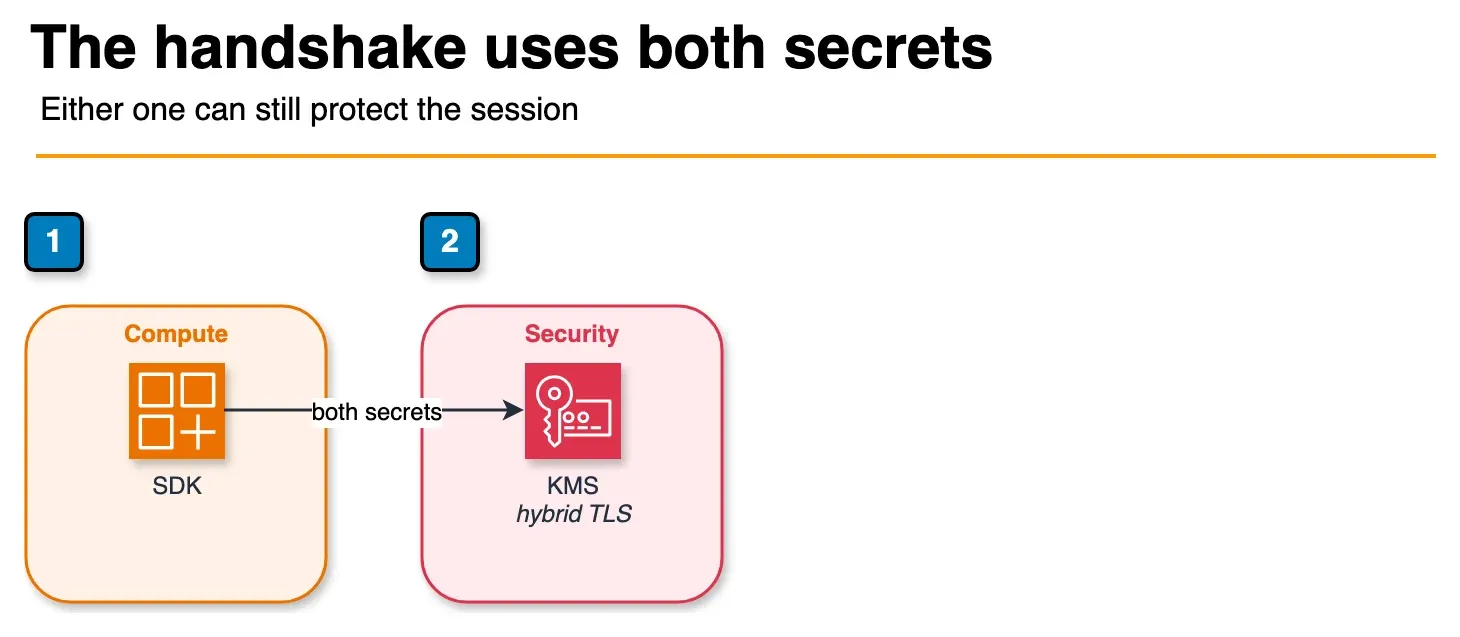
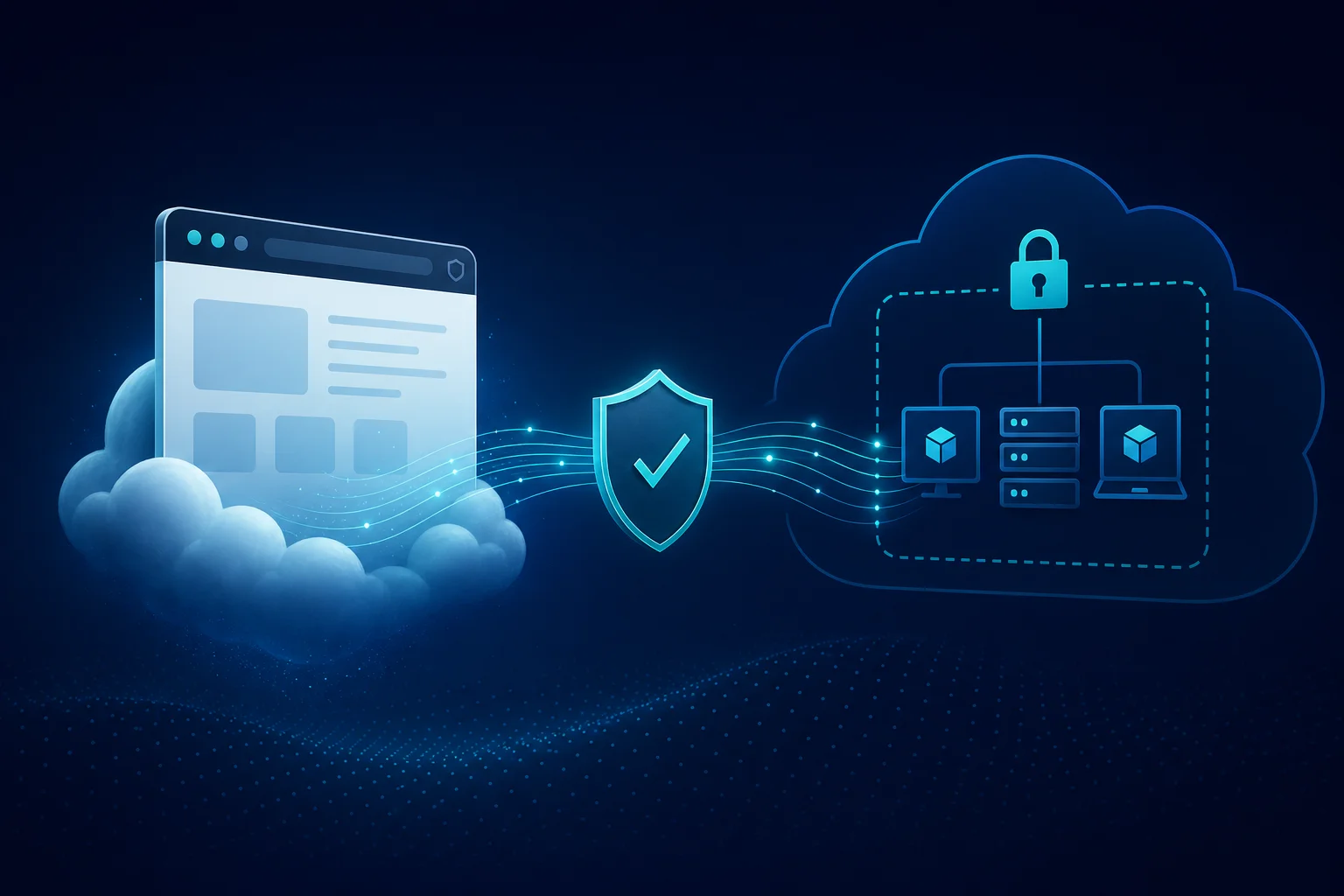
Figure: hybrid TLS in the article. The session key is derived from the classical exchange and from ML-KEM. If one side is broken, the other still protects the session. The SDK negotiates this when the endpoint supports it. Open the draw.io source.
The IETF hybrid construction (draft-ietf-tls-hybrid-design) wraps two key-exchange operations into a single TLS handshake. The shared secret is derived from both:
session_key = HKDF(classical_secret || pq_secret, ...)If the classical algorithm (ECDHE-P256, ECDHE-X25519) is broken — for example, by a future quantum computer running Shor’s algorithm — the post-quantum component (ML-KEM-768 or ML-KEM-1024) still protects the session.
If the post-quantum algorithm is broken — for example, by an undiscovered classical attack on the Module-LWE lattice problem — the well-studied classical component still protects the session.
This is why “hybrid” is the migration step rather than “pure PQ.” Hybrid hedges against catastrophic discoveries on either side until ML-KEM has another 5-10 years of public scrutiny.
Enabling ML-KEM hybrid TLS in your applications
For AWS SDK v3 (Node.js, Python boto3, Java v2, Go v2), the SDK uses the s2n-tls library which negotiates ML-KEM hybrid by default when the AWS service endpoint supports it. To explicitly require ML-KEM, set the security policy:
Python (boto3):
import boto3
from botocore.config import Config

config = Config(
    tls_context={'security_policy': 'PQ-TLSv1-2-2023-12'}
)
kms = boto3.client('kms', config=config)
Node.js (AWS SDK v3):
import { KMSClient } from '@aws-sdk/client-kms';
import { NodeHttpHandler } from '@smithy/node-http-handler';
import https from 'https';

const kms = new KMSClient({
  requestHandler: new NodeHttpHandler({
    httpsAgent: new https.Agent({
      secureOptions: 'PQ-TLSv1-2-2023-12',
    }),
  }),
});
For non-AWS clients (your application connecting to AWS endpoints), use s2n-tls or a TLS library that supports the IETF hybrid construct (OpenSSL 3.5+, BoringSSL with the appropriate flags, Go’s crypto/tls in Go 1.24+). Browser support for ML-KEM hybrid TLS shipped in Chrome 124, Firefox 132, and Safari 17.7 — most modern browsers negotiate it automatically against PQ-enabled servers.
ML-DSA signing in KMS
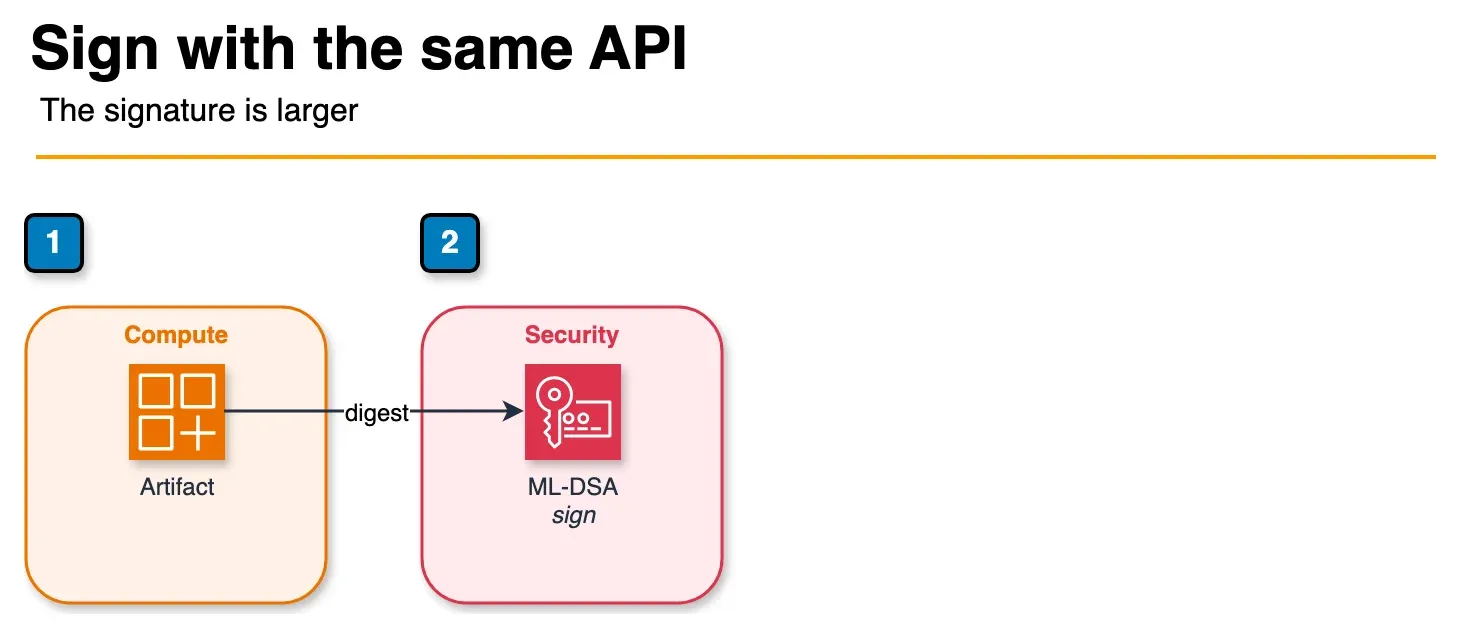
Figure: ML-DSA in the article. Create a sign-and-verify key and call Sign. The signature is larger than an ECDSA signature. The sample alias is not shown. Open the draw.io source.
ML-DSA in KMS is exposed through the standard KMS Sign / Verify API. Create a key with the post-quantum signing key spec:
aws kms create-key \
    --key-spec ML_DSA_65 \
    --key-usage SIGN_VERIFY \
    --description "Code signing - PQ"
Then sign as you would with RSA or ECDSA:
aws kms sign \
    --key-id alias/code-signing-pq \
    --message fileb://artifact.tar.gz \
    --message-type DIGEST \
    --signing-algorithm ML_DSA_65
The signature is larger than ECDSA — 3.3 KB for ML-DSA-65 vs 64 bytes for ECDSA-P256 — which matters for storage-constrained workflows (TPM-bound signing, embedded device firmware) but is negligible for code signing, document signing, container image signing (cosign supports ML-DSA in 2.5+), and supply-chain attestations.
Performance benchmarks
In synthetic benchmarks against AWS KMS endpoints in us-east-1 from an EC2 c7i.2xlarge in the same region:
| Operation | Classical | ML-KEM Hybrid | Delta |
|---|---|---|---|
| TLS handshake (cold connection) | 4.2 ms | 5.1 ms | +0.9 ms |
| TLS handshake (warm/resumption) | 0.8 ms | 0.8 ms | 0 |
| Subsequent KMS Encrypt (256 byte plaintext) | 1.2 ms | 1.2 ms | 0 |
| Sign with ECDSA-P256 | 6.4 ms | n/a | n/a |
| Sign with ML-DSA-65 | n/a | 5.9 ms | -0.5 ms |
The handshake overhead is the only meaningful difference. For a service that opens one connection per process and runs for hours, the cost amortizes to zero. For a high-frequency short-lived-connection workload (DNS-over-TLS, IoT telemetry on cellular, real-time control), benchmark before enabling.
Migration playbook for existing deployments
- Inventory. List every KMS key (CMK and AWS-managed), every ACM certificate, every IAM signing certificate, every customer-managed long-lived key in Secrets Manager. Tag with
data_sensitivity_horizon(immediate / 1-5y / 5-15y / 15y+). - New defaults. Default new long-lived workloads (>5y horizon) to ML-KEM hybrid TLS in transport and ML-DSA signing for signed artefacts.
- Re-encrypt long-lived ciphertexts. Use KMS aliases to swap underlying key material — applications keep using
alias/data-vault, KMS rotates the underlying material from classical to PQ-protected. For server-side encryption at rest (S3-SSE-KMS, EBS, RDS), the data is re-encrypted on next write under the new key version; for ciphertexts at rest that no longer get rewritten, run a one-time re-encryption job usingkms:ReEncrypt. - Plan ACM certificate renewals. ACM-issued public certificates remain classical until PQ issuance is GA. For private CAs (AWS Private CA), check the post-quantum roadmap; for now, plan the certificate inventory to be reissuable with minimal downtime when PQ public certificates ship.
- Update code-signing. Container signing (cosign), Lambda signing (AWS Signer), and supply-chain attestations (in-toto, SLSA) — migrate to ML-DSA on next CI/CD update. Most major signing tools added ML-DSA support in 2025.
- Document. Add a post-quantum readiness statement to your security architecture document. Auditors will start asking about it under ISO 27001:2022 / NIST CSF 2.0 cryptographic-asset-management controls within the next 12-24 months.
Common pitfalls
- Treating hybrid TLS as the same as pure-PQ. Hybrid is the safe migration step. Pure ML-KEM TLS will become available, but hybrid is what AWS supports today and what NIST recommends until 2030+.
- Forgetting browser support. A server that requires ML-KEM hybrid will fail handshakes from older browsers. Configure the TLS security policy to support the hybrid construct alongside classical fallback for public-facing endpoints.
- Ignoring signed-artefact lifetime. A code-signing certificate issued today will validate signatures created today for the certificate’s full lifetime — usually 1-3 years. If the underlying signature is RSA-2048 and a CRQC arrives in 2032, signatures created in 2026 are at risk. Move code-signing to ML-DSA on the next certificate cycle.
- Overestimating the latency penalty. Most teams find the handshake overhead invisible. Run benchmarks before assuming impact.
- Skipping the inventory. The migration is cheap when you know what you have. The inventory is the expensive step — start it now even if you defer the actual algorithm change.
What to Do This Week
- Inventory CMKs/certs; tag sensitivity horizon (>5y → hybrid TLS / ML-DSA candidates).
- Enable ML-KEM hybrid on SDK clients talking to KMS/Secrets Manager in a non-prod account; measure handshake TPS.
- Complete the PQC checklist.
What This Post Doesn’t Cover
Browser PQ certificate issuance timelines, Transfer Family SSH PQ policies in depth, and pure-PQ (non-hybrid) TLS defaults.
Where to go next
Start the inventory now; migrate on natural key/cert rotation cadence.
Frequently asked questions
Is post-quantum cryptography on AWS a 2026 decision or a 2030 decision?
What is "hybrid" TLS and why does AWS use it?
Does enabling post-quantum TLS slow down my application?
How does ML-DSA in KMS differ from RSA / ECDSA signing?
What is the migration path for existing KMS keys and certificates?

Agentic AI & Cloud Security
Works on making teams more productive with agentic AI. Writes the FactualMinds guides on AWS security and compliance: identity, threat detection, data protection, and audit readiness, the controls AI agents need before they touch production systems.