AWS Service Announcements: May 2026 Roundup
Quick summary: July 2026 refresh of May’s production-impacting AWS launches — MCP Server + Agent Toolkit GA (us-east-1 / eu-central-1), SAP MCP on AgentCore, next-gen Resilience Hub, Scheduler SDK expansions, HealthLake CMS-0057-F.
Key Takeaways
- May 2026 was the month AWS turned agentic development from a preview story into a governed production surface
- As of July 19, 2026, managed MCP Server regional availability at GA remains US East (N
- The rest of May extended the pattern into SAP ERP, Resilience Hub, Scheduler, and HealthLake
- Reproduce this — Triage worksheet: --- 1
- Why it matters: Teams using Cursor, Kiro, or Claude Code to build on AWS have been wiring ad-hoc MCP servers with broad IAM policies and stale training data
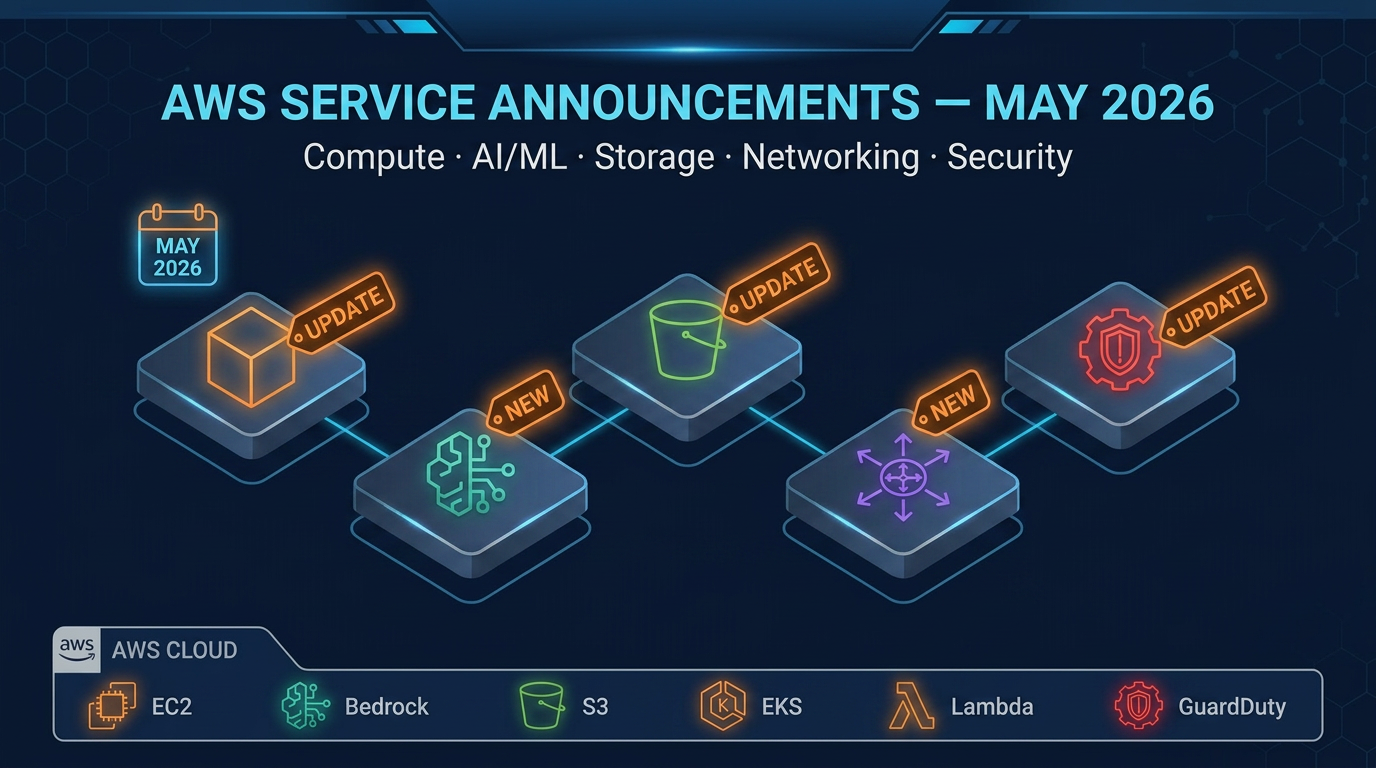
Table of Contents
May 2026 was the month AWS turned agentic development from a preview story into a governed production surface. On May 6, 2026, the AWS MCP Server and Agent Toolkit for AWS both reached general availability — IAM-guardrailed agent access to AWS APIs, still available at no additional MCP charge (you pay for the APIs and resources agents touch). As of July 19, 2026, managed MCP Server regional availability at GA remains US East (N. Virginia) and Europe (Frankfurt) — confirm What’s New before assuming global footprint. The rest of May extended the pattern into SAP ERP, Resilience Hub, Scheduler, and HealthLake. This roundup covers the seven announcements worth evaluating against your architecture.
Reproduce this — Triage worksheet:
examples/architecture-blog-2026/aws-news/may-2026-announcement-triage.md
1. Developer Tools — AWS MCP Server and Agent Toolkit for AWS Reach GA (May 6)
What changed: On May 6, 2026, AWS announced the general availability of the AWS MCP Server — a managed Model Context Protocol server that gives AI coding agents secure, auditable access to AWS services. The same day, AWS launched the Agent Toolkit for AWS — a production-ready suite bundling 40+ validated agent skills, the managed MCP server, and three installable plugins (AWS Core, AWS Data Analytics, AWS Agents). New GA capabilities include calling any AWS API through a single tool, sandboxed Python script execution, agent skills that replace agent SOPs, and documentation search without requiring AWS credentials.
Why it matters: Teams using Cursor, Kiro, or Claude Code to build on AWS have been wiring ad-hoc MCP servers with broad IAM policies and stale training data. The managed MCP Server moves API access behind IAM guardrails, CloudWatch metrics, and CloudTrail logging — the minimum governance bar for production agent workflows.
What this means for your workloads: If your platform team is evaluating agent-assisted IaC or operations, start with the Agent Toolkit Quick Start in us-east-1 or eu-central-1. Scope IAM policies to the services your agents actually touch. For a field-ready placement guide, see our AWS MCP Server GA post and Agent Toolkit skills guide.
2. AI/ML — AWS for SAP MCP Server GA on Amazon Bedrock AgentCore (May 1)
What changed: On May 1, 2026, AWS announced general availability of the AWS for SAP MCP Server on Amazon Bedrock AgentCore. The server connects AI agents to SAP ERP systems via MCP and OData standards, enabling create/read/update/delete operations on SAP business objects — sales orders, purchase orders, materials, and finance documents. It deploys on the managed AgentCore Runtime with session isolation, private connectivity, dual-layer OAuth 2.0 authentication, and CloudWatch telemetry.
Why it matters: SAP integration has historically required custom middleware, brittle screen-scraping, or expensive iPaaS connectors. A first-party MCP server on AgentCore gives AI agents a standards-based path to SAP data without you operating the integration infrastructure.
What this means for your workloads: If you run SAP S/4 HANA or SAP ECC and are piloting agentic automation for finance, procurement, or supply chain, evaluate a proof-of-concept with the CloudFormation deployment templates. The container image ships at no cost; you pay for AgentCore Runtime and underlying SAP OData traffic. Treat early adopters’ use cases (Fortescue, Harman International, PLDT) as reference patterns, not guarantees for your codebase complexity.
3. AI/ML — Amazon Quick Integrates New Relic AI Agents (May 5)
What changed: On May 5, 2026, AWS announced that Amazon Quick now integrates with New Relic’s AI agents. After connecting to New Relic’s remote MCP server, on-call engineers and SREs can invoke New Relic agents from conversational prompts in Quick — including alert insights, user impact analysis, log analysis, transaction diagnostics, and natural language NRQL queries. Quick Flows can automate recurring triage runbooks or escalation workflows.
Why it matters: Incident response still requires context-switching between observability consoles, runbooks in Confluence, and chat tools. Wiring New Relic agents into Quick keeps investigation, RCA generation, and task creation in one workspace — with organizational context from Quick Spaces layered on top of live telemetry.
What this means for your workloads: If your team already uses New Relic and is evaluating Amazon Quick for the broader agentic workspace, connect the MCP integration and test one on-call runbook as a Quick Flow before automating escalation paths. Available in all Regions where Amazon Quick is offered.
4. Management & Governance — Next-Generation AWS Resilience Hub GA (May 28)
What changed: On May 28, 2026, AWS announced general availability of the next generation of AWS Resilience Hub. The update introduces a three-level application model (systems, user journeys, services), dependency discovery assessments, generative AI-powered failure mode analysis against Well-Architected best practices, modular resilience policies, and AWS Organizations integration for org-wide posture monitoring.
Why it matters: Traditional DR planning documents drift from production reality within weeks. Resilience Hub v2 ties resilience objectives to discovered dependencies and generates prioritized recommendations — closing the gap between architecture diagrams and what actually runs.
What this means for your workloads: Existing Resilience Hub customers can adopt the new experience at their own pace via the migration user guide. Platform and SRE teams should model one critical user journey first — payment processing, authentication, or data ingestion — before expanding org-wide. Available in 15 commercial Regions including us-east-1, eu-west-1, and ap-southeast-1.
5. Application Integration — EventBridge Scheduler Adds 619 SDK API Actions (May 12)
What changed: On May 12, 2026, AWS announced that Amazon EventBridge Scheduler expanded AWS SDK integrations with 13 additional services and 619 new API actions — including AWS Lambda Managed Instances. You can now schedule direct invocations of a broader set of AWS services without writing custom integration code, including scaling Lambda managed instances up or down on a time-based schedule.
Why it matters: Scheduled operations that previously required Lambda wrapper functions or Step Functions state machines can now target AWS APIs directly from Scheduler. That reduces moving parts for capacity scheduling, maintenance windows, and periodic cleanup jobs.
What this means for your workloads: Audit your EventBridge Scheduler rules that invoke Lambda functions solely to call a single AWS API. Candidates for direct SDK integration include start/stop schedules for non-production environments, periodic rightsizing triggers, and Lambda Managed Instance capacity adjustments. GA in all Regions where EventBridge Scheduler is available.
6. Healthcare — AWS HealthLake Supports CMS-0057-F APIs (May 29)
What changed: On May 29, 2026, AWS announced that AWS HealthLake now supports CMS Interoperability and Prior Authorization Final Rule (CMS-0057-F) requirements. Healthcare payers must implement four standardized FHIR-based APIs by January 1, 2027: Patient Access, Provider Access, Payer-to-Payer, and Prior Authorization. HealthLake provides native implementations aligned with CARIN IG, DaVinci PDex, SMART App Launch, and related implementation guides.
Why it matters: The January 2027 deadline is fixed. Payers building custom FHIR API infrastructure from scratch face 18-month delivery risk. A managed HealthLake path reduces the integration surface — but compliance responsibility remains with the payer.
What this means for your workloads: If you are a Medicare Advantage organization, Medicaid managed care plan, CHIP entity, or QHP issuer, map your current API readiness against the four required endpoints now. Consult legal and compliance counsel on CMS-0057-F obligations — this announcement describes technical capability, not regulatory certification.
7. Analytics — Amazon EMR Serverless Spark Connect for Interactive Workloads (May)
What changed: In May 2026, AWS announced interactive sessions with Spark Connect on Amazon EMR Serverless — enabling managed notebooks in SageMaker Unified Studio and other environments (Jupyter, VS Code) to develop and run Apache Spark applications with a persistent Spark context. Spark Connect’s client-server architecture decouples the application client from the Spark driver.
Why it matters: Data engineers previously chose between self-managed Spark clusters for interactive work and serverless batch for production. EMR Serverless with Spark Connect bridges that gap — interactive development without standing up long-lived clusters.
What this means for your workloads: Teams on SageMaker Unified Studio notebooks should evaluate EMR Serverless as a Spark runtime option alongside Athena for Apache Spark. Available with EMR release 7.13 in all Regions where EMR Serverless is offered.
What This Post Doesn’t Cover
This roundup omits lifecycle and maintenance announcements (services entering sunset or maintenance mode), minor regional expansions, and individual Bedrock model region additions unless they change architecture decisions. For March 2026 highlights (Nova Forge, Lambda Durable Functions, Graviton5), see our March 2026 edition. For June 2026 (Claude Fable 5, FinOps Agent, Cognito multi-Region replication), see the June 2026 roundup.
What to Do This Week
- Platform teams: Install the Agent Toolkit for AWS in a sandbox account and run one governed MCP workflow against a non-production stack.
- SAP estates: Request a scoped AgentCore + SAP MCP proof-of-concept for one Procure-to-Pay or order-management workflow.
- SRE teams: Model one critical user journey in the next-generation Resilience Hub and compare dependency discovery output against your CMDB.
- Scheduler users: Inventory Lambda wrapper functions used only for scheduled AWS API calls — candidates for direct EventBridge Scheduler SDK targets.
- Healthcare payers: Begin CMS-0057-F gap assessment against HealthLake’s four API categories before the January 2027 deadline.
If your team lacks bandwidth to triage AWS releases and translate them into infrastructure improvements, FactualMinds helps organizations stay current as an AWS Select Tier Services Partner. Reach out through our AWS Managed Services page.
Deeper dives on this site
AWS Cloud Engineering
The FactualMinds engineering and consulting team — AWS-certified architects and engineers building production cloud infrastructure for organizations across industries. As an AWS Select Tier Services Partner, we bring hands-on expertise in AI agents on Amazon Bedrock, serverless, security, data analytics, cost optimization, and cloud migration.