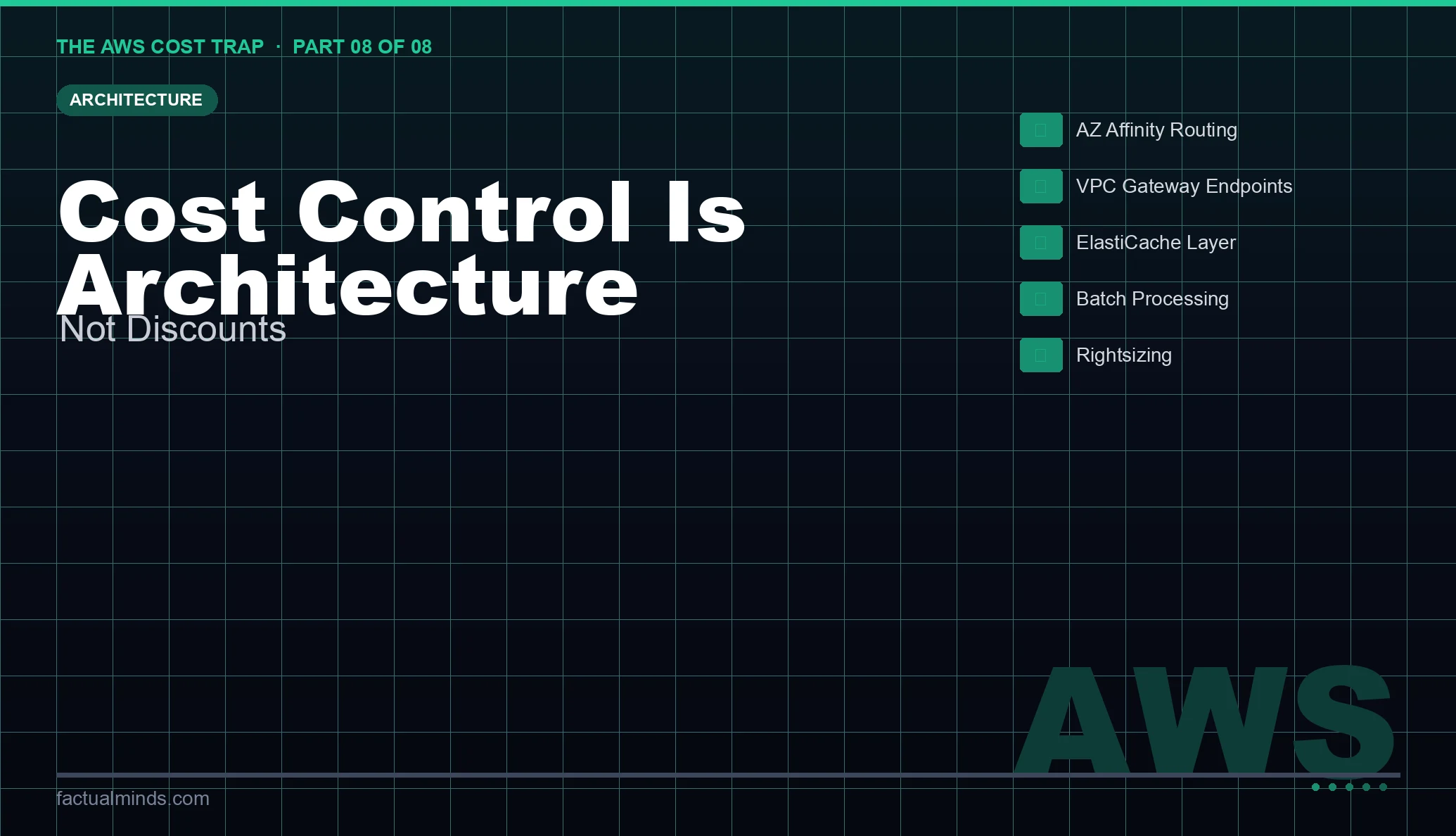
5 AWS Cost Optimization & FinOps Strategies Most Teams Overlook
Quick summary: Beyond Reserved Instances — practical FinOps and AWS cost optimization strategies to reduce your AWS bill by 20-40% without sacrificing performance or reliability.
Key Takeaways
- Beyond Reserved Instances — practical FinOps and AWS cost optimization strategies to reduce your AWS bill by 20-40% without sacrificing performance or reliability
- Beyond Reserved Instances — practical FinOps and AWS cost optimization strategies to reduce your AWS bill by 20-40% without sacrificing performance or reliability

Table of Contents
Most teams know about Reserved Instances and Savings Plans. But in our experience helping businesses with FinOps consulting and AWS cost optimization, the biggest savings often come from strategies that are less obvious.
Here are five approaches we consistently find deliver 20-40% cost reductions — updated with the latest AWS cost management features through early 2026.
1. Right-Size Before You Reserve
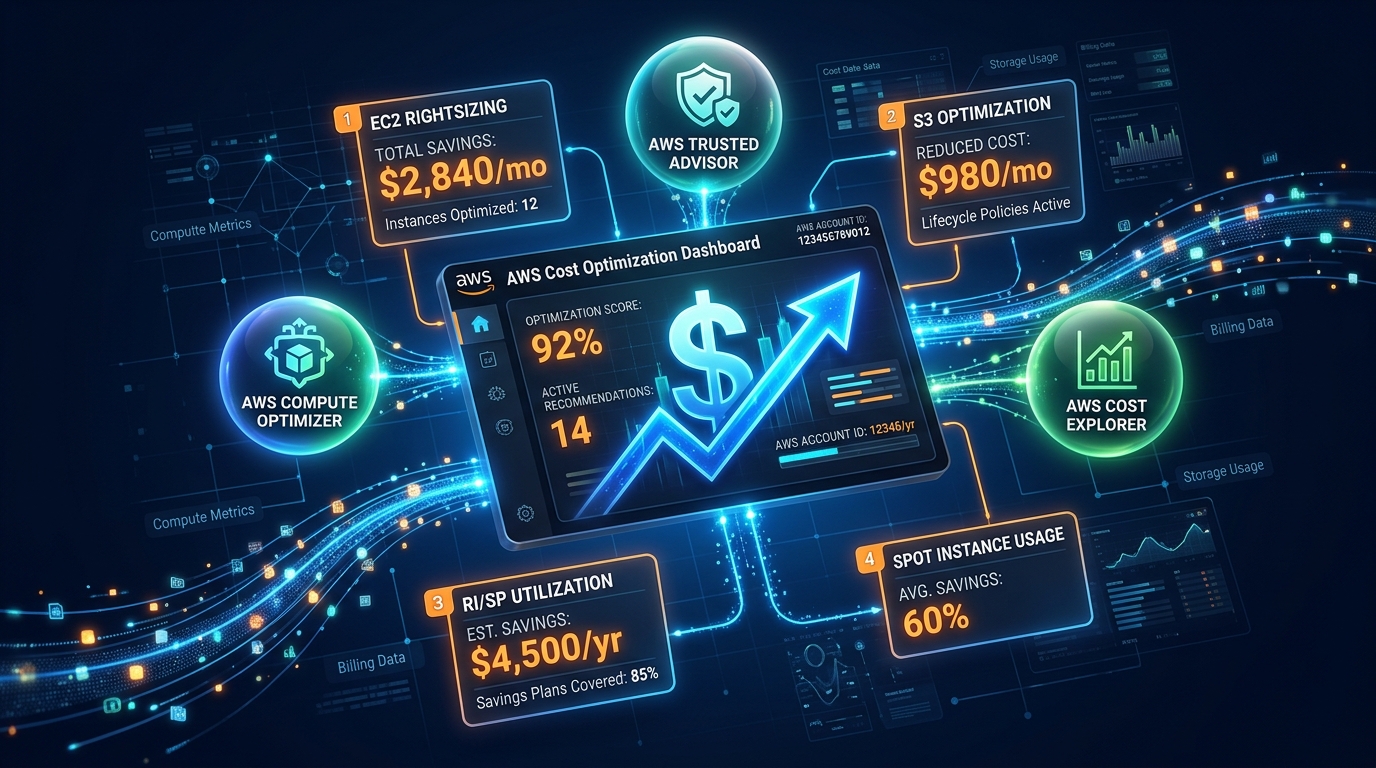
Committing to Reserved Instances on oversized resources locks in waste for 1-3 years. Before purchasing any reservations, analyze actual CPU and memory utilization using AWS Compute Optimizer. We regularly find instances running at 10-15% utilization that can be downsized by 50% or more.
Graviton4 & Graviton5: Graviton4 instances (C8g, M8g, R8g) are approximately 20% cheaper per unit of compute than equivalent x86 instances and 30% faster than Graviton3. Graviton5 (m9g, c9g, r9g families) is now available in preview/limited GA with approximately 30% additional performance over Graviton4. For new workloads, evaluate Graviton5 where available; for immediate cost savings, Graviton4 is the proven choice.
Compute Optimizer Graviton migration recommendations: AWS Compute Optimizer now generates cross-architecture recommendations — it will explicitly recommend migrating from an x86 instance to a Graviton equivalent when the performance profile supports it, and show the estimated monthly savings. This removes the guesswork from Graviton migration planning. Run Compute Optimizer on all accounts before purchasing any Savings Plans, since moving to Graviton often unlocks a smaller, cheaper commitment.
Cost Efficiency Score: The AWS Cost Optimization Hub now provides a Cost Efficiency Score — a single percentage that represents how optimized your environment is relative to AWS best practices. Use it to benchmark your starting point and track improvement over time. Compute Optimizer’s automated EBS optimization recommendations were also expanded in 2025 to cover more storage configuration scenarios.
2. Implement Storage Lifecycle Policies
S3 costs add up quickly when data sits in Standard tier indefinitely. Set up lifecycle rules to transition objects to S3 Intelligent-Tiering, Glacier Instant Retrieval, or Glacier Deep Archive based on access patterns. For most organizations, 60-70% of stored data has not been accessed in the past 90 days.
2025 update — S3 Express One Zone price cuts: AWS reduced S3 Express One Zone prices by up to 85% in April 2025, making high-performance object storage significantly more accessible for latency-sensitive workloads. S3 Tables with Intelligent-Tiering (December 2025) also now automatically moves Iceberg table data to lower-cost tiers based on query frequency.
3. Optimize Data Transfer Routes
Data transfer charges between AWS regions, availability zones, and to the internet are often the third-largest line item on an AWS bill — and the most overlooked. Use VPC endpoints for AWS service communication, consolidate workloads in fewer AZs where HA requirements allow, and leverage CloudFront for egress optimization.
4. Schedule Non-Production Resources
Development, staging, and QA environments rarely need to run 24/7. Implement AWS Instance Scheduler or simple Lambda functions to stop non-production resources outside business hours. This alone can cut non-production compute costs by 65%.
Eliminate bastion host costs with EC2 Instance Connect Endpoint: If your non-production environments include a bastion host EC2 instance for SSH access, replace it with EC2 Instance Connect Endpoint (EICE). EICE provides browser-based and CLI SSH access to private EC2 instances and RDS databases without any EC2 bastion — eliminating the instance cost entirely. It is free to use and requires no changes to instance security groups beyond allowing inbound traffic from the EICE prefix list.
New savings opportunity — Database Savings Plans: AWS launched Database Savings Plans in December 2025, offering up to 35% discount on RDS, Aurora, and DynamoDB usage in exchange for a 1 or 3-year commitment. Previously, database reservations were available only for specific instance types. Database Savings Plans apply across all database types in a commitment, providing more flexibility than instance-level RIs.
5. Enable and Tune Cost Anomaly Detection
AWS Cost Anomaly Detection uses machine learning to identify unusual spending patterns and alert you before a misconfigured resource or runaway process results in a surprise bill. It is free to enable and takes minutes to set up.
2025 update: Cost Anomaly Detection now uses rolling 24-hour detection windows (previously 48-hour), which means anomalies surface faster. AWS also expanded managed monitoring for additional service categories, so more spending patterns receive automatic anomaly detection without custom monitor configuration.
RI/SP Group Sharing (November 2025): AWS made Reserved Instance and Savings Plan Group Sharing generally available — allowing organizations to carve out RI/SP discount pools by business unit or cost center, preventing one team’s heavy usage from consuming another team’s reserved capacity. This is particularly valuable for multi-team organizations that manage cloud budgets independently.
Bonus: Use the Cost Optimization Hub
The AWS Cost Optimization Hub (launched 2023, significantly expanded through 2025) consolidates recommendations from Compute Optimizer, Trusted Advisor, and Cost Explorer into a single prioritized view. It estimates annual savings for each recommendation and lets you mark actions as planned, in-progress, or completed. If you are not reviewing this dashboard monthly, you are likely leaving money on the table.
Related Cost Optimization Resources
For deeper guidance on specific cost optimization challenges:
Foundation & Visibility:
- AWS Cost Explorer and Budgets Monitoring Guide — Setting up custom cost anomaly monitors and budget alerts
- How to Use AWS Cost Anomaly Detection to Catch Surprise Bills — Machine learning-based detection setup and alert tuning
FinOps & Governance:
- FinOps on AWS: Complete Guide to Cloud Cost Governance — Organizational structure, tagging strategy, chargeback models
- AWS FinOps Gap: Engineering vs. Finance and Cost Ownership — Breaking down silos between engineering and finance teams
- AWS Cost Control Architecture & Optimization Playbook — Architectural patterns for cost-aware application design
Service-Specific Optimization:
- AWS Lambda Cost Optimization: Pay-per-Request vs. Provisioned Concurrency — Workload-based lambda pricing decisions
- AWS S3 Storage Costs Are Not Cheap: A Practical Guide — Lifecycle policies, intelligent-tiering, transfer optimization
- High-Scale Postgres on AWS: Cost Optimization — RDS, Aurora, database architecture decisions
Growth & Scalability:
- AWS Eliminate Surprise Bills During Autoscaling — Cost-aware autoscaling policies that prevent bill shocks
- Cost-Aware CI/CD Pipelines on AWS — Optimizing CodePipeline, CodeBuild, and artifact storage costs
- Cost-Optimized SaaS Stack on AWS: End-to-End — Holistic SaaS architecture for unit economics optimization
Start With Visibility
The foundation of any cost optimization effort is visibility. If you are not sure where your money is going, start with a free AWS cost assessment from our team. We will identify the top savings opportunities specific to your environment.
For organizations ready to build a continuous FinOps practice — not just a one-time cost reduction — see our FinOps Consulting service. FinOps moves cloud cost management from a periodic cleanup exercise into an operational discipline with clear team accountability and ongoing governance.
For a deeper look at the governance frameworks, tagging strategies, and organizational structures that make FinOps work at scale, see our comprehensive guide: FinOps on AWS: A Complete Guide to Cloud Cost Governance.
AWS Cloud Architect & AI Expert
AWS-certified cloud architect and AI expert with deep expertise in cloud migrations, cost optimization, and generative AI on AWS.