FinOps on AWS: The Complete Guide to Cloud Cost Governance
Quick summary: Cloud cost governance that actually sticks. A comprehensive guide to FinOps on AWS — the Inform/Optimize/Operate framework, AWS-native tools, team structure, and how to know when to hire a FinOps consultant.
Key Takeaways
- A comprehensive guide to FinOps on AWS — the Inform/Optimize/Operate framework, AWS-native tools, team structure, and how to know when to hire a FinOps consultant
- A comprehensive guide to FinOps on AWS — the Inform/Optimize/Operate framework, AWS-native tools, team structure, and how to know when to hire a FinOps consultant

Table of Contents
Cloud spending grows faster than engineering teams expect. A startup that spends $10,000/month at Series A reaches $80,000/month by Series B — and nobody planned for that curve. The AWS bill arrives at the end of the month, engineering does not have visibility into what drove the increase, and finance has no mechanism to hold anyone accountable.
FinOps (Cloud Financial Operations) is the practice that closes this gap. Not by restricting cloud usage — that is counterproductive — but by creating the visibility, accountability, and process that makes cloud spending a shared organizational discipline.
This guide covers the complete FinOps framework for AWS environments: what FinOps is, how to implement it, what tools to use, and when the complexity warrants bringing in a FinOps consultant.
What Is FinOps?
The FinOps Foundation defines FinOps as “an evolving cloud financial management discipline and cultural practice that enables organizations to get maximum business value by helping engineering, finance, and business teams to collaborate on data-driven spending decisions.”
Three things stand out in that definition:
Cultural practice — FinOps is not a tool you install. It is a change in how engineering and finance teams relate to cloud spending. Tools enable FinOps; they do not replace the organizational change.
Collaboration — FinOps requires engineering, finance, and product teams to look at the same data and make decisions together. When engineers do not know what things cost, they optimize for speed. When finance does not understand what engineers are building, they optimize by cutting budgets. FinOps creates a shared language.
Data-driven — Cost decisions should be based on actual usage data and business outcomes, not gut feel or arbitrary constraints. The goal is maximizing business value per dollar spent, not minimizing the bill.
Why Most AWS Cost Reduction Efforts Fail
Most organizations approach AWS cost optimization as a periodic cleanup exercise. An engineer notices the bill is high, spends a week right-sizing instances and deleting unused resources, and reduces costs by 20%. Six months later, costs are back where they started.
This fails because it addresses symptoms without addressing causes. The causes are organizational:
- Engineers have no visibility into the cost of the infrastructure they provision
- No one owns cloud costs at the team or product level
- There is no feedback loop between infrastructure decisions and cost outcomes
- Cost optimization is reactive (clean up after costs grow) rather than proactive (prevent waste from accumulating)
FinOps addresses these root causes by embedding cost awareness into how engineering teams work.
The FinOps Foundation Framework: Three Phases
The FinOps Foundation defines the practice around three iterative phases. Organizations cycle through these continuously — they are not sequential one-time steps.
Phase 1: Inform
You cannot optimize what you cannot see. The Inform phase establishes visibility:
Cost allocation — Every resource tagged with metadata that enables attribution: environment (production/staging/dev), team, product, service, and cost center. Without comprehensive tagging, your Cost Explorer shows “EC2: $45,000” with no way to know which teams or products drove that spend.
Showback — Reports that show each team their cloud costs. Not to charge them, but to create awareness. Most engineers have never seen what their services cost. Showing them changes behavior immediately.
Chargeback — Actually charging teams or business units for their cloud usage, either as internal transfers or as part of cost accountability metrics. More mature FinOps implementations move from showback to chargeback.
Forecasting — Predicting future spend based on current usage patterns and planned growth. This enables engineering and finance to agree on cloud budgets before the bill arrives, rather than after.
Unit economics — Connecting cloud spend to business metrics. Cost per active user. Cost per transaction. Cost per API call. These metrics make optimization decisions business-driven: “Our cost per user increased 15% this quarter because we added a new ML feature” is a decision — you can optimize the feature, raise prices, or accept the cost. “EC2 costs went up” is just a number.
The most impactful part of the Inform phase is often the tagging audit. Organizations with poor tagging coverage are flying blind — they cannot attribute costs, cannot hold teams accountable, and cannot make informed optimization decisions. Implementing a comprehensive tagging standard is the foundational step.
Phase 2: Optimize
With visibility established, systematic optimization becomes possible. Optimization happens at multiple timescales:
Immediate actions (days to weeks):
- Terminate unused resources: unattached EBS volumes, stopped instances, orphaned load balancers, unused Elastic IPs
- Stop non-production environments outside business hours (typically saves 60–65% of non-production compute)
- Delete old snapshots beyond your retention policy
- Right-size obviously oversized instances using Compute Optimizer recommendations
Short-term actions (weeks to months):
- Purchase Savings Plans for steady-state compute workloads (EC2 Savings Plans, Compute Savings Plans, or Lambda Savings Plans)
- Implement S3 lifecycle policies to transition data to Intelligent-Tiering and Glacier
- Move from gp2 to gp3 EBS volumes (same or better performance, 20% cheaper)
- Implement VPC endpoints for S3 and DynamoDB to eliminate NAT Gateway charges for AWS service access
Strategic actions (months):
- Migrate qualifying workloads to Graviton instances (20–30% price/performance improvement over x86)
- Adopt serverless for appropriate workloads (Lambda, Fargate) to eliminate idle compute costs
- Optimize data transfer patterns to minimize cross-AZ and internet egress charges
- Implement database right-sizing and Reserved Instance or Database Savings Plans commitments
A critical rule: right-size before committing. Purchasing Reserved Instances or Savings Plans on oversized resources locks in waste for 1–3 years. Always analyze actual CPU and memory utilization with Compute Optimizer before any commitment purchase.
Phase 3: Operate
The Operate phase is where FinOps becomes self-sustaining. Instead of periodic cleanup, cost optimization happens continuously as part of normal engineering workflows.
Budget alerts and anomaly detection — AWS Budgets set thresholds for each team, service, and environment. Cost Anomaly Detection uses machine learning to identify unusual spending patterns before they accumulate into large monthly charges. With 24-hour detection windows (updated in 2025), anomalies surface in near-real-time.
Cost review cadences — Regular (monthly or sprint-aligned) cost reviews where teams examine their spend against forecast, discuss anomalies, and plan optimization work. These should be short (30 minutes) and data-driven.
Optimization backlogs — Cost optimization tasks tracked in the same systems as engineering work (JIRA, Linear, etc.) with owners and due dates. This ensures optimization work gets prioritized alongside product work rather than perpetually deferred.
FinOps champions — Engineers in each team who own cost visibility for their services, participate in cross-team FinOps reviews, and serve as the point of contact for cost-related questions. This distributes accountability without requiring every engineer to become a FinOps expert.
Architecture review gates — Cost review as part of the design process for new features and services. “What is the expected cost of this at 1x, 10x, and 100x scale?” before building prevents costly surprises later.
AWS Tools for FinOps
AWS provides a comprehensive native toolset for cloud cost governance. You do not need a third-party FinOps platform to implement mature FinOps practices on AWS.
AWS Cost Explorer
Cost Explorer is the primary analysis tool. Key capabilities:
- Spend visualization — Multi-dimensional filtering by service, region, account, tag, instance type, and usage type
- Trending — Month-over-month and day-over-day spend comparisons
- Savings Plan recommendations — ML-powered recommendations for commitment purchases based on your usage patterns
- RI utilization reports — Track whether existing reserved capacity is being used efficiently
- Forecasting — Predict future spend based on historical patterns
Most FinOps practices start with Cost Explorer. Understanding your spend baseline — which services cost what, which regions drive spend, which tags are unallocated — is the foundation of everything else.
AWS Budgets
Budgets enable proactive financial management:
- Cost budgets — Alert when actual or forecasted spend exceeds a threshold
- Usage budgets — Alert when usage of specific metrics (EC2 hours, S3 storage) exceeds limits
- Savings Plans coverage budgets — Alert when Savings Plans coverage drops below a target
- Budget actions — Automatically apply IAM policies, EC2 Auto Scaling policies, or run Systems Manager automation when budget thresholds are hit
Budget actions are particularly powerful: you can automatically stop non-production resources when a development account budget is exceeded, preventing runaway spend from a misconfigured experiment.
Cost Anomaly Detection
Cost Anomaly Detection uses machine learning to identify unusual spending patterns without requiring manual threshold configuration. It learns your baseline spending patterns and alerts when something deviates significantly — catching both sudden spikes (a Lambda function in an infinite loop) and gradual drift (a new service that was not expected to have significant cost).
In 2025, AWS updated Cost Anomaly Detection to use 24-hour detection windows (previously 48 hours), meaning anomalies surface approximately twice as fast.
AWS Compute Optimizer
Compute Optimizer analyzes CloudWatch metrics to recommend right-sizing changes for:
- EC2 instances (CPU, memory, network utilization)
- Auto Scaling groups
- EBS volumes (IOPS and throughput utilization)
- Lambda functions (memory allocation vs. actual consumption)
- ECS tasks (CPU and memory right-sizing)
Compute Optimizer’s recommendations come with estimated monthly savings and risk assessment — you can filter to recommendations with low disruption risk for immediate implementation.
Cost Optimization Hub
Cost Optimization Hub (significantly expanded through 2025) consolidates recommendations from Compute Optimizer, Trusted Advisor, and Cost Explorer into a single prioritized view across all accounts in an AWS Organization. Each recommendation includes:
- Estimated annual savings
- Implementation effort
- Risk level
- Current status (identified, planned, in-progress, completed, archived)
For multi-account organizations, Cost Optimization Hub provides the unified visibility that makes FinOps at scale tractable.
AWS Cost and Usage Reports (CUR)
For advanced analysis — custom dashboards, allocation to multiple cost centers, chargeback calculations — the Cost and Usage Report provides granular billing data in S3, queryable with Athena or loadable into QuickSight.
CUR is the data source for most enterprise FinOps implementations that need custom allocation logic beyond what Cost Explorer provides natively.
FinOps Team Structure
FinOps is a cross-functional practice. Organizations implement it with varying team structures:
The FinOps Hub — A small central team (1–3 people) that owns the FinOps practice, manages tools, produces reports, and runs cross-team reviews. Engineering teams own their costs; the hub provides the tools and process. This model works well for mid-market organizations (50–200 engineers).
Embedded FinOps — FinOps champions in each engineering team, coordinated by a central function. Each champion owns cost visibility and optimization for their services. The central function provides tooling, training, and cross-team coordination. This model works for larger organizations where cost ownership needs to be tightly coupled with product ownership.
FinOps as DevOps — At early-stage startups, FinOps is often owned by the DevOps or platform engineering team as part of their operational responsibilities. Cost monitoring tools are set up; engineers review their costs as part of sprint reviews.
For organizations that do not have the internal capacity to build a FinOps practice, a FinOps consulting engagement can implement the practice, train the team, and transition to internal ownership over 2–4 months.
FinOps Maturity Levels
The FinOps Foundation defines three maturity levels: Crawl, Walk, and Run.
Crawl — Basic cost visibility. Some tagging in place. Awareness of major cost drivers. Occasional cost reviews. Ad-hoc optimization when costs become painful.
Walk — Comprehensive tagging. Team-level showback. Regular cost reviews. Savings Plans in place. Budget alerts configured. Optimization work tracked.
Run — Full cost attribution to business outcomes. Unit economics tracked. Cost integrated into engineering workflows and design decisions. FinOps champions in each team. Continuous optimization through automated policies and active backlogs.
Most organizations start at Crawl without realizing it. Getting to Walk is a 2–4 month journey for most. Run takes 6–12 months of sustained effort.
Common FinOps Mistakes on AWS
Buying Savings Plans before right-sizing — The most common and expensive mistake. If you commit to Reserved Instances on an oversized instance and then right-size later, your RI does not automatically downsize. You either pay for unused capacity or exchange at a cost.
Treating tagging as optional — Untagged resources are unattributed costs. With 30–40% of resources untagged in a typical environment, a significant portion of spend is invisible and unaccountable.
Conflating FinOps with cost cutting — FinOps is not about minimizing cloud spending. It is about maximizing value per dollar. Sometimes the right FinOps decision is to spend more — adding redundancy, upgrading to higher-performance instances, adopting a managed service that costs more than self-managed but reduces engineering overhead.
One-time cleanup instead of ongoing practice — This is the most common long-term failure. A successful cost reduction that is not followed by process change will be reversed within 6–12 months as the environment grows and new resources accumulate.
No ownership below the account level — Assigning cost accountability at the AWS account level is too coarse for most organizations. Teams need to see and own the costs of specific services and products within accounts, not just account totals.
When to Hire a FinOps Consultant
FinOps consulting makes sense when:
You have meaningful AWS spend — The return on FinOps consulting is proportional to your AWS bill. At $20,000+/month, the savings potential typically exceeds the cost of a consulting engagement.
Your bill is growing faster than your business — This indicates structural waste that will compound. A one-time cleanup will not fix the underlying causes.
You have no tagging and no cost visibility — Building the foundation from scratch is faster with an experienced partner than figuring it out internally.
You are about to make large commitments — Savings Plans and Reserved Instances require analysis to get right. An incorrect commitment can cost as much as the savings you were trying to capture.
Cost reduction is urgent — Board pressure, a funding round, or a profitability requirement with a deadline. External FinOps expertise accelerates implementation significantly.
You have tried internally and cost has not improved — This usually indicates an organizational issue — lack of accountability, lack of process — that requires an outside perspective to diagnose and address.
For organizations ready to build a sustainable FinOps practice, see our FinOps Consulting Services. For the specific optimization strategies that drive the biggest savings, read our 5 AWS Cost Optimization Strategies Most Teams Overlook. For setting up the monitoring foundation, see our AWS Cost Explorer and Budgets guide.
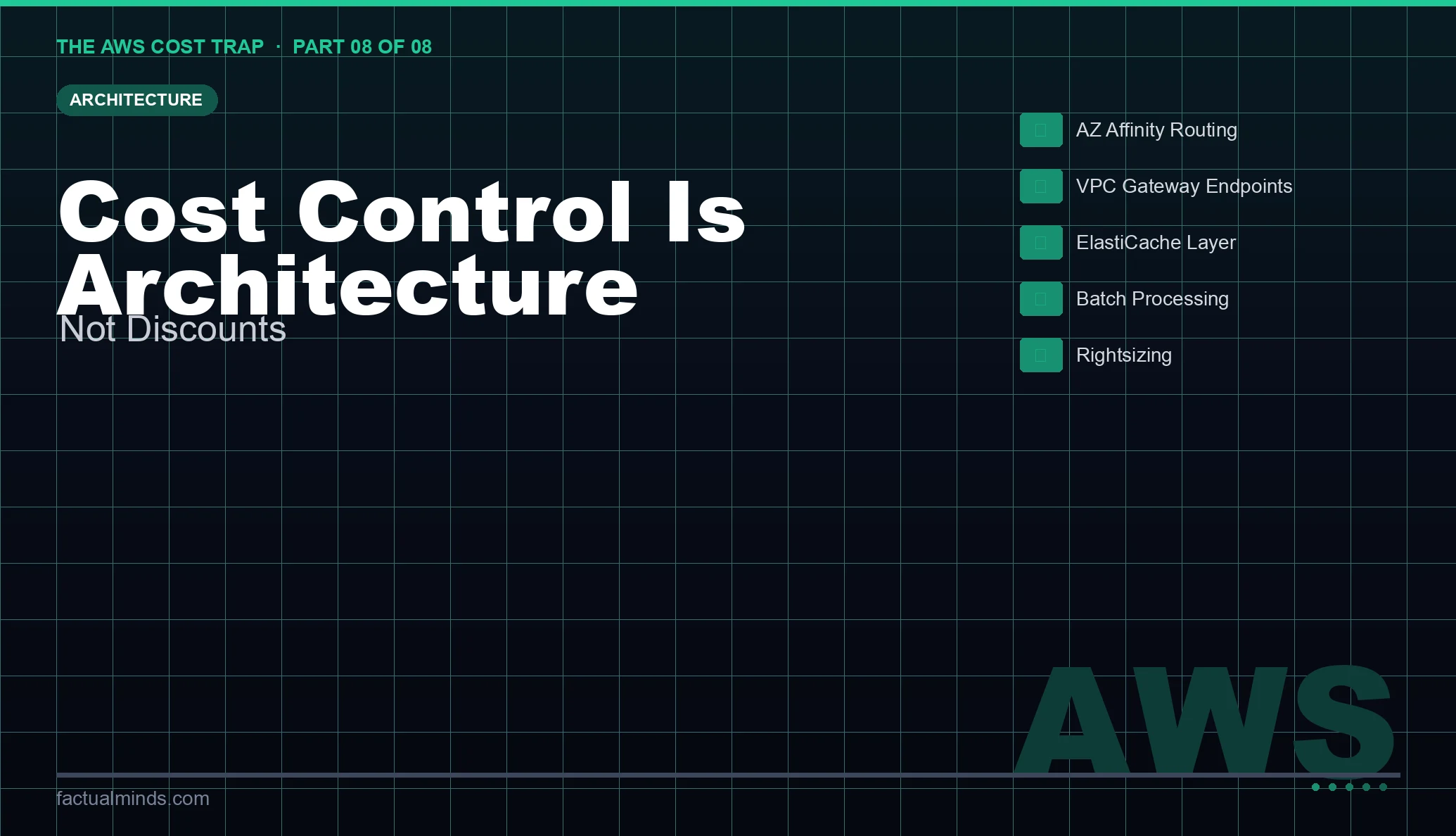
Go deeper — The AWS Cost Trap series: This guide covers the FinOps framework and tools. For the architectural root causes behind the costs those tools surface, see the 8-part series starting with AWS Pricing Is Not Transparent — It’s Emergent Behavior. The series covers data transfer cost failures, autoscaling feedback loops, observability cost anti-patterns, S3 usage traps, the engineering ownership gap, real startup failure patterns, and the architectural optimization playbook.
AWS Cloud Architect & AI Expert
AWS-certified cloud architect and AI expert with deep expertise in cloud migrations, cost optimization, and generative AI on AWS.