NIST Cybersecurity Framework 2.0 on AWS: Implementation & Maturity Guide
Quick summary: NIST CSF 2.0 on AWS: Govern + six functions, tiers, 800-53/171/CMMC. July 2026 Tier-3 checklist.
Key Takeaways
- NIST CSF 2.0 on AWS: Govern + six functions, tiers, 800-53/171/CMMC
- July 2026 Tier-3 checklist
- As of July 2026, implementations should target 2.0 — not 1.1
- First-party benchmark (illustrative plan below): many orgs move Tier 1/2 → Tier 3 (Repeatable) in ~12 months when Govern cadence exists — tools alone stall at Tier 2
- Reproduce this: CSF 2.0 Tier-3 checklist Counter-case: there is no NIST CSF certification badge — use ISO 27001 / SOC 2 / CMMC for external attestation; CSF organizes outcomes
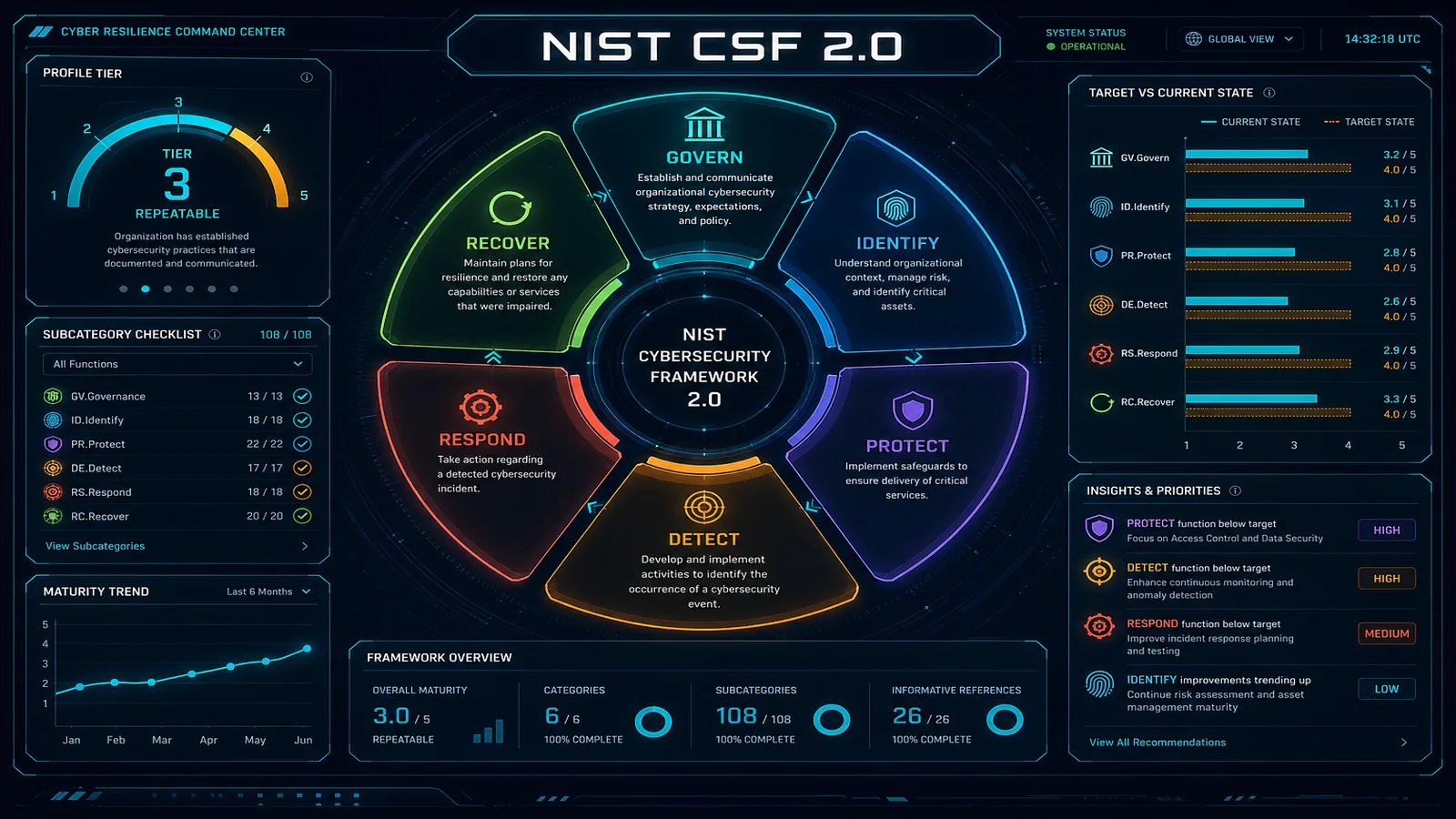
Table of Contents
NIST CSF 2.0 (published February 2024) remains the 2026 default organizing language for cybersecurity outcomes: six functions with Govern as the foundation, then Identify, Protect, Detect, Respond, Recover. As of July 2026, implementations should target 2.0 — not 1.1.
First-party benchmark (illustrative plan below): many orgs move Tier 1/2 → Tier 3 (Repeatable) in ~12 months when Govern cadence exists — tools alone stall at Tier 2.
Reproduce this: CSF 2.0 Tier-3 checklist
Counter-case: there is no NIST CSF certification badge — use ISO 27001 / SOC 2 / CMMC for external attestation; CSF organizes outcomes.
Contact for CSF programs on AWS / GovCloud.
The Six CSF 2.0 Functions
CSF 2.0 organizes outcomes into six functions:
| Function | Question it answers |
|---|---|
| Govern (NEW in 2.0) | How are cybersecurity risk management decisions made and overseen? |
| Identify | What assets, risks, and dependencies do we need to protect? |
| Protect | How do we prevent or limit the impact of cyber events? |
| Detect | How do we discover that something happened? |
| Respond | How do we contain and act on what we detected? |
| Recover | How do we restore operations and improve from what we learned? |
The functions are concurrent, not sequential. A mature program operates all six continuously.
Govern (GV) — The 2.0 Addition
The Govern function recognizes that cybersecurity stagnation is a governance problem, not a tooling problem. It has six categories: Organizational Context (GV.OC), Risk Management Strategy (GV.RM), Roles, Responsibilities, and Authorities (GV.RR), Policy (GV.PO), Oversight (GV.OV), and Cybersecurity Supply Chain Risk Management (GV.SC).
Operationalizing Govern on AWS
| CSF Subcategory | What you need | AWS / org evidence |
|---|---|---|
| GV.OC-01 Organizational mission | Documented mission and cyber risk in context | Board / leadership docs |
| GV.RM-01 Risk strategy approved | Risk appetite, tolerance, and methodology | Signed risk strategy doc |
| GV.RR-02 Cybersecurity roles assigned | Documented org chart with security roles | RACI for AWS Org accounts |
| GV.PO-01 Policies established and communicated | Information security policy + sub-policies | Policy library, training records |
| GV.OV-01 Cybersecurity strategy reviewed | Quarterly leadership review | Management review minutes |
| GV.SC-04 Suppliers known | Third-party inventory with risk tier | Vendor register, SBOM, AWS Marketplace tracking |
Govern is largely organizational evidence — minutes, signed policies, training rosters, and a vendor register. AWS contributes by being a documented supplier (AWS Artifact provides AWS’s compliance attestations for your supply chain register).
Identify (ID) — Asset, Risk, and Dependency Visibility
Identify is about knowing what you have. On AWS, this means continuous inventory.
| CSF Subcategory | AWS service | What it does |
|---|---|---|
| ID.AM-01 Hardware inventory | AWS Config, Resource Explorer | Real-time inventory of all AWS resources across accounts |
| ID.AM-02 Software inventory | Inspector v2, Systems Manager Inventory | Package and library inventory with CVE mapping |
| ID.AM-03 Data flows | VPC Flow Logs, Network Access Analyzer | Traffic analysis between resources |
| ID.AM-04 External systems | AWS Marketplace tracking, IAM Identity Center external IdPs | Third-party integrations |
| ID.AM-05 Resource prioritization | Resource tags, Cost Allocation Tags | Criticality classification |
| ID.RA-01 Asset vulnerabilities identified | Inspector v2, GuardDuty | Continuous CVE and threat scanning |
| ID.RA-05 Threats and vulnerabilities prioritized | Security Hub, Inspector risk scoring | CVSS + KEV + reachability |
Tagging is the underpinning. Without consistent tags (environment, data-classification, owner, criticality), nothing in Identify scales. Use AWS Organizations Tag Policies to enforce required tags.
Protect (PR) — Safeguards
Protect is the largest function — controls covering identity, awareness, data, infrastructure, and platform integrity.
| CSF Subcategory | AWS services |
|---|---|
| PR.AA-01 Identities issued and managed | IAM Identity Center, IAM, Cognito |
| PR.AA-03 Access permissions managed | IAM policies, IAM Access Analyzer, Verified Permissions |
| PR.AA-05 Authentication strength | MFA enforced, IAM password policies, FIDO2 keys |
| PR.AT-01 Personnel awareness | Annual security training, phishing simulations |
| PR.DS-01 Data at rest protected | KMS, S3 encryption, EBS encryption, RDS encryption |
| PR.DS-02 Data in transit protected | ACM (TLS), VPC endpoints, PrivateLink |
| PR.DS-10 Sensitive data identified | Macie, custom data identifiers |
| PR.IR-01 Network integrity protected | VPC, Security Groups, Network Firewall, Shield, WAF |
| PR.PS-01 Configuration management | Config conformance packs, IaC pipelines |
| PR.PS-04 Logging implemented | CloudTrail, CloudWatch Logs, VPC Flow Logs, Security Lake |
| PR.PS-06 Software updated | Systems Manager Patch Manager, Inspector |
For a deep dive on the IAM side, see AWS IAM best practices for least-privilege and Verified Permissions with Cedar.
Detect (DE) — Continuous Monitoring and Anomaly Detection
Detect is where AWS-native services do the heavy lifting.
| CSF Subcategory | AWS service |
|---|---|
| DE.CM-01 Networks monitored | VPC Flow Logs analysis, GuardDuty, Network Firewall logs |
| DE.CM-02 Physical environment monitored | Inherited from AWS (Artifact reports) |
| DE.CM-03 Personnel activity monitored | CloudTrail data events, IAM Access Analyzer |
| DE.CM-06 External service provider activity monitored | CloudTrail Lake, third-party SaaS logging |
| DE.CM-09 External actor anomalies detected | GuardDuty (S3 protection, Malware Protection, EKS, RDS) |
| DE.AE-02 Detected events analyzed | Security Hub, Security Lake (OCSF), Detective |
| DE.AE-04 Adverse event impact estimated | Detective behavior graphs, Security Hub severity |
| DE.AE-08 Incidents declared | EventBridge → ServiceNow / Jira / PagerDuty integration |
Security Lake is the strategic anchor. Centralizing OCSF-formatted logs means downstream tools (Athena, OpenSearch, third-party SIEM) all consume the same schema. See our Security Lake guide.
Respond (RS) — Incident Response
| CSF Subcategory | What it requires |
|---|---|
| RS.MA-01 Incident response plan executed | Documented IR runbook tested annually |
| RS.MA-04 Incidents triaged and validated | Severity scoring, containment SLAs |
| RS.AN-03 Forensic data analyzed | CloudTrail Lake queries, Detective investigation |
| RS.CO-02 Internal stakeholders notified | EventBridge → SNS / Slack notifications |
| RS.CO-03 External stakeholders notified | Customer / regulator notification procedure (GDPR 72h, HIPAA 60d) |
| RS.MI-01 Incidents contained | Automated containment via Lambda + Step Functions |
| RS.MI-02 Incidents eradicated | Forensic snapshot, instance termination, credential rotation |
The runbook needs to specify who has authority — for high-severity events, who can quarantine an EC2 instance, who can rotate root credentials, who can disable a federated identity. Document this with explicit IAM permissions and break-glass procedures.
Recover (RC) — Restoration and Lessons Learned
| CSF Subcategory | AWS service |
|---|---|
| RC.RP-01 Recovery plan executed | Documented BCP/DR plan, tested annually |
| RC.RP-04 Critical functions restored | AWS Backup, Pilot Light / Warm Standby / Multi-Region |
| RC.RP-06 Restoration verified | Restore tests with success criteria |
| RC.IM-02 Lessons learned applied | Post-incident review, policy updates, control improvements |
Recovery is also about communications during an incident. Document customer status page updates, internal Slack channels, and escalation paths in the recovery plan — not the response plan.
Implementation Tiers — How to Progress
CSF defines four implementation tiers describing rigor:
Tier 1 — Partial
- Risk management practices ad hoc and reactive
- Limited cybersecurity awareness
- No formal information sharing
- Cybersecurity policy is informal or undocumented
On AWS: Manual incident response, reactive misconfiguration fixes, no centralized logging, ad hoc IAM policies.
Tier 2 — Risk Informed
- Risk management practices approved by management but not consistently applied organization-wide
- Cybersecurity awareness exists at management level
- Limited information sharing with peers and partners
On AWS: GuardDuty enabled but findings not consistently triaged, Security Hub deployed but no playbooks, IAM policies reviewed periodically but not enforced.
Tier 3 — Repeatable
- Formal cybersecurity risk management policy approved
- Practices regularly updated based on changes in threats, technology, and mission
- Risk-informed policies applied consistently
On AWS: Documented runbooks, automated containment for known threats, Config conformance packs enforced, quarterly access reviews via Access Analyzer.
Tier 4 — Adaptive
- Continuous improvement informed by lessons learned and predictive indicators
- Cybersecurity is part of organizational culture and integrated with enterprise risk management
- Real-time information sharing
On AWS: Security Lake feeds threat intelligence into automated response, threat models updated quarterly, GenAI-driven anomaly detection, automated remediation pipelines.
Most commercial organizations target Tier 3 within 18 months. Tier 4 requires significant analyst capacity and is appropriate for high-target industries (defense, finance, healthcare) and regulated organizations under continuous attack.
NIST SP 800-53, SP 800-171, and CMMC on AWS
For organizations needing more than the framework — actual control language for federal or DoD work:
| Standard | Purpose | AWS environment |
|---|---|---|
| NIST SP 800-53 Rev 5 | Federal information system controls (FISMA) | AWS GovCloud (US) — FedRAMP High |
| NIST SP 800-171 Rev 2 | Protecting CUI in non-federal systems | AWS GovCloud (US) — FedRAMP High preferred; AWS commercial regions for some Level 1 work |
| NIST SP 800-172 | Enhanced security for high-value CUI | AWS GovCloud (US), additional controls |
| CMMC Level 1 | FAR 52.204-21 (17 basic safeguards) | AWS commercial acceptable |
| CMMC Level 2 | NIST SP 800-171 Rev 2 (110 controls) | AWS GovCloud (US) standard |
| CMMC Level 3 | NIST SP 800-172 enhancements | AWS GovCloud (US), additional architecture |
If you’re a defense contractor handling CUI, you’re working toward CMMC Level 2 — and your AWS environment is GovCloud (US). The infrastructure controls inherit from FedRAMP High; you implement the application-layer 800-171 controls.
Implementation Plan — 12 Months to Tier 3
A realistic CSF 2.0 program plan:
Months 1–2: Govern Foundation
- Adopt an information security policy approved by leadership
- Establish quarterly cybersecurity oversight cadence
- Document risk management methodology and risk appetite
- Stand up a vendor risk register
Months 2–4: Identify
- Roll out organization-wide tagging policy
- Deploy AWS Config across all accounts
- Inspector v2 enabled organization-wide
- First risk assessment completed
Months 3–6: Protect
- IAM Identity Center deployed; MFA enforced
- KMS strategy documented; encryption at rest 100%
- VPC standardization with Network Firewall where required
- Security awareness training rolled out
Months 4–8: Detect
- GuardDuty across all accounts (Org-wide)
- Security Hub aggregation
- Security Lake stood up
- Critical alert routing to PagerDuty / Slack
Months 6–10: Respond
- IR runbooks documented and tested
- Automated containment for top-5 finding types
- Tabletop exercise quarterly
Months 8–12: Recover
- BCP/DR documented and tested
- Backup with cross-region replication
- Restore test logged quarterly
Month 12: Tier Assessment
Engage a third party to assess your current tier and identify the path to the next.
What to Do This Week
- Score current tier honestly (Partial → Adaptive).
- Stand up Govern artifacts (roles, risk appetite, review cadence).
- Map Detect/Respond to Org GuardDuty + Security Hub using the Tier-3 checklist.
What This Post Doesn’t Cover
Full SP 800-53 control-by-control FedRAMP packages and C3PAO assessment logistics.
Frequently asked questions
What changed in NIST CSF 2.0 vs 1.1?
How does NIST CSF differ from NIST SP 800-53?
How does CMMC relate to NIST CSF and SP 800-171?
What are NIST CSF implementation tiers and how do I progress through them?
Do I need NIST CSF certification?

Agentic AI & Cloud Security
Works on making teams more productive with agentic AI. Writes the FactualMinds guides on AWS security and compliance: identity, threat detection, data protection, and audit readiness, the controls AI agents need before they touch production systems.