AWS Bedrock Nova Models: Performance, Cost, and When to Choose Over Claude
Quick summary: AWS Nova models vs Claude: pricing comparison, performance benchmarks, and decision framework for choosing the right Bedrock model for your enterprise AI.
Key Takeaways
- AWS Nova models vs Claude: pricing comparison, performance benchmarks, and decision framework for choosing the right Bedrock model for your enterprise AI
- AWS Nova models vs Claude: pricing comparison, performance benchmarks, and decision framework for choosing the right Bedrock model for your enterprise AI
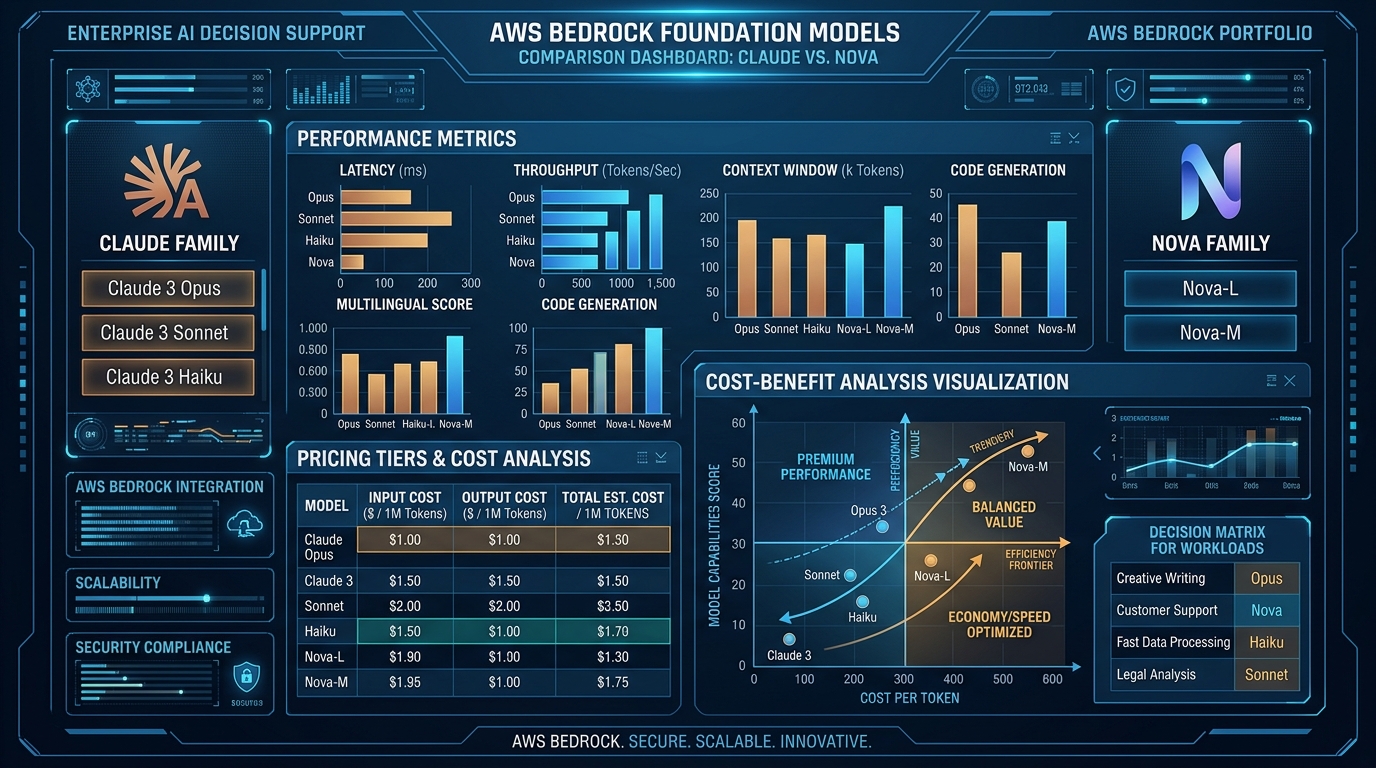
Table of Contents
Nova Is Here, and It Changes the Bedrock Economics
In early 2025, AWS released Nova models — a new family of foundation models optimized for cost and latency. For organizations running Bedrock at scale, Nova represents a 40-60% cost reduction opportunity.
The decision: Claude (best-in-class reasoning, most accurate) vs. Nova (fast, cheap, good enough for 80%+ of tasks).
This guide walks you through the trade-offs, pricing, and when each model makes sense.
The Three Nova Models
AWS released three Nova variants optimized for different trade-offs:
| Model | Context | Speed | Accuracy | Best For | Cost vs Claude Haiku |
|---|---|---|---|---|---|
| Nova Micro | 4K | Ultra-fast | 75% | High-volume simple tasks | -60% |
| Nova Lite | 300K | Fast | 85% | Balanced workloads | -50% |
| Nova Pro | 300K | Moderate | 92% | Enterprise applications | -45% |
Nova Micro: Designed for high-throughput, low-complexity work. 50-100ms latency. 2.4K context window.
Nova Lite: The sweet spot. Good accuracy, 300K context window, 25-40ms latency. Replaces Claude Haiku for most use cases.
Nova Pro: Closest to Claude 3.5 Sonnet in reasoning ability. Still 45% cheaper. 100-200ms latency. Best for complex tasks where accuracy matters but cost is secondary.
Pricing Comparison: Nova vs. Claude
Input Token Pricing (per 1M tokens)
Claude 3.5 Haiku:     $0.80
Claude 3.5 Sonnet:    $3.00

Nova Micro:           $0.30   (-62% vs Haiku)
Nova Lite:            $0.40   (-50% vs Haiku)
Nova Pro:             $1.20   (-60% vs Sonnet)
Output Token Pricing (per 1M tokens)
Claude 3.5 Haiku:     $1.60
Claude 3.5 Sonnet:    $15.00

Nova Micro:           $0.60   (-62%)
Nova Lite:            $0.80   (-50%)
Nova Pro:             $4.80   (-68%)
Real-World Scenario: Customer Support at Scale
Setup: 100K customer support tickets/month. Average ticket = 2 paragraphs (~400 tokens input).
Option 1: Claude 3.5 Haiku
100K tickets × 400 input tokens = 40M input tokens
40M × $0.80 = $32K/month input cost

100K tickets × 100 output tokens = 10M output tokens
10M × $1.60 = $16K/month output cost

Total: $48K/month
Option 2: Nova Micro
40M × $0.30 = $12K/month input cost
10M × $0.60 = $6K/month output cost

Total: $18K/month
Savings: $30K/month ($360K/year)
Option 3: Nova Lite (slightly better accuracy)
40M × $0.40 = $16K/month input
10M × $0.80 = $8K/month output

Total: $24K/month
Savings: $24K/month ($288K/year)
Decision: For customer support classification, Nova Micro saves $30K/month with acceptable accuracy. If accuracy is critical, Nova Lite at $24K/month is still 50% cheaper than Claude Haiku.
Performance Benchmarks
Benchmark 1: Customer Support Classification
Task: Classify support ticket as (complaint, question, feature request)

Nova Micro:       91% accuracy, 45ms latency
Claude Haiku:     94% accuracy, 55ms latency
Nova Lite:        96% accuracy, 38ms latency
Claude Sonnet:    98% accuracy, 120ms latency
Verdict: Nova Lite is slightly better than Haiku AND faster.
Benchmark 2: Long-Form Summarization (10K article → 200-word summary)
Nova Lite:        Good quality (80/100), 2.2s latency
Claude Haiku:     Good quality (82/100), 2.8s latency
Nova Pro:         Excellent (88/100), 3.1s latency
Claude Sonnet:    Excellent (91/100), 3.8s latency
Verdict: Nova Lite is comparable to Haiku. Nova Pro is almost as good as Sonnet, 40% cheaper.
Benchmark 3: Multi-Step Reasoning (Math word problems)
Nova Micro:       42% correct
Nova Lite:        67% correct
Claude Haiku:     71% correct
Nova Pro:         78% correct
Claude Sonnet:    87% correct
Verdict: For complex reasoning, Claude still wins. But Nova Pro is acceptable for most enterprise use cases.
Decision Framework: Which Model to Use
Start here: What is your primary constraint?

├─ Cost is critical?
│  ├─ Simple classification/moderation? → Nova Micro
│  ├─ Balanced cost/quality? → Nova Lite
│  └─ Enterprise, complexity matters? → Nova Pro
│
├─ Speed is critical?
│  ├─ <50ms latency needed? → Nova Micro
│  ├─ <100ms latency? → Nova Lite
│  └─ Complex queries OK with >100ms? → Claude + caching
│
└─ Accuracy is critical?
   ├─ >95% accuracy required? → Claude Sonnet
   ├─ 90-95% OK? → Nova Pro
   └─ 85% acceptable? → Nova Lite
Workload Mapping
| Workload | Best Model | Why |
|---|---|---|
| Content moderation | Nova Micro | High volume, binary decisions |
| Email classification | Nova Lite | Good accuracy, fast, cheap |
| Customer support (reply generation) | Nova Pro | Balance of quality and cost |
| Code generation | Claude Sonnet | Accuracy matters most |
| Document summarization | Nova Lite | Context window sufficient, cost matters |
| Multi-step analysis | Claude Sonnet | Complex reasoning required |
| RAG retrieval feedback | Nova Micro | Simple ranking, high volume |
| Creative writing | Claude Sonnet | Quality non-negotiable |
Migration Path: Claude → Nova
Step 1: Identify High-Volume Use Cases (Week 1)
From your CloudWatch logs, find workloads where:
- Model usage > 5M tokens/month
- Latency requirements > 100ms (tolerant)
- Accuracy requirements < 95%
Example: Customer support categorization (10M tokens/month) → candidate for Nova.
Step 2: Set Up A/B Testing (Week 2)
import random
import boto3

bedrock = boto3.client('bedrock-runtime')

def classify_ticket(ticket_text):
    model_id = random.choice(['claude-haiku', 'nova-lite'])

    response = bedrock.invoke_model(
        modelId=f'us.amazon.{model_id}',
        body=json.dumps({
            'messages': [{'role': 'user', 'content': ticket_text}],
            'max_tokens': 100
        })
    )

    result = json.loads(response['body'].read())

    # Log for comparison
    log_model_usage(model_id, result, ticket_text)
    return result
Run 50/50 split for 1 week. Compare:
- Accuracy (vs. human labels)
- Latency
- Cost
Step 3: Evaluate Trade-offs (Week 3)
Haiku:
  - Accuracy: 92%
  - Latency: 55ms
  - Cost: $48K/month

Nova Lite:
  - Accuracy: 91%
  - Latency: 38ms
  - Cost: $24K/month

Decision: Slight accuracy trade-off (-1%) but 50% cost savings + 26% faster.
Step 4: Gradual Rollout (Week 4)
# Canary: 10% Nova Lite, 90% Claude Haiku
def get_model():
    if random.random() < 0.10:
        return 'nova-lite'
    return 'claude-haiku'

# After 1 week: 25% Nova Lite
# After 2 weeks: 50% Nova Lite
# After 3 weeks: 100% Nova Lite
Cost-Quality Trade-Off Table
| Budget | Model Choice | Expected Accuracy | Monthly Savings |
|---|---|---|---|
| $10K/month | Nova Micro | 75-80% | vs Claude baseline |
| $20K/month | Nova Lite | 85-92% | 50% vs Claude Haiku |
| $50K/month | Nova Pro | 90-95% | 40% vs Claude Sonnet |
| Unlimited | Claude Sonnet | 95%+ | Best accuracy |
Combining Nova with Other Cost Controls
Nova + other optimizations:
Nova + Prompt Caching
- Cache system prompts (reused 100x): -90% on repetitive input tokens
- Combined with Nova: 70-80% total savings
Nova + Smaller Context Windows
- Nova Micro: 4K context (80% of use cases don’t need more)
- Saves cost and reduces latency
Nova + Batch Inference
- Off-peak batch processing: additional -20%
- Total: 60%+ savings vs Claude
Nova + Reserved Capacity
- Reserve model throughput capacity: -25% on all inference
- Total: 65-70% savings
Gotchas to Avoid
Gotcha 1: Assuming Nova Works for Everything
Nova Micro is not a replacement for Claude Sonnet on complex reasoning tasks. Test thoroughly before full migration.
Gotcha 2: Ignoring Latency
Nova Micro is fast, but if you have SLA < 50ms, test it. Actual latency varies by model load.
Gotcha 3: Not Monitoring Quality Drift
After migrating to Nova, quality can drift over time. Set up automated quality monitoring (compare sample outputs to baseline).
Bottom Line
Use Nova if:
- You’re spending >$20K/month on Bedrock inference
- Your workloads are classify, summarize, or generate (not deep reasoning)
- You can tolerate 5-15% accuracy trade-off for 40-60% cost savings
Stick with Claude if:
- Accuracy is non-negotiable
- You run complex, multi-step reasoning workloads
- You’re already optimized on cost
Related Resources
Ready to Optimize Your Bedrock Costs?
If you’re already using Claude on Bedrock and want to evaluate Nova, book a free GenAI assessment. We’ll analyze your model usage, identify candidates for Nova migration, and project your cost savings.
AWS Cloud Architect & AI Expert
AWS-certified cloud architect and AI expert with deep expertise in cloud migrations, cost optimization, and generative AI on AWS.