MiniStack Review 2026: Free LocalStack Alternative with Real AWS Infrastructure
Quick summary: MiniStack is a free, MIT-licensed AWS emulator that spins up real Postgres, Redis, and Docker containers—not mocks. Here is what it does well, where it falls short, and whether it replaces LocalStack for your team.
Key Takeaways
- MiniStack is a free, MIT-licensed AWS emulator that spins up real Postgres, Redis, and Docker containers—not mocks
- MiniStack is a free, MIT-licensed AWS emulator that spins up real Postgres, Redis, and Docker containers—not mocks
Table of Contents
When LocalStack moved its core services behind a paid tier, the AWS developer community lost its go-to free emulator. Developers who relied on local S3, RDS, and Lambda testing suddenly faced a choice: pay up, build their own mock, or find an alternative. Enter MiniStack — a free, open-source AWS emulator that shipped just days ago and is already gaining serious traction.
We reviewed MiniStack’s architecture, features, and performance. Here is whether it is a viable replacement for LocalStack and what makes it different.
What is MiniStack?
MiniStack is a free, MIT-licensed AWS emulator that runs 38+ AWS services locally on a single port (4566). Unlike LocalStack, it requires no account, API key, or telemetry. Launch it once via Docker or pip, and you get a fully functional local AWS environment.
Key facts:
- Language: Python 3.12+
- Install: Docker, PyPI, or docker-compose
- License: MIT (completely free, no commercial restrictions)
- Launch date: April 7, 2026 (Product Hunt debut)
- Community: 1,800+ GitHub stars, 900+ passing tests, actively maintained with multiple daily commits
- Services: 38+ AWS services across compute, storage, databases, messaging, security, and more
The project exists because LocalStack’s free tier no longer exists. Nahuel Nucera and Johannes Grumböck built MiniStack as a direct answer to that gap—and it has earned the community’s attention fast.
The “Real Infrastructure” Difference
Here is the architectural difference that sets MiniStack apart: most AWS emulators mock the services. MiniStack spins up real containers.
When you request RDS in MiniStack, it does not pretend to be a PostgreSQL database—it launches a real PostgreSQL container and runs your SQL against it. Same for Redis (ElastiCache), Docker (ECS), and SQL queries (Athena via DuckDB). This “real infrastructure” approach has a direct benefit: your local tests are more faithful to production.
Compare this to traditional mocks:
- Mocks catch schema errors and API signature mistakes but miss database-specific behavior, transaction edge cases, and performance surprises.
- Real infrastructure forces you to confront the same constraints your production code faces—connection pooling, query planning, concurrency limits.
For teams with database-heavy applications, this is the difference between “tests passed locally but failed in production” and “tests are telling us the truth.”
38+ AWS Services at a Glance
Here is what MiniStack supports:
| Category | Services |
|---|---|
| Storage | S3, EBS, EFS, S3 Object Lock |
| Compute | Lambda, EC2, ECS, EMR |
| Databases | RDS (PostgreSQL/MySQL), DynamoDB, DynamoDB Streams |
| Caching | ElastiCache (Redis) |
| Messaging | SQS (FIFO + DLQ), SNS, Kinesis, EventBridge |
| Workflows | Step Functions (full ASL interpreter) |
| APIs | API Gateway v1/v2, AppSync |
| Analytics | Athena (DuckDB-backed), Glue, Firehose |
| Security | IAM, KMS, ACM, WAF v2, Secrets Manager, STS |
| Networking | Route53, CloudFront, ALB/ELBv2 |
| Identity | Cognito |
| Infrastructure | CloudFormation, CloudWatch Logs/Metrics, SSM |
| SES, SESv2 |
Lambda support deserves special mention: MiniStack maintains warm worker pools for Python and Node.js, and uses Docker Runtime Interface (RIE) emulation for Go and Rust binaries. This means your Lambda tests execute real code, not stubs.
Quick Start
Installation: Three paths.
# Via pip
pip install ministack && ministack

# Via Docker
docker run -p 4566:4566 nahuelnucera/ministack

# Via docker-compose
git clone https://github.com/Nahuel990/ministack.git
cd ministack
docker compose up -d
Verify: Check the health endpoint.
curl http://localhost:4566/_ministack/healthUse: Point your AWS SDK to the local endpoint. Example with AWS CLI:
aws --endpoint-url=http://localhost:4566 s3 mb s3://my-bucket
aws --endpoint-url=http://localhost:4566 s3 ls
With Terraform:
provider "aws" {
  region     = "us-east-1"
  access_key = "test"
  secret_key = "test"

  endpoints {
    s3  = "http://localhost:4566"
    rds = "http://localhost:4566"
  }
}
With Python boto3:
import boto3

s3 = boto3.client(
    's3',
    endpoint_url='http://localhost:4566',
    aws_access_key_id='test',
    aws_secret_access_key='test',
)

s3.create_bucket(Bucket='my-bucket')
The endpoint swap is the only required change. All existing code paths work unchanged.
Performance Comparison
Here is how MiniStack stacks up against LocalStack:
| Metric | LocalStack Free | LocalStack Pro | MiniStack |
|---|---|---|---|
| Price | Now paid | $35+/month | Free forever |
| License | BSL | Proprietary | MIT |
| Startup time | 15–30s | 15–30s | ~2s |
| Memory (idle) | ~500MB | ~500MB | ~30MB |
| Image size | ~1GB | ~1GB | ~250MB |
| RDS/ElastiCache/ECS | Paid only | Included | Included, free |
| EC2, EMR, EBS, EFS | Paid only | Included | Included, free |
| Core services (S3, Lambda, etc.) | Paid | Included | Included |
The headline: MiniStack boots 7–15x faster, uses 15x less RAM, and gives you RDS/ElastiCache/ECS at zero cost. The tradeoff is maturity—it is a younger project than LocalStack Pro, and edge-case AWS behaviors may not be fully replicated yet.
Real-World Use Cases
Local development loops. Developers run MiniStack once (docker run) and test S3 uploads, Lambda invocations, and DynamoDB queries without touching AWS. Zero cloud costs, instant feedback.
CI/CD integration. MiniStack’s 2-second startup makes it ideal for test pipelines. Spin up before tests, reset state, tear down after. With POST /_ministack/reset, you can nuke all state between test runs without restarting the container.
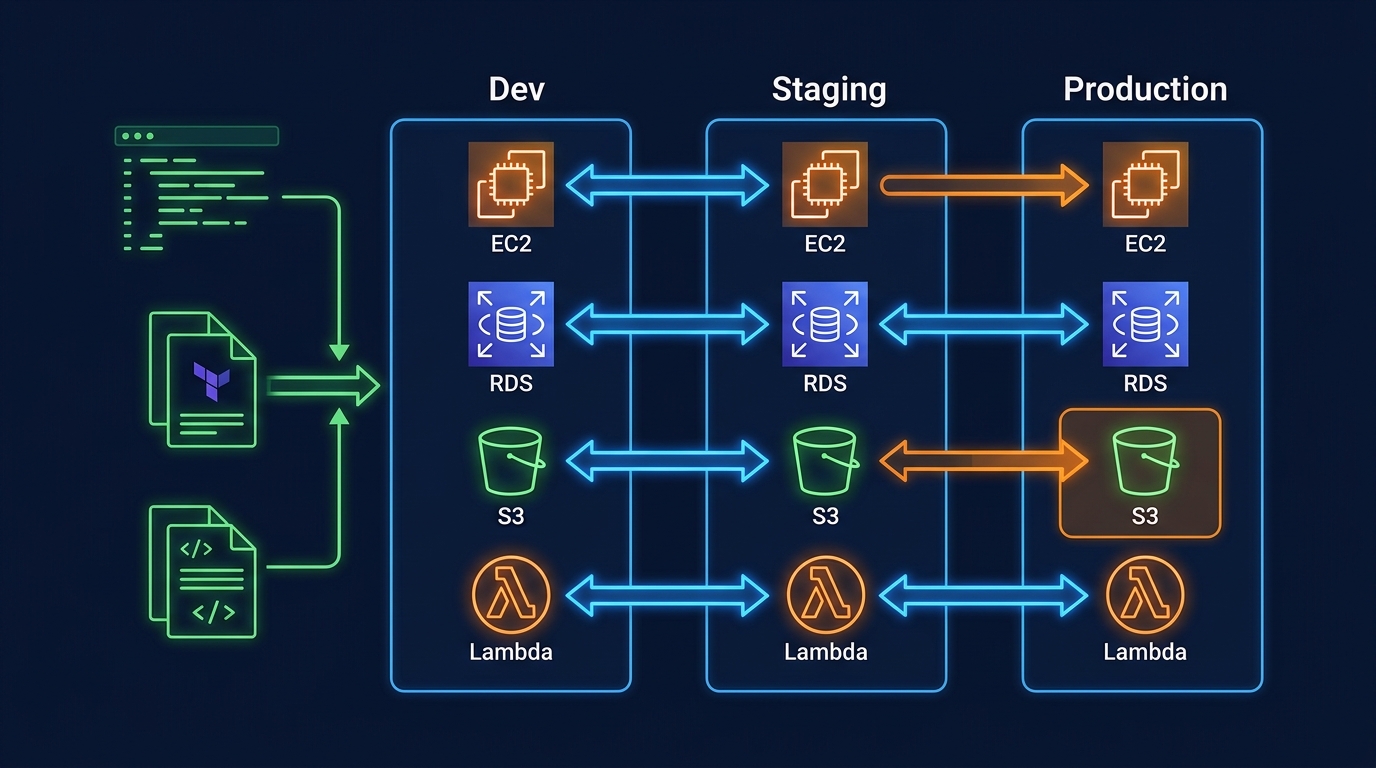
Terraform and CDK testing. Write infrastructure as code, validate it locally against MiniStack before applying to staging or prod. Works with all major IaC frameworks (Terraform, AWS CDK, Pulumi, CloudFormation).
Integration testing with real databases. Because MiniStack runs actual Postgres and Redis, you can test connection pooling, transaction isolation, and caching behavior that mocks would hide.
Multi-tenant isolation testing. MiniStack’s IAM support allows you to test cross-account access patterns locally. Create separate Access Key IDs to simulate tenant isolation.
Limitations and Things to Watch
MiniStack is impressive, but it has gaps.
Scope. With 38 services, MiniStack covers the “80% of use cases” well. But if your code relies on niche services (e.g., AWS Timestream, AWS IoT Core, AWS Glue Catalog subtleties), you may hit unimplemented features.
Small team. MiniStack is maintained by two developers. As AWS itself evolves (new services, feature launches, API changes), the maintenance burden grows. GitHub issue #221 flags “CODE FREEZE DUE MIGRATION,” suggesting the team is mid-architecture refactor. Monitor the project’s activity rate.
Early stage. With 900+ tests and solid core coverage, MiniStack is stable for local dev and CI. But it has not yet reached the maturity of LocalStack Pro’s multi-year refinement. Edge cases and lesser-used service parameters may differ from real AWS behavior.
No paid support tier. If something breaks, you are relying on community issues and the maintainers’ goodwill. For mission-critical CI, LocalStack Pro’s commercial support may be worth the cost.
Should You Switch?
Yes, if you:
- Are frustrated by LocalStack’s paywall and need RDS, ElastiCache, or ECS locally
- Want faster test cycles (2-second startup vs. 30 seconds saves real time in CI)
- Are testing database-heavy applications and want real Postgres/MySQL, not mocks
- Have simple, common AWS service use cases (S3, Lambda, DynamoDB, SQS, etc.)
- Are using Terraform, CDK, or Pulumi and need a free validation environment
No, if you:
- Are already paying for LocalStack Pro and have a stable CI pipeline—switching has opportunity cost
- Rely heavily on AWS service features that MiniStack does not yet implement
- Need commercial support contracts for your local AWS emulation (niche, but important for some organizations)
- Are testing very new or niche AWS services that MiniStack has not added yet
For most teams: The free tier + real infrastructure makes MiniStack worth trying. If it covers your services, the performance and cost gains are real.
The Bigger Picture
MiniStack fills a vacuum. LocalStack’s decision to commercialize created an opening, and MiniStack filled it with a different architectural bet: real containers over mocks, simplicity over complexity, MIT license over BSL.
At 1,800 stars and climbing, it has community momentum. The Product Hunt launch (April 7, 2026) just happened, and multiple daily commits show active development. The “real infrastructure” approach is not just marketing—it genuinely produces better test fidelity for database-heavy code.
The risk is sustainability. Two maintainers supporting 38 services is ambitious. Watch the GitHub activity over the next 3–6 months. If the commit frequency sustains, MiniStack becomes the de facto free AWS emulator. If activity drops, LocalStack’s paywall remains the only game in town.
For now, if your use case aligns with MiniStack’s coverage, you should trial it. The worst case is you spend an hour setting it up and fall back to LocalStack. The best case is you cut your local test time in half and save thousands on cloud costs.
AWS Cloud Architect & AI Expert
AWS-certified cloud architect and AI expert with deep expertise in cloud migrations, cost optimization, and generative AI on AWS.