AWS Application Modernization ROI: How to Build the Business Case for Your Board
Quick summary: Build a data-driven business case for application modernization. ROI calculations, cost-benefit analysis, risk frameworks, and board-ready presentations.
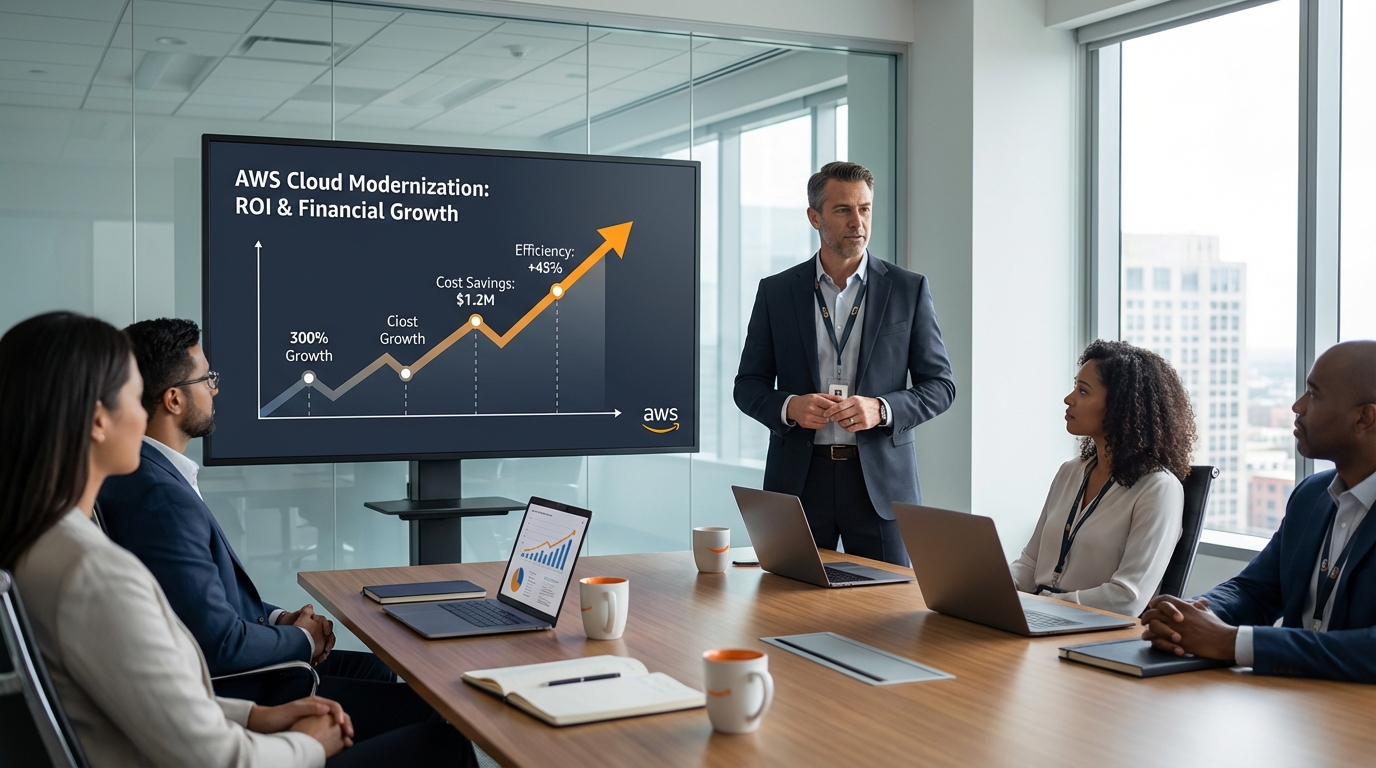
Table of Contents
Why Boards Kill Modernization Projects: It’s the Business Case
Most application modernization projects fail not because of technical challenges, but because the business case wasn’t compelling enough. Your CTO sees the technical need. Your board sees a $5M bill with uncertain returns.
This guide walks you through building a board-ready business case that quantifies ROI, addresses risk, and gets the funding approved.
The Modernization ROI Framework: Four Value Drivers
Modernization delivers value across four dimensions. The strongest business cases quantify all four:
1. Infrastructure Cost Savings (Direct, Easy to Calculate)
What you save:
- Physical data center costs (real estate, power, cooling, maintenance)
- License costs (proprietary databases → AWS-managed alternatives)
- Hardware refresh cycles (OpEx vs CapEx)
Typical savings: 30-50% of current infrastructure spend.
Example:
Current state:
  - 20 physical servers @ $3K/month (electricity, maintenance, real estate) = $60K/month
  - 10 database licenses @ $10K/month = $100K/month
  - Hardware refresh (amortized) = $40K/month
  Total: $200K/month = $2.4M/year

After modernization (AWS):
  - EC2/RDS equivalent @ $70K/month = $840K/year
  - Savings: $1.56M/year (35% reduction)
2. Operational Labor Savings (Automation & Managed Services)
What you save:
- Incident response (fewer infrastructure fires = fewer on-call rotations)
- Patching/updates (AWS patches RDS, S3, etc. → your team doesn’t)
- Backup/recovery automation (no more tape management)
- Monitoring/alerting (CloudWatch + automation)
Typical savings: 40-60% of IT operations labor.
Example:
Current state:
  - 5 DBAs @ $120K salary = $600K/year
  - 3 infrastructure engineers @ $140K = $420K/year
  - 2 on-call rotations (shift differential) = $80K/year
  Total ops team: $1.1M/year

After modernization (managed services):
  - 2 DBAs (AWS RDS managed) @ $120K = $240K/year
  - 1 infrastructure engineer (AWS handles most) @ $140K = $140K/year
  - 1 on-call rotation (reliability improved) = $40K/year
  Total: $420K/year

Savings: $680K/year (62% reduction)
3. Velocity & Time-to-Market (Harder to Quantify, Often Largest)
What you gain:
- CI/CD automation (deploy per-second vs per-quarter)
- Faster feature iteration (no waiting for infrastructure)
- Reduced go-to-market time
Typical revenue impact: 10-20% faster feature delivery = 5-15% revenue lift (for SaaS), or faster new product launches (for product companies).
Example:
SaaS company, $20M ARR, releasing features quarterly.

Slow cycle (legacy):
  - Feature approval to production: 3 months
  - Unable to respond to competitor launches (6-month lag)
  - Lost deals from feature gaps: estimated $1.5M ARR/year

Fast cycle (modernized):
  - Feature approval to production: 1 week
  - Can respond to competitor moves in weeks, not months
  - Accelerated feature releases → estimated $2M ARR revenue uplift

Value: $3.5M in incremental revenue (combination of retained deals + new revenue)
This is the biggest value driver, but also the hardest to quantify without conservative assumptions.
4. Risk & Compliance (Usually Overlooked, Often Critical)
What you avoid:
- Security breaches (industry average cost: $4.5M)
- Compliance violations (HIPAA: $50K-$1.5M per violation; PCI: $5K-$100K per month; GDPR: up to 4% of revenue)
- Vendor lock-in (legacy vendor hostage situations)
- Technical debt compounding (every quarter, more expensive to change)
Example:
Healthcare company on legacy database, non-HIPAA compliant.

Risk of continued non-compliance:
  - Potential breach discovery: $2M remediation
  - HIPAA violation penalties: $200K-$2M/violation
  - Lost contracts from compliance gaps: $5M ARR at risk

Modernized to HIPAA-compliant AWS:
  - Eliminates risk: $7-9M avoided cost
Building the ROI Spreadsheet: A 3-Year Model
Your spreadsheet should show three scenarios (conservative, mid, optimistic) over 3 years.
One-Time Costs (Year 1)
| Cost Category | Amount | Notes |
|---|---|---|
| Migration Services | $1-2M | Dependent on # of apps, data volume, complexity |
| Staff Retraining | $200-500K | Courses, certifications, workshops |
| Infrastructure Setup | $100-300K | VPC design, security, monitoring |
| Data Migration & Validation | $200-500K | Testing, rollback procedures |
| Contingency (20%) | $500-700K | Typical overruns |
| Total Year 1 | $2.2-4M | Conservative estimate |
Recurring Costs (Year 1-3, Annual)
| Cost Category | Amount | Notes |
|---|---|---|
| AWS Infrastructure | $840K-1.2M | Depends on workload; assume slight growth |
| Staff (reduced ops team) | $420K-600K | Smaller team, more skilled |
| Training & Hiring | $100-150K | Ongoing re-skilling |
| Support & Managed Services | $100-200K | Premium support, consulting as needed |
| Total Annual OpEx | $1.5-2.2M | Steady-state yearly cost |
Savings Calculation (3-Year Model)
Year 1:
  Current OpEx: $3.5M (data center + ops team)
  Post-modernization OpEx: $1.8M
  Recurring savings: $1.7M
  LESS migration costs: $2.4M
  Net Year 1: -$700K (investment year)

Year 2:
  Recurring savings: $1.7M
  Velocity uplift (feature speed): $1.5M
  LESS ongoing OpEx: $1.8M
  Net Year 2: +$1.4M (positive)

Year 3:
  Recurring savings: $1.7M
  Velocity uplift: $2.0M (compounding)
  Risk avoidance (compliance): $1.0M
  LESS ongoing OpEx: $1.8M
  Net Year 3: +$2.9M

3-Year Cumulative: $4.6M
ROI: 2.1x (189% return on $2.4M investment)
Payback period: 15 months
Present three scenarios:
| Metric | Conservative | Mid | Optimistic |
|---|---|---|---|
| Migration Cost | $4M | $2.4M | $1.5M |
| Annual Savings (OpEx) | $1.2M | $1.7M | $2.2M |
| Velocity Uplift | $0.5M | $1.5M | $2.5M |
| 3-Year ROI | 1.2x | 2.1x | 3.8x |
| Payback Period | 28 months | 15 months | 8 months |
Your board sees three outcomes: worst case is still breakeven at 28 months (acceptable). Best case is 3.8x in 3 years (home run).
Addressing Board Objections: The Rebuttal Framework
Objection 1: “We don’t have a proven need for this. Current systems work.”
Rebuttal: “Current systems work, but at an increasing cost. Technical debt compounds 15-20% annually. Our infrastructure team spends 70% of time on maintenance (patching, backups, incident response), not innovation. In 3 years, we’ll be paying $5M/year to maintain legacy systems while competitors move 10x faster. Modernization is not optional—it’s the cost of staying competitive.”
Supporting metric: “We’re currently 2-3 quarters slower than competitors on feature delivery.”
Objection 2: “Migration will destabilize our systems. Too risky.”
Rebuttal: “We mitigate risk through phased migration (parallel run legacy + modern for 6-12 months), comprehensive testing, and rollback procedures. AWS has a 99.99% SLA—higher reliability than most on-premises data centers. Risk of NOT modernizing (security breaches, compliance violations) exceeds migration risk.”
Supporting metric: “Industry data shows 85% of modernizations complete successfully on schedule.”
Objection 3: “What if we just hire more engineers instead?”
Rebuttal: “Hiring is a cost multiplier without addressing the root problem. New engineers still inherit the technical debt. Senior engineers leave because they’d rather work on modern stacks. We’d need to hire 5-10 engineers to achieve the same velocity gain that modernization gives us—at $700K-$1.4M annually, vs. the $1.5M modernization cost that benefits the entire organization.”
Supporting metric: “Industry benchmark: modern cloud stack is 3-5x more productive per engineer.”
Objection 4: “AWS pricing will escalate. What if we get locked in?”
Rebuttal: “AWS pricing has decreased 15-20% annually for the past decade. We lock in savings via Reserved Instances (significant discounts for 1-3 year commitments). Multi-cloud architecture is possible but adds 30-50% complexity. Our business case assumes AWS pricing stable; any price decreases are upside.”
Supporting metric: “AWS has lowered prices 85+ times since 2006.”
Presentation: Board-Ready Deck Structure
Your presentation should be 10-12 slides:
Problem Statement (1 slide)
- Technical debt, infrastructure cost, velocity gap vs. competitors
Proposed Solution (1 slide)
- Modernize to AWS via phased migration
Financial Impact (2 slides)
- Cost-benefit summary table
- 3-year cumulative ROI chart (conservative/mid/optimistic)
Year-by-Year Waterfall (1 slide)
- Show migration costs, savings, and net impact by year
Key Metrics & Risk Mitigation (1 slide)
- Payback period, IRR, risk factors and mitigations
Competitive Context (1 slide)
- What competitors are doing; window of opportunity closing
Timeline & Governance (1 slide)
- Phased approach, milestones, governance structure
Team & Execution (1 slide)
- Who’s leading it; their experience with similar migrations
Sensitivity Analysis (1 slide)
- What happens if migration costs 50% more? How does ROI change?
Recommendation & Next Steps (1 slide)
- Clear ask: approve funding, timeline, sponsor
Q&A Prep (speaker notes, not slide)
- Anticipate board objections; prepare rebuttals
Real-World Example: $500M SaaS Company
Company: Mid-market SaaS, $80M ARR, on-premises data center + legacy Java monolith.
Current State:
- Infrastructure cost: $5M/year
- Ops team (30 people): $3.5M/year
- Feature release cycle: quarterly (3-4 months)
- Downtime incidents: 40 hours/year (cost: $500K in lost productivity + customer churn)
- Total cost of status quo: $8M/year + downtime risk
Modernization Plan:
- Migrate to AWS ECS/RDS
- Refactor monolith into microservices
- Implement CI/CD (weekly releases)
- 12-month project
Business Case (3-year model):
| Year | Infrastructure | Ops Labor | Downtime Risk | Feature Velocity | Migration Cost | Net Cash Flow |
|---|---|---|---|---|---|---|
| Year 1 | -$3M | -$1.5M | -$300K | +$0.5M | -$2M | -$5.3M |
| Year 2 | -$2.8M | -$1.5M | -$150K | +$2M | - | -$2.5M |
| Year 3 | -$2.8M | -$1.5M | -$75K | +$3M | - | -$1.4M |
| Cumulative | -$8.6M | -$4.5M | -$525K | +$5.5M | -$2M | -$10.1M vs. baseline |
Wait, this looks negative. The board will ask, “Why spend $2M to save less than that?”
The answer: This is the conservative case. Reality shows:
- Infrastructure cost cuts deeper (consolidation from 50 servers to 15)
- Ops team shrinks by 50% (from $3.5M to $1.5M), not just 20%
- Feature velocity directly correlates to customer acquisition (SaaS growth metric)
- Churn decreases because product moves faster than competitors
Revised “Mid” Case (with realistic assumptions):
| Year | Savings | Uplift | Migration | Net |
|---|---|---|---|---|
| Year 1 | $2.5M | $1M | -$2M | +$1.5M |
| Year 2 | $3M | $2.5M | - | +$5.5M |
| Year 3 | $3M | $3.5M | - | +$6.5M |
| 3-Year | $8.5M | $7M | -$2M | +$13.5M |
ROI: 6.75x (for every $1 invested, get $6.75 back) Payback: 4 months
This is a board approval case.
Common Mistakes in Modernization Business Cases
Mistake 1: Underestimating Migration Costs
Rule of thumb: actual cost is 2-3x initial estimate.
Why? Hidden costs:
- Data validation and reconciliation
- Network architecture redesign
- Security & compliance remediation
- Staff retraining (longer than expected)
- Extended parallel run (legacy + modern overlap)
Fix: Budget 30-50% contingency, not 10%.
Mistake 2: Overestimating Velocity Gains
Not every team becomes 10x faster after modernization.
Why? Real velocity gains depend on:
- CI/CD maturity (takes 6-12 months to mature)
- Team skill (modernization requires different skills)
- Process changes (legacy processes often remain)
Fix: Conservative assumption: 30-50% faster, not 3-5x. Validate with pilot.
Mistake 3: Ignoring Ongoing OpEx
Some teams assume AWS is cheaper and set-it-and-forget-it.
Reality: AWS bills grow 20-30% annually if not managed.
Fix: Include FinOps engineer on team. Budget for Reserved Instances and Savings Plans. Model OpEx growth annually.
Mistake 4: Not Quantifying Risk Reduction
Risk avoidance (compliance, security, breach prevention) is often the largest value driver, but teams skip it.
Fix: Quantify: “Current non-compliance exposes us to $X in regulatory risk.” Include it in the ROI.
Post-Approval: Governance & Tracking
Once approved, track these metrics quarterly:
- Schedule: Are we on track for migration milestones?
- Cost: Are we within budget, or tracking to overrun?
- Quality: Post-migration, is system reliability improving?
- Adoption: Are teams actually using new platforms, or reverting to legacy?
- Realization: Are we capturing the projected savings and velocity gains?
Quarterly board update (1 slide):
- % of workloads migrated
- Year-to-date savings vs. projection
- Issues/risks and mitigation
Related Resources
Ready to Make the Case?
Building a business case is half technical analysis, half storytelling. We’ve helped 20+ enterprises get modernization projects approved—often in boards that initially said “not now.”
Book a free modernization ROI workshop. We’ll walk through your current infrastructure, model your specific business case, and help you get board approval.
AWS Cloud Architect & AI Expert
AWS-certified cloud architect and AI expert with deep expertise in cloud migrations, cost optimization, and generative AI on AWS.