Which AWS Transform Capability Do You Actually Need?
Quick summary: AWS Transform is several products. Continuous modernization went generally available on 3 August 2026. Pick one primary capability for the estate, or the program runs two campaigns at once.
Key Takeaways
- AWS Transform is several products
- Continuous modernization went generally available on 3 August 2026
- On 4 October 2026 the lab still had one line item called "AWS Transform
- Continuous modernization became generally available on 3 August 2026
- Network modernization shipped on 20 May 2026
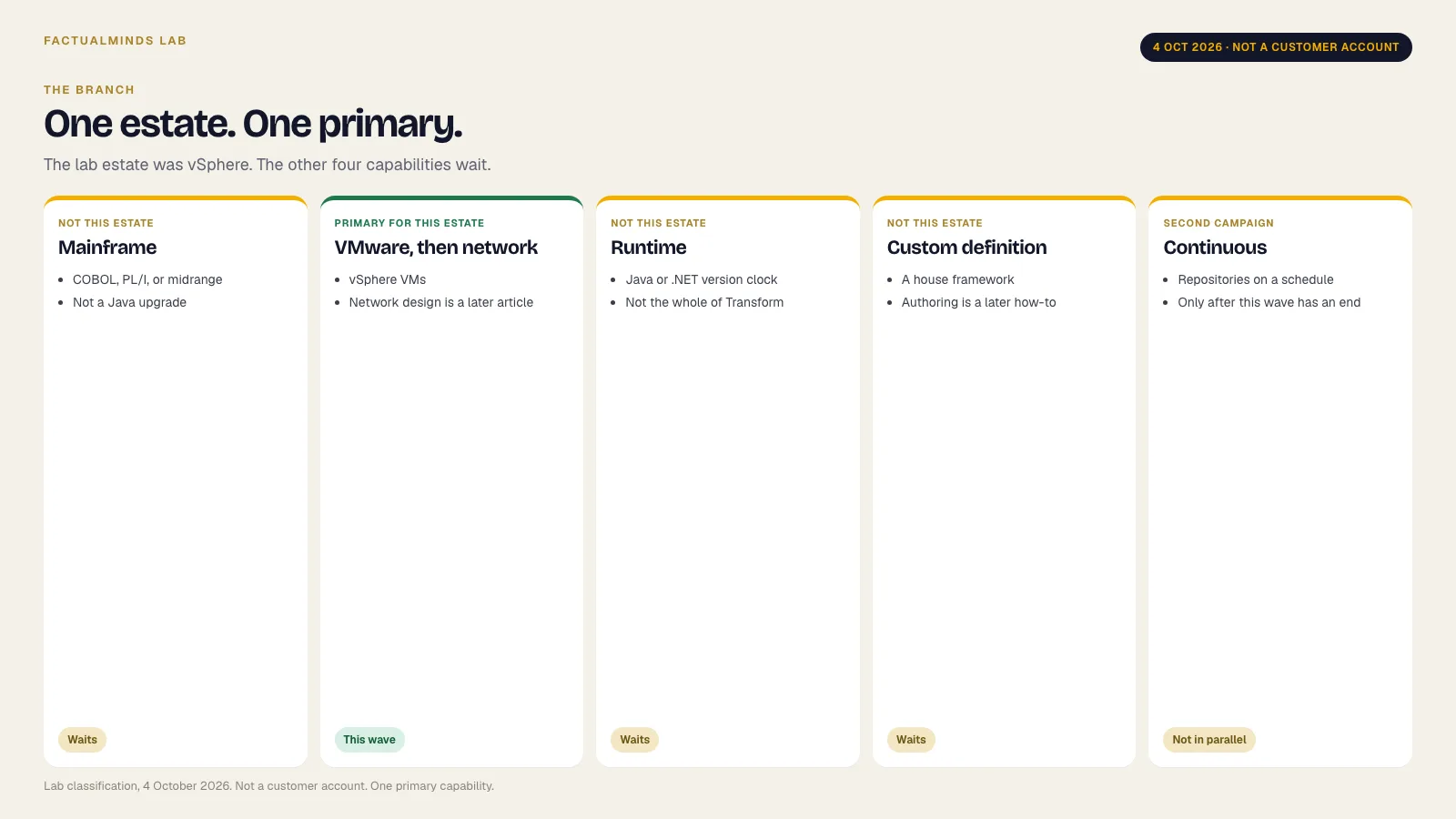
Table of Contents
On 4 October 2026 the lab still had one line item called “AWS Transform.” The calendar underneath it mixed a repository schedule with a vSphere move. Continuous modernization became generally available on 3 August 2026. Network modernization shipped on 20 May 2026. Those are two capabilities. The line item treated them as one product.
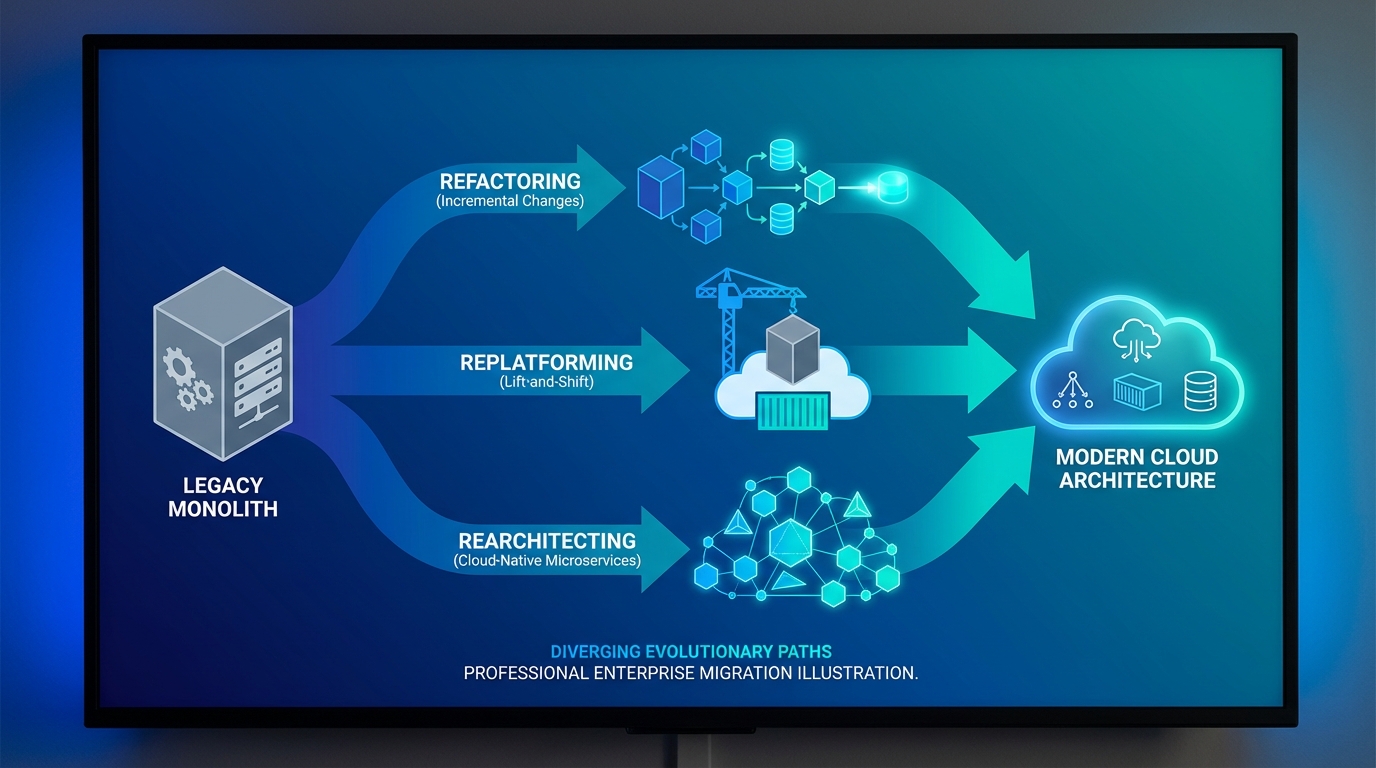
This page is the branch. The continuous modernization article owns the operating model after you have chosen source-code change. The refactor, replatform, or rearchitect post still chooses the path. Amazon Q for Developers keeps the Java and .NET product mention. The VMware guide still ranks EVS, MGN, and native. Do not re-rank them here.
Reproduce this — Copy the capability worksheet. One estate, one primary capability, and a sentence for why the others are not this wave.
Classify the estate first
| What you actually have | Primary capability | Where the depth lives |
|---|---|---|
| COBOL, PL/I, or a midrange workload | Mainframe transformation | Not this page. Do not describe it as a Java upgrade. |
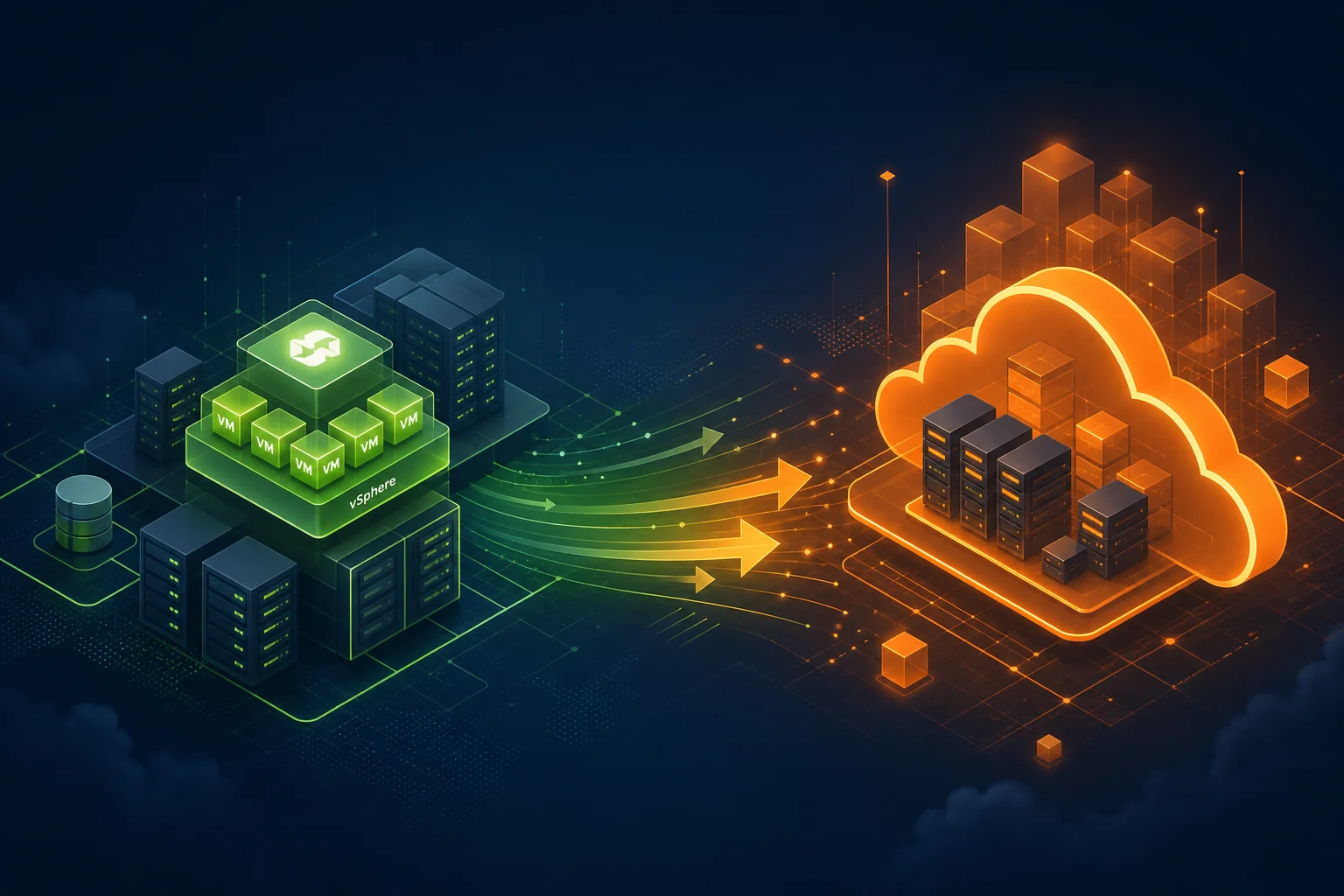
| vSphere VMs, and a network you have not designed | VMware migration, then network modernization | VMware guide for the path. Network modernization is a later article. |
| Java or .NET on a version clock | Runtime transformation | Q Developer for the product mention. It is a campaign, not the whole of Transform. |
| A house framework AWS did not ship a transform for | Custom transformation definition | Authoring the definition is a later how-to. This row only names it. |
| Repositories you will analyze on a schedule | Continuous modernization | Continuous vs rewrite. GA 3 August 2026. |
We recommend one primary capability per wave. The trade-off is that a second real problem waits. Take that trade. A program that lists every row as “phase 1” has not classified the estate.
Where this fails
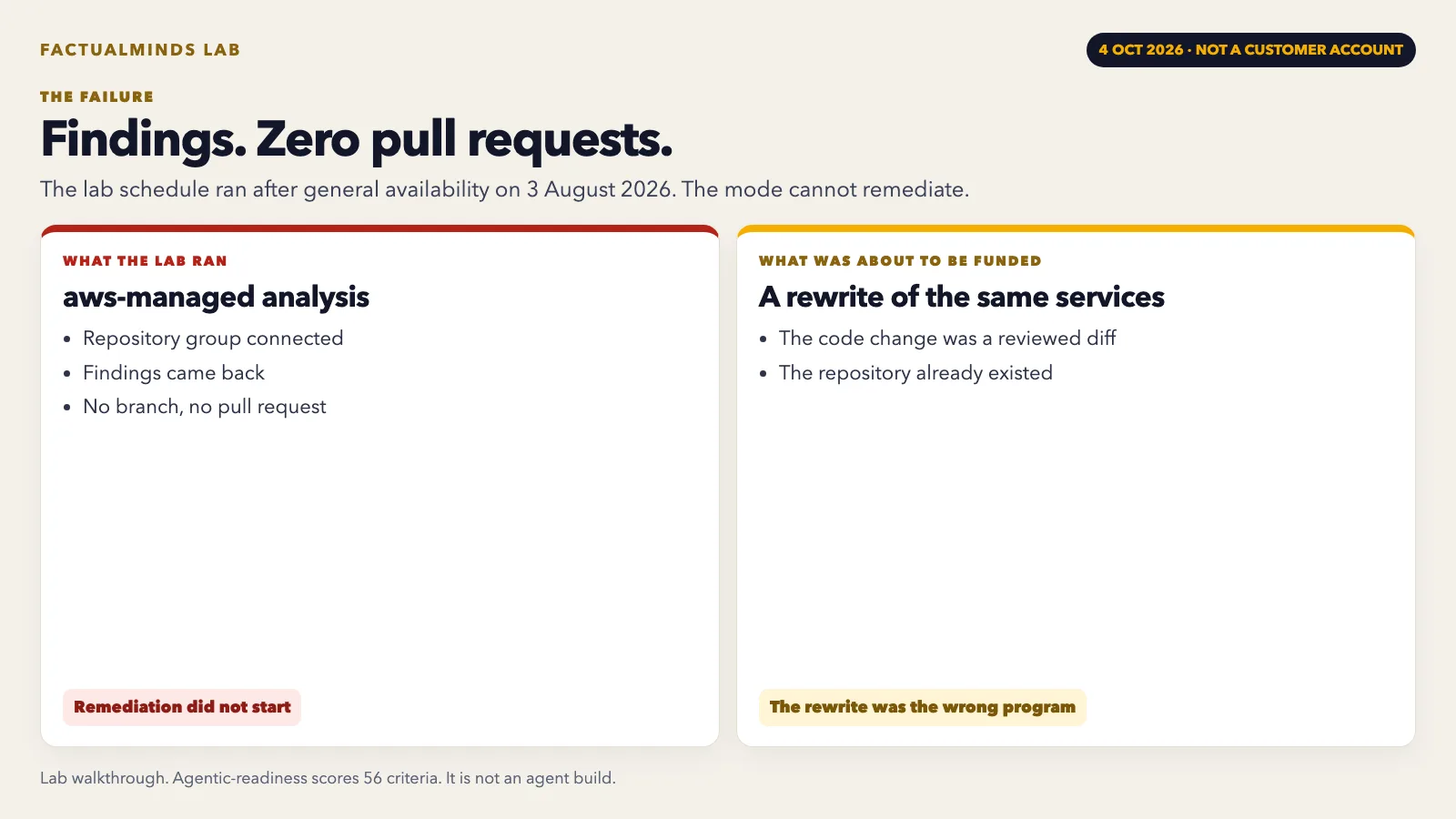
What broke — Lab, 4 October 2026. Not a customer account. The plan said “enable AWS Transform” for a vSphere estate and attached a daily repository analysis. Detection: the worksheet had two primaries and no end date. Recovery: keep the VMware path on its own guide, and start continuous modernization only for the repositories that are already the system of change. Lesson: one announcement is not the catalog.
The user guide capability list moves. Re-read it before you promise a capability that was not on the list when this page was checked on 4 October 2026.
What to Do This Week
- Write the estate in one sentence. If the sentence needs “and,” you have two programs.
- Pick the row. Link the page that owns the depth. Do not paste that page into the plan.
- Give the wave an owner and either an end date or the words “standing schedule.”
- Leave EVS versus MGN on the VMware guide.
- Take a portfolio that spans capabilities to application modernization or migration, matching which row you picked.
What This Post Doesn’t Cover
It does not explain continuous modernization, design a VPC, author a custom definition, or claim time saved. Those articles exist or are scheduled. Region support changes; confirm the region list before you name a Region in the plan.
Frequently asked questions
Which AWS Transform capability should we buy first?
When should we not start a second Transform campaign in parallel?
Is continuous modernization the same thing as AWS Transform?
What could go wrong if we treat one announcement as the whole offer?
Does this page rank EVS, MGN, and a native rebuild?

AWS Cloud Architect & AI Expert
AWS-certified cloud architect and AI expert with deep expertise in cloud migrations, cost optimization, and generative AI on AWS.