Scaling EdTech Platforms on AWS: Serverless Architecture for Education
Quick summary: July 2026: EdTech serverless on AWS — exam-day spikes, SQS grading buffers, CloudFront video egress, and a readiness checklist so load tests match Monday 9am reality.
Key Takeaways
- July 2026: EdTech serverless on AWS — exam-day spikes, SQS grading buffers, CloudFront video egress, and a readiness checklist so load tests match Monday 9am reality
- As of July 19, 2026, serverless still fits that shape — if you model exam windows, not average DAU
- Reprice Lambda, API Gateway, and especially CloudFront egress after any regional rate change; video often dominates the bill more than compute
- For the fuller 2026 LMS/assessment reference (SQS buffering, Aurora Serverless v2, Bedrock Guardrails), see EdTech on AWS (2026)
- These patterns map perfectly to DynamoDB's single-table design, providing single-digit millisecond latency with zero database management

Table of Contents
Education technology scales unlike retail: a platform with 500 summer users can hit tens of thousands on day one of term; a live exam can compress a week of quiz traffic into fifteen minutes — then go quiet over break.
As of July 19, 2026, serverless still fits that shape — if you model exam windows, not average DAU. Reprice Lambda, API Gateway, and especially CloudFront egress after any regional rate change; video often dominates the bill more than compute.
For the fuller 2026 LMS/assessment reference (SQS buffering, Aurora Serverless v2, Bedrock Guardrails), see EdTech on AWS (2026).
Reproduce this — Exam-day checklist:
examples/architecture-blog-2026/edtech-lms/serverless-exam-day-checklist.md· Capacity worksheet:exam-day-capacity-worksheet.csv
Why Serverless for Education
The economics of serverless align perfectly with education workloads:
| Characteristic | Education Reality | Serverless Fit |
|---|---|---|
| Traffic variability | 100x difference between peak and off-peak | Scales from zero to any load automatically |
| Budget constraints | Education has limited IT budgets | Pay only for actual usage |
| Engineering team size | Small teams (3-10 engineers) | Zero infrastructure management |
| Availability requirements | Must not fail during exams and enrollment | Managed services with built-in high availability |
| Global access | Students worldwide, different time zones | CloudFront + edge computing for low latency |
A serverless architecture on AWS lets a 5-person EdTech startup deliver the same reliability and scale as a platform built by a 50-person engineering team.
Architecture Pattern: Modern LMS
Core Platform
Students/Teachers → CloudFront (CDN) → API Gateway (HTTP API) → Lambda Functions:
    ├→ Course Service      → DynamoDB (courses, enrollments)
    ├→ Content Service     → S3 (materials) + DynamoDB (metadata)
    ├→ Assignment Service  → DynamoDB (submissions) + S3 (files)
    ├→ Discussion Service  → DynamoDB (threads, posts)
    ├→ Gradebook Service   → DynamoDB (grades, rubrics)
    └→ Notification Service → SES (email) + Pinpoint (push)
Why DynamoDB: Education platforms have well-defined access patterns — get courses by student, list assignments by course, retrieve grades by student and course. These patterns map perfectly to DynamoDB’s single-table design, providing single-digit millisecond latency with zero database management.
Why HTTP API: API Gateway HTTP API is 70% cheaper than REST API and adds lower latency. For most LMS endpoints, the simpler HTTP API provides everything needed — routing, authorization (JWT validation), and throttling.
Real-Time Features
Student Actions → API Gateway (WebSocket) → Lambda → DynamoDB
                                                    → EventBridge → Lambda → Connected Clients
WebSocket connections via API Gateway enable:
- Live collaboration — Multiple students editing a shared document
- Real-time discussions — Chat-style discussion boards during lectures
- Live notifications — Instant grade posting, assignment due date reminders
- Presence indicators — Show who is currently online in a course
Architecture Pattern: Live Assessment System
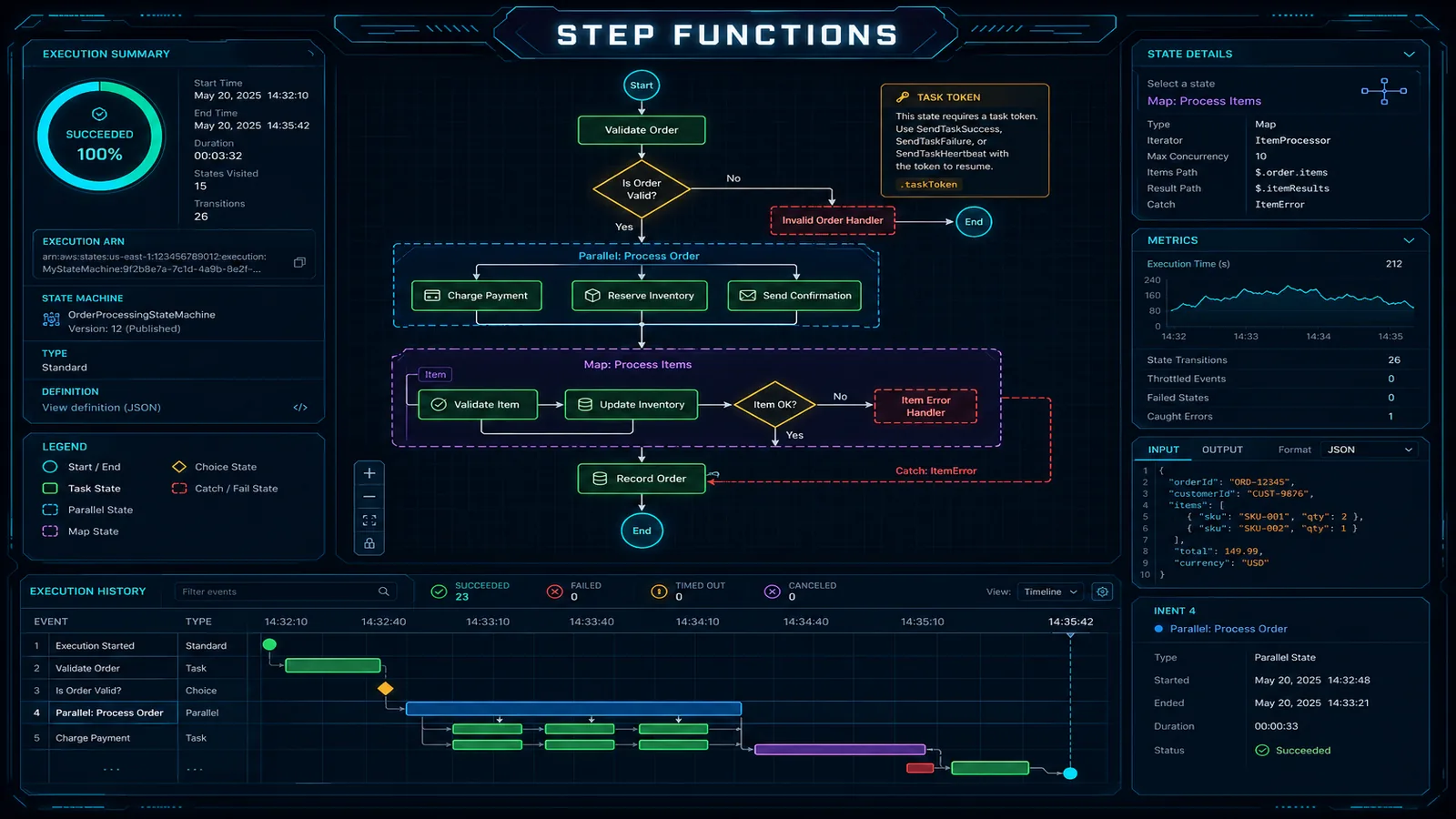
This is the highest-stakes workload in education — thousands of students submitting answers simultaneously during a timed exam:
Submission Pipeline
Student Submit → API Gateway → Lambda (validate + timestamp) → SQS FIFO (ordered by student)
                                                                        ↓
                                                                Lambda (grade) → DynamoDB (results)
                                                                        ↓
                                                                DynamoDB Streams → Lambda → Analytics
Design decisions:
- API Gateway + Lambda accepts submissions instantly — Lambda scales to thousands of concurrent executions automatically, so no student experiences a timeout during a peak submission window
- SQS FIFO provides exactly-once processing and ordering guarantees per student (using student ID as the message group ID). If a student submits twice (network glitch), deduplication prevents double-grading.
- DynamoDB stores results with single-digit millisecond write latency. Students see their score immediately after the exam closes.
Auto-Scaling Exam Capacity
The beauty of this serverless architecture is that it handles 10 students or 100,000 students without any configuration changes:
| Concurrent Students | Lambda Instances | SQS Processing | DynamoDB |
|---|---|---|---|
| 100 | ~10-20 | Near-instant | On-demand scales automatically |
| 1,000 | ~100-200 | Seconds | On-demand scales automatically |
| 10,000 | ~1,000-2,000 | Seconds | On-demand scales automatically |
| 100,000 | ~5,000-10,000 | Minutes | On-demand scales automatically |
No pre-provisioning, no capacity planning, no “will it handle the load?” anxiety before a major exam.
Architecture Pattern: Video Content Delivery
Lecture Recording and Streaming
Instructor Uploads → S3 (source) → EventBridge → MediaConvert (transcode):
    ├→ HLS adaptive streaming (480p, 720p, 1080p)
    ├→ Thumbnail generation
    └→ Audio extraction (for podcasts)
        ↓
    S3 (transcoded) → CloudFront (signed URLs) → Students
        ↓
    Transcribe (auto-captions) → S3 (VTT files)
Key features:
- Adaptive bitrate streaming — MediaConvert creates HLS playlists with multiple quality levels. Students on slow connections get 480p; fast connections get 1080p. The player switches automatically.
- Signed URLs — CloudFront signed URLs ensure only enrolled students can access course videos. URLs expire after a configured duration.
- Auto-captioning — Amazon Transcribe generates closed captions automatically — critical for accessibility compliance (ADA, Section 508) and for non-native English speakers.
- Global delivery — CloudFront caches content at edge locations worldwide. A student in Tokyo and a student in London both experience fast video loading.
Cost Optimization for Video
Video storage and delivery is typically the largest EdTech cost:
- S3 Intelligent-Tiering — Videos from previous semesters automatically move to cheaper storage tiers. Current semester content stays in standard access.
- CloudFront caching — Popular videos (introductory lectures) are served from cache, avoiding S3 retrieval costs. Cache hit rates of 90%+ are common for educational content.
- MediaConvert on-demand — Pay only for transcoding time. No always-on infrastructure for a task that happens once per video upload.
- Lifecycle policies — Delete transcoding source files after processing. Keep only the transcoded output.
Architecture Pattern: AI-Powered Learning
AI Tutoring Assistant
Student Question → API Gateway → Lambda → Bedrock (Claude Sonnet 5.5 recommended as of September 2026):
    ├→ System prompt (course context, learning objectives, student level)
    ├→ Conversation history (DynamoDB)
    ├→ Course materials (RAG with Knowledge Bases for Bedrock)
    └→ Guardrails (age-appropriate, on-topic, no answer-giving)
        ↓
    AI Response → Lambda (log, analyze) → Student
Amazon Bedrock enables AI features that were previously impossible for small EdTech teams:
- Personalized tutoring — AI that adapts explanations based on student comprehension level and learning history
- Practice problem generation — Generate unlimited practice problems with varying difficulty based on curriculum standards
- Essay feedback — Structured feedback on student writing with specific improvement suggestions (without giving answers)
- Content summarization — Generate study guides from lecture transcripts and course materials
Guardrails are essential for education AI:
- Block responses that give direct answers to homework/exam questions
- Filter age-inappropriate content
- Keep conversations focused on course material
- Prevent hallucinated citations or incorrect factual claims
Learning Analytics
Student Interactions → Kinesis Firehose → S3 (data lake) → Glue ETL → Athena/QuickSight:
    ├→ Engagement metrics (time on task, completion rates)
    ├→ Performance trends (assessment scores over time)
    ├→ At-risk indicators (declining engagement, missed assignments)
    └→ Content effectiveness (which materials correlate with better outcomes)
Data analytics enables evidence-based education — identifying which teaching approaches work, which students need intervention, and how to improve course design based on actual learning outcomes.
Student Data Privacy
FERPA Compliance Checklist
- AWS BAA signed for FERPA-eligible services
- All student data encrypted at rest (S3 SSE-KMS, DynamoDB encryption, RDS encryption)
- All data in transit over TLS 1.2+
- IAM roles with least-privilege access to student data
- CloudTrail logging all access to student data stores
- Data retention policies matching institutional requirements
- Student data deletion capability (right to be forgotten)
- Access controls preventing unauthorized staff access
- Vendor data processing agreements for any third-party services
COPPA for K-12 Platforms
Platforms serving children under 13 must implement additional protections:
- Verifiable parental consent before collecting student data
- Data minimization — collect only what is necessary for the educational purpose
- No behavioral advertising using student data
- Parental access to view and delete their child’s data
- Clear privacy policy in accessible language
For comprehensive data security and compliance architecture, see our security services.
Cost Analysis: Serverless EdTech Platform
Monthly cost for a platform serving 10,000 active students:
| Service | Usage | Monthly Cost |
|---|---|---|
| Lambda | 50M invocations, 200ms avg duration | ~$95 |
| API Gateway (HTTP API) | 50M requests | ~$50 |
| DynamoDB (on-demand) | 100M reads, 20M writes | ~$150 |
| S3 (5 TB course content) | Storage + requests | ~$120 |
| CloudFront (10 TB transfer) | Video delivery | ~$850 |
| MediaConvert | 100 hours transcoded/month | ~$200 |
| SES (notifications) | 500K emails | ~$50 |
| CloudWatch (monitoring) | Logs + metrics | ~$50 |
| Total | ~$1,565/month |
During summer break with 500 active students, the same platform might cost $200-$300/month — Lambda, DynamoDB, and API Gateway costs drop proportionally with traffic. Only S3 storage remains constant.
Cost rows above are illustrative mid-2026 order-of-magnitude for one fictional 10k-MAU profile — recompute with AWS Pricing Calculator for your Region and video GB.
What This Post Doesn’t Cover
- K-12 device management / MDM — outside this architecture note.
- Full FERPA legal advice — use the FERPA boundary matrix as an engineering prompt, not counsel.
- On-prem LMS lift — see migration readiness posts.
What to Do This Week
- Re-run load tests with exam-window concurrency, not average DAU.
- Put SQS (or equivalent) in front of grading writes; confirm DLQ alarms.
- Split CloudFront egress from Lambda in Cost Explorer for last term’s peak week.

AWS Cloud Architect & AI Expert
AWS-certified cloud architect and AI expert with deep expertise in cloud migrations, cost optimization, and generative AI on AWS.