OpenAI GPT-5.6 Luna & Terra Price Cuts on Amazon Bedrock (July 2026)
Quick summary: On July 30, 2026 AWS cut Bedrock on-demand prices 80% for GPT-5.6 Luna and 20% for Terra — Luna is now $0.22/$1.32 per 1M tokens. Here is the routing math and what not to re-price overnight.
Key Takeaways
- On July 30, 2026 AWS cut Bedrock on-demand prices 80% for GPT-5
- 6 Luna and 20% for Terra — Luna is now $0
- 22/$1
- 32 per 1M tokens
- AWS lifecycle notice (June 30, 2026) — Amazon Bedrock Agents Classic is in maintenance for new customers after July 30, 2026

Table of Contents
AWS lifecycle notice (June 30, 2026) — Amazon Bedrock Agents Classic is in maintenance for new customers after July 30, 2026. Net-new agent builds should use Bedrock AgentCore. Full matrix: lifecycle roundup.
On July 30, 2026, AWS announced that on-demand inference prices on Amazon Bedrock for OpenAI GPT-5.6 Luna dropped 80% and GPT-5.6 Terra dropped 20%, in line with OpenAI’s first-party price cut. GPT-5.6 Sol is unchanged. The new rates apply automatically.
This is a routing and FinOps event, not a “flip the default model ID” event. If you already run OpenAI on Bedrock (see our April 2026 OpenAI-on-Bedrock analysis), recalculate cost per completed task by lane — then promote only the lanes that still pass quality.
What changed on the Bedrock rate card
Published Amazon Bedrock on-demand rates after the cut (US East N. Virginia / Ohio and US West Oregon where listed):
| Model | Input / 1M tokens | Output / 1M tokens | Cache read / 1M | Cut vs prior |
|---|---|---|---|---|
| GPT-5.6 Luna | $0.22 | $1.32 | $0.022 | −80% |
| GPT-5.6 Terra | $2.20 | $13.20 | $0.22 | −20% |
| GPT-5.6 Sol | $5.50 | $33.00 | $0.55 | Unchanged |
Source: Amazon Bedrock pricing (OpenAI frontier table, post–July 30, 2026). OpenAI’s global API list is slightly lower ($0.20/$1.20 Luna; $2/$12 Terra); Bedrock’s published in-region figures track OpenAI’s data-residency tier (~10% uplift). Treat the Bedrock page as the budget source of truth for AWS bills.
Implied prior Bedrock-equivalent rates (from the stated 80% / 20% cuts): Luna ≈ $1.10 / $6.60, Terra ≈ $2.75 / $16.50 per 1M input/output.
AWS positions the tiers the same way it did at GPT-5.6 GA:
- Luna — fast, high-volume: classification, summarization, routing, customer-service automation, routine tool workflows
- Terra — everyday production with stronger reasoning at GPT-5.5-class quality, lower cost
- Sol — flagship multi-step / agentic reasoning (price unchanged — do not expect this cut to move Sol TCO)
On August 3, 2026, AWS expanded Sol, Terra, and Luna to 1 million token context windows on Bedrock. Prompt caching with explicit cache breakpoints applies to those long-context requests, so repeated prefix is billed at the cache-read discount rather than full input. That is a context and cache design change, not a second rate cut — do not re-price the July 30 table because the window grew.
When 1M context matters: full-repo review, long legal packs, or multi-turn agent history that previously required chunking.
When it does not: classification/routing lanes already well under 200K. Sending a 1M window “because it is available” inflates uncached input until breakpoints are set.
First-party pricing math (not a client silhouette)
No anonymized engagement is cited for this specific July 30 cut. The numbers below are reproducible arithmetic on the published Bedrock rate card — one illustrative monthly shape, labeled as math.
Illustrative Luna month: 50M input tokens + 5M output tokens (high-volume classification / routing mix).
| Period | Input | Output | Monthly total |
|---|---|---|---|
| Pre-cut (implied) | 50 × $1.10 = $55.00 | 5 × $6.60 = $33.00 | $88.00 |
| Post-cut (published) | 50 × $0.22 = $11.00 | 5 × $1.32 = $6.60 | $17.60 |
Direction: −$70.40 / month (−80%) for that token mix on Luna alone. Same volume on Terra post-cut: (50 × $2.20) + (5 × $13.20) = $176.00 — still ~10× Luna for identical token counts, which is why model choice still dominates the bill.
Reproduce this — Open the Bedrock pricing OpenAI table. Multiply your Cost Explorer / CUR input and output token totals by the Luna and Terra rows. For cache-heavy agent loops, include cache-write and cache-read lines separately (90% discount on cache read). If totals diverge, you are missing a service tier or Mantle usage type — see AWS’s CUR Bedrock token-type guide.
Pair this with the broader playbook in Bedrock cost optimization: token budgets and model selection.
Opinionated routing after the cut
We recommend: default new high-QPS classification / extraction / thin-tool lanes to Luna on Bedrock Mantle after a frozen-prompt quality bakeoff. Keep everyday agentic production on Terra until Luna’s pass rate matches. Keep deep overnight / exploit-class / multi-hundred-step agents on Sol (or Claude Opus 5 where ZDR-default + Guardrails composition matter more — see Opus 5 on Bedrock).
Trade-off you accept: lower $ / MTok on Luna vs higher risk of silent quality regressions on nuanced prompts if you promote by price alone.
| Lane | Prefer after July 30 | Why |
|---|---|---|
| Classification, routing, summarization, high-QPS chat | Luna | −80% list price; built for volume |
| Everyday code gen, structured extraction, mid-tier agents | Terra (−20%) | Stronger reasoning without Sol rates |
| Long-horizon agents, cyber research, hardest coding | Sol (unchanged) or Claude Opus 5 | Capability / governance, not this price event |
| Cheap AWS-native alternatives | Nova / Haiku | Still worth A/B when OpenAI-specific behavior is not required — Nova guide |
For the enterprise Bedrock-vs-direct-API frame (IAM, PrivateLink, commitments), see AWS Bedrock vs OpenAI API.
What broke (pattern): “cheaper tokens, same task cost”)
What broke — Teams that only reprice the model ID and leave prompts,
max_output/ completion budgets, and tool-loop depth unchanged often see token $ drop while cost per completed task barely moves. Root cause: Luna (and Terra) still bill output heavily relative to input; verbose system prompts and uncapped completions dominate. Detect via CUR: output-token $ share stays >50% of the model line. Fix: cap max output per lane, add prompt-cache breakpoints for sticky prefixes (90% cache-read discount), and measure $ / successful task, not $ / 1K tokens.
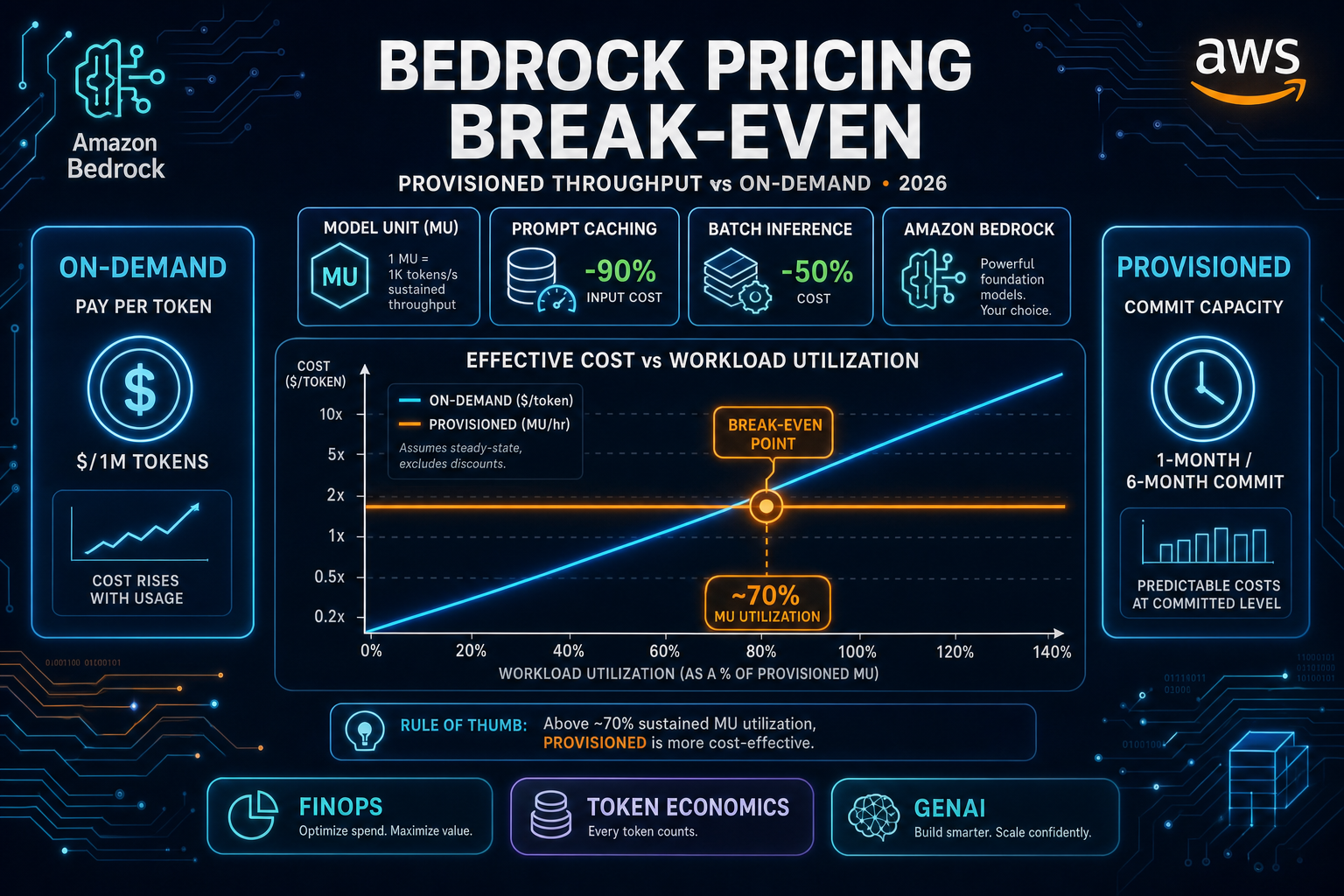
On-demand still wins for spiky traffic; if you were about to buy Provisioned Throughput for a Luna-class lane, re-run the break-even after this cut — on-demand vs Provisioned Throughput.
Invoke Luna / Terra on Mantle (Responses API)
Context: OpenAI Python SDK against Bedrock Mantle, region us-east-1, model IDs from the Luna / Terra model cards. Auth via Bedrock API key or SigV4 as documented for your path.
# openai>=1.x; OPENAI_BASE_URL=https://bedrock-mantle.us-east-1.api.aws/openai/v1
from openai import OpenAI

client = OpenAI()  # uses OPENAI_API_KEY + OPENAI_BASE_URL from env

response = client.responses.create(
    model='openai.gpt-5.6-luna',
    input='Classify this support ticket into billing, outage, or how-to. Reply with one label only.',
)

print(response)
Swap openai.gpt-5.6-terra for mid-tier lanes. Regions today: us-east-1, us-east-2, us-west-2 for Luna/Terra; Sol is us-east-1 / us-east-2 only. Geo/global inference IDs are not supported on these Mantle model cards at time of writing — plan capacity inside those Regions.
What to Do This Week
- Pull last 30 days of Bedrock OpenAI token usage from Cost Explorer / CUR; split by model ID.
- Recompute monthly $ at the new Luna / Terra rows; leave Sol at $5.50 / $33.
- Pick one high-volume lane that is not Sol-dependent; freeze 50–100 production prompts; score Luna vs current model on pass rate, p95 latency, and $ / completed task.
- Enable prompt caching on sticky system + tool prefixes; confirm cache-read lines appear in CUR.
- Update budgets and anomaly detectors — an 80% Luna drop can look like a “usage cliff” to naive alerts (FinOps Agent / Cost Anomaly context).
- If you are still on OpenAI direct for regulated data, revisit Bedrock for commitment consolidation and IAM — GenAI on AWS / Amazon Bedrock consulting.
What This Post Doesn’t Cover
- A published FactualMinds latency/quality bakeoff of Luna vs Terra vs Claude Haiku/Sonnet on our prompt packs (no harness linked yet).
- OpenAI Fast-mode / Flex / Batch tier matrices beyond pointing at the OpenAI and Bedrock rate cards.
- Codex-on-Bedrock developer UX (covered in the OpenAI models + Codex post).
- EU / non-US regional availability for GPT-5.6 Sol/Terra/Luna beyond the three US Regions AWS listed.
Use the rate card + your CUR. Promote lane-by-lane.
Related reading
- Amazon Bedrock + OpenAI Models, Codex & Managed Agents
- AWS Bedrock vs OpenAI API: Enterprise Decision Guide
- AWS Bedrock Cost Optimization: Token Budgets and Model Selection
- Bedrock Provisioned Throughput vs On-Demand Break-Even
- Claude Opus 5 on AWS Bedrock (July 2026)
- Amazon Bedrock Nova Models Guide
- Generative AI on AWS · Amazon Bedrock services · AWS cost optimization
AWS Cloud Architect & AI Expert
AWS-certified cloud architect and AI expert with deep expertise in cloud migrations, cost optimization, and generative AI on AWS.