Legacy Batch: Replace the Cron Server with Scheduler, Step Functions, and Batch
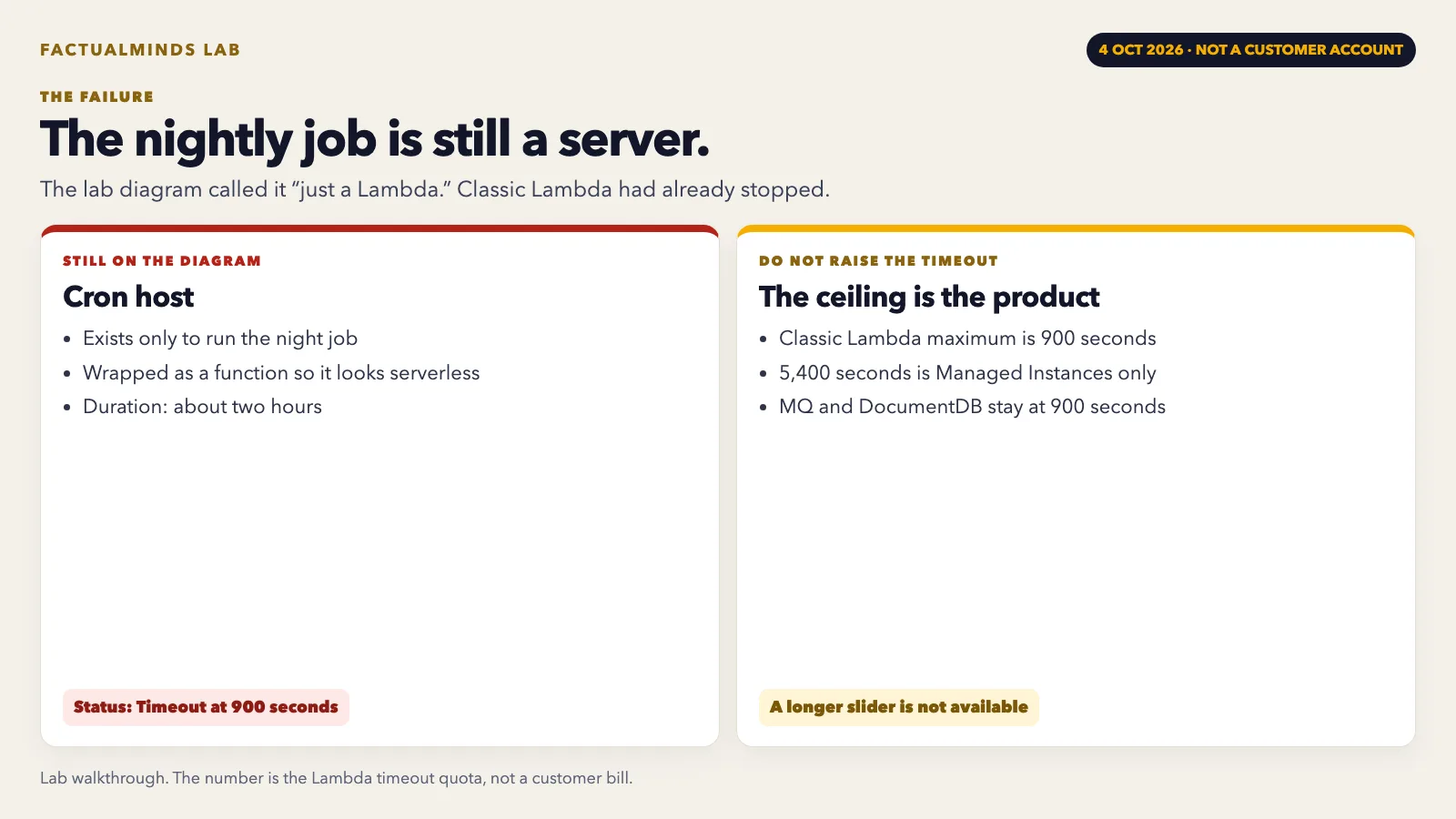
Quick summary: Classic Lambda stops at 900 seconds. Lambda Managed Instances can run async work for 5,400 seconds. Anything longer than that band belongs on AWS Batch, not on the VM that only exists for the schedule.
Key Takeaways
- Classic Lambda stops at 900 seconds
- Lambda Managed Instances can run async work for 5,400 seconds
- Anything longer than that band belongs on AWS Batch, not on the VM that only exists for the schedule
- The lab diagram on 4 October 2026 still had a VM whose only purpose was a nightly script
- On Lambda Managed Instances, asynchronous invocations and event-source mappings can run for 5,400 seconds, except Amazon MQ and Amazon DocumentDB
Table of Contents
The lab diagram on 4 October 2026 still had a VM whose only purpose was a nightly script. Classic Lambda stops at 900 seconds. On Lambda Managed Instances, asynchronous invocations and event-source mappings can run for 5,400 seconds, except Amazon MQ and Amazon DocumentDB. Those ceilings are in the Lambda timeout documentation. The VM was not in either band. It was a computer that existed so Task Scheduler had somewhere to run.
This is not the EventBridge patterns post, which owns domain events. It is not the serverless strangler playbook, which owns the request path. The 90-minute LMI post owns that timeout as an operations topic. A Lambda whose handler is one SDK call belongs on the Scheduler spoke, not here.
Reproduce this — Copy the duration-band worksheet. One job per row. Write the band before you draw a new server.
Three bands
| Normal run | Compute | Stop |
|---|---|---|
| Up to 900 seconds | Classic Lambda, started by EventBridge Scheduler | The job branches across hours of dependencies. Use Step Functions for the chain, not a longer function. |
| Up to 5,400 seconds, async or event-source | Lambda Managed Instances | You needed a service that stays up. That is not a job. Amazon MQ and DocumentDB sources are outside this window. |
| Multi-hour, or an array of work items | AWS Batch | You are about to raise a function timeout in a loop. Batch is the band. |
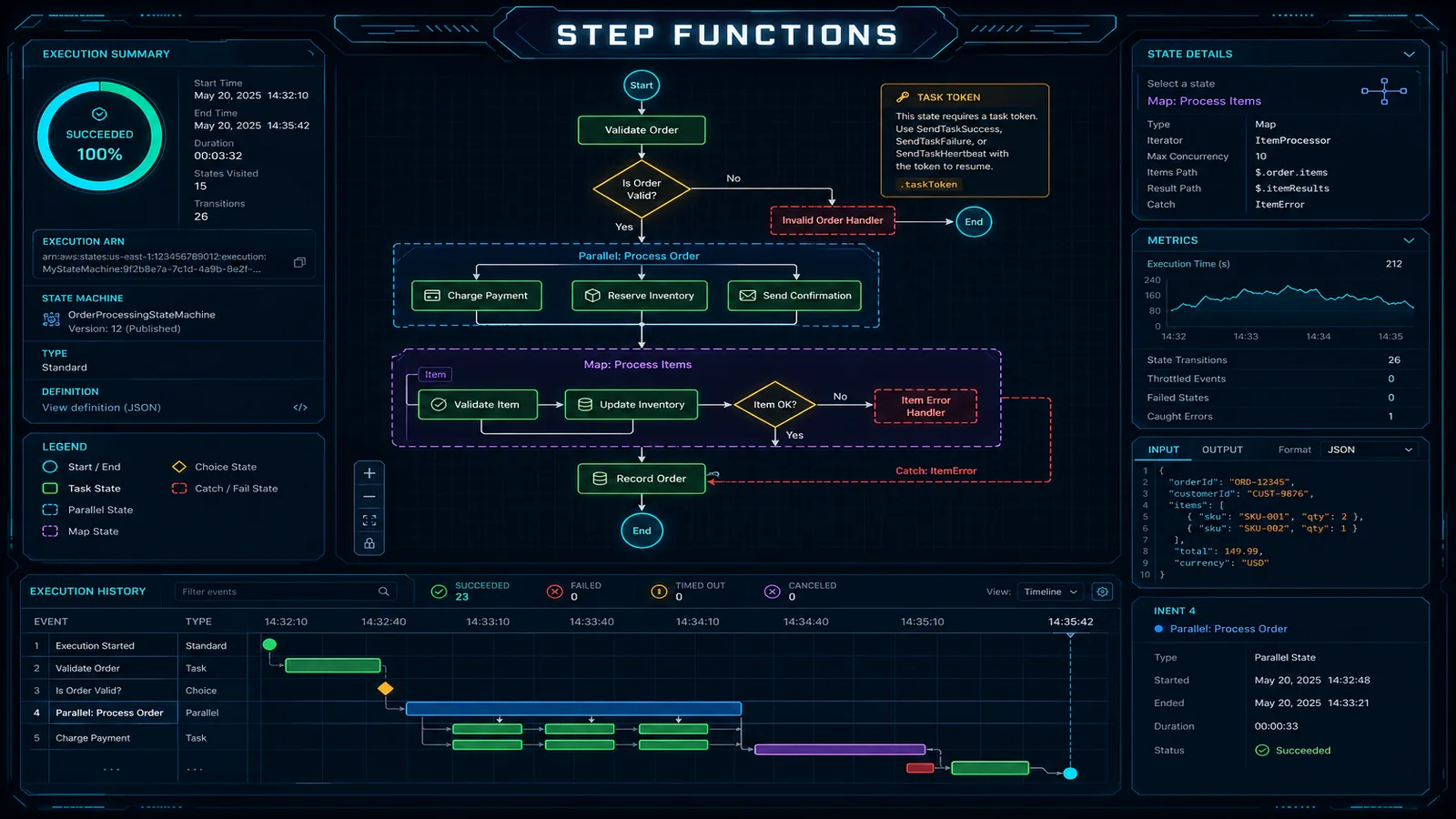
Step Functions holds the dependencies between jobs. Scheduler is the clock. File arrival is a trigger, an S3 event or a similar signal, not a second cron that hopes the file is there.
We recommend deleting the VM when the job fits a band. The trade-off is an AWS schedule and a compute service you did not operate before. Take that trade when the VM’s only job is the schedule. Keep a server when the workload is a long-running process with its own uptime, and then it is not a batch job.
Where this fails
What broke — Lab, 4 October 2026. Not a customer account. The nightly job was moved to classic Lambda and timed out at 900 seconds because the run was two hours. Detection: the duration cell was empty and the target was Lambda anyway. Recovery: put the run on Batch and let Scheduler start the state machine. Lesson: rehosting the cron VM, or picking Lambda because it is familiar, preserves the box or the timeout.
What to Do This Week
- Export the cron entries and Task Scheduler tasks. One line per job: name, duration, dependency.
- Mark the band. Leave one-call API wrappers for the Scheduler spoke.
- Replace file-polling crons with an arrival event.
- Put dependencies in Step Functions. Do not encode them as “start this cron 20 minutes later.”
- If the estate is the modernization program, continue with application modernization.
What This Post Doesn’t Cover
It does not price Step Functions transitions, design a fan-out of a million items, or explain EventBridge versus SNS versus SQS. The fan-out comparison is a different article. The one-call Scheduler spoke is a different article. Operations for LMI stay on the LMI guides.
Frequently asked questions
How do we retire a Windows or EC2 box that only runs nightly jobs?
When should we not put the job on classic Lambda?
What could go wrong if file arrival is modeled as a second cron?
Is this the article about a Lambda that only calls one API?
Where do Step Functions patterns stop and this page start?

AWS Cloud Architect & AI Expert
AWS-certified cloud architect and AI expert with deep expertise in cloud migrations, cost optimization, and generative AI on AWS.