Classic Lambda vs Managed Instances vs Fargate vs Lambda MicroVMs
Quick summary: Lambda MicroVMs went generally available on 22 June 2026, in ten regions as of 19 August 2026. They are not AgentCore microVMs and not Lambda Managed Instances. Classic Lambda still stops at 900 seconds.
Key Takeaways
- Lambda MicroVMs went generally available on 22 June 2026, in ten regions as of 19 August 2026
- They are not AgentCore microVMs and not Lambda Managed Instances
- Classic Lambda still stops at 900 seconds
- Lambda MicroVMs became generally available on 22 June 2026
- As of 19 August 2026 they were in ten regions, on ARM64, with snapshot resume and per-user isolation for user-supplied or model-generated code
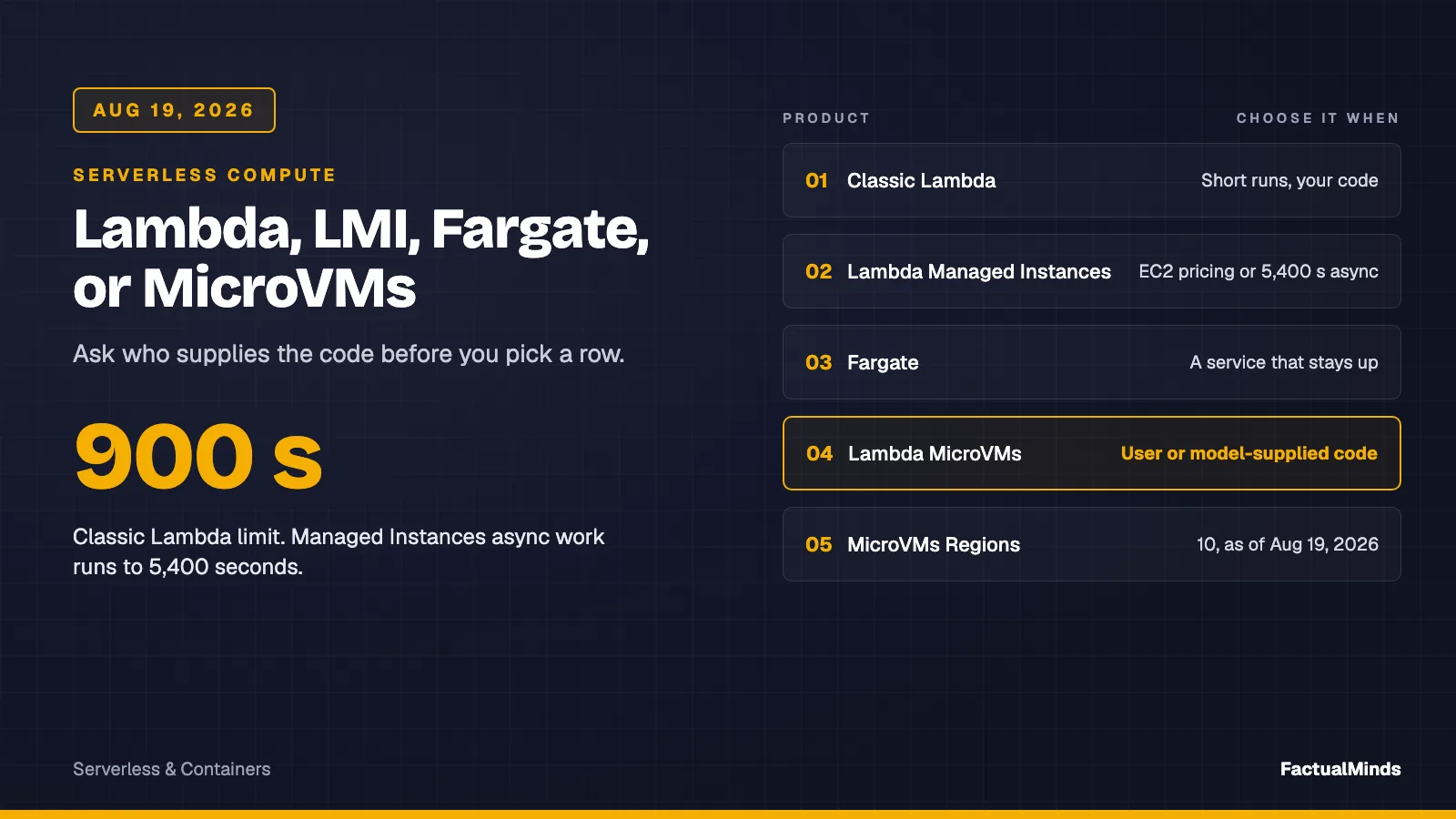
Table of Contents
Lambda MicroVMs became generally available on 22 June 2026. As of 19 August 2026 they were in ten regions, on ARM64, with snapshot resume and per-user isolation for user-supplied or model-generated code. Checked on 4 October 2026, that product is still easy to confuse with two others. AgentCore Runtime’s microVM is the isolation inside the AgentCore production guide. Lambda Managed Instances are EC2 capacity providers for functions you wrote, documented in the LMI guide. That makes three products sharing one word.
Classic Lambda stops at 900 seconds. Asynchronous work and event-source mappings on Lambda Managed Instances can run 5,400 seconds, except Amazon MQ and Amazon DocumentDB. The 90-minute post and the LMI operations guide own those operations. The Lambda versus Fargate compare and the EC2 versus Lambda compare stay two-way. The compute decision tree should point here for the four-way branch.
The branch
| Row | Choose it when | Stop |
|---|---|---|
| Classic Lambda | Short invocations of your own code, with isolation left to AWS. | The run exceeds 900 seconds, or a stranger supplied the code. |
| Lambda Managed Instances | The function model fits, you want EC2 pricing and Savings Plans, or you need the 5,400-second async window. | You needed a VM boundary per user. LMI is not that product. |
| Fargate | It is a service that stays up. | It is a job or a sandbox. Do not run a service to get a timeout. |
| Lambda MicroVMs | Each user or agent needs a VM boundary and a resumable filesystem. The code is user-supplied or model-generated. | The Region is not on the list. Confirm the MicroVMs guide. Ten regions as of 19 August 2026 is not “all regions.” |
We recommend naming the product in the first sentence of the design. The trade-off is a narrower choice than “serverless.” A diagram that says microVM and means three things will be built as the wrong one.
Where this fails
What to Do This Week
- For each new workload, fill in who supplies the code, the duration, and whether it stays up.
- If the code is yours and the run is short, classic Lambda. Stop there.
- If you need EC2 price or 5,400 seconds, LMI. Read the operations guide. Do not repeat it in the design doc.
- If a user or a model supplies the code, confirm the MicroVMs region list before you promise the feature.
- A platform that is mixing these up across teams is AWS serverless work.
What This Post Doesn’t Cover
It does not operate LMI, price Fargate, or explain AgentCore Gateway, Memory, or identity. It does not claim a region count past 19 August 2026. Re-check the guide before you publish a region in a plan.
Frequently asked questions
Which serverless compute should run this workload in 2026?
When should we not call Lambda MicroVMs an AgentCore feature?
What could go wrong if we pick Lambda MicroVMs outside the region list?
Does this replace the Lambda versus Fargate compare?
When is Fargate the wrong row?

Enterprise AI Transformation
Enterprise AI transformation and implementation leader focused on pilot-to-production playbooks, with a background in financial services. Writes the FactualMinds guides on serverless, CI/CD, and DevOps on AWS, the delivery plumbing production AI depends on.


 Palaniappan P