HomeNest CareBridge Wins 3rd Place in the AWS CDS Partner Hackathon (and $4,000)
Quick summary: On 19 November 2026, HomeNest CareBridge placed 3rd among 1,132 participants in the AWS Communication Developer Services Partner Hackathon and won $4,000. This is a demo project, not a client deployment.
Key Takeaways
- On 19 November 2026, HomeNest CareBridge placed 3rd among 1,132 participants in the AWS Communication Developer Services Partner Hackathon and won $4,000
- This is a demo project, not a client deployment
- On 19 November 2026, the AWS Communication Developer Services Partner Hackathon announced its winners
- HomeNest CareBridge placed 3rd out of 1,132 participants and won $4,000
- The team submitted the project to judges under the event rules, and the numbers below describe what the demo does, not a customer deployment
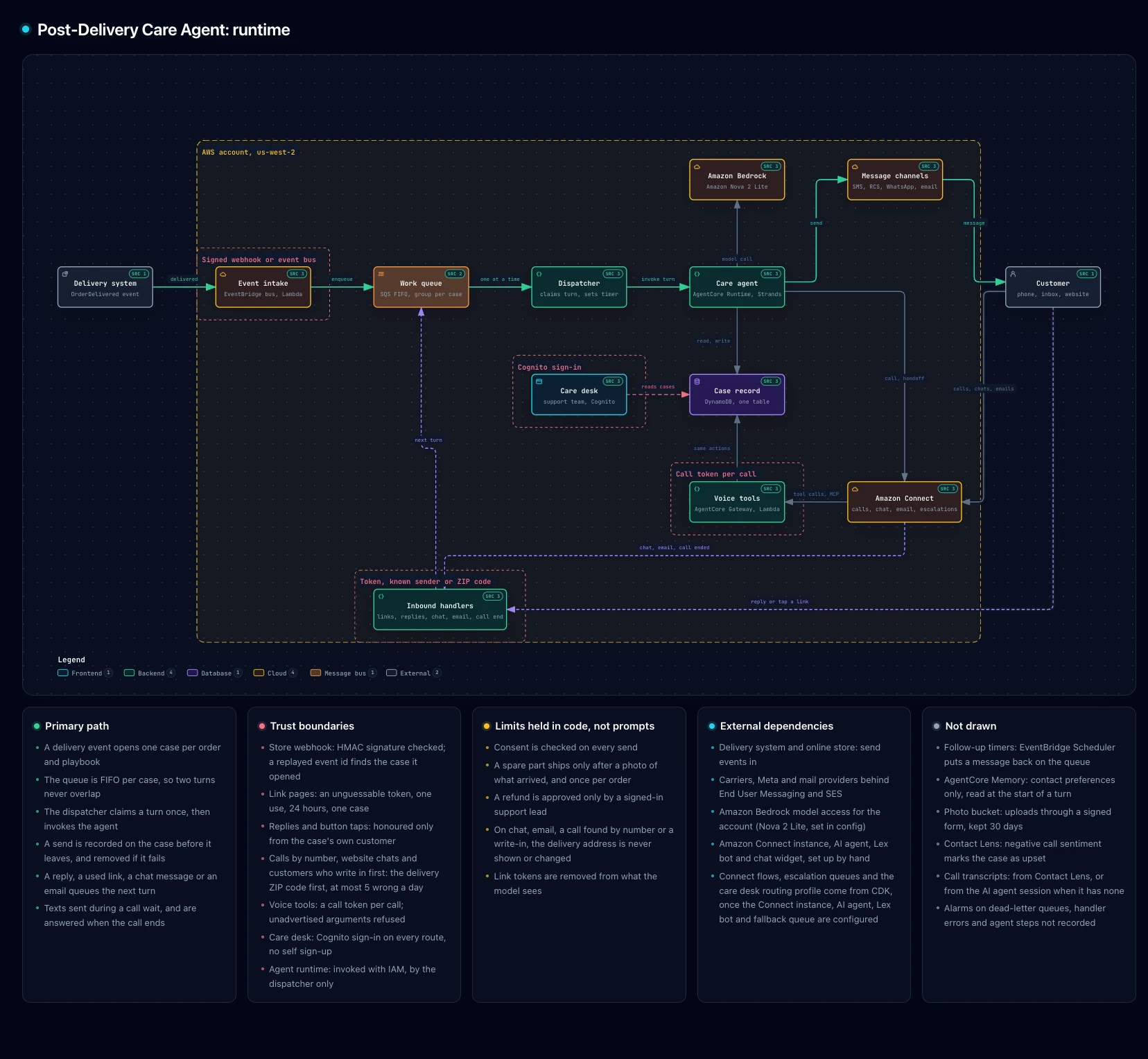
Table of Contents
On 19 November 2026, the AWS Communication Developer Services Partner Hackathon announced its winners. HomeNest CareBridge placed 3rd out of 1,132 participants and won $4,000. Six weeks from the morning submissions opened to the deadline, and the part we are still pleased about is the phone call that keeps the RCS case.
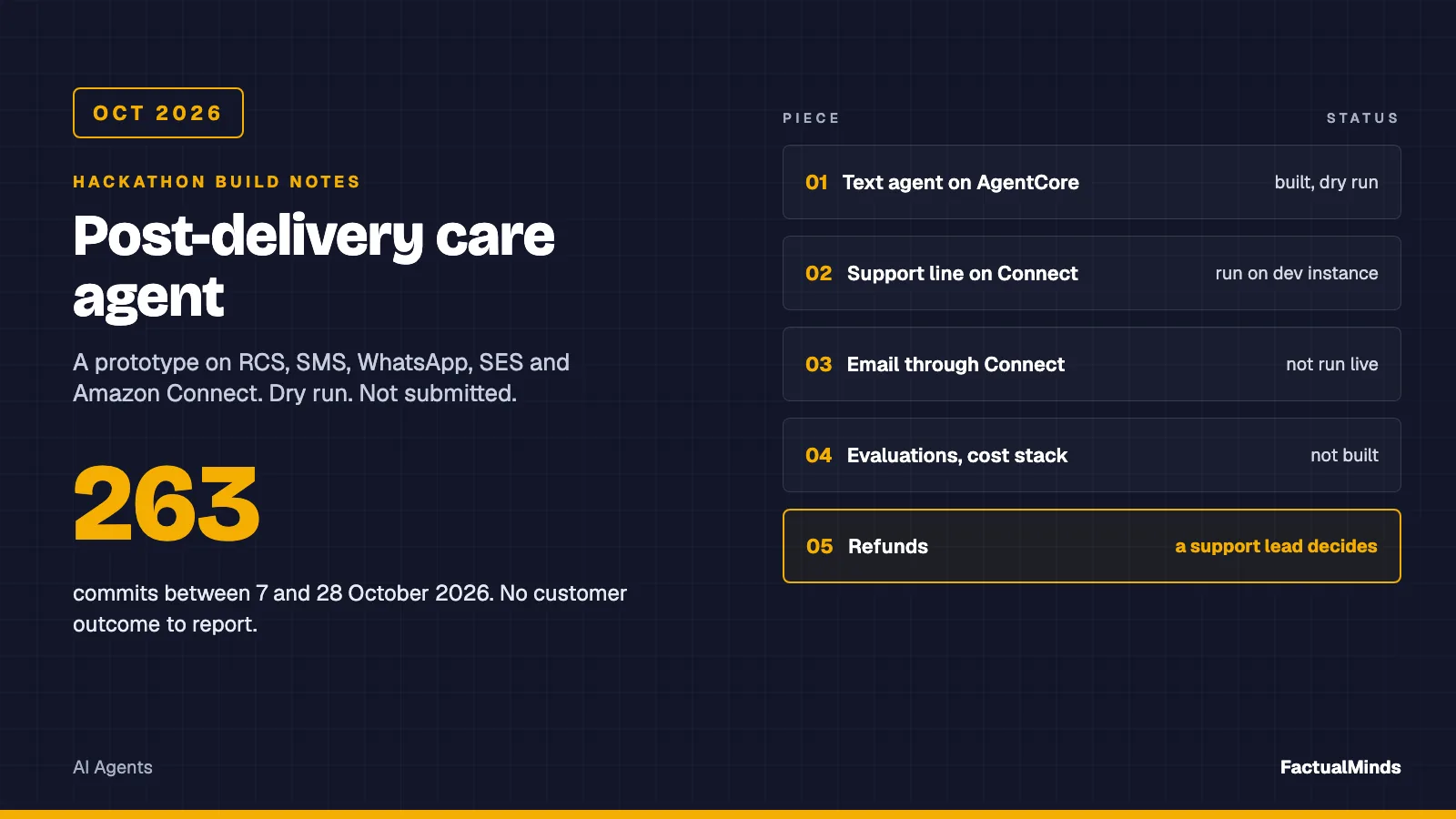
HomeNest is a fictional appliance and furniture retailer. We built it for the hackathon. It is not a client. This is not a published AI-agent case study — FactualMinds has zero published AI-agent case studies. The team submitted the project to judges under the event rules, and the numbers below describe what the demo does, not a customer deployment.
Here are the four numbers at a glance. Keep them next to the event context, not as a brag in isolation.
- place finish
- 3rd
- cash prize
- $4,000
- participants
- 1,132
- total prize pool
- $40,000
About the hackathon
The AWS CDS Partner Hackathon was open to AWS Partners who are professionals or post-grads, above the age of majority. The build window ran from 14 September 2026 at 6:00 am Pacific through 28 October 2026 at 1:00 pm Pacific. Judging followed from 6 November through 12 November 2026. It was online. The rules say no purchase was required to enter.
Four prizes were awarded. First place went to Twine ($18,000), second to CuidAgent ($8,000), third is this entry, and the Meta-sponsored Best of WhatsApp went to SkyAssist ($10,000). We name the others once.
The 3rd-place prize is $4,000 cash. It also unlocks, at our discretion, white-glove enablement for an AWS Marketplace listing, go-to-market support for a CDS-aligned solution, and case-study or marketing support. The joint case study co-authored with AWS is the 1st-place prize only. A project can win only one prize.
What the demo does
The Devpost tagline is “From Rich Text to Live Voice — Effortless Care Without Starting Over.” The design keeps the text and the call on one case, so the customer is not asked to start the story over.
HomeNest is a fictional store that sells appliances and furniture. After a delivery, the agent opens a case and sends an RCS check-in with three reply buttons: Give feedback, I need help, Call me. Phones that do not support RCS receive SMS instead. WhatsApp and email are in the design.
The demo story is a washer displaying error code E21 with water left in the drum. The agent walks the fix one step at a time and waits before moving on. It can send the written guide and its video when asked. A spare part ships only after the customer uploads a photo through a one-use link, and only once per order. The link itself works once, for 24 hours, on one case. Photos go to a private bucket and are deleted after 30 days.
If the fix does not work, the agent books a technician with the product, the problem, and the steps already tried. The team then phones to arrange the visit.
The agent uses a channel only if that channel is switched on and the customer consented to it. STOP (and stopall, unsubscribe, cancel, end, quit as the whole message) opts that channel out before the agent runs again. For WhatsApp, the first outbound message is an approved template, and free text is only allowed inside 24 hours of the customer’s last message.
A phone call continues the same case. The caller is recognised by number, then asked to give the delivery ZIP before the agent shares anything beyond the fix steps. The address is never read out. Caller ID can be forged, so the ZIP is a weak second check. A one-time code sent to the number on the order was not built during the hackathon. That gap is open.
How it is built
The text path runs on Strands Agents on Amazon Bedrock AgentCore Runtime using model id us.amazon.nova-2-lite-v1:0 (Amazon Nova 2 Lite). The voice path uses Amazon Connect with an AI agent, Amazon Lex V2, and Amazon Nova 2 Sonic for speech-to-speech. Voice tools are Lambda functions behind Amazon Bedrock AgentCore Gateway (MCP). The voice agent is capped at eight model calls per turn and ten concurrent turns.
AgentCore Memory keeps contact preferences between orders, so the agent does not ask the same consent question on every case.
Channels go through AWS End User Messaging (RCS, SMS, WhatsApp) and Amazon SES. The email sender for the demo is care@send.factualminds.com.
The persistence layer is a single DynamoDB table. An SQS FIFO queue with one message group per case ensures two turns never run on the same case at the same time. A send is recorded on the case before it is delivered to the customer. If delivery fails, the record is removed — a retry does not contact the customer twice. EventBridge Scheduler handles follow-up messages.
Three unanswered contacts in a row close the case as lost, or hand it to a person if any message was undelivered. If the customer is flagged as upset, one unanswered contact hands the case to a person immediately.
The webhook handles 100 requests per second, burst 200. The infrastructure is defined in AWS CDK (TypeScript) stacks. The agent code, domain logic, and Lambda handlers are Python 3.14.
Refunds. The agent asks. A signed-in support lead approves or declines in an operator console, once. The tools reject a refund above what is left of the order and reject any amount above 100 in the order’s currency. Discount cap is 15% of the order total. Store credit cap is 20%. Refund requests are available on the delivery_failed, return_requested, and negative_review playbooks. On the delivered playbook the agent can ask, but the tool constraints still apply. On a failed delivery the playbook can also correct the address and book a new delivery date. The agent does not grant refunds by itself.
A call token represents one case and expires after two hours. The voice agent is not given a guessable case id.
The source tree has 396 Python test functions (def test_) and 42 CDK tests. All are written to run without live AWS and without a live model. The README also names 16 scripted support-line conversations that run against the deployed Connect agent; those are separate from the 396 unit tests.
What broke
Our recommendation: put the caps in the tools, not only in the prompt. A refund limit in a prompt can be argued past by a confused model; a limit enforced in the Lambda the tool calls cannot. The trade-off is a slower refund path, because a named person has to approve it. For anything that moves money, that is the right trade-off.
What to Do This Week
- Read the customer-support agent page. /ai-agents/customer-support/ is the support family: the lookups an agent may answer, and the writes that stay with a person.
- Pick one channel first. The AWS CDS channel guide at /blog/aws-communication-developer-services-2026/ walks through RCS, SMS, WhatsApp, and SES so you can choose before you connect a model. Do not stand up all six channels at once.
- Look at the CDS consulting page. The specific setup steps for AWS End User Messaging and Amazon Connect live at /services/aws-communication-developer-services/.
- See the product page. /carebridge/ describes CareBridge, the post-purchase care agent this demo grew into: the five playbooks, the six channels, and the limits enforced in code. /homenest/ is the same agent set up for appliance and furniture retailers: setup help, error codes, parts on photo proof, and technician booking.
- Start small. One post-purchase playbook, one channel, and a person in the loop on anything that moves money. That is a working system. Five playbooks and six channels can follow once the first one is running and the edge cases are understood.
What This Post Doesn’t Cover
- SMS on the support line is not configured. Guides and links from a voice call go by email instead.
- Email through Amazon Connect is built and has not been run on a live instance.
- No measured resolution time, handle time, or cost per case from real shoppers. Those numbers do not exist. Do not use this project as a benchmark for what a production deployment will cost or how fast it will resolve tickets.
- The repository is proprietary. It was shared with the hackathon judges under the event rules. There is no public clone URL. The Devpost project page is the right starting point.
- No WhatsApp message counts, RCS delivery rates, or Bedrock token costs from real traffic, because there was no real traffic.
FactualMinds is an AWS Select Tier Services Partner. This post is the hackathon result, not a customer result.
Sources
- HomeNest CareBridge on Devpost
- AWS CDS Partner Hackathon event page
- Event rules (prizes, eligibility, judging weights)
- Event dates page (submission and judging window)
- Project gallery (142 submissions)
Frequently asked questions
Is HomeNest a real FactualMinds customer?
What does 3rd place include and what does it not include?
What happens if a caller gives the right delivery ZIP but forged their caller ID?
What can go wrong if the voice agent reports a tool error as a success?
When should you not treat this design as a production customer deployment?
What can go wrong with refunds if the model claims it already granted one?
Reference bounds
How the HomeNest CareBridge stays bounded
Level 2 — reference architecture. Risk high. Oversight: approval required.
Check in after a delivery, walk one fix step at a time, and continue the same case on a call.
Explore, then act, then confirm, then verify. Explore gathers the context for the HomeNest CareBridge. Act stays reversible. Confirm stops before an irreversible step. Verify is a separate check of the outcome.
- Starts when
- A delivery event, a customer reply, or a call on a known number.
- Tools
- A write goes through a router, a permission check, a policy check, and a budget check. The model does not commit it. An approval token lives in tool context, not in the user message.
- Stops for a person
- The agent may message and propose a part or a technician. A refund stays a request a support lead approves. An address correction is only on a failed delivery.
- Checked by
- A part ships only after a one-use photo, and only once per order. A send is recorded before it goes out. The voice agent does not claim a tool succeeded when the answer is an error.
- Untrusted data
- The shopper message, including text that claims a refund was already granted or that the caller is staff.
- If it fails
- If the HomeNest CareBridge stops, name the reason: completed, budget_exceeded, timed_out, cancelled, guardrail_blocked, approval_required, tool_failure, verification_failed, or partial_completion. Retry a timeout at most twice. Back off on rate limits. After repeated verification failure, escalate. Stop when the budget is exhausted or a permission is denied. No unbounded loop. The agent may message and propose a part or a technician. A refund stays a request a support lead approves. An address correction is only on a failed delivery.
This is the reference architecture for the page, not a published production deployment. The shared contract is the AWS store-agent architecture. Permissions and data boundaries are in securing store agents. The commercial page is customer support.

AWS Cloud Engineering
The FactualMinds engineering and consulting team — AWS-certified architects and engineers building production cloud infrastructure for organizations across industries. As an AWS Select Tier Services Partner, we bring hands-on expertise in AI agents on Amazon Bedrock, serverless, security, data analytics, cost optimization, and cloud migration.

 Palaniappan P