Build eCommerce Store AI Agents on Amazon Bedrock AgentCore (2026)
Quick summary: Supervisor + 4 commerce specialists on AgentCore Runtime: 8 Gateway tools, Cedar write gates, and the same ~180→95 ms Gateway canary signal — sample architecture, not a client engagement.
Key Takeaways
- Supervisor + 4 commerce specialists on AgentCore Runtime: 8 Gateway tools, Cedar write gates, and the same ~180→95 ms Gateway canary signal — sample architecture, not a client engagement
- AWS lifecycle notice (June 30, 2026) — Amazon Bedrock Agents Classic is in maintenance for new customers after July 30, 2026
- Net-new agent builds should use Bedrock AgentCore
- On June 17, 2026, AgentCore Harness reached general availability on the same platform as Runtime, Memory, Gateway, Identity, and Policy (What's New)
- First-party signals we reuse (not eCommerce outcomes) — Gateway server-side tools cut median tool round-trip ~180 ms → ~95 ms on a B2B CRM assistant (12 tools, ~8k turns/day) — Gateway post
Table of Contents
AWS lifecycle notice (June 30, 2026) — Amazon Bedrock Agents Classic is in maintenance for new customers after July 30, 2026. Net-new agent builds should use Bedrock AgentCore. Full matrix: lifecycle roundup.
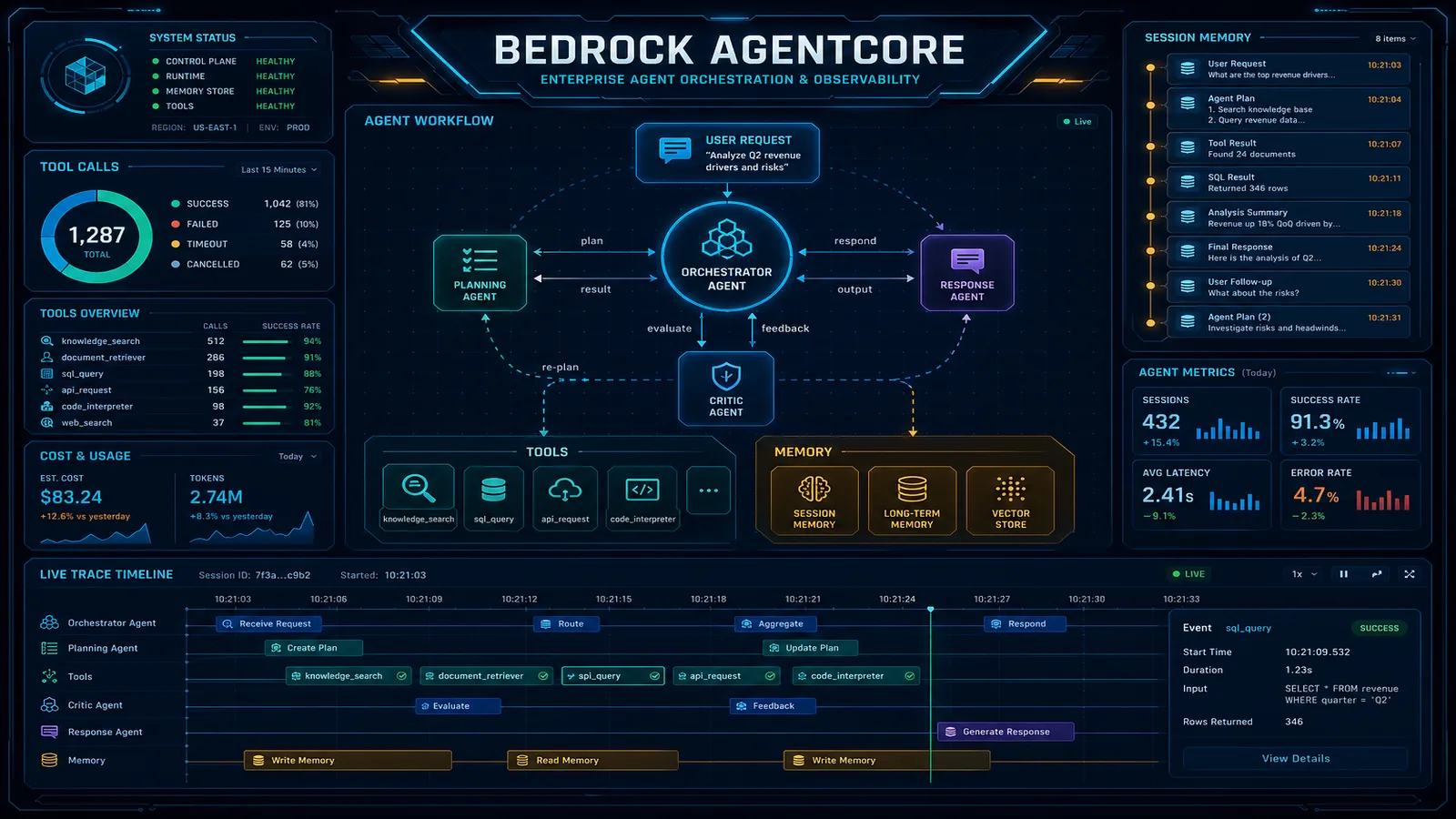
On June 17, 2026, AgentCore Harness reached general availability on the same platform as Runtime, Memory, Gateway, Identity, and Policy (What’s New). For an eCommerce storefront, that stack is the paved road: a supervisor that routes to sales, order ops, support triage, and inventory specialists — with Gateway as the write-path choke point.
This post is an end-to-end sample architecture with cloneable stubs. It is not an anonymized client engagement. Commerce order volumes, refund rates, and fixture IDs (ORD-1001, SKU-TEE-BLU-M) are demo data.
First-party signals we reuse (not eCommerce outcomes) — Gateway server-side tools cut median tool round-trip ~180 ms → ~95 ms on a B2B CRM assistant (12 tools, ~8k turns/day) — Gateway post. Platform TCO silhouette: support-style AgentCore at 50K sessions/mo ~$791/mo platform + model (decision guide). Model your own mix on the AgentCore pricing calculator.
Reproduce this — Clone the artifacts under
examples/architecture-blog-2026/ecommerce-agentcore-store-agents/.python3 -m py_compile supervisor_agent.py specialists/*.pysyntax-checks the stubs. Deploy steps and Policy gates are inmonday-checklist.md.
Why multi-agent for commerce (and when not to)
A single agent with catalog search, cancel, refund, and warehouse adjust tools will mis-route under load. The multi-agent supervisor pattern still applies — but on AgentCore Runtime, not Classic InvokeAgent + action groups.
Opinionated take: use Runtime + Strands for supervisor and specialists when routing, hop caps, and role-aware tools are product logic. Collapse to one Harness agent only if you have ≤5 tools, one team, and no associate-only writes. Trade-off: multi-agent adds invoke latency and ops surface; you buy clearer prompts, IAM, and Policy scopes.
Reference architecture
Shopper/Associate → IdP JWT → AgentCore Identity
        → Supervisor Runtime (Strands)
              ├─ Sales Runtime      (catalog / cart)
              ├─ Orders Runtime     (status / cancel)
              ├─ Support Runtime    (returns / escalate)
              └─ Inventory Runtime  (stock / merch)
        → AgentCore Memory (user-scoped)
        → AgentCore Gateway (8 OpenAPI tools)
              → Policy (Cedar) → OMS / catalog / WMS APIs
→ Observability (OTEL → CloudWatch)| Component | Role in this sample |
|---|---|
| Runtime | Host supervisor + 4 specialists (microVM session isolation) |
| Identity | Shopper vs associate/admin JWT claims into Gateway |
| Memory | Short-term turn context; long-term preferences / order episodes per shopper id — FGAC + flexible namespaces as of August 28, 2026 |
| Gateway | 8 OpenAPI tools from commerce-openapi.yaml |
| Policy | Cedar gates on cancelOrder, createReturn, updateInventory |
| Observability | Routing distribution, tool errors, Policy ALLOW/DENY spans |
Specialist contracts
Sales / shopping assistant
Read-heavy: product search, SKU detail, cart. No shopper payment capture in this sample. AgentCore Payments reached GA on August 18, 2026 for gated agent-to-API spend with a session budget — it is still not a replacement for checkout. See What this post doesn’t cover.
Local fixtures live in specialists/sales_agent.py. Production should call Gateway searchProducts / getProduct / getCart instead of in-process dicts.
Order automation
Status, shipment tracking, cancel/modify inside the cancel window. Delivered orders should DENY cancel and route to support for returns.
Support triage
Returns, refunds under a cap ($75 in the demo Cedar), policy FAQs, human escalation for chargebacks / legal / over-cap amounts.
Inventory / merchandising
Stock reads for associates (and optionally via sales for availability). Writes require associate or admin claims — shopper JWTs must fail at Policy even if the model asks.
Supervisor routing
Intent → agent matrix: routing-decision-matrix.md.
Rules we bake into the supervisor:
- Classify once; invoke one specialist per turn (unless the specialist returns an explicit follow-up).
- Cap hops at 2; then clarify or
escalate_to_human. - Never call cancel/refund/inventory write tools from the supervisor — specialists + Gateway own writes.
Context: Python 3.12+, strands-agents ≥ 1.x, bedrock-agentcore Runtime entrypoint, model pin global.anthropic.claude-sonnet-4-5-20250929-v1:0 (swap per region). Full file: supervisor_agent.py.
# Excerpt — dry-run route tools; replace invoke_specialist with InvokeAgentRuntime.
@tool
def route_to_orders(user_message: str) -> str:
    """Route order status, cancel, modify, and shipment tracking to the orders agent."""
    return invoke_specialist("orders", user_message, {"hop": 1})

@tool
def escalate_to_human(reason: str, user_message: str) -> str:
    """Hand off when risk is high or specialists are ambiguous."""
    return json.dumps({"status": "escalated", "reason": reason, "queue": "commerce-tier2"})
Gateway tool catalog (8 tools)
Attach gateway/commerce-openapi.yaml as an OpenAPI target:
| operationId | Risk |
|---|---|
searchProducts, getProduct, getCart | Low (read) |
getOrder, getShipment, getInventory | Low (read) |
cancelOrder, createReturn | High |
updateInventory | Critical |
When the catalog grows past ~10 tools, use Gateway semantic search so the model sees a shortlist — same failure mode called out in the Gateway server-side tools post.
Cedar Policy on the write path
Sample policies: policy/refund-and-cancel.cedar.
NL equivalents:
- Shoppers/associates may
cancelOrderonly while status isprocessingorpending. createReturnauto path only whenrefundUsd <= 75.updateInventoryonly when JWTroleisassociateoradmin.
Run Policy in LOG_ONLY for a canary window, then ENFORCE. Prompt text is not a substitute.
// Excerpt — auto-refund ceiling (demo). Align entity shapes to your Gateway schema.
permit (
  principal,
  action == Action::"createReturn",
  resource
)
when {
  principal has role &&
  ["shopper", "associate", "admin"].contains(principal.role) &&
  resource has refundUsd &&
  resource.refundUsd <= 75
};
What broke (counter-case)
What broke — Early supervisor drafts that “helpfully” called all four specialists on ambiguous prompts (
help with my purchase). Result: duplicate tool calls, conflicting status text, and cancel attempted on a delivered fixture after support also opened a return. Detection: Gateway traces showed two write tools in one turn; PolicyLOG_ONLYlogged a would-be DENY on cancel. Fix: hop cap = 2, clarify-first on ambiguous intents, forbid cancel on delivered at Cedar, escalate chargeback language. Lesson: multi-agent without hop and Policy discipline is worse than a single agent.
Observability
Enable AgentCore Observability (OTEL into CloudWatch) on supervisor and Gateway. Track:
- Routing distribution (sales / orders / support / inventory / escalate)
- Specialist and Gateway p95 latency (platform signal from CRM canary: ~95 ms median tool RTT after server-side Gateway — your OMS will dominate absolute numbers)
- Policy ALLOW vs DENY counts (
aws.agentcore.policy.authorization_decisionspans) - Escalation rate to
commerce-tier2
Traces show what happened. Pair with AgentCore Evaluations before you scale session volume — batch, online, and A/B testing are generally available as of June 2026; confirm your Region before launch.
What this post doesn’t cover
- AgentCore Payments as shopper checkout or card capture. Payments GA (August 18, 2026) is for agent-to-API / MCP / content microtransactions with a PaymentSession budget — not PAN in Memory, not unbounded purchase. Architecture: production guide.
- AgentCore Browser for third-party seller portals
- Full ERP / Shopify / Magento connectors (replace the OpenAPI host with yours)
- AgentCore Optimization A/B on prompts
- Classic Agents migration playbooks (see production guide)
- Measured eCommerce engagement KPIs — this sample does not invent them
What to do this week
- Clone
ecommerce-agentcore-store-agentsand runpython3 -m py_compileon the stubs. - Stand up Identity JWT with
roleclaims (shopper|associate|admin). - Upload
commerce-openapi.yamlto Gateway; attach Cedar fromrefund-and-cancel.cedarinLOG_ONLY. - Deploy supervisor + four specialist Runtimes; wire ARNs into supervisor env.
- Prove DENY paths: cancel on
ORD-1001(delivered), refund$100, inventory write with shopper JWT. - Build a CloudWatch dashboard for routing + Policy DENY; alarm on DENY spikes.
- Flip Policy to
ENFORCEonly after the canary week. - Model platform + token cost on the AgentCore pricing calculator.
Full gate list: monday-checklist.md.
If you only do one thing
Put Gateway Policy in front of cancelOrder, createReturn, and updateInventory before you polish the shopping prompt. A clever sales agent without write gates is an automated refund machine.
Related reading
This post is the store-agent reference build. The workflow-by-workflow treatment lives in the eCommerce AI Agents series — 64 parts covering support and WISMO, inventory reorder, autonomy per action, and when one agent stops being enough.
AWS Cloud Architect & AI Expert
AWS-certified cloud architect and AI expert with deep expertise in cloud migrations, cost optimization, and generative AI on AWS.