DataSync vs Transfer Family vs Custom Scripts
Quick summary: Two jobs, checked 4 October 2026. DataSync copies a dataset. Transfer Family terminates SFTP, FTPS, FTP, and AS2 so a partner can drop a file in S3. A script is the short list that fits neither.
Key Takeaways
- Two jobs, checked 4 October 2026
- Transfer Family terminates SFTP, FTPS, FTP, and AS2 so a partner can drop a file in S3
- The migration review on 4 October 2026 used one box labeled "file transfer
- Transfer Family terminates four partner protocols: SFTP, FTPS, FTP, and AS2
- The destination is S3, EFS, or FSx
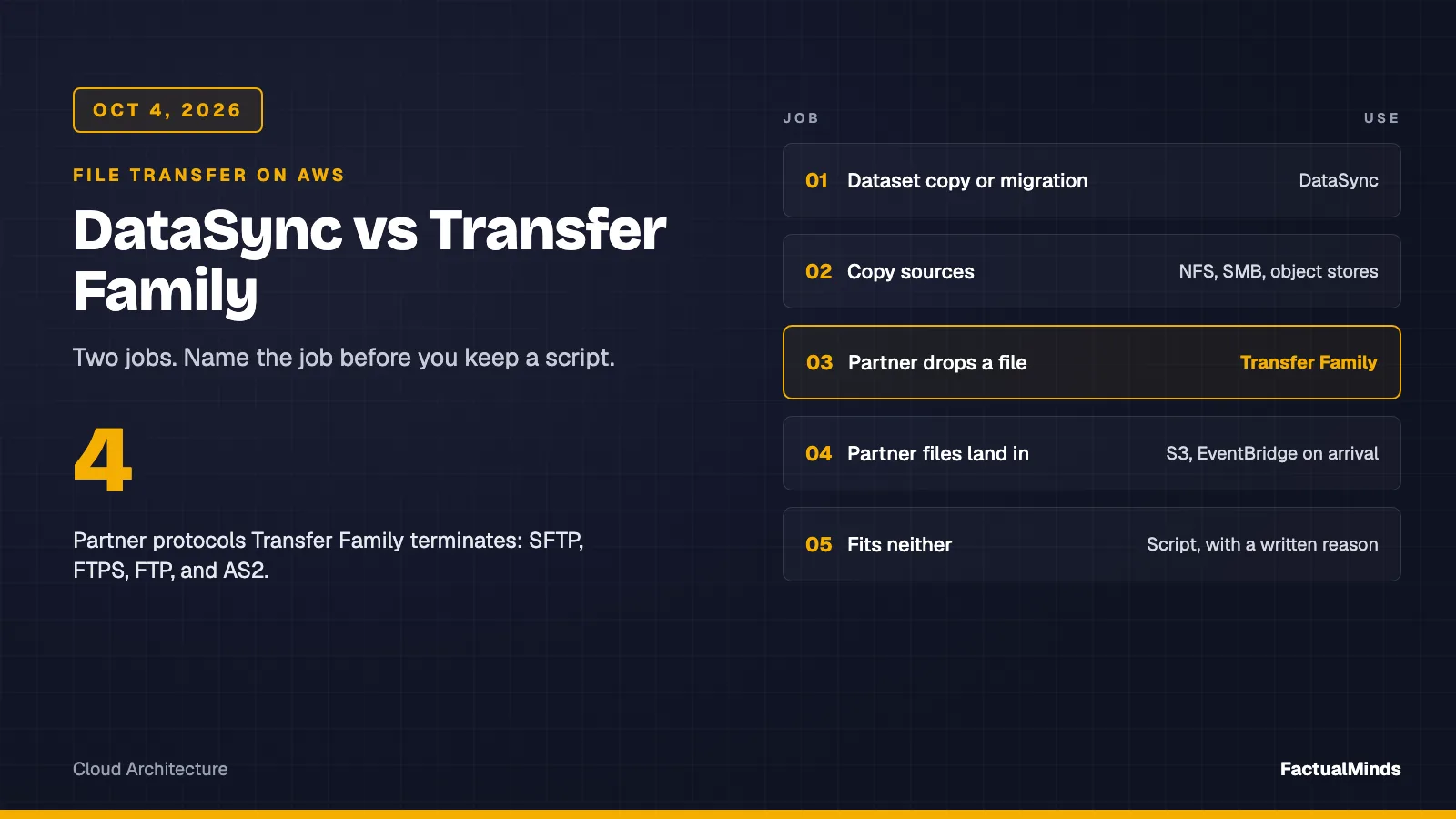
Table of Contents
The migration review on 4 October 2026 used one box labeled “file transfer.” DataSync copies datasets from NFS, SMB, and object stores. Transfer Family terminates four partner protocols: SFTP, FTPS, FTP, and AS2. The migration strategy post gives DataSync a paragraph and does not choose between them. The names sound alike, so the rsync job and the self-managed SFTP host both stayed.
Reproduce this — Copy the fork worksheet. Write which of the two jobs this is before you keep a script.
Two jobs
Bulk or recurring dataset migration is DataSync. You control the source. The task runs on a schedule. The destination is S3, EFS, or FSx. This is the replacement for rsync and for a NAS copy you operate yourself.
A partner who must speak SFTP, FTPS, FTP, or AS2 is Transfer Family, landing in S3, with EventBridge when the object arrives. You are not migrating a filesystem. You are retiring the server that existed so the partner had a protocol to log into. Identity, directories, and the validation workflow are not this article.
A script is what remains when the source is too odd for both. Name the reason on the worksheet. “We already have the script” is not a reason.
We recommend the managed primitive over the host. The trade-off is an AWS task or an AWS endpoint instead of a server you can SSH to. Take that trade unless the stop on the worksheet is true. The S3 security post still owns bucket exposure. Do not restate it here.
Where this fails
What broke — Lab, 4 October 2026. Not a customer account. A partner SFTP requirement was implemented as a DataSync task plus a note that “someone will drop the files on a share.” Detection: the worksheet’s protocol cell was SFTP and the choice cell was DataSync. Recovery: Transfer Family into a prefix, event on arrival, no second server. Lesson: dataset copy and partner protocol are different jobs.
What to Do This Week
- Split the file backlog into dataset copies and partner protocols.
- Put dataset copies on DataSync. Delete the matching rsync once a task has succeeded twice.
- Put partner protocols on Transfer Family. Do not design users on this page.
- List any remaining script and the reason it fits neither product.
- Take the migration program to AWS migration.
What This Post Doesn’t Cover
It does not specify Transfer Family users, logical directories, or the validation state machine. It does not price DataSync. It does not redo the migration strategy post’s wave plan.
Frequently asked questions
Should we use DataSync or Transfer Family?
When should we not keep the rsync script or the self-managed SFTP host?
What could go wrong if we put partner users on DataSync?
Does this page design the partner-drop workflow?
Where do we send a migration program after the fork?

AWS Cloud Architect & AI Expert
AWS-certified cloud architect and AI expert with deep expertise in cloud migrations, cost optimization, and generative AI on AWS.

 Nash Ogden