Custom AWS Development for Retail: When Off-the-Shelf Is Not Enough
Quick summary: Loyalty, pricing, inventory sync, multi-CDN — retail breaks generic templates. July 2026: buy-vs-build matrix, EventBridge patterns, CloudFront case study (−40% page load).
Key Takeaways
- July 2026: buy-vs-build matrix, EventBridge patterns, CloudFront case study (−40% page load)
- Buy SaaS when the peak QPS and rule complexity fit; build on AWS when they do not
- Quantified outcome (first-party case study): cosmetics brand image path moved to S3 + CloudFront → ~40% faster product/checkout page loads with 99
- 99% availability under spikes
- A promotional email send at 9am on a Tuesday can create a 15x traffic surge on product pages within minutes — before auto-scaling has time to react unless it has been pre-configured correctly
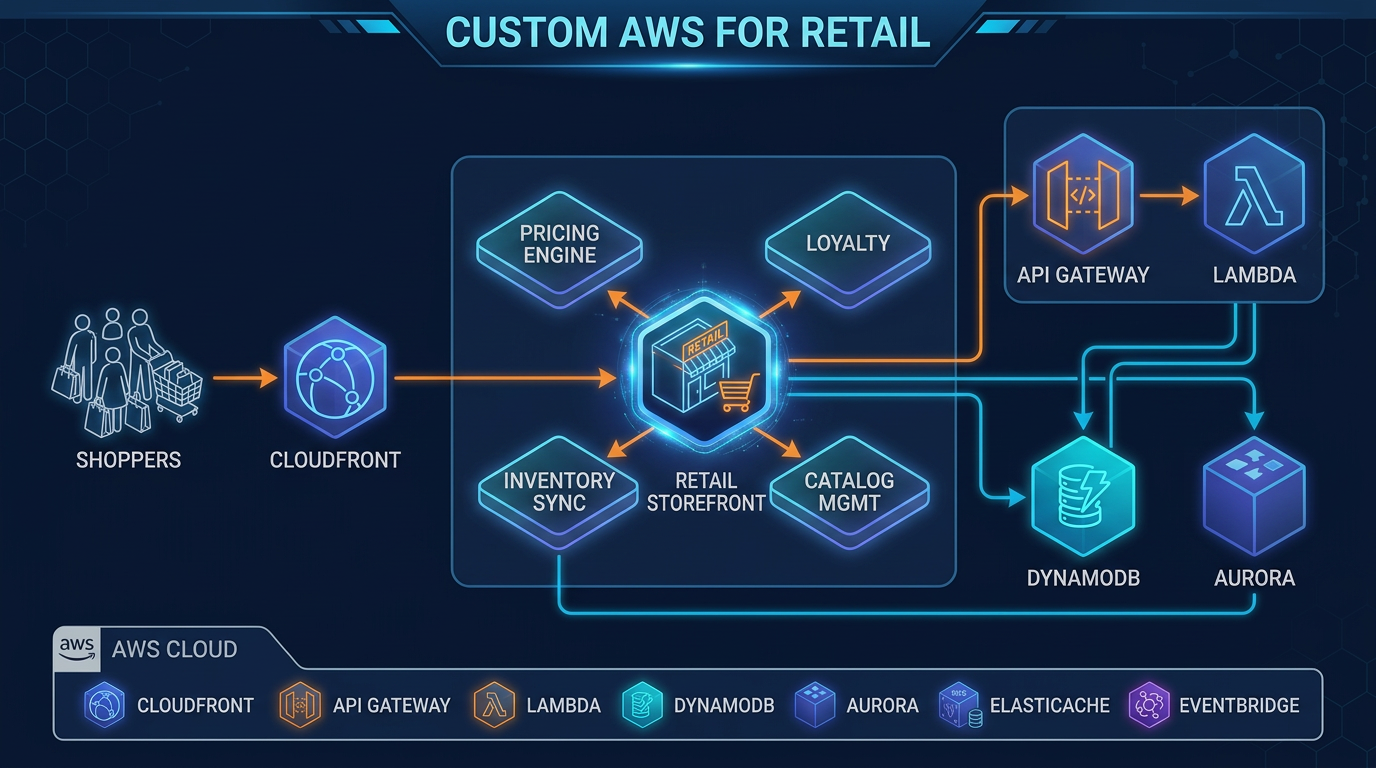
Table of Contents
Generic cloud configurations handle generic workloads. Retail is not a generic workload.
As of July 2026, the custom builds that still show up in retail AWS scopes are the same four: loyalty at checkout latency, pricing/promo engines, multi-channel inventory sync, and global image/CDN delivery — plus event-driven order fan-out so peak week does not become a synchronous timeout cascade. Buy SaaS when the peak QPS and rule complexity fit; build on AWS when they do not.
Quantified outcome (first-party case study): cosmetics brand image path moved to S3 + CloudFront → ~40% faster product/checkout page loads with 99.99% availability under spikes.
Reproduce this: Custom vs buy decision matrix · retail complete guide
Why Retail AWS Architecture Is Different
Most cloud architecture patterns assume predictable, roughly uniform traffic and straightforward data flows. Retail breaks both assumptions.
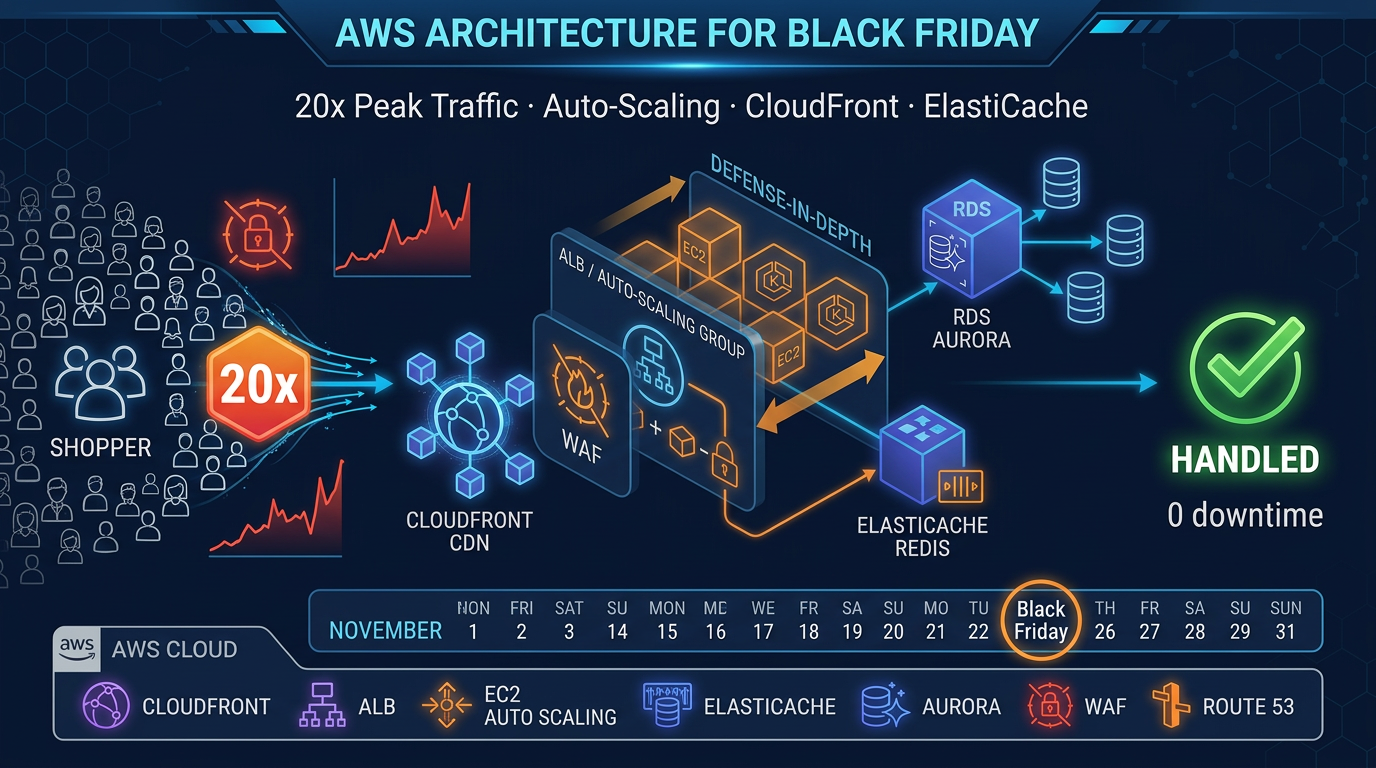
Traffic in retail is seasonal, campaign-driven, and frequently spike-shaped. A promotional email send at 9am on a Tuesday can create a 15x traffic surge on product pages within minutes — before auto-scaling has time to react unless it has been pre-configured correctly. Black Friday and Cyber Monday create multi-day sustained peak loads that require different handling than a sudden spike.
Data flows in retail are complex. An order touches inventory systems, payment processors, fulfillment platforms, email notification pipelines, and analytics systems — often running on different vendors, different clouds, or legacy on-premises infrastructure. Connecting these cleanly on AWS requires event-driven architecture that is designed specifically for the integration points your stack actually has.
Custom AWS development for retail means building around these realities, not working around them.
Common Custom AWS Builds for eCommerce
Loyalty and rewards platforms. Real-time points calculation at checkout requires low-latency reads from DynamoDB or ElastiCache (Valkey/Redis OSS) with careful consistency for writes. Off-the-shelf loyalty tools often cannot handle the throughput retail requires at peak, and building natively on AWS allows the loyalty engine to share the same scaling and security posture as the rest of your infrastructure.
Custom pricing and promotion engines. Price calculation at scale — with tiered pricing, customer-specific discounts, real-time promotional rules, and A/B test variants — requires a Lambda-based pricing service that integrates with your product database and checkout. A purpose-built pricing engine on AWS can calculate and cache prices at the product catalog level, reducing checkout latency and supporting complex pricing logic that third-party tools cannot express.
Event-driven inventory sync. Multi-channel retail creates inventory state problems when order management systems, warehouse systems, and eCommerce platforms maintain separate inventory counts. An event-driven sync architecture using Amazon EventBridge and SQS guarantees that inventory changes propagate reliably across systems without tight coupling or batch-lag, reducing oversell and stockout events.
Multi-CDN delivery for global storefronts. A single CDN introduces geographic performance gaps and a single point of failure for high-traffic events. Custom multi-CDN routing using Route 53 latency-based routing combined with CloudFront and a secondary CDN allows retailers to serve the nearest edge location while maintaining failover capability.
Event-Driven Retail Architecture on AWS
The most scalable retail architectures on AWS are event-driven. Instead of synchronous service-to-service API calls, each action in the retail workflow — order placed, payment confirmed, inventory updated, shipment triggered — publishes an event that downstream systems consume asynchronously.
Amazon EventBridge serves as the event bus, routing order events to fulfillment systems, inventory systems, email notification pipelines, and analytics. SQS queues absorb bursts without losing events. Lambda functions process events at scale without maintaining persistent compute.
This pattern decouples retail systems from each other, making each component independently scalable and independently deployable. It also creates a reliable audit trail of every state change across your retail workflow — valuable both for debugging and for compliance documentation.
How We Scope Custom AWS Development Engagements
Custom AWS development engagements for retail start with a discovery phase focused on your current architecture, integration points, and performance requirements — not a generic “cloud readiness assessment.” We need to understand your traffic patterns, your peak scenarios, and the systems that need to talk to each other before we can design something useful.
From discovery we move to architecture design, where we document the AWS components, integration patterns, and data flows specific to your retail stack. Architecture review is collaborative — you should understand and agree with every decision before we write infrastructure code.
Implementation follows an iterative model. Core infrastructure ships first, integrations follow, and performance validation happens under realistic load before any system goes to production.
Case Study: Custom Image Delivery for a Growing Cosmetics Brand
A cosmetics brand serving product images from their application server was experiencing slow product pages, high data transfer costs, and reliability issues during traffic spikes. The existing setup had no caching layer and no separation between static and dynamic content.
FactualMinds designed and implemented a custom S3 and CloudFront image delivery architecture, migrating all product images to S3 with structured folder hierarchies matching the product catalog, configuring CloudFront with optimized cache-control headers, and updating the application to reference S3 URLs through CloudFront for all image assets.
The result was a 40% reduction in page load times across product pages and checkout, significant savings on data transfer costs, and 99.99% availability — without manual scaling intervention during traffic events.
What this post doesn’t cover
Headless CMS vendor selection and full PCI SAQ scoping — only the custom AWS build patterns around them.
What to do Monday morning
- List capabilities that missed latency/QPS SLOs last peak (loyalty, pricing, inventory, images).
- Score each on the buy vs build matrix.
- Prefer EventBridge + SQS for order fan-out before another sync microservice.
- Next: Black Friday architecture · AWS for retail guide · eCommerce AI agents series.
- Book a scoping call · retail industry page.
AWS Cloud Architect & AI Expert
AWS-certified cloud architect and AI expert with deep expertise in cloud migrations, cost optimization, and generative AI on AWS.