Claude Opus 5 on AWS (July 2026): Bedrock Adoption Guide for Long-Running Agents
Quick summary: On July 24, 2026 AWS shipped Claude Opus 5 on Bedrock — 1M-token context, 128K max output, ZDR by default. Here is the Bedrock vs Claude Platform routing call and a lane-by-lane rollout plan.
Key Takeaways
- On July 24, 2026 AWS shipped Claude Opus 5 on Bedrock — 1M-token context, 128K max output, ZDR by default
- Here is the Bedrock vs Claude Platform routing call and a lane-by-lane rollout plan
- AWS lifecycle notice (June 30, 2026) — Amazon Bedrock Agents Classic is in maintenance for new customers after July 30, 2026
- Net-new agent builds should use Bedrock AgentCore
- On July 24, 2026, AWS announced Claude Opus 5 availability on AWS — Anthropic’s most advanced Opus model yet, with zero data retention (ZDR) on the Bedrock path

Table of Contents
AWS lifecycle notice (June 30, 2026) — Amazon Bedrock Agents Classic is in maintenance for new customers after July 30, 2026. Net-new agent builds should use Bedrock AgentCore. Full matrix: lifecycle roundup.
On July 24, 2026, AWS announced Claude Opus 5 availability on AWS — Anthropic’s most advanced Opus model yet, with zero data retention (ZDR) on the Bedrock path. The companion AWS Machine Learning Blog post frames it as a step-change for coding, multi-hour agents, and document-heavy enterprise work, with access through Amazon Bedrock and Claude Platform on AWS.
If you already ship GenAI on Bedrock, treat this as a routing and evaluation event, not a global model swap. The Bedrock model card pins the architectural numbers: 1M-token context, 128K max output, adaptive thinking on by default, and prompt caching from 512 tokens. This post is the adoption lens — where Opus 5 fits next to Sonnet 5 and Fable 5, how to invoke it safely, and how to promote lanes without model churn.
What changed on July 24, 2026
Per AWS and the model card, Claude Opus 5 is positioned for:
- Coding — navigating large codebases and adapting strategy mid-task
- Long-running agents — hours-to-overnight jobs that recover from errors and keep going
- Document-heavy professional work — deeper reasoning over long corpora
Two access paths, same model family:
| Path | ZDR | Best when |
|---|---|---|
| Amazon Bedrock | On by default | You need AWS-native governance, regional residency, Guardrails / Knowledge Bases composition |
| Claude Platform on AWS | On request | Teams want Anthropic-native console/APIs with AWS billing and auth |
AWS also notes Opus 5 can fall back to Opus 4.8 in higher-risk cyber areas (configurable via API). Production handlers must treat that as a first-class response path, not a surprise quality regression.
For the Sonnet-tier parallel launch, see Claude Sonnet 5 on AWS. For Mythos-class / long-horizon knowledge work, see Claude Fable 5.
Specs that change architecture (not marketing)
From the Claude Opus 5 model card:
| Spec | Value | Why it matters |
|---|---|---|
| Context window | 1M tokens | Whole repos + doc packs in one session — you still pay for what you send |
| Max output | 128K tokens | Long artifacts without chunking — watch client/stream timeouts |
| Reasoning | Adaptive thinking (default on) | Extra latency vs “fast” Sonnet calls; effort capped at high if thinking is disabled |
| Knowledge cutoff | May 2026 | Newer than prior Opus 4.x cards for recent AWS/Anthropic surface area |
| Prompt cache | Min 512 tokens, ≤4 checkpoints, 5m / 1h TTL | Lower threshold than older Opus generations — rewrite cache points if you were sized for 4,096 |
| Launch | July 24, 2026 | Active lifecycle; confirm service tiers and regional matrix before hardcoding residency |
Opinionated take: default new long-horizon coding and overnight agent lanes to Opus 5 on Bedrock (ZDR default + Guardrails). Keep high-QPS chat and cheap classification on Sonnet 5 / Haiku / Nova. Do not promote Opus 5 as a drop-in for every Sonnet call — the adaptive-thinking tax and Opus-tier pricing will blow cost caps on short turns.
Trade-off you accept: higher per-task quality and overnight agent reliability vs higher token cost and thinking latency on short prompts.
Invoke Opus 5 on Bedrock (Converse first)
Prefer the Converse API on bedrock-runtime with an explicit maxTokens. Leaving maxTokens unset defaults toward the model maximum (128K) and silently reserves far more quota than a normal request needs — a common cause of unexpected ThrottlingException.
Use a cross-region inference profile unless you have a hard in-region requirement:
- Geo:
us.anthropic.claude-opus-5,eu.anthropic.claude-opus-5,au.anthropic.claude-opus-5 - Global:
global.anthropic.claude-opus-5 - Mantle / Messages API base ID:
anthropic.claude-opus-5
Context: boto3 Bedrock Runtime, region us-east-1, inference profile ID.
import boto3

client = boto3.client('bedrock-runtime', region_name='us-east-1')

response = client.converse(
    modelId='global.anthropic.claude-opus-5',
    messages=[
        {
            'role': 'user',
            'content': [
                {
                    'text': 'Summarize the failure modes in this migration plan and propose a rollback checklist.'
                }
            ],
        }
    ],
    inferenceConfig={'maxTokens': 4096},
)

blocks = response['output']['message']['content']
print('\n'.join(b.get('text', '') for b in blocks if 'text' in b))
For Anthropic-native Messages ergonomics on Bedrock Mantle (SigV4), AWS documents AnthropicBedrockMantle with model="anthropic.claude-opus-5" — useful when your app already speaks the Anthropic SDK. Guardrails, Knowledge Bases, Flows, and Agents composition stay on the bedrock-runtime feature set; Mantle’s supported surface is narrower (see model card).
What broke (pattern, not a cited client) — Teams that copy-paste Opus 4.x invoke wrappers into Opus 5 often leave
maxTokensunset or sized to 64K habits while the card allows 128K. First production spike: throttling under modest QPS because each request reserved the default ceiling. Fix: setmaxTokensto the task budget (e.g. 2K–8K for summaries, higher only for long artifacts) and prefer geo/global inference profiles for headroom.
Bedrock vs Claude Platform: first-pass routing
| Decision point | Start with Amazon Bedrock | Start with Claude Platform on AWS |
|---|---|---|
| Data retention | ZDR default | ZDR on request |
| Governance | IAM, residency profiles, AWS-native controls | Anthropic-native workspace + AWS billing/auth |
| Composition | Guardrails, Knowledge Bases, Flows, Agents | Anthropic platform features / console UX |
| Operating model | Central platform team owns model access in AWS | Product teams prefer Anthropic-style surfaces |
For enterprise control-plane tradeoffs more broadly, see AWS Bedrock vs OpenAI API for Enterprise. For agent runtime choices after Agents Classic maintenance, see AgentCore vs Amazon Q.
Where Opus 5 fits vs Sonnet 5 and Fable 5
Most portfolios need lanes, not one hero model:
| Lane | Prefer | Why |
|---|---|---|
| Overnight / multi-hour agents, large-repo coding | Opus 5 | Positioned for long-running recovery and production-quality code adaptation |
| Agentic tool use at scale with cost sensitivity | Sonnet 5 (benchmark first) | Strong agent/coding mid-tier; validate before paying Opus rates |
| Mythos-class multi-day knowledge work with safeguard story | Fable 5 | Different retention/refusal contract — read the Fable guide before mixing |
| High-QPS chat / classification | Haiku / Nova | Latency and cost; Opus 5 is the wrong default |
Anthropic (via AWS) positions Opus 5 as matching Fable 5’s top-tier intelligence in many domains at Opus-tier pricing — that is a cost/capability claim to verify on your prompts, not a license to route everything to Opus.
Rollout plan: 2-week Opus 5 evaluation
Avoid model churn with a fixed protocol:
- Pick three lanes — (a) multi-file coding, (b) a long-running agent job (≥30 min wall clock), (c) one document-heavy analysis path.
- Freeze prompts — replay production-representative traces; no ad-hoc “try this cool prompt” demos.
- Score three metrics per lane — quality pass rate (human rubric), latency to completed task, cost per completed task (not cost per 1K tokens alone).
- Instrument fallbacks — log when cyber/safety paths fall back to Opus 4.8; define accept / retry / escalate.
- Promote lane-by-lane — only move lanes that beat the current baseline on quality and stay inside cost/latency budgets.
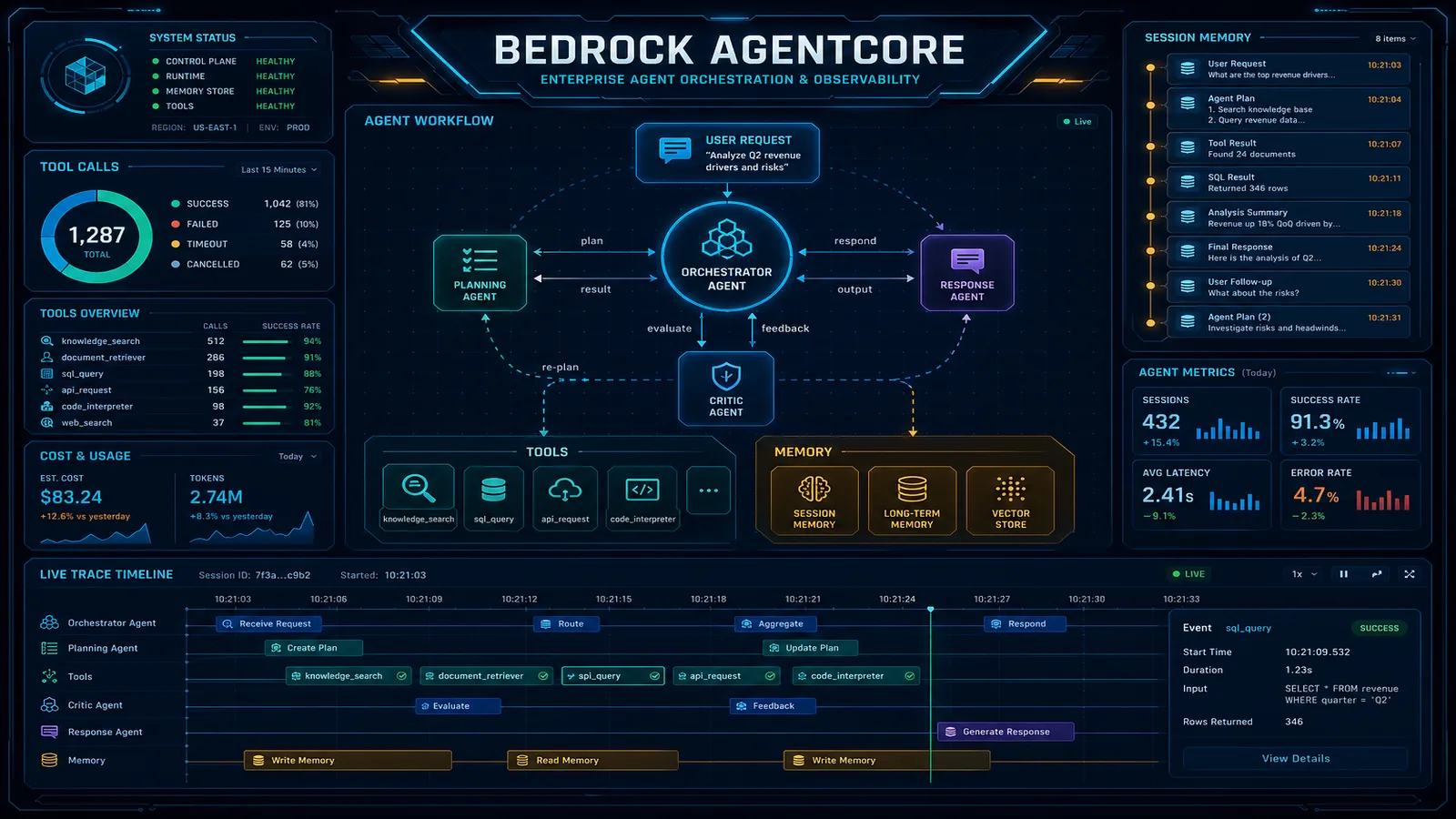
Pair agent lanes with Bedrock AgentCore production patterns and token-budget / model-selection FinOps.
What to Do This Week
- Confirm regional / geo / global profile IDs against the live model card for your residency rules.
- Enable Opus 5 access in a non-prod account; smoke-test Converse with
maxTokens: 1024. - Add cache checkpoints only after measuring prompt size ≥ 512 tokens on the sticky prefix.
- Wire Guardrails on Bedrock if the lane touches customer PII or policy-sensitive content.
- Schedule the three-lane eval; block any “flip default model ID in prod” PR until scores land.
What This Post Doesn’t Cover
- Official $/MTok pricing tables (use Amazon Bedrock Pricing — rates change).
- A published first-party latency/cost benchmark for Opus 5 vs Opus 4.8 / Sonnet 5 on FactualMinds workloads (eval harness linked above when ready).
- Full AgentCore runtime packaging for overnight jobs (separate guide).
- Claude Platform on AWS console walkthrough beyond the Bedrock-first recommendation.
Use this as an adoption framework, then validate on your prompt distribution and quota envelope.
Related reading
AWS Cloud Architect & AI Expert
AWS-certified cloud architect and AI expert with deep expertise in cloud migrations, cost optimization, and generative AI on AWS.