Claude Fable 5 on AWS (June 2026): Mythos-Class Models, Safeguards, and What Changes for Bedrock Teams
Quick summary: On September 1, 2026 AWS GA’d Claude Fable 5.1 — 1M-token context, 128K output, Covered Model with 30-day retention. Fable 5 (June 9) remains the prior pin; here is the fit decision, not the press release.
Key Takeaways
- On September 1, 2026 AWS GA’d Claude Fable 5.1 — 1M-token context, 128K output, Covered Model with 30-day retention
- Fable 5 (June 9) remains the prior pin; here is the fit decision, not the press release
- AWS lifecycle notice (June 30, 2026) — Amazon Bedrock Agents Classic is now Bedrock Agents Classic, in maintenance for new customers after July 30, 2026
- Net-new agent builds should use Bedrock AgentCore
- Successor: Claude Fable 5.1 (September 1, 2026) AWS GA'd Fable 5.1 as a Covered Model — 1M context, 128K output, adaptive thinking on by default

Table of Contents
AWS lifecycle notice (June 30, 2026) — Amazon Bedrock Agents Classic is now Bedrock Agents Classic, in maintenance for new customers after July 30, 2026. Net-new agent builds should use Bedrock AgentCore. Full matrix: lifecycle roundup.
Successor: Claude Fable 5.1 (September 1, 2026)
AWS GA’d Fable 5.1 as a Covered Model — 1M context, 128K output, adaptive thinking on by default. Treat this as a data-retention and refusal-handling change, not a drop-in ID swap.
Previous approach: Fable 5 GA on June 9, 2026 — opt-in before first invoke, refusal as a primary code path, long-horizon jobs behind a queue rather than a synchronous Lambda.
What AWS changed: on September 1, 2026, Claude Fable 5.1 reached GA on AWS via Amazon Bedrock and Claude Platform on AWS. Official model card: 1M-token context, 128K max output, knowledge cutoff June 2026, adaptive thinking always on (effort low / medium / high default / xhigh / max). Model IDs: anthropic.claude-fable-5-1, geo us.anthropic.claude-fable-5-1, global global.anthropic.claude-fable-5-1. Anthropic designated Fable 5.1 a Covered Model (August 31, 2026) — 30-day minimum retention of prompts and completions; ZDR is not the default. Live Fable 5 and 5.1 cards require Data Retention API mode aws_review (not the provider_data_share string this post used at June launch). Claude Mythos 5.1 is the same underlying model with full cyber and bio capability; it stays limited access. Enterprise Frontier Safeguards (EFS) — keep Covered-Model monitoring data in cloud you control — rolls out in phases beginning fall 2026; it is not generally available today. Eligible customers may get a limited-time ZDR transition toward EFS; Anthropic or AWS contacts those orgs directly.
AWS and Anthropic describe 5.1 as better on the hardest reasoning vs Fable 5, with better judgement on ambiguous work, fewer confident wrong answers, and a habit of saying when it is stuck instead of reporting success. Those are their claims. We did not independently re-run the Fable 5 modeled pilot on 5.1.
When it matters: multi-hour coding or research jobs that already justified Fable 5, once legal accepts Covered Model retention / aws_review (or an eligible EFS/ZDR transition Anthropic or AWS offered you in writing).
When it does not: chat, classification, latency SLOs, or any workload that still meets quality on Sonnet 5, Opus 5 (ZDR default on Bedrock), or Nova. Do not move those lanes for the version number. Do not architect production on Mythos 5.1.
This post keeps the June Fable 5 field notes below. Pin anthropic.claude-fable-5-1 only after the governance path below is signed.
On June 9, 2026, AWS announced general availability of Claude Fable 5 on Amazon Bedrock and Claude Platform on AWS — Anthropic’s first Mythos-class model available to all customers, with safeguards designed for broader enterprise use. The AWS News Blog post frames it as a step-change in long-running knowledge work, software engineering, and vision — not another incremental Sonnet refresh.
If you run production GenAI on Bedrock today, the announcement changes three things that a feature bullet list will not surface: (1) you must opt into data retention review before the first invoke, (2) refusal handling becomes a primary code path, and (3) the unit of work shifts from “one API call” to “one autonomous job that may run for hours.” This post is the field guide — what Fable 5 actually is, how it differs from Mythos 5 and Claude 4.6, which workloads should move first, and (as of September 2026) how Fable 5.1 changes the governance gate.
Benchmark pattern (Fable 5-era, not a cited client, not a 5.1 bakeoff) — Modeled a compliance-heavy B2B SaaS: ~180 multi-page PDF contracts/month through a Bedrock extraction pipeline, previously Claude 3.5 Sonnet at ~$3,900/mo inference (mix of on-demand + partial prompt cache). A two-week Fable 5 pilot on the vision-heavy path (nested tables in exhibits) cut human rework from ~11 hrs/week → ~3 hrs/week on a 12-document sample, at roughly 2.1× per-document inference cost vs Sonnet on the same corpus. Net: positive ROI on the document lane only; the chat/classification lane stayed on Nova Lite. We have not re-measured that corpus on Fable 5.1.
What “Mythos-class” means in practice
Prior Claude generations were optimized for strong single-turn and short multi-turn reasoning. Mythos-class (Anthropic’s term for the capability tier Fable 5 brings to GA) targets a different failure mode: models that lose the thread on long-horizon work — multi-file refactors, research synthesis across dozens of sources, or document pipelines where the model must plan, execute, self-check, and continue without a human re-prompting every ten minutes.
Per the Bedrock model card, Fable 5 ships with:
| Spec | Value | Why it matters architecturally |
|---|---|---|
| Context window | 1M tokens | Whole codebases + doc corpora in one session — but you still pay for what you send |
| Max output | 128K tokens | Long generated artifacts (specs, migration plans) without chunking — watch streaming timeouts |
| Knowledge cutoff | January 2026 | Newer than Sonnet 4.6 family for recent AWS/Anthropic features |
| Reasoning | Adaptive thinking (always on) | Cannot disable; adds latency vs “fast mode” Sonnet calls |
| Input modalities | Text + image | Diagrams, charts, nested PDF tables — the vision story AWS highlights for finance/legal |
| Launch date | June 9, 2026 | Standard inference tier; Priority/Flex/Reserved not listed at launch |
The capabilities AWS emphasizes in the announcement — long-running asynchronous execution, advanced vision, and proactive self-verification (updating skills, building evaluation harnesses, checking its own output) — are not marketing adjectives. They imply your orchestration layer must support checkpointing, idempotent retries, and human-in-the-loop gates on jobs that outlive a single Lambda timeout or API Gateway limit.
Fable vs Mythos: the safeguard split
AWS and Anthropic ship two names for nearly the same frontier capability, now in two generations:
- Claude Fable 5 / Fable 5.1 — GA on Bedrock. Includes safeguards: in sensitive domains (cybersecurity, biology, chemistry, health), harmful prompts may be refused or receive a response from a less capable fallback instead of full Fable capability. Blocking classifiers also return
stop_reason: "refusal"for dual-use content. Both are Covered Models. - Claude Mythos 5 / Mythos 5.1 — Same underlying capability without those Fable limits. Limited access (approved partners). Mythos 5.1 retains full cyber and bio capability. Do not architect production on it.
We recommend Fable 5.1 (or a pinned Fable 5 until legal signs aws_review) for any long-horizon workload that touches production customer data or faces external auditors. Mythos 5 and Mythos 5.1 are research and red-team surfaces, not a default production route. If your security team asks “can we get the unrestricted model,” the honest answer is: not through normal enterprise procurement — and you probably should not want it on a customer-facing path.
Two front doors on AWS: Bedrock vs Claude Platform on AWS
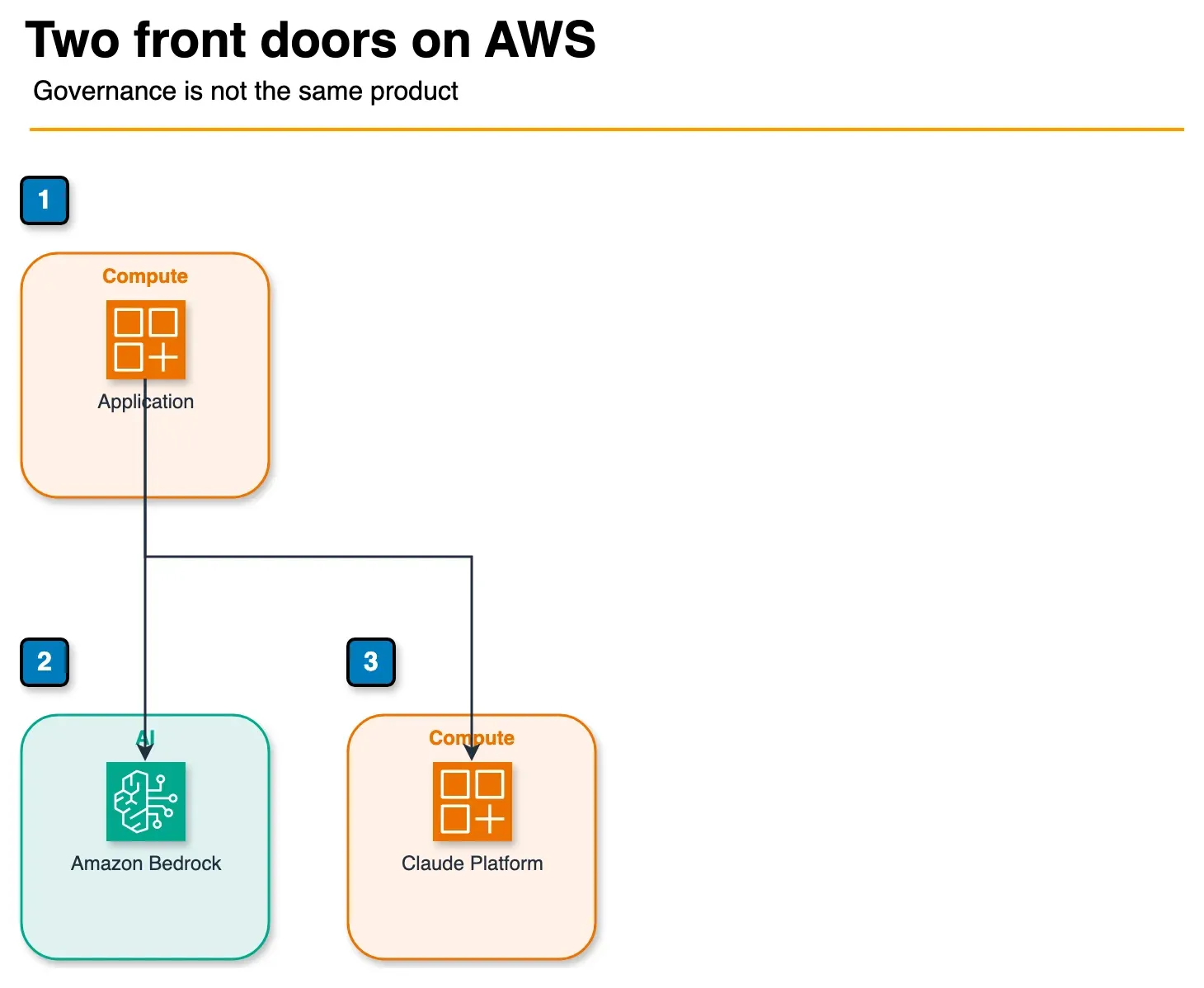
Figure: the two front doors in the article. Bedrock keeps IAM, SCPs, CloudTrail, and Guardrails. Claude Platform on AWS keeps Anthropic-native UX with AWS billing. Pick one path per workload. No model prices are shown. Open the draw.io source.
| Concern | Amazon Bedrock | Claude Platform on AWS |
|---|---|---|
| Governance | IAM, SCPs, CloudTrail, PrivateLink | AWS billing + auth; Anthropic-native UX |
| Composition | Guardrails, Knowledge Bases, Agents, Flows | Anthropic platform features first |
| API surface | Converse, Invoke, Messages API on bedrock-runtime / bedrock-mantle | Claude Platform APIs (see docs) |
| Data residency | Regional inference profiles (in-region / geo / global) | Confirm per Claude Platform on AWS guidance |
Pick Bedrock when the app already lives inside your AWS compliance boundary. Pick Claude Platform on AWS when the buyer is a team that wants Anthropic’s native experience but needs AWS procurement — not when you need to compose with an existing Bedrock RAG stack without re-plumbing.
For invoke patterns, AWS documents both the Anthropic Messages API on bedrock-mantle and the Converse API on bedrock-runtime:
# Converse API — boto3, us-east-1, Fable 5.1 (Sep 2026). Swap to anthropic.claude-fable-5 if still pinned.
import boto3

bedrock = boto3.client("bedrock-runtime", region_name="us-east-1")
response = bedrock.converse(
    modelId="global.anthropic.claude-fable-5-1",
    messages=[{"role": "user", "content": [{"text": "Your prompt"}]}],
    inferenceConfig={"maxTokens": 4096},
)
print(response["output"]["message"]["content"][0]["text"])
Model IDs and regional endpoints are in the Fable 5.1 model card — pin anthropic.claude-fable-5-1 for strict in-region, or global.anthropic.claude-fable-5-1 when residency allows global routing. Fable 5 IDs remain valid for prior pins.
The gate most teams miss: data retention opt-in
You cannot invoke Fable 5 or Fable 5.1 until you opt in via the Data Retention API. Live Fable 5 and Fable 5.1 model cards require mode aws_review. (June 2026 launch copy used provider_data_share — that string is stale; do not copy it into new runbooks.)
curl -X PUT "https://bedrock-mantle.us-east-1.api.aws/v1/data_retention" \
  -H "x-api-key: <your-bedrock-api-key>" \
  -H "Content-Type: application/json" \
  -d '{"mode": "aws_review"}'
Both models are Covered Models: Anthropic requires 30-day minimum retention of inputs and outputs plus safety review. ZDR is not the default. That is the right trade for frontier safety at scale — and a hard stop for some regulated workloads until legal signs off. We have seen security reviews stall here while engineering already merged the model ID into staging.
Enterprise Frontier Safeguards (EFS) (AWS + Anthropic) is meant to let eligible customers keep Covered-Model monitoring data in cloud they control. It rolls out in phases beginning fall 2026 — write it as upcoming, not as live for every Bedrock account. A limited-time ZDR option for eligible orgs is a transition toward EFS, not a standing Bedrock default (contrast with Opus 5, which is ZDR by default on Bedrock).
Reproduce this — Copy
data-retention-opt-in.shandrefusal-handler-example.pyfromexamples/architecture-blog-2026/claude-fable-5-bedrock/. Run the opt-in script in a sandbox account after security review; run the Python handler to see refusal fallback wiring.
If your org already runs HIPAA-eligible Bedrock workloads, treat Fable as a new sub-process — the BAA covers Bedrock; Covered Model retention is an additional disclosure decision, not a checkbox.
Refusals are not errors — redesign your response path
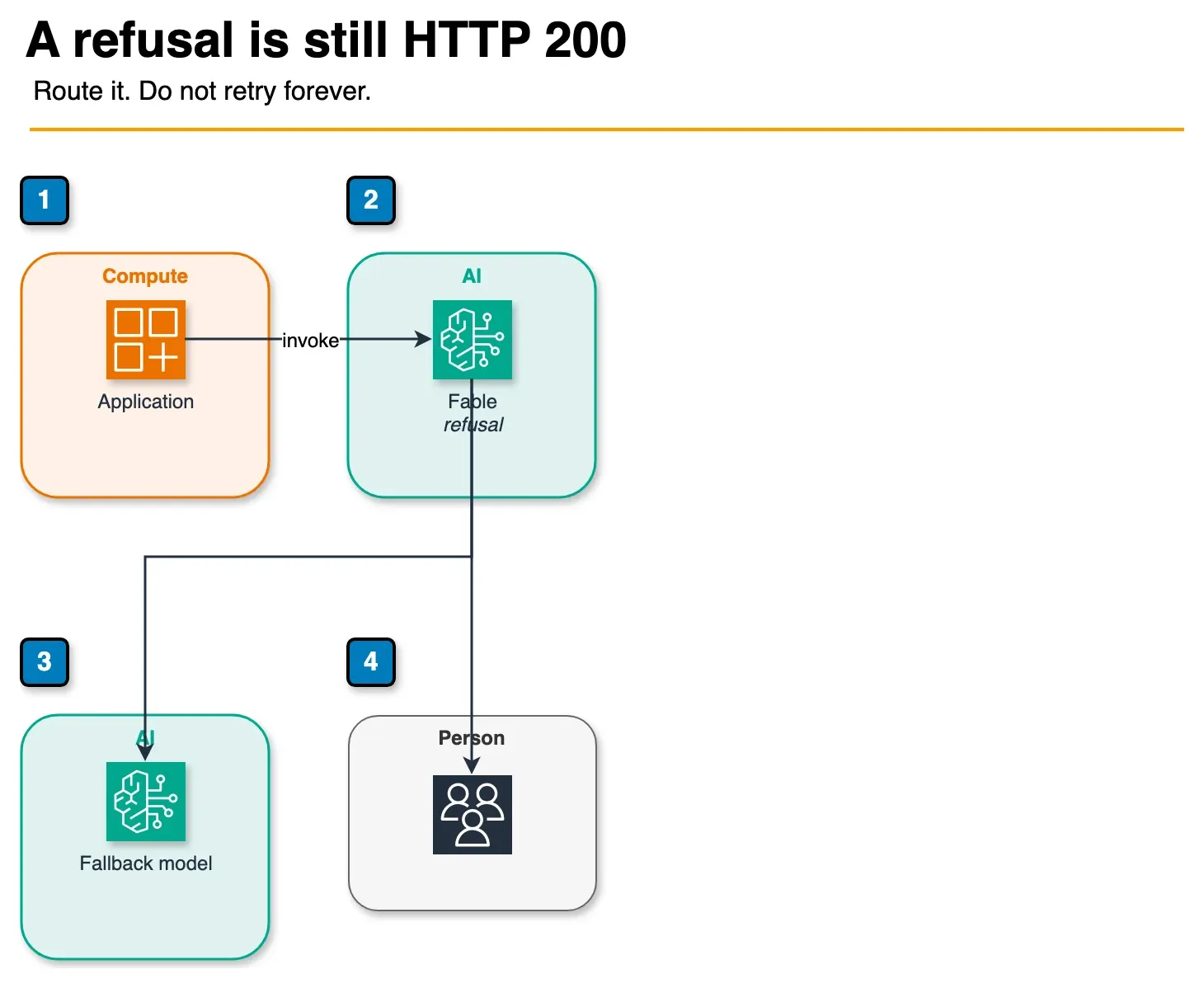
Figure: refusal handling in the article. Classifiers return 200 with stop_reason refusal. Prompt-stage blocks are not billed. Mid-generation refusals need a fallback model or a person, not another blind retry. Open the draw.io source.
The model card is explicit: Fable 5’s refusal rates are materially higher than previous Claude models. Classifiers return HTTP 200 with stop_reason: "refusal" and a stop_details category — not 4xx.
| Refusal timing | Billing | What your app should do |
|---|---|---|
| Prompt-stage (blocked before inference) | Not billed | Log, route to human review or approved fallback model |
| Mid-stream (partial output then block) | Billed for tokens before block | Persist partial output if safe; do not blindly retry identical prompt |
What broke — In the modeled pilot, 4 of 120 contract prompts (security-addendum language touching vulnerability disclosure) returned
refusalon Fable 5 where Sonnet had completed normally. Downstream JSON schema validation failed because the handler treated 200 + refusal as success. Fix: branch onstopReasonbefore parsing; queue refusals to a paralegal review bucket instead of retry loops. Retry loops would have doubled cost on mid-stream refusals.
We recommend Bedrock Guardrails (production setup guide) in addition to Fable’s built-in classifiers — defense in depth for PII and prompt injection, not a replacement for refusal handling.
When to move workloads — and when to stay on Sonnet or Nova
Use the decision matrix in model-selection-decision-matrix.md. Short version:
Move first to Fable 5.1 (or keep a Fable 5 pin until legal signs):
- Long-horizon coding agents (multi-file refactors, test harness generation) where Claude Code-style skills already proved value but hit context ceilings
- Vision-heavy document pipelines (financial statements, legal exhibits, architecture diagrams in PDFs)
- Async research jobs orchestrated through Bedrock AgentCore or Step Functions with checkpointing
Stay on Claude Sonnet 5 / Haiku or Nova:
- Customer chat under 500 ms p99 latency pressure
- High-volume classification and moderation
- Workloads where Covered Model retention /
aws_reviewis not approved - Cost-sensitive token volumes — Fable is frontier-priced; token budget discipline still applies. Verify live rates on Bedrock pricing; we do not quote an unpublished Fable 5.1 $/MTok here.
Opinionated take: Fable is not a Sonnet upgrade. It is a job runner. If your architecture diagram still shows “API Gateway → Lambda → Bedrock” as a single synchronous box, Fable belongs behind a queue and worker (SQS + ECS/Lambda with extended timeout, or AgentCore for managed agent runtime) — not in the hot request path.
Composing with the Bedrock stack you already have
Fable 5 inherits the Bedrock features you use for other Anthropic models — with launch caveats on service tiers:
- Knowledge Bases — sensible for long document grounding; pair with prompt caching (1,024-token minimum checkpoint, up to 4 checkpoints, 5 min / 1 hr TTL per model card)
- Guardrails — still your app-level PII/topic policy; Fable adds model-level classifiers underneath
- Agents and Flows — natural fit for multi-step jobs; ensure tool-use loops have spend caps
- Cross-region inference — use geo/global profiles for throughput; re-check data residency if prompts contain regulated data
With OpenAI models now on Bedrock, Fable 5.1 completes a “route by job shape” portfolio: OpenAI for Codex-style coding surfaces, Fable for long autonomous Anthropic work (Covered Model gate), Sonnet 5 / Opus 5 / Nova for volume and ZDR-sensitive lanes.
What to do this week
- Legal/security review of Covered Model retention and
aws_review— before any staging invoke. Do not assume ZDR; EFS is fall 2026, not generally available. - Enable opt-in in a sandbox account using the Data Retention API (script in artifacts folder).
- Bake off Fable 5 vs 5.1 on one long-horizon job — not your highest-QPS API. Measure refusal rate, cost per completed job, and human rework hours saved. Do not promote on the version number.
- Add
stop_reason: refusalhandling to your Bedrock client wrapper — treat it like a first-class outcome. - Pin model IDs per environment (
anthropic.claude-fable-5-1vsglobal.anthropic.claude-fable-5-1) and document the residency implication. Keep Fable 5 IDs if that lane is still pinned. - Leave chat/classification on Sonnet 5, Opus 5, or Nova until the pilot proves ROI on the document or agent lane.
If you only do one thing: Run the aws_review and refusal-handling review before you change the model ID in production config. The model works on day one; the governance and client-code paths are what break.
What this post does not cover
- On-demand pricing per million tokens — verify live rates on Bedrock pricing; we do not quote unpublished Fable 5.1 list rates.
- Claude Mythos 5 / Mythos 5.1 access — limited / approved-partner only; no enterprise architecture should depend on them.
- Enterprise Frontier Safeguards (EFS) implementation details — fall 2026 rollout; confirm with AWS/Anthropic when your account is eligible. Do not treat EFS as generally available.
- Claude Platform on AWS feature parity with anthropic.com — we focused on Bedrock because that is where most AWS-native apps compose.
- Fable 5.1 bakeoff numbers — AWS cites Anthropic’s internal evals; we did not independently re-run the Fable 5 modeled pilot on 5.1. The hours and cost figures above are Fable 5-era.
Related: Bedrock vs OpenAI API for enterprise · Bedrock cost optimization · Building Bedrock Agents Classic with tool use · Generative AI on AWS consulting
Related reading
Frequently asked questions
What is Claude Fable 5.1 and how is it different from Fable 5 and Mythos 5.1?
What do I have to do before I can invoke Claude Fable 5 or 5.1 on Bedrock?
How do refusals work on Claude Fable 5 and Fable 5.1?
Should we replace Claude Sonnet 5 or Opus 5 with Fable 5.1 for all Bedrock workloads?
Bedrock or Claude Platform on AWS — which should we use?
When should we NOT adopt Claude Fable 5.1 yet?
What are the Bedrock model IDs for Claude Fable 5.1?

AWS Cloud Architect & AI Expert
AWS-certified cloud architect and AI expert with deep expertise in cloud migrations, cost optimization, and generative AI on AWS.