AWS Transform Continuous Modernization vs a Funded Rewrite
Quick summary: A lab schedule after the 3 August 2026 GA returned findings and zero pull requests. Agentic-readiness scores 56 criteria. AWS-managed compute runs analyses only — remediation still needs Batch or EC2.
Key Takeaways
- A lab schedule after the 3 August 2026 GA returned findings and zero pull requests
- Agentic-readiness scores 56 criteria
- AWS-managed compute runs analyses only — remediation still needs Batch or EC2
- Analysis had been submitted with on a schedule dated after 3 August 2026, when continuous modernization became generally available in every region where AWS Transform is supported
- Lab figure of three programs for one repository group, with continuous modernization selected and aws-managed marked analysis-only
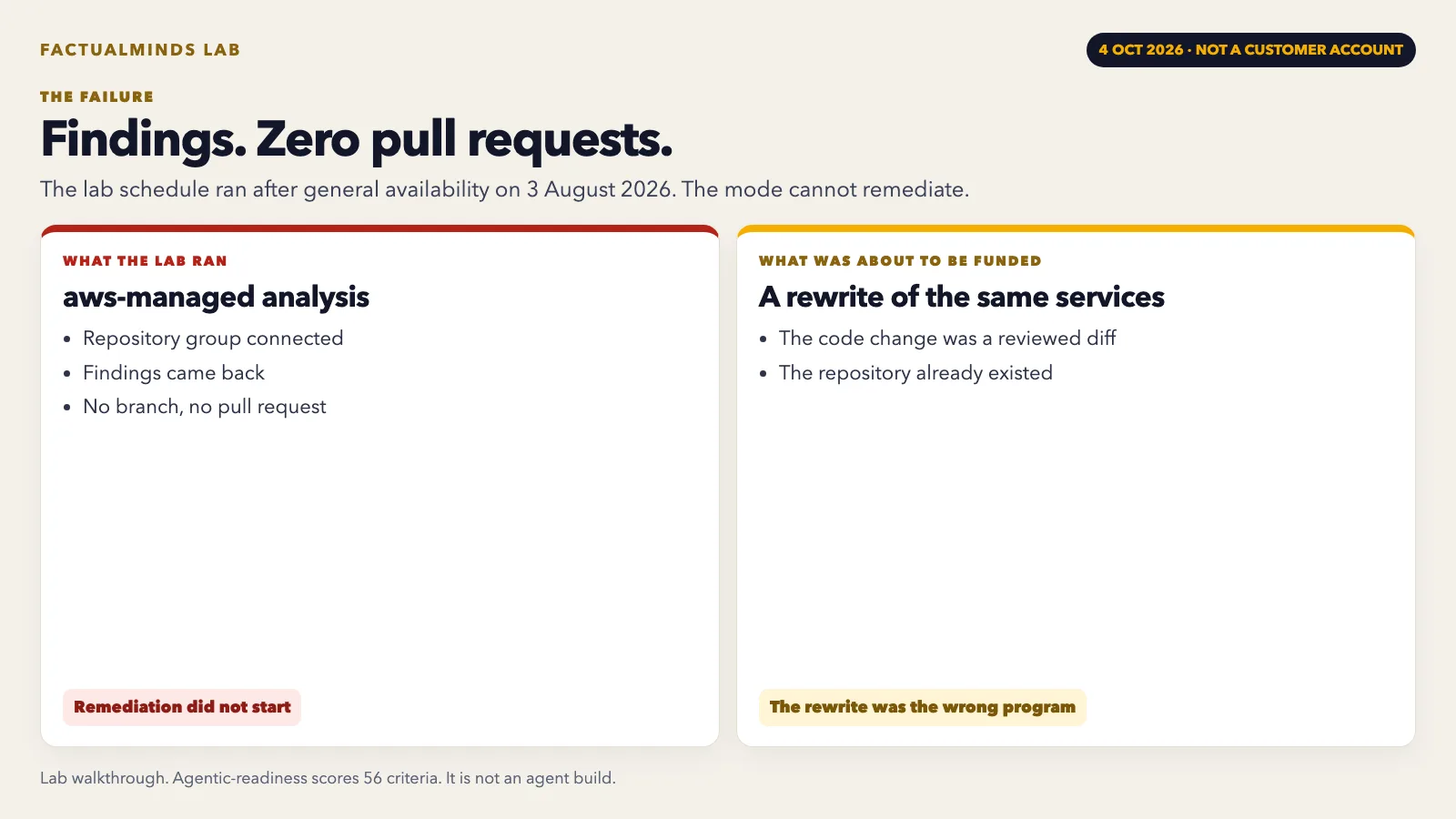
Table of Contents
The lab repository group had findings and zero pull requests. Analysis had been submitted with --mode aws-managed on a schedule dated after 3 August 2026, when continuous modernization became generally available in every region where AWS Transform is supported. The user guide says that mode runs analyses only. Remediation never started. The other proposal in the room was a funded rewrite of the same services. The rewrite was not required. The compute mode was.
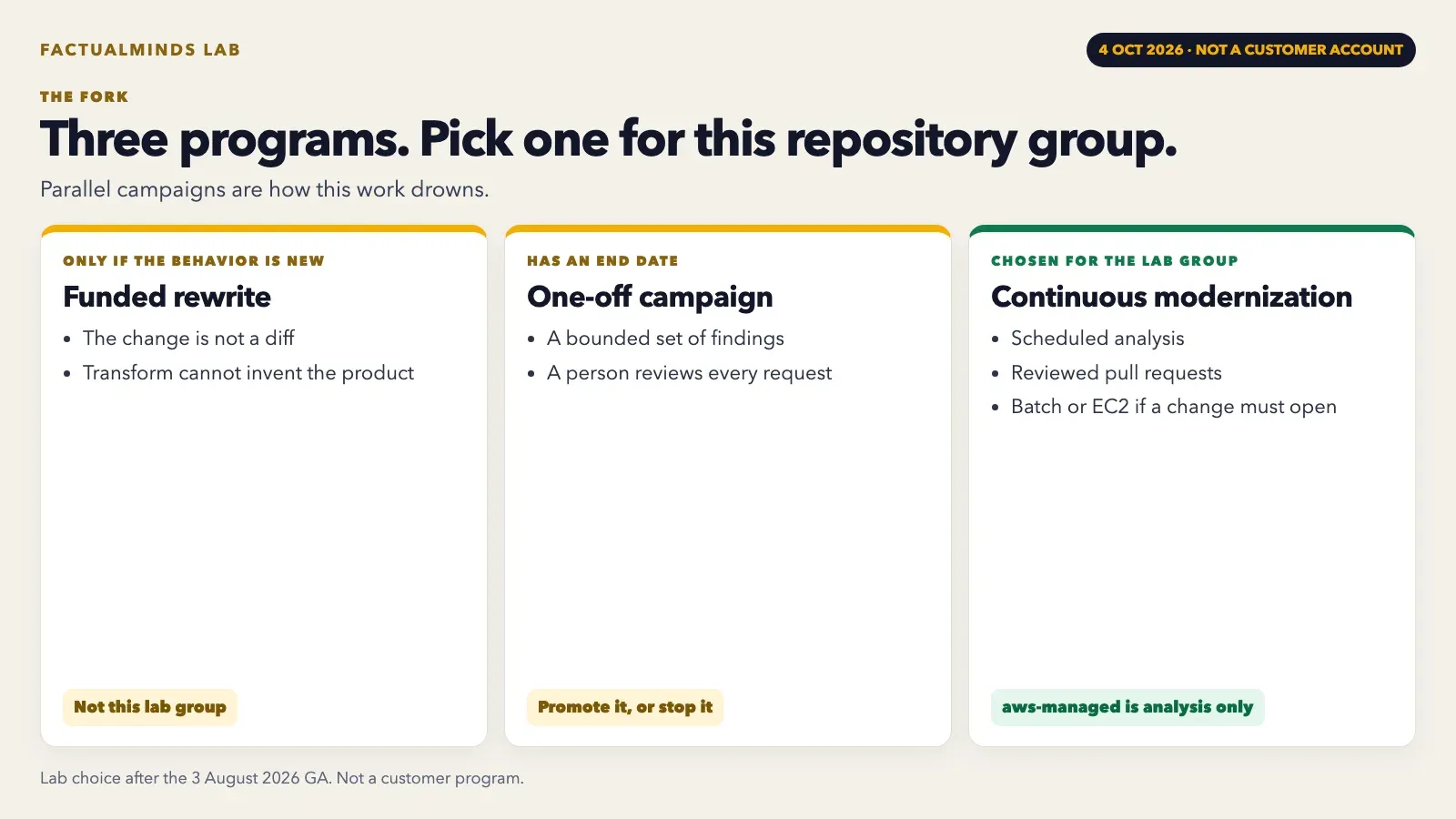
Lab figure, 4 October 2026. Not a customer account. One repository group, one program. Remediation still means Batch or EC2.
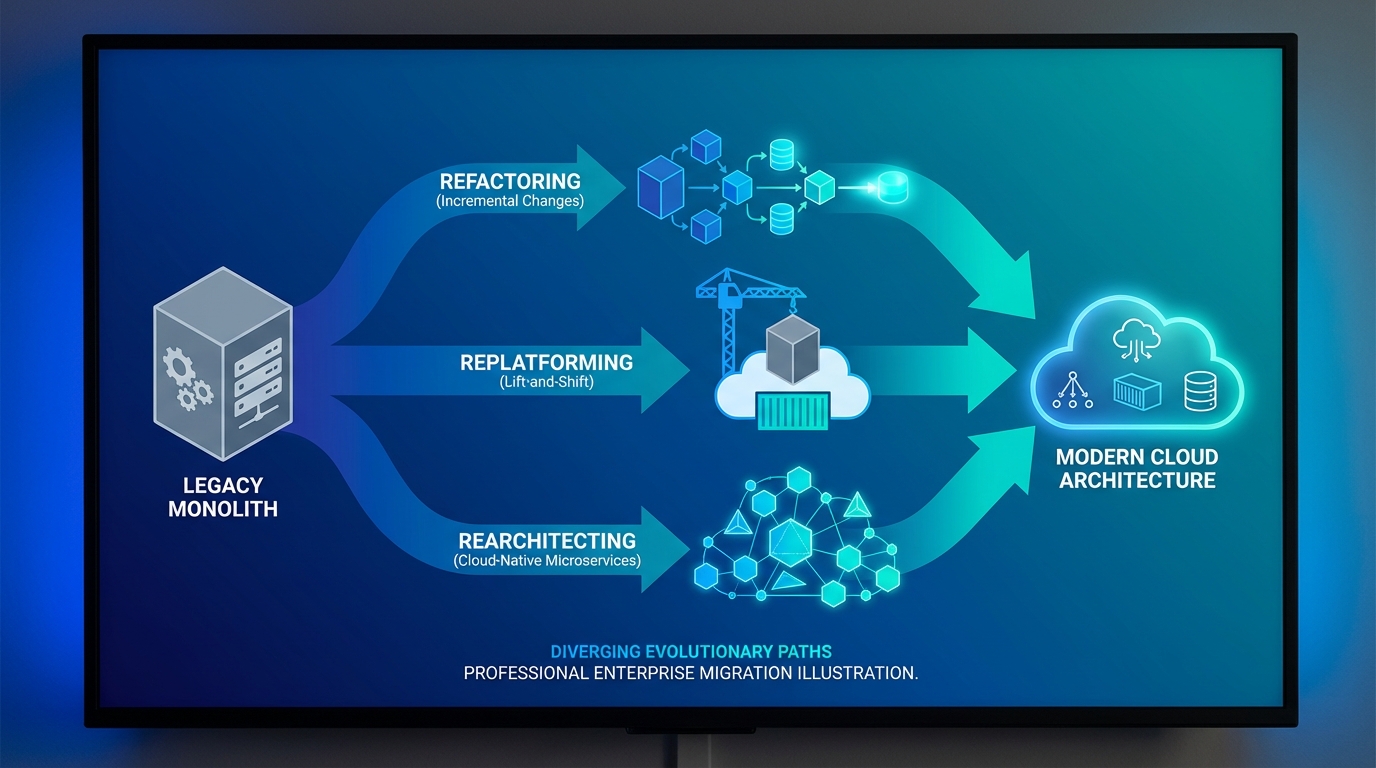
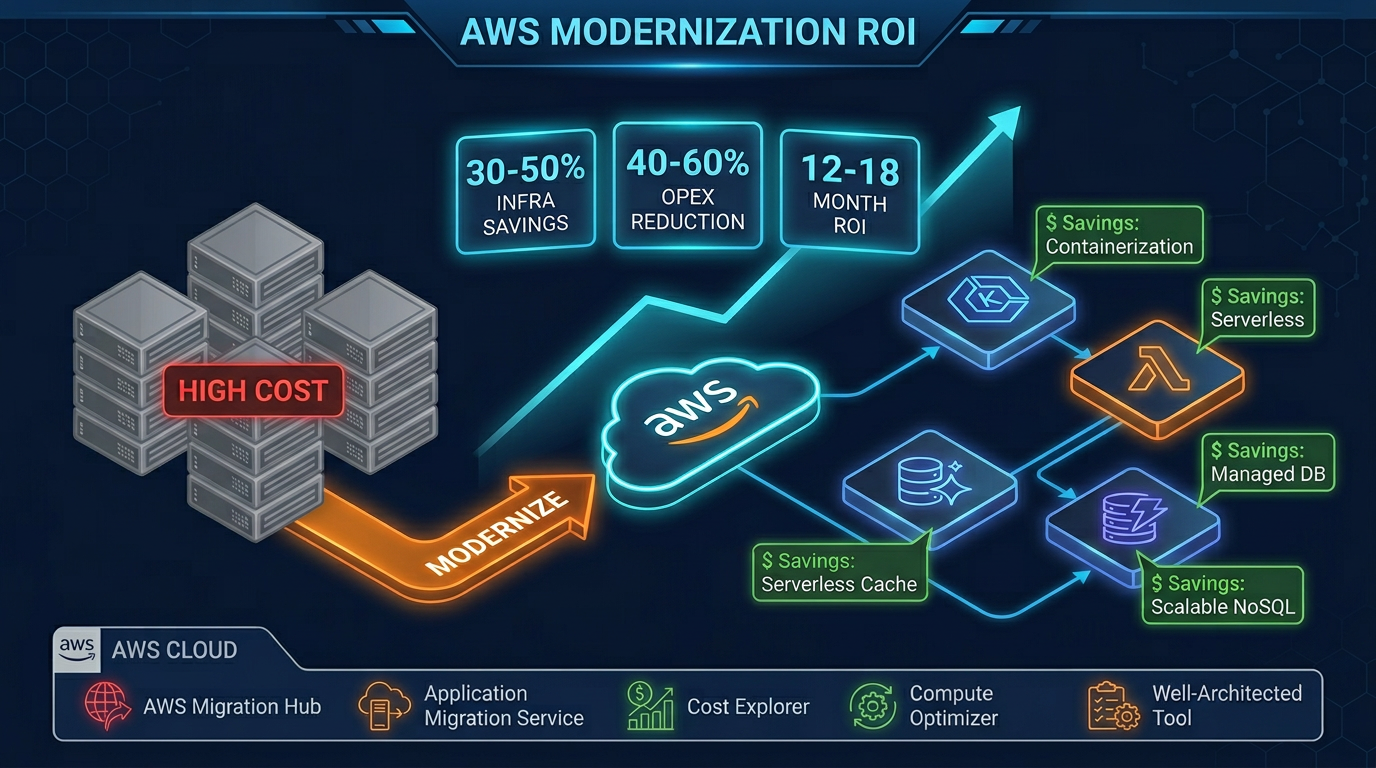
A June 2026 preview had been limited to US East (N. Virginia) and Europe (Frankfurt). The path decision is already written: refactor, replatform, or rearchitect, and the board ROI post. This article starts after the path is “change the source.” It does not redraw the 7 Rs.
The product connects GitHub organizations, GitLab groups (including self-hosted), and Bitbucket workspaces, plus local git directories. It runs analyses on demand or on a daily, weekly, or monthly schedule. For a finding that has a remediation, it opens a branch and a pull request or merge request. The user guide is the source for the limits below. Amazon Q for Developers remains the page for the Java and .NET product mention. This article does not restate it.
Reproduce this — Copy the program-choice worksheet. Score one repository group, not the whole company, before you fund a rewrite.
Three programs
Pick one primary program for a repository group. Parallel campaigns are how this work drowns.
Funded rewrite. The change is a new domain model, a contract the current code does not express, or a behavior you cannot accept as a diff. Transform can score modernization readiness. It cannot invent the product. Choose a rewrite when a reviewed pull request would still be the wrong change. The trade-off is calendar and staff. A rewrite that exists because the team has not connected the repository is not this program.
One-off Transform campaign. A bounded set of findings, an end date, and a human review on every pull request. Use it for a runtime or framework move that has a transformation definition and a finish line. When the campaign ends, either stop or promote the schedule into the third program. A campaign with no end date is continuous modernization wearing a project code.
Continuous modernization. Tech-debt operations. Connect the source, discover repositories, label them, run a recurring analysis, and remediate findings a person reviews. The user guide’s analysis types are rapid-techdebt-analysis (manifests only: pom.xml, package.json, requirements.txt), tech-debt-comprehensive, security, agentic-readiness, modernization-readiness, and custom. Agentic-readiness scores 56 criteria across five categories: Infrastructure and Platform, Application Architecture, Data Foundations, Identity/Security/Governance, and Operations and Observability. That score is an analysis. It is not an agent, and it is not a case study.
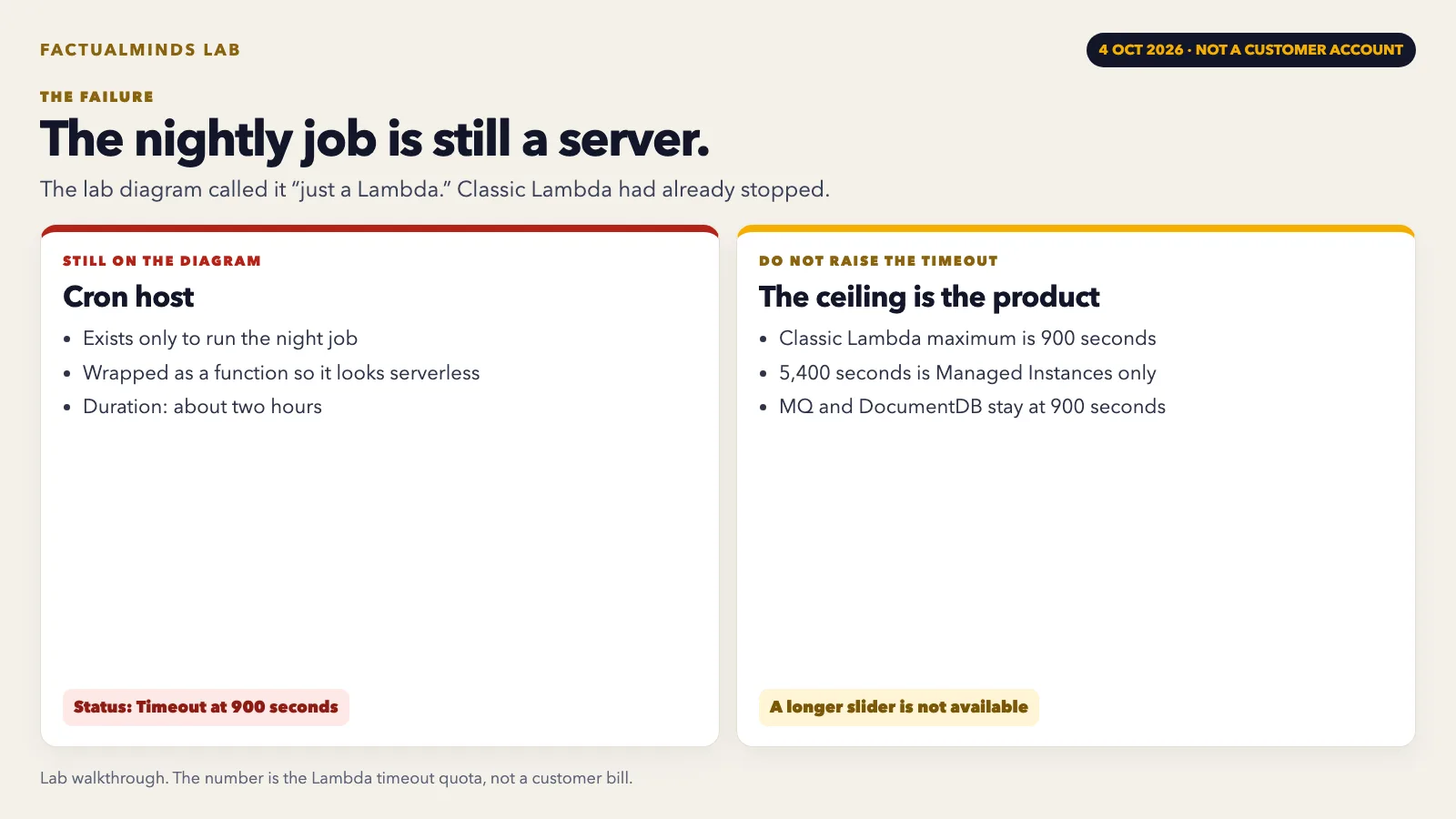
We recommend continuous modernization over a funded rewrite when the unit of change is a reviewed diff in a repository you already have. We recommend the rewrite when the unit of change is a behavior the repository does not contain. The trade-off is that continuous modernization will not retire a database, a cron host, or a missing test suite.
What general availability includes
From the 3 August 2026 announcement and the user guide, as checked on 4 October 2026:
- Sources: GitHub, GitLab, Bitbucket, and local repositories. Discovery can label repositories by team, priority, or wave.
- Findings carry severity (high, medium, low) and status (open, dismissed, obsolete). Re-analysis marks resolved findings obsolete.
- Remediation modes: findings-based, a transformation-definition override, or a direct transformation with no finding. Output is a GitHub pull request, a GitLab merge request, a Bitbucket pull request, or a local branch.
- Custom analysis runs a transformation definition (
--type custom). List definitions withatx custom def list. Authoring a definition is not this article. - Schedules use EventBridge Scheduler through
atx ct schedule, on a daily, weekly, or monthly cadence. - Analysis and remediation run with your credentials. Source code stays in your control.
Security analysis needs a one-time infrastructure setup. The other analysis types do not all share that prerequisite. Read that section before you promise a security scan in week one.
Compute is part of the decision
The user guide separates four places the work can run:
| Mode | What it is for | Stop |
|---|---|---|
| Local (default) | Trying the tool, a small repository, one person | A portfolio. Your laptop is not the schedule. |
AWS Transform-managed (--mode aws-managed) | Remote analysis with nothing to provision | Remediation, a custom transformation definition, or a repository that is only on disk. The guide says this mode runs analyses only. |
| AWS Batch on Fargate (recommended) | Analyses and remediations for most portfolios, isolated jobs | You have not provisioned the stack, or you expected zero setup. Least privilege on an existing stack is the managed policy AWSTransformInfrastructureExecutorAccessBatch. |
| Amazon EC2 | A persistent instance for larger or recurring work | You wanted serverless scale-out. The instance stays up between submissions. |
The 3 August announcement says you can run analyses locally or remotely using Amazon EC2 or AWS Batch. The user guide is stricter about the managed mode: it is the no-setup analysis path, and it is not the remediation path. Use the guide when those two sentences seem to conflict.
Where this fails
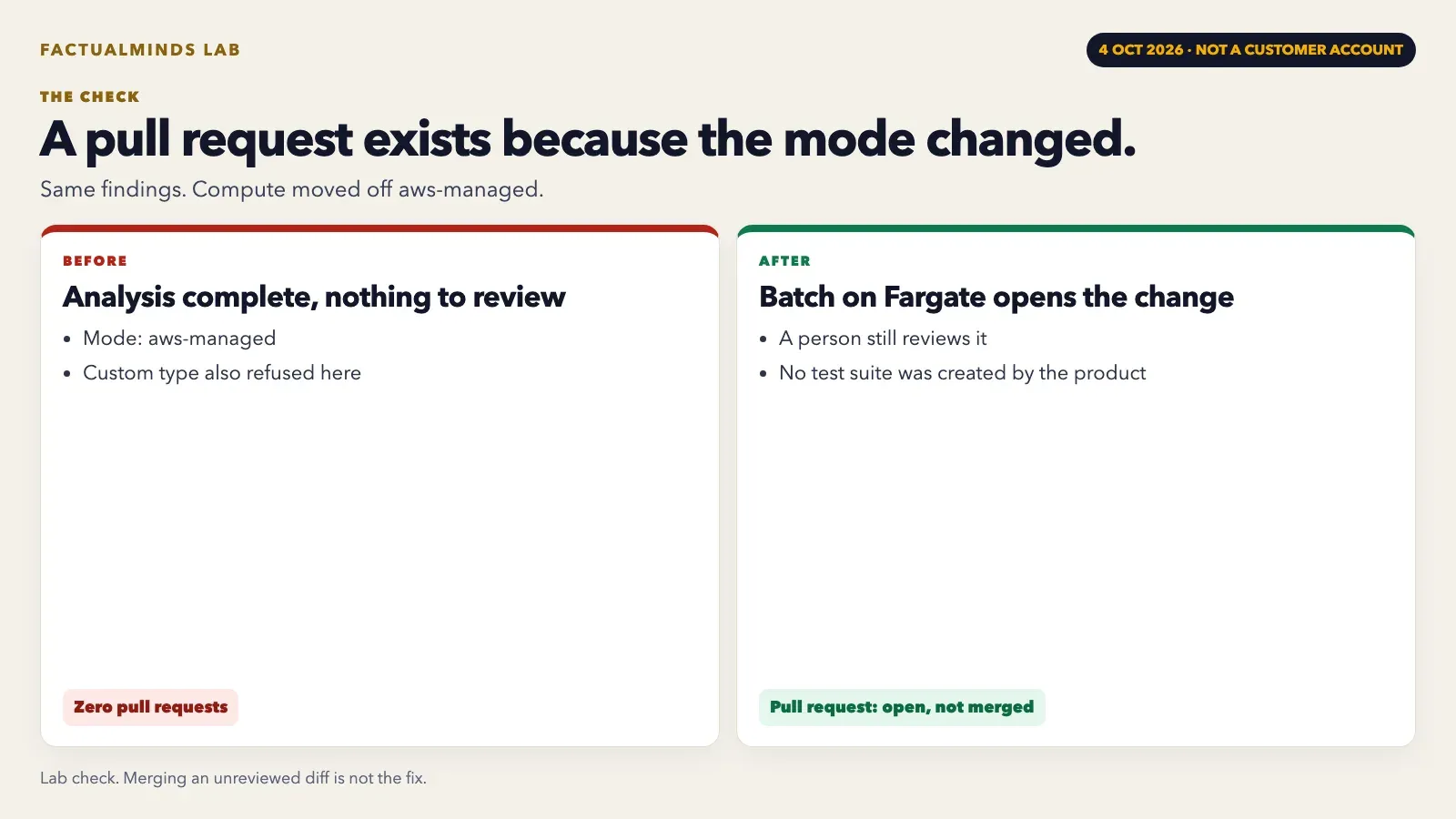
Lab figure, 4 October 2026. Not a customer account. The check is an open pull request after the mode change. It is not a merge, and it is not a rewrite.
A team submits analysis with --mode aws-managed, sees findings, and then asks for pull requests. The user guide’s rule is the failure: managed infrastructure does not run remediation, and it does not run --type custom. The schedule can be green and the repository can have zero pull requests. Detection is the mode, not the finding count. The fix is AWS Batch or Amazon EC2 for any step that must open a change, then a person reviews the request. Do not “fix” it by merging unreviewed diffs.
The second failure is a rewrite funded because agentic-readiness returned a low score. The 56 criteria describe whether an agent could call the system. They do not authorize an autonomous rewrite. The seams that make an old system callable are a different article, and it is not this one. The primitives checklist is the place to delete a cron host. Transform will not delete it for you.
What to Do This Week
- Name one repository group. Do not connect the company on day one.
- Pick the program: rewrite, one-off campaign, or continuous schedule. Write the end date if it is a campaign.
- If the program is Transform, pick compute before the first scheduled run. Remediation means Batch or EC2, not aws-managed.
- Run one analysis type first.
rapid-techdebt-analysisdoes not read source. Do not report it as a code review. - Require review on every generated pull request. If the repository has no tests, the program does not create them.
- Take a program that spans estates to application modernization.
What This Post Doesn’t Cover
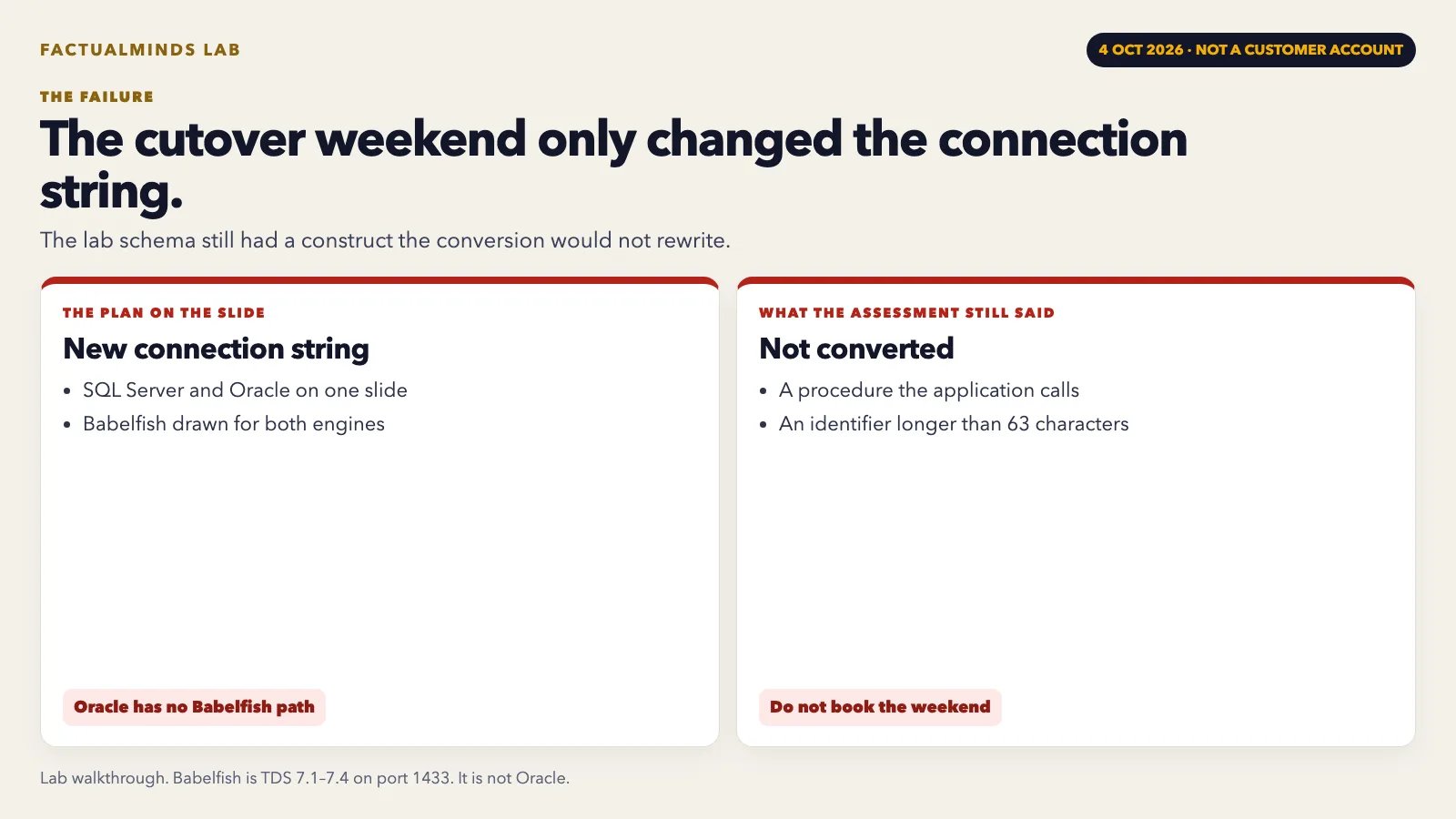
The catalog of AWS Transform capabilities (mainframe, VMware, network, runtime, custom, continuous) is which AWS Transform capability. This page is only continuous modernization versus a rewrite. It does not rank EVS against MGN, does not move a database, does not design a strangler, and does not claim hours saved. Custom transformation authoring is a separate how-to. Region availability changes; confirm the region list before you promise a Region.
Frequently asked questions
Should we fund a rewrite or run AWS Transform continuous modernization?
Run continuous modernization when the code can be analyzed on a schedule and a human can review the pull requests. Fund a rewrite when the change is a new domain model, a seam the transformer cannot see, or a test suite you do not have. A one-off Transform campaign sits between them: a bounded set of findings with an end date, not a standing operating cadence.
When should we not use AWS Transform-managed compute?
Do not use it for remediation or for a custom transformation definition. The user guide states that AWS Transform-managed infrastructure runs analyses only. Remediation, and a custom type, require AWS Batch (Fargate) or Amazon EC2. It also cannot read a repository that exists only on your laptop.
What could go wrong if we treat a pull request as a merge?
The product opens a branch and a pull request or merge request for findings that have a remediation. A person still reviews it. Merging without the tests the repository does not have ships the transform's diff. Continuous modernization does not create the test suite.
Does this replace refactor versus replatform versus rearchitect?
No. That decision, and the modernization ROI post, still choose the path. This article is the operating model after the path is refactor of source code. It is not a second 7 Rs matrix.
Does continuous modernization move the database or peel a strangler seam?
No. It connects GitHub, GitLab, or Bitbucket, analyzes repositories, and can open reviewed pull requests. A database migration and a runtime seam are other projects. Agentic-readiness is an analysis type with 56 criteria. It is not an agent build.
Which AWS Transform product is this?
Continuous modernization, generally available on 3 August 2026, in the regions where AWS Transform is supported. Mainframe, VMware, network, and the other capabilities are a different decision, covered by the capability catalog. Do not treat this launch as the whole of AWS Transform.
AWS Cloud Architect & AI Expert
AWS-certified cloud architect and AI expert with deep expertise in cloud migrations, cost optimization, and generative AI on AWS.