Amazon SES for eCommerce: Scaling Promotional and Transactional Email That Actually Reaches the Inbox
Quick summary: Amazon SES is the most cost-effective email infrastructure for high-volume retail sending — but inbox placement requires dedicated IPs, proper authentication, and automated bounce handling. Here is how to do it right.
Key Takeaways
- Amazon SES is the most cost-effective email infrastructure for high-volume retail sending — but inbox placement requires dedicated IPs, proper authentication, and automated bounce handling
- A well-configured email infrastructure means every promotional send, order confirmation, and abandoned cart recovery reaches the inbox
- Amazon SES is the right infrastructure choice for retail email at scale
- But "setting up SES" and "setting up SES for reliable inbox placement" are two different projects
- A promotional email with 20% open rate that goes to spam for 30% of your list is actually a 14% open rate campaign
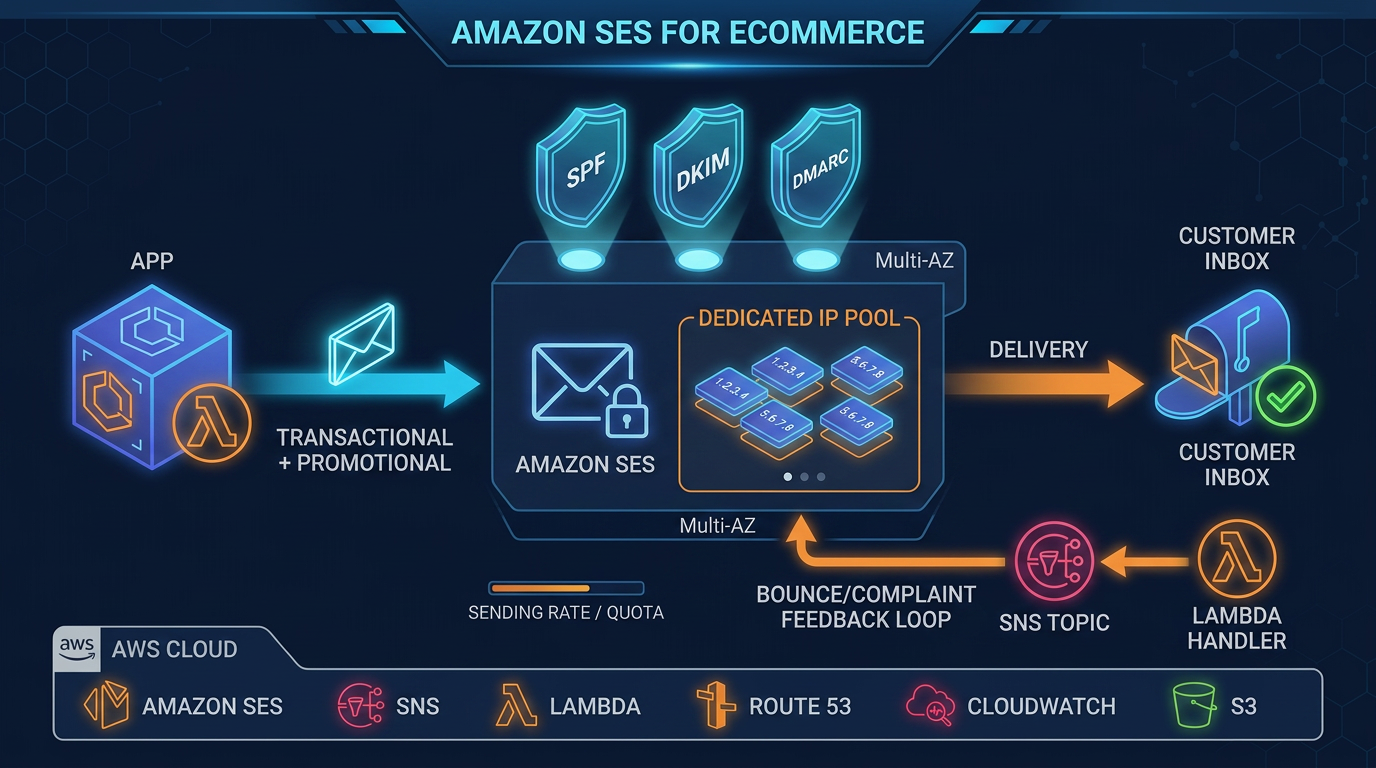
Table of Contents
Email is still the highest-ROI marketing channel in retail. A well-configured email infrastructure means every promotional send, order confirmation, and abandoned cart recovery reaches the inbox. A poorly configured one means your campaigns go to spam — or worse, you get blacklisted mid-send during a major promotional event.
Amazon SES is the right infrastructure choice for retail email at scale. But “setting up SES” and “setting up SES for reliable inbox placement” are two different projects.
Why eCommerce Email Deliverability Is a Revenue Problem
Inbox placement rates directly affect campaign revenue. A promotional email with 20% open rate that goes to spam for 30% of your list is actually a 14% open rate campaign. At scale, that gap between measured open rate and actual inbox delivery represents real revenue — the customers who would have converted if they had seen the email.
The deliverability problem is compounding. If your bounces, complaints, or spam placements climb above threshold levels at major inbox providers, your sending reputation deteriorates. Deteriorating reputation further reduces inbox placement. The spiral is difficult to reverse once it starts.
For transactional email — order confirmations, shipping notifications, password resets — deliverability failure has direct customer service consequences. A customer who does not receive their order confirmation calls support. At scale, that is measurable support cost tied directly to email infrastructure.
Until May 29, 2026 the gap between “open rate measured” and “open rate possible if every send reached the inbox” had to be estimated from third-party seed lists. SES Virtual Deliverability Manager now reports inbox placement rates per sending domain and campaign (sampled from representative industry data) and surfaces industry blocklist activity in every commercial AWS region where SES runs. For a retail team, that is the difference between guessing how much promotional revenue went to the spam folder and seeing it in the deliverability dashboard the morning after a send.
SES vs. SendGrid vs. Mailchimp for High-Volume Retail Sends
The comparison matters for retail teams deciding where to invest in email infrastructure.
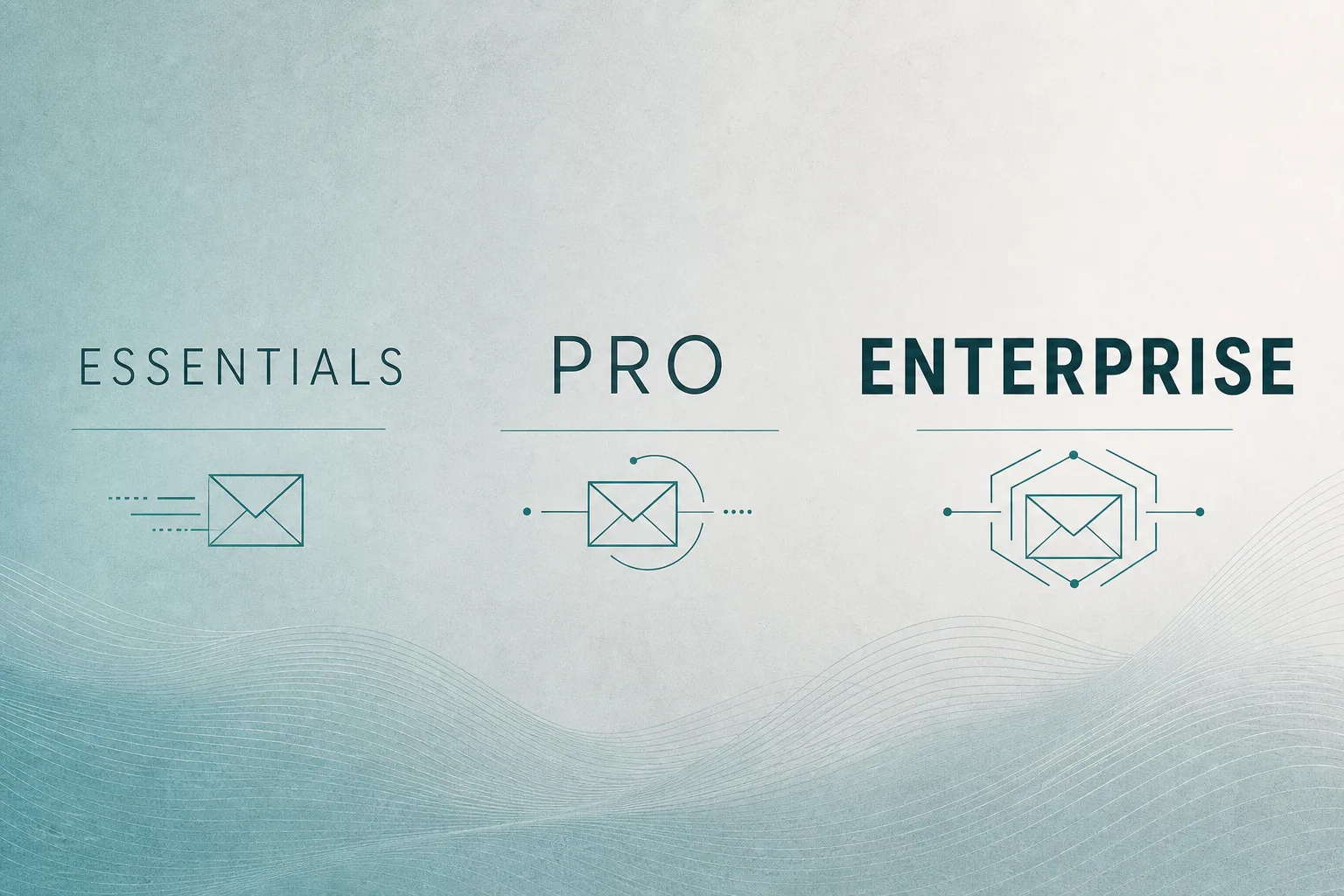
Amazon SES a-la-carte outbound is still $0.10 per 1,000 emails — for context, 10 million send-only emails is about $1,000 in SES send fees versus $20,000–$50,000 on many commercial ESPs at equivalent volume. As of July 21, 2026, SES also offers Essentials / Pro / Enterprise pricing plans: higher per-1k rates plus Pro $105/account/region/month or Enterprise $500 when you need bundled managed dedicated IPs, Global VDM, tenants, or Global Endpoints. See the SES pricing plans guide. The trade-off versus a full ESP remains: SES requires more configuration work upfront (auth, bounce handling, stream isolation) unless you buy a plan that includes the deliverability stack.
SendGrid and Mailchimp offer managed deliverability infrastructure at significantly higher per-email cost. They make sense for lower-volume senders who need campaign-management UI, not for retail platforms sending 10M+ emails per month where the cost differential is material.
For eCommerce teams sending high-volume promotional email, building on SES with proper configuration (and Pro when managed DIPs + Global VDM matter) delivers better economics and comparable deliverability to commercial ESPs — with tight AWS integration for event-driven transactional email.
Setting Up Dedicated IPs for eCommerce Sending
Shared SES IP pools assign sending reputation across all accounts using those IPs. If another account on your shared pool triggers a spam complaint spike, your sending reputation is affected. For retail senders where deliverability is a revenue issue, dedicated IPs are not optional.
Dedicated IPs in SES still cost about $24.95 per IP per month a-la-carte (or managed DIP fees). Pro and Enterprise plans include managed dedicated IP capacity — do not assume SES “eliminates” IP charges on bare a-la-carte. For high-volume retail senders, IP isolation is still cheap relative to the revenue protection it provides.
The configuration involves requesting dedicated IPs through the SES console, associating them with a configuration set, and routing your sending traffic through that configuration set. The more important part is what happens next: IP warm-up.
Automating Bounce and Complaint Handling
Automated bounce and complaint processing is mandatory for inbox placement. Label the ceilings carefully: SES can suspend accounts around a ~0.1% complaint rate via SES feedback; Gmail Postmaster spam rate should stay under 0.10% (degrades earlier ~0.08%); published Google/Yahoo bulk-sender guidance also cites staying under 0.3% spam complaints. Do not treat these as one number.
The correct SES architecture routes all delivery events through Amazon SNS topics: one for bounces, one for complaints, one for delivery confirmations. SNS delivers these events to SQS queues. Lambda functions process the queues and suppress problematic addresses in real time, before the next send goes out.
This automation prevents your suppression list from falling behind your sending list — which is what causes complaint spikes. Without automated handling, a hard-bounce address stays on your list until someone manually removes it. With automation, it is suppressed within seconds of the first bounce event.
If you are a marketing-automation platform sending on behalf of multiple retailers — the same engagement shape as the TargetBay case study below — the June 1, 2026 tenant-level suppression list release matters. Configure the Lambda processor to call PutSuppressedDestination with a TenantName parameter so a complaint storm against one retailer’s holiday campaign does not silence transactional sends for the rest of the roster. The same applies to multi-brand retail groups running separate brands out of a single AWS account.
2024–2026 Bulk-Sender Bars + One-Click Unsubscribe
Retail promo volume almost always crosses the ~5,000 emails/day bulk-sender line to consumer mailboxes. Treat these as table stakes in 2026:
- Authentication — SPF + DKIM + DMARC with alignment (minimum
p=none; plan toward enforcement for BIMI). - One-click unsubscribe (RFC 8058) — marketing/bulk streams must include
List-UnsubscribeandList-Unsubscribe-Postheaders. SES does not add these for you; put them in templates or send code and honor POST unsubscribe within two business days. - Mailbox-provider bars — Google/Yahoo (Feb 2024) plus Microsoft Outlook consumer enforcement (May 5, 2025). Monitor Gmail Postmaster spam rate separately from SES complaint metrics.
- Stream isolation — promotional vs transactional on separate configuration sets (and ideally separate dedicated IP pools). A holiday promo complaint spike must not poison order-confirmation IPs.
When dedicated IPs and Global VDM are non-negotiable for peak season, model SES Pro against stacking a-la-carte managed DIP + VDM fees (pricing plans).
Lifecycle Triggers Without an ESP Builder
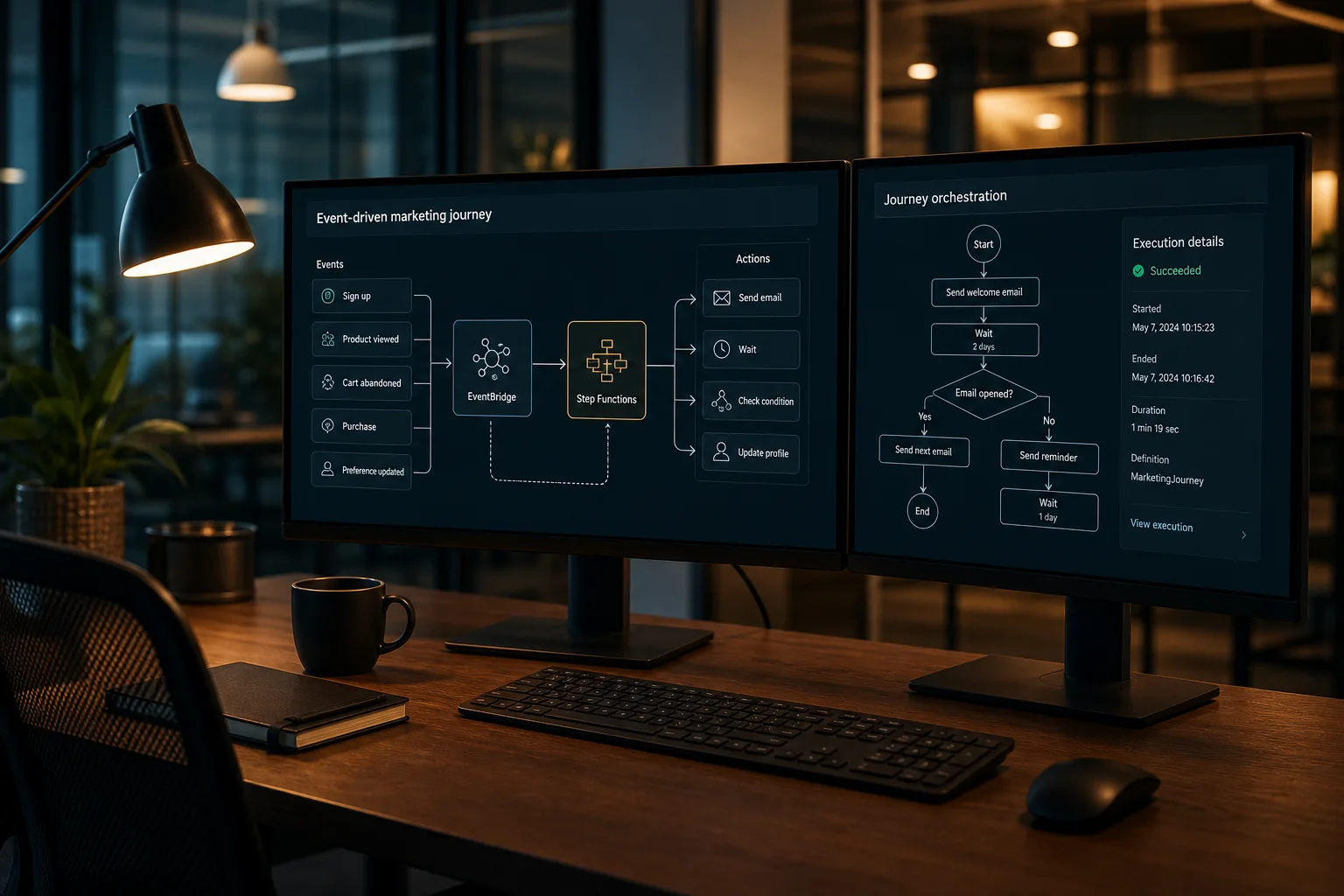
Abandoned cart, browse abandonment, and post-purchase drip sequences do not require SendGrid/Mailchimp automation UIs. On AWS, a common pattern is EventBridge (order/cart events) → Step Functions (waits, branches, suppression checks) → SES (configuration set per stream). Keep the contact store in DynamoDB/RDS; keep marketing-team visual builders on Customer.io/Loops/Klaviyo if marketers need them — hybrid is fine. Details in Marketing automation on AWS with SES.
Send-Time Tracking Consent, Bot Opens, and App Deep Links
Previous approach: one configuration set per combination of open-tracking and click-tracking, and every Open/Click event counted as human engagement. Mobile apps that needed Universal Links / App Links often disabled SES click tracking so the path prefix would match.
What AWS changed in August 2026:
- August 21 — tracking overrides.
ConfigurationOverridesonSendEmailandSendBulkEmailenable or disable open and click tracking per request, taking precedence over the configuration set. No extra charge. AWS positions this for recipient-level consent (GDPR, CNIL). SES does not store consent for you — your app still decides which recipients get tracking on (What’s New). - August 7 —
isBotEvent. Open and Click events published to SNS or Firehose now includeisBotEventofLikelyorUnlikely. If you already publish those events, the field appears automatically (What’s New). - August 14 —
ses:custom-path. On a custom click-tracking domain, addses:custom-pathto<a>tags so tracking URLs use/CL1/{yourpath}/…instead of/CL0/…, matching iOS Universal Links and Android App Links without turning tracking off (What’s New). The path is not in click event data — useses:tagsfor analytics.
When this matters: EU promotional lists with mixed tracking consent; retail open-rate dashboards inflated by prefetch bots; branded apps that must deep-link from email.
When it does not: a single-policy list that already tracks everyone the same way, no mobile app, and VDM inbox placement (not open rate) as the primary KPI.
Do not treat isBotEvent as a legal determination. It is a signal. Subtract Likely bots from human engagement reports; keep using VDM inbox placement for “did it reach the inbox.”
IP Warm-Up: The Step Most Teams Skip
New dedicated IPs have no sending history. Major inbox providers do not know whether the IPs are trustworthy. Sending at full volume from a cold IP triggers immediate spam filtering — your first large campaign would go directly to spam for most recipients.
IP warm-up is the process of gradually increasing sending volume over several weeks, starting with a small percentage of your most engaged subscribers (recent openers and purchasers), and growing volume as positive engagement signals (opens, clicks) accumulate and inbox providers recognize the IPs as legitimate.
A typical warm-up schedule:
- Week 1: 1,000–2,000 emails per day
- Week 2: 5,000–10,000 per day
- Week 3: 25,000–50,000 per day
- Week 4: 100,000–200,000 per day
- Weeks 5–8: Scale to full volume
The key is sending to your most engaged segments during warm-up. High engagement on warm-up sends builds reputation faster and creates headroom for the inevitable lower-engagement promotional sends that follow.
Case Study: Scaling to 200M Emails Per Month for an eCommerce Marketing Platform
TargetBay, a marketing automation platform serving eCommerce retailers, needed to scale to over 200 million emails per month with consistent inbox placement for both transactional and promotional sends.
FactualMinds designed and implemented a production-grade SES infrastructure that covered every layer: sandbox removal and production access approval, dedicated IP provisioning and phased warm-up over six weeks, SPF/DKIM/DMARC domain authentication across all sending domains, and automated bounce and complaint handling using SNS, SQS, and Lambda.
CloudWatch dashboards monitored bounce rate, complaint rate, and inbox placement continuously, with automated alerts when any metric approached risk thresholds. The system was designed to support TargetBay’s growth without requiring ongoing manual reputation management.
The result was a scalable, 200M+ emails per month infrastructure with improved deliverability, managed sender reputation, and automated compliance with major inbox provider requirements.
For more on Amazon SES deliverability services, see our SES service page. For the full picture on AWS for retail, see our retail industry page. If the next question is which of these sends an agent should be allowed to trigger, start with cart abandonment recovery and post-purchase engagement in the eCommerce AI Agents series.
AWS Cloud Architect & AI Expert
AWS-certified cloud architect and AI expert with deep expertise in cloud migrations, cost optimization, and generative AI on AWS.