Retail Omnichannel Analytics on AWS (2026): Lakehouse, KPI Catalog, and Streaming Lanes
Quick summary: For a specialty retailer (~380 stores, 2.4M loyalty members), S3 Tables Iceberg silver plus Kinesis cart events cut dashboard refresh from 26 hours to 22 minutes — conversion reporting error dropped from 11% to 2%.
Key Takeaways
- For a specialty retailer (~380 stores, 2
- 4M loyalty members), S3 Tables Iceberg silver plus Kinesis cart events cut dashboard refresh from 26 hours to 22 minutes — conversion reporting error dropped from 11% to 2%
- Benchmark pattern (not a cited client) — Specialty retailer, ~380 stores, 2
- 4M loyalty members, Shopify Plus + legacy POS, nightly-only warehouse (dashboard refresh 26 hours)
- Phase 1: ERP/WMS → Glue → S3 Tables silver Iceberg
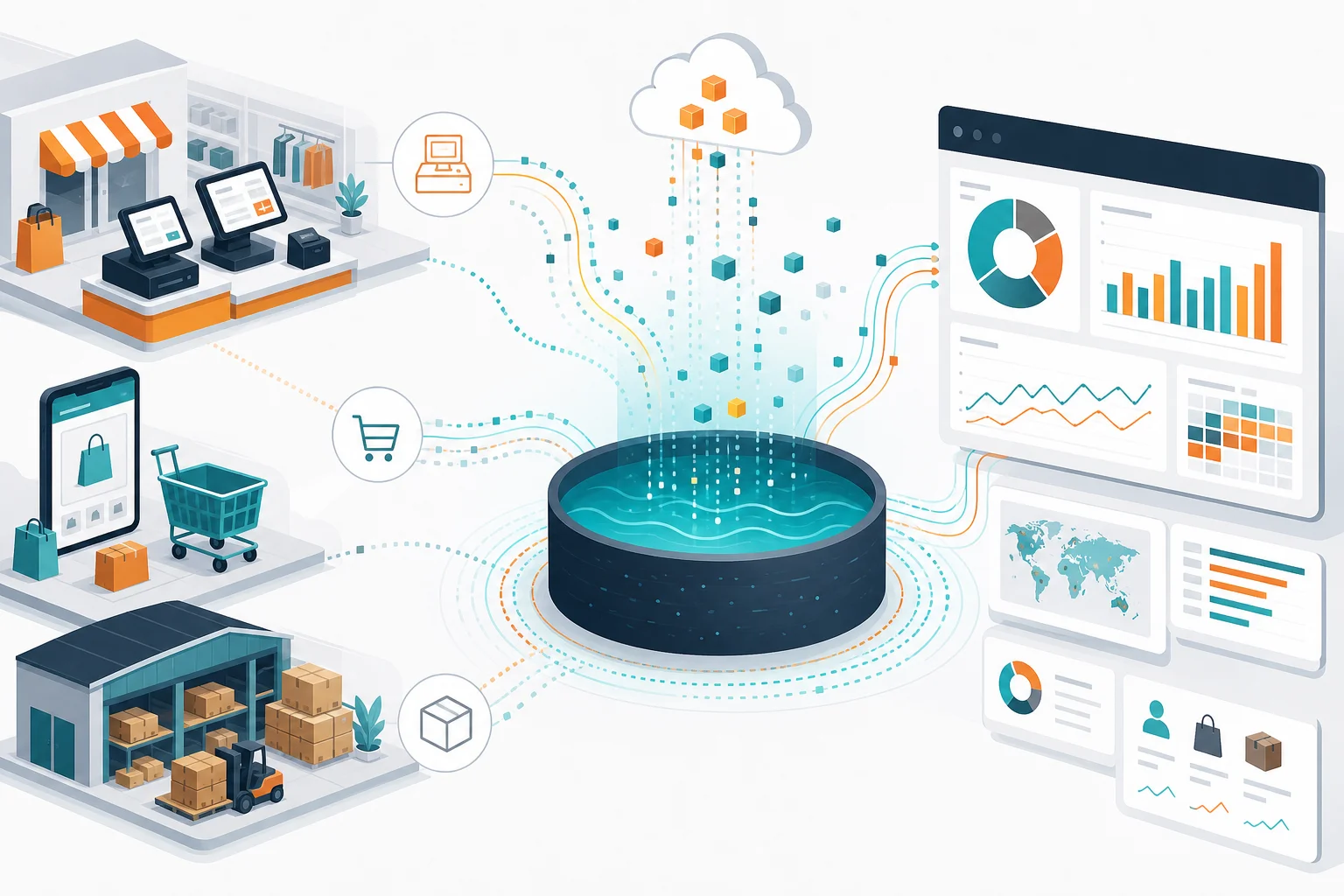
Table of Contents
Amazon S3 Tables is purpose-built managed Apache Iceberg storage — AWS documents up to 3× faster query performance and up to 10× more transactions per second versus self-managed Iceberg, with automatic compaction (S3 Tables features). For omnichannel retailers merging POS, e-commerce, loyalty, and WMS feeds, that compaction difference shows up as Athena bill stability during promotion weeks — not just query speed.
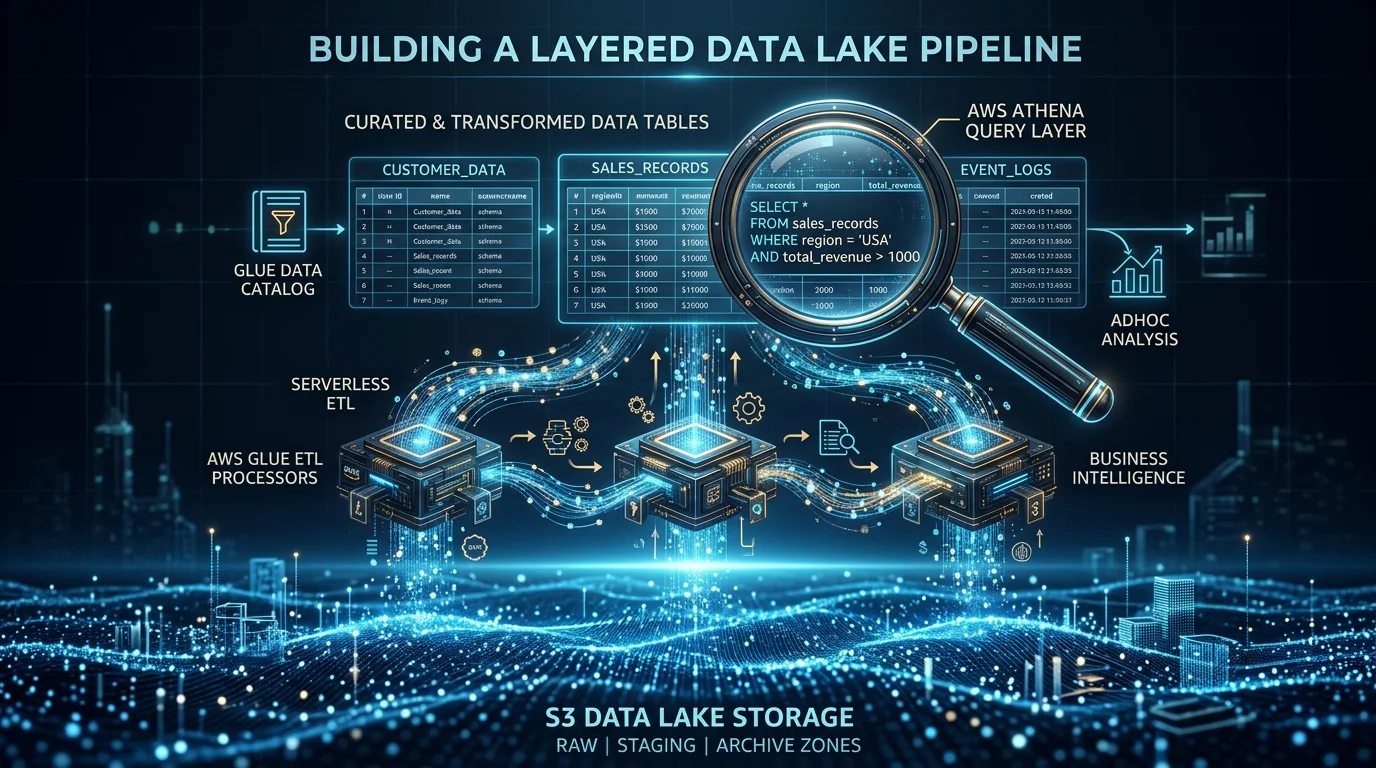
This post is the retail omnichannel analytics reference architecture — bronze/silver/gold lanes, streaming vs batch decision matrix, and a QuickSight KPI catalog. It is not retail peak traffic scaling, not the retail industry overview, not logistics supply chain, not PropTech MLS search, and not generic data lake setup (though you will reuse Glue patterns from there).
Artifacts: retail KPI catalog CSV, analytics lane decision matrix.
Benchmark pattern (not a cited client) — Specialty retailer, ~380 stores, 2.4M loyalty members, Shopify Plus + legacy POS, nightly-only warehouse (dashboard refresh 26 hours). Phase 1: ERP/WMS → Glue → S3 Tables silver Iceberg. Phase 2: cart + POS stream → Kinesis → Firehose → silver MERGE. Dashboard refresh 26h → 22 min; conversion reporting error 11% → 2% after identity resolution in silver.
Reference architecture
POS / stores ──────┐
E-commerce (Shopify)─┼──► Kinesis (real-time) ──► Firehose ──► S3 Tables bronze
WMS / ERP ─────────┘         │                           │
                             │                           ▼
Loyalty CRM ──► Glue batch ──┴──► S3 Tables silver (Iceberg)
                                        │
                                        ├──► Athena / Spark
                                        └──► QuickSight (SPICE + direct)
Opinionated take: Silver identity resolution before gold KPIs. Retailers that build gold conversion_rate on bronze web sessions without loyalty bridge tables ship dashboards the merchandising team stops trusting within one quarter.
Lane selection — streaming vs batch
Use analytics-lane-decision.md for full rules. Summary:
| Data product | Default lane | Rationale |
|---|---|---|
| Cart / browse events | Kinesis → Firehose | Sub-hour abandonment triggers |
| POS transactions | Kinesis or 15-min Glue | Store hours need near-real-time comp |
| ERP inventory | Daily Glue | Snapshot semantics |
| Loyalty tier | Daily Glue | Low change frequency |
| Campaign attribution | Hourly stream or batch | Depends on ad platform API cadence |
Silver layer — S3 Tables Iceberg
AWS Glue 5 + S3 Tables per AWS Big Data Blog Aurora-to-S3-Tables pattern:
-- Context: Athena engine v3, Iceberg table in S3 Tables namespace (July 2026)
CREATE TABLE retail_silver.order_events (
  event_id string,
  channel string,
  loyalty_id string,
  sku string,
  event_ts timestamp,
  revenue decimal(12,2)
)
PARTITIONED BY (day(event_ts))
TBLPROPERTIES ('table_type' = 'ICEBERG');
Partition on day(event_ts) for promotion-week pruning — see Athena Iceberg cost guide.
QuickSight KPI catalog
Import retail-kpi-catalog.csv as your dashboard backlog. Minimum viable executive set:
| KPI | SPICE or direct | Owner |
|---|---|---|
conversion_rate | SPICE (hourly refresh) | Merchandising |
cart_abandonment | SPICE | E-commerce |
sku_velocity | Direct query | Inventory |
loyalty_redemption_rate | SPICE | Marketing |
inventory_fill_rate | Direct query | Supply chain |
Wire Amazon Q in QuickSight only after KPI definitions are steward-approved — GenBI on ambiguous metrics amplifies distrust.
Identity resolution — the omnichannel hinge
What broke — Week 2 post-launch. Web
session_idjoined to POSreceipt_idvia email string match. 11% of transactions double-counted when households shared email; 6% dropped when POS masked emails. Detection:conversion_rateexceeded 100% for two store regions in QuickSight. Fix: silveridentity_bridgetable keyed onloyalty_idwithemail_hash(SHA-256 salted) as secondary — POS and web both emit loyalty scan when present. Rollback: reverted gold views to store-only channel reporting for 48h while bridge backfilled.
Cost guardrails
- Kinesis: 1 shard per ~1k writes/sec sustained; scale shards before Black Friday, not on the day
- S3 Tables: leverage managed compaction — still monitor Athena scanned bytes per KPI
- SPICE: cap datasets at 10M rows per QuickSight production guide; spill to direct query for SKU drill-down
What to Do This Week
- Inventory sources: POS, e-commerce, loyalty, WMS — document refresh latency today.
- Download retail-kpi-catalog.csv; assign owners to five KPIs.
- Stand up one Kinesis stream for cart events → Firehose → S3 Tables bronze — prove 22-minute refresh on a single dashboard.
- Build
identity_bridgebefore any omnichannel conversion metric. - Schedule daily row-count reconciliation: source vs silver.
Reproduce this — Clone KPI definitions from retail-kpi-catalog.csv. Apply lane rules from analytics-lane-decision.md to your source list. Track refresh latency before/after in a spreadsheet column.
What This Post Doesn’t Cover
- Demand forecasting with SageMaker Forecast — see logistics planning tier for adjacent patterns
- Retail peak traffic and auto-scaling — see Black Friday architecture
- Data governance council and catalog — see governance operating model
- Clean Rooms for retail media networks — see AWS Clean Rooms
We have not load-tested Kinesis shard limits above 8k events/sec for this silhouette — scale shard count using AWS calculator before Cyber Week.
Frequently asked questions
When should we use Kinesis vs nightly Glue batch for retail events?
Use Kinesis when any dashboard or trigger needs sub-hour latency — cart abandonment, same-day inventory allocation, flash-sale monitoring. Nightly Glue is sufficient for ERP inventory snapshots, loyalty tier changes, and category planning when SKU count is under ~50k and stores close books daily.
When should we NOT build a lakehouse for retail analytics?
Skip custom lakehouse when you have a single channel (stores only), one ERP extract satisfies all KPIs, and QuickSight SPICE on a nightly CSV is under 2M rows. The operational overhead of Iceberg compaction, stream consumers, and catalog governance is not justified below ~$80k/mo combined commerce revenue with omnichannel complexity.
What breaks when POS and web order IDs do not join?
Omnichannel conversion double-counts or drops — symptom: conversion_rate KPI swings 8+ points day-over-day with no campaign change. Fix: silver-layer identity resolution table (loyalty_id, email_hash, store_card_token) with explicit null handling; never join on raw email in bronze.
S3 Tables vs self-managed Iceberg on S3 — when does S3 Tables win?
S3 Tables wins when you want managed compaction, snapshot management, and higher transaction throughput without operating Iceberg maintenance jobs. Self-managed Iceberg on S3 is fine for mature data platform teams already running Glue 5 compaction schedules — see our Glue 5 Iceberg post.
When should we use QuickSight SPICE vs direct query?
SPICE for executive dashboards with bounded datasets and predictable refresh (conversion, loyalty, campaign ROAS). Direct query for SKU-level inventory drill-down where row counts exceed SPICE limits or freshness must match Athena within minutes.
What could go wrong with real-time retail pipelines?
Iterator age alarms ignored during promotions, Firehose delivery failures silently dropping cart events, and Iceberg small-file proliferation slowing Athena. Mitigate with EventBridge on stream lag, S3 Tables managed compaction, and row-count reconciliation between source and silver daily.
AWS Cloud Architect & AI Expert
AWS-certified cloud architect and AI expert with deep expertise in cloud migrations, cost optimization, and generative AI on AWS.