Media & OTT Streaming on AWS (2026): Live vs VOD Architecture, Egress Math, and When IVS Beats Elemental
Quick summary: On a composite mid-market OTT platform (~180k concurrent live peak, ~12 TB/month VOD catalog), routing Saturday-night live through MediaConvert batch queues added ~$4,200/mo in idle transcode capacity before switching live to IVS and keeping MediaConvert for catalog only. CloudFront egress still dominates steady-state — model it before you buy encoders.
Key Takeaways
- CloudFront egress still dominates steady-state — model it before you buy encoders
- AWS lifecycle notice (June 30, 2026) — Amazon Chime SDK Carrier Voice Focus reached end of support on June 30, 2026
- Use Chime SDK Voice or third-party telephony for new workloads
- This post is the video pipeline layer — not e-commerce peak traffic (HTTP cart scaling), not Kinesis vs MSK (event streaming analytics), and not CloudFront vs Cloudflare (CDN vendor comparison)
- 8k/mo modeled at ~22 TB delivered)
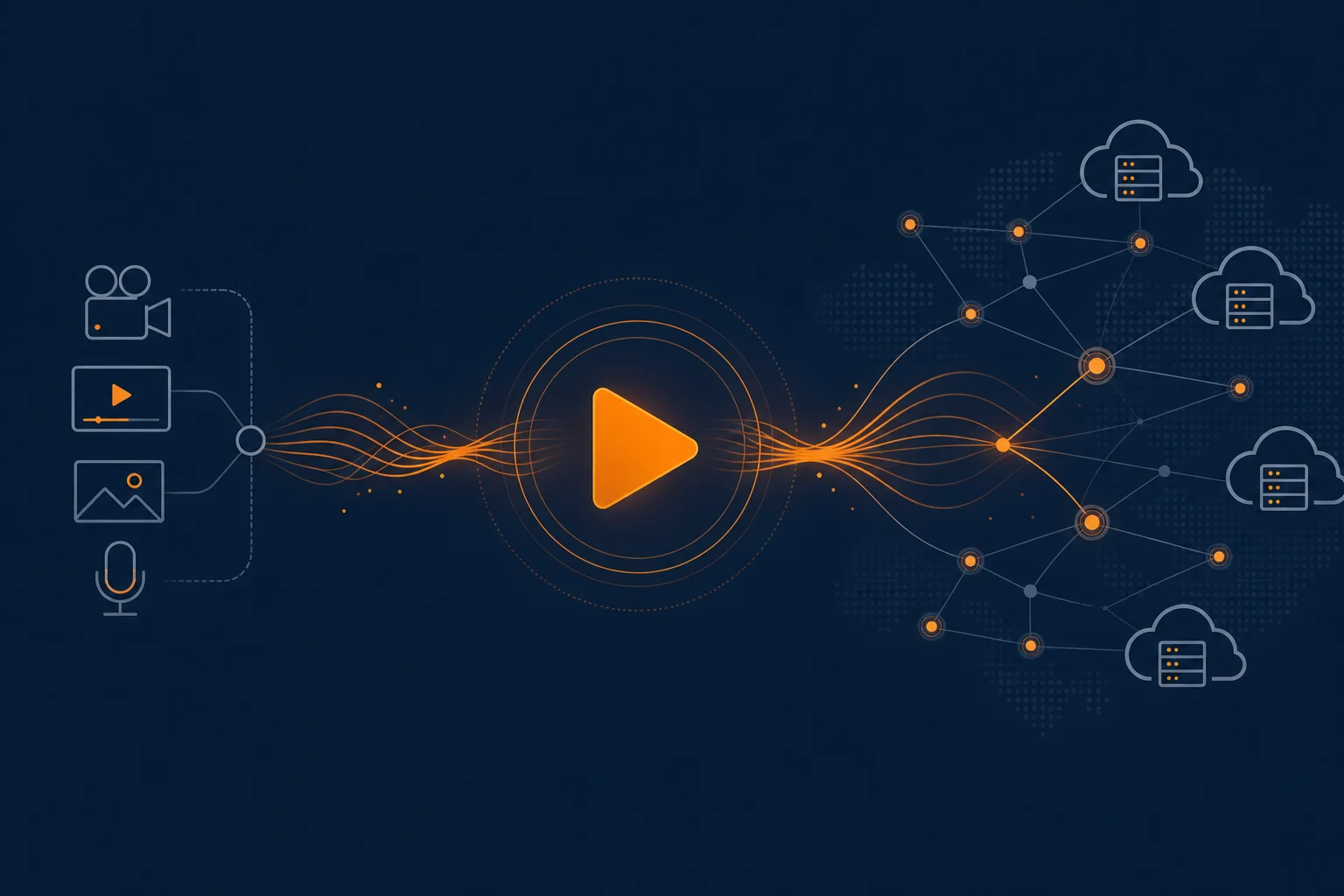
Table of Contents
AWS lifecycle notice (June 30, 2026) — Amazon Chime SDK Carrier Voice Focus reached end of support on June 30, 2026. Use Chime SDK Voice or third-party telephony for new workloads. Full matrix: lifecycle roundup.
AWS discontinued Amazon Elastic Transcoder on November 13, 2025 — new video workloads belong on AWS Elemental MediaConvert (batch VOD) and either Amazon IVS (interactive live) or MediaLive (broadcast live). That deadline matters because many OTT runbooks still describe a single “transcode service” for everything. Live and catalog are different jobs; billing proves it fast.
This post is the video pipeline layer — not e-commerce peak traffic (HTTP cart scaling), not Kinesis vs MSK (event streaming analytics), and not CloudFront vs Cloudflare (CDN vendor comparison). We ship a live vs VOD decision matrix, egress cost model CSV, DRM packaging checklist, and streaming pipeline draw.io.
Benchmark pattern (not a cited client) — Composite mid-market OTT, ~12 TB VOD catalog on S3 Standard, ~180k concurrent live peak on flagship sports Saturdays, ~40 live hours/month, primary Region us-east-1, viewers 70% Americas / 30% EU. Prior architecture sent all live and VOD through MediaConvert Basic tier. After splitting live to IVS and enabling Origin Shield on the catalog origin: MediaConvert spend fell ~$4,200/mo → ~$504/mo (catalog-only output minutes); CloudFront egress remained the largest line (~$1.8k/mo modeled at ~22 TB delivered). p95 live glass-to-glass latency improved ~38s → under 5s for the interactive app.
Four jobs — four mechanisms
| Job | Mechanism | Wrong default |
|---|---|---|
| Interactive live | Amazon IVS (low-latency) | MediaConvert batch for Saturday night |
| Broadcast / ad-insertion live | MediaLive + MediaPackage | IVS when you need SCTE-35 |
| VOD catalog | MediaConvert → S3 → package | Re-transcode live capture nightly |
| Global delivery | CloudFront (+ Origin Shield) | S3 website endpoint to viewers |
Opinionated take: IVS for interactive live; MediaLive for broadcast live; MediaConvert for catalog only. Syndication always terminates at CloudFront — price egress before codecs.
Live path: IVS vs MediaLive
Amazon IVS targets sub-5-second glass-to-glass for interactive experiences (AWS documents under 5 seconds for low-latency channels). Ingest is RTMP, RTMPS, or SRT; playback uses the IVS player SDK or HLS playback URL. Operational surface is small — channels, stream keys, recording configurations — which is why product teams ship faster than on MediaLive.
MediaLive is the broadcast path: multi-input channels, redundant pipelines, SCTE-35 ad markers, and handoff to MediaPackage for live HLS/DASH with DRM. Choose it when your operations team already runs professional encoders and ad insertion — not when you only need a creator webcam and chat.
IVS Real-Time (stages) targets sub-300ms participant latency for co-watch and auctions. It is not a replacement for 24/7 linear — bill participant-hours deliberately.
VOD path: MediaConvert and packaging
MediaConvert bills normalized output minutes with Basic vs Professional tiers (Professional for HEVC, AV1, multi-pass, DRM). Volume discounts apply per Region. Typical catalog flow:
- Mezzanine uploads land in S3 (or arrive from MAM export).
- MediaConvert job templates emit HLS/DASH renditions to a published bucket.
- Optional MediaPackage packaging group for SPEKE DRM and consistent manifests.
- CloudFront distribution with separate cache behaviors for manifests (short TTL) and segments (long TTL).
Context for a one-off probe — AWS CLI 2.x, us-east-1:
aws mediaconvert describe-endpoints --region us-east-1
aws mediaconvert list-jobs --max-results 5 --endpoint-url <ACCOUNT_ENDPOINT>
Egress math (where OTT budgets actually go)
Once catalog encoding is amortized, data transfer out via CloudFront dominates. The egress CSV models:
- Catalog-only replay factor (~1.3× catalog TB/month as delivered egress)
- Origin Shield incremental cost vs duplicate origin fetches
- Failure row: live misrouted through MediaConvert (output minutes explode)
Pair with data transfer traps when origin and analytics buckets sit in different Regions — video origins are not exempt from cross-Region charges on admin traffic.
What broke — Opening weekend for a licensed sports package. Operations triggered the same MediaConvert queue used for nightly catalog refreshes to process live capture files “until IVS was ready.” Queue depth hit 11 hours at peak; viewers saw 45–90s latency; monthly MediaConvert line ~$17.5k vs ~$700 baseline. Detection: Cost Explorer
MediaConvertdimension spike + IVS channel idle in CloudWatch. Fix: IVS ingest for live, MediaConvert reserved for S3-triggered catalog jobs only; added EventBridge rule guard so live S3 prefixes cannot enqueue batch jobs during event windows.
DRM and multi-CDN cautions
Premium catalogs need MediaPackage SPEKE with KMS-backed keys — see the DRM checklist. Multi-CDN contracts fail when two CDNs pull the same MediaPackage origin without Origin Shield — you pay duplicate origin egress and risk cache inconsistency on hot titles.
What to do this week
- Split live and VOD IAM and queue boundaries — no shared MediaConvert queue.
- Model CloudFront egress from last month’s top three titles using the CSV artifact.
- Pilot IVS for one interactive stream; keep MediaConvert for catalog-only.
- Enable Origin Shield on the catalog origin if global POPs hammer S3 during premieres.
- Run DRM checklist on staging players (iOS + Android) before subscription launch.
What this post doesn’t cover
- Studio MAM, IMF, and on-prem playout — ingest starts after MAM export.
- Full legal review of content licensing territories — geo blocks on CloudFront are mentioned, not law advice.
- Amazon Kinesis / analytics on viewing events — see Kinesis decision guide.
- Retail e-commerce peak scaling — retail architecture.
Related: CloudFront pricing · Data transfer costs · Architecture review services
AWS Cloud Architect & AI Expert
AWS-certified cloud architect and AI expert with deep expertise in cloud migrations, cost optimization, and generative AI on AWS.