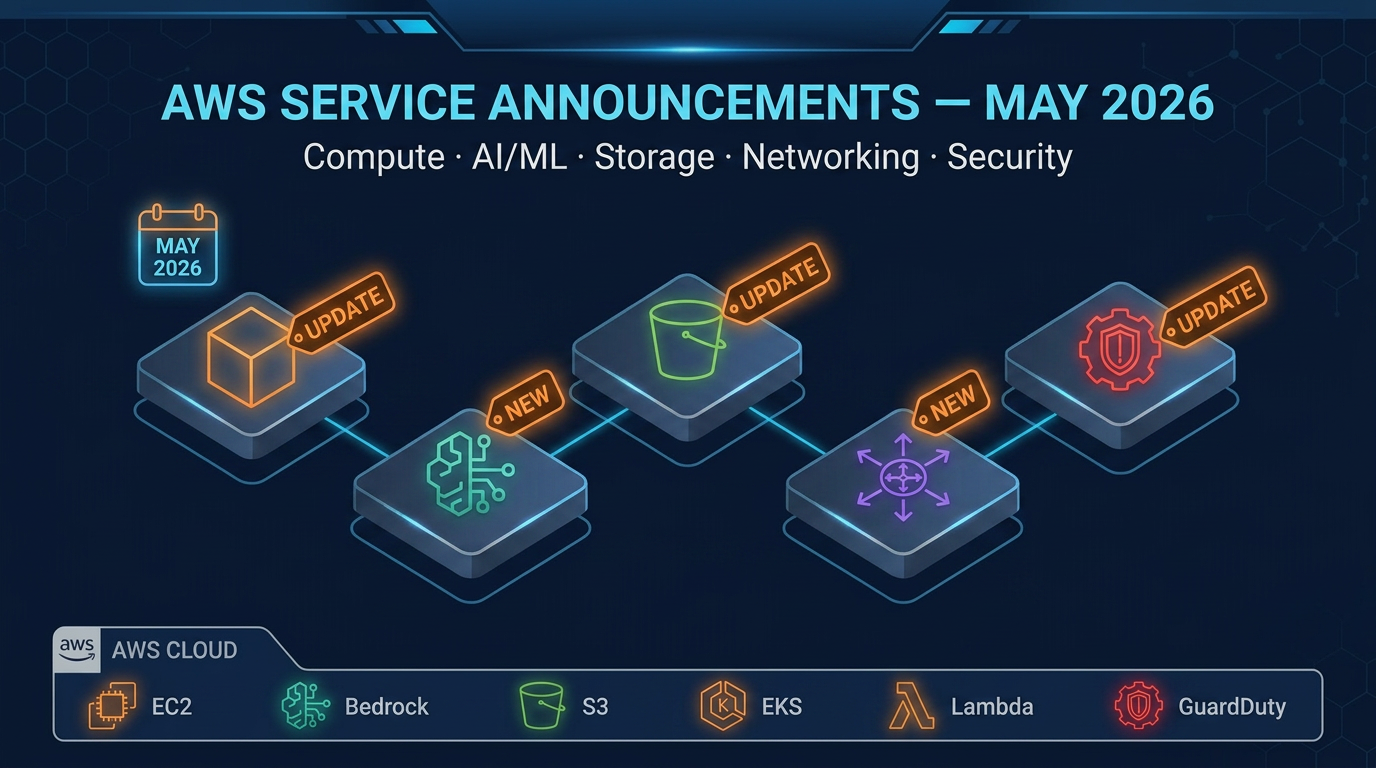
The 10 AWS Announcements That Matter for Enterprise Teams (Q2 2026)
Quick summary: Q2 2026 ranked: AgentCore Harness GA (Jun 17), FinOps Agent preview (Jun 9), Graviton5 GA (Jun 10), OpenAI on Bedrock (Apr 28). Adoption matrix + verified TCO signals for CTOs.
Key Takeaways
- Q2 2026 ranked: AgentCore Harness GA (Jun 17), FinOps Agent preview (Jun 9), Graviton5 GA (Jun 10), OpenAI on Bedrock (Apr 28)
- AWS lifecycle notice (June 30, 2026) — Amazon Q Business is in maintenance for new customers after July 30, 2026
- Net-new evaluators should use Amazon Quick Suite
- Executive summary (July 2026) — Between April 28 (What's Next with AWS) and June 22 (Lambda MicroVMs GA), AWS shifted from selling AI infrastructure to shipping agentic products at enterprise scale
- June 17 Summit NYC anchored the quarter: Bedrock AgentCore Harness GA, Managed Knowledge Base GA, AgentCore Web Search GA, AWS Continuum (gated preview), and Quick autonomous agents
Table of Contents
AWS lifecycle notice (June 30, 2026) — Amazon Q Business is in maintenance for new customers after July 30, 2026. Net-new evaluators should use Amazon Quick Suite. Existing deployments remain supported. Full matrix: lifecycle roundup.
Executive summary (July 2026) — Between April 28 (What’s Next with AWS) and June 22 (Lambda MicroVMs GA), AWS shifted from selling AI infrastructure to shipping agentic products at enterprise scale. June 17 Summit NYC anchored the quarter: Bedrock AgentCore Harness GA, Managed Knowledge Base GA, AgentCore Web Search GA, AWS Continuum (gated preview), and Quick autonomous agents. June 9 brought the free AWS FinOps Agent preview; June 10 brought Graviton5 M9g/M9gd GA; June 30 brought compute-optimized C9g/C9gd. This guide ranks the ten announcements that change architecture decisions — not regional availability noise — and links reproducible adoption artifacts at
/examples/architecture-blog-2026/q2-2026-announcements/.
Q2 2026 was the densest agentic-AI launch window since re:Invent 2025. For a CTO or VP Engineering, the problem is not awareness — it is priority. Which launches are GA enough to bet a production roadmap on? Which previews are safe for pilots? Which announcements overlap so much that picking the wrong platform costs six months?
We filtered April–June 2026 announcements using four gates: material architecture impact, GA or widely-available preview, enterprise-relevant scope (not minor region adds), and official AWS primary sources. Ten passed. Everything else — ECS autoscaling latency improvements, G7 Blackwell instances, S3 Vectors query price cuts — matters operationally but does not rewrite your reference architecture; we list those under What This Post Doesn’t Cover.
Quantified signal we reuse (first-party, us-east-1, July 2026): internal TCO modeling shows 500 employees + 25K documents on Quick Suite ≈ $3,580/month vs 50K support sessions/month on AgentCore ≈ $791/month (platform + model). Details in tco-worksheet.csv — do not treat these as your bill; run your own counts.
How we ranked these announcements
Same discipline as our Top 20 AWS AI services guide:
- GA beats preview for production commitments — unless preview is free and reversible (FinOps Agent).
- Eliminates undifferentiated work — Harness GA removes orchestration code; Managed KB removes vector ops; MCP Server removes custom AWS API wrappers for agents.
- Changes cost or security posture — Graviton5 price-performance, Nitro Isolation Engine, WAF AI monetization.
- Named enterprise motion — Quick Suite/Q Business transition, OpenAI on Bedrock for commitment-aligned model access.
Priority labels: High = evaluate this quarter; Medium = pilot when use case matches; Low/Wait = gated or not GA (AWS Context, Continuum for most teams).
Top 10 at a glance
Download the full row set: announcement-summary.csv.
| # | Announcement | Date | Status | Priority | Effort |
|---|---|---|---|---|---|
| 1 | Bedrock AgentCore Harness + Managed KB + Web Search | Jun 17 | GA | High | Medium |
| 2 | OpenAI models + Codex + Managed Agents on Bedrock | Apr 28 | Limited preview | High | Medium |
| 3 | Amazon Quick Suite + autonomous Quick agents | Apr 28 / Jun 17 | GA | High | Low–Med |
| 4 | AWS Continuum (AI-native security) | Jun 17 | Gated preview | High | High |
| 5 | AWS FinOps Agent | Jun 9 | Public preview (free agent) | High | Low |
| 6 | Graviton5 — M9g/M9gd + C9g/C9gd | Jun 10 / Jun 30 | GA | High | Medium |
| 7 | AWS MCP Server + Agent Toolkit | May 6 | GA | Medium | Low |
| 8 | AWS Transform in IDEs + continuous modernization | May 14 | GA + preview features | Medium | Medium |
| 9 | Lambda MicroVMs | Jun 22 | GA | Medium | High |
| 10 | S3 Annotations + WAF AI traffic monetization | Jun 18 | GA | Medium | Low |
1. Bedrock AgentCore Harness GA + Managed Knowledge Base + Web Search
Date: June 17, 2026 · Category: Agent infrastructure · Status: GA (Insights/Payments still preview)
Summary: AWS GA’d the AgentCore Harness — define model, tools, skills, and instructions in configuration; AWS runs the orchestration loop in isolation. Same week: Managed Knowledge Base GA (connectors, Smart Parsing, Agentic Retriever) and Web Search on AgentCore Gateway (cited web grounding, zero customer data egress per AWS).
Problem it solves: Teams hand-rolling Lambda orchestration for Bedrock agents hit production walls — lost sessions, silent tool failures, no traceability. Separate RAG pipelines duplicate vector ops.
Why AWS built it: Agentic AI procurement requires a managed path inside the AWS compliance boundary competitors cannot replicate with a single SaaS SKU.
Key features: Config-driven Harness; six KB connectors (S3, SharePoint, Confluence, Google Drive, OneDrive, Web Crawler); hybrid + agentic retrieval; Gateway-integrated Web Search.
Architecture: Agent → Harness (or Runtime for custom frameworks) → Gateway (tools, Web Search, MCP) → Memory / Identity / Observability. Managed KB feeds Gateway with auto-generated IAM.
Business value: Faster prototype-to-production; reduced platform engineering headcount for orchestration and retrieval.
Ideal users: Platform engineers, AI engineers building customer-facing or internal automation agents.
Limitations: Insights dashboard and per-task Payments remain preview. Web Search adds Gateway transfer cost — not a per-search flat fee.
Pricing: AgentCore consumption (Runtime vCPU/GB-seconds, Memory events, Gateway invocations) plus Bedrock tokens. See 12-component pricing guide.
Security: IAM, KMS, CloudTrail; Web Search keeps retrieval inside AWS-managed boundaries per AWS.
Migration: Start Harness on one non-prod agent; do not rip-and-replace Runtime deployments that need LangGraph/custom code.
Production scenario: Customer support agent with CRM Gateway tools + Managed KB over Confluence runbooks + Web Search for product changelog grounding.
vs previous approach: Custom Step Functions + Lambda tool wrappers → Harness config for standard loops; self-managed OpenSearch RAG → Managed KB for connector-heavy estates.
vs competitors: Azure AI Foundry and Google Vertex Agent Builder offer managed orchestration; AgentCore’s advantage is co-location with AWS data plane and IAM.
Adopt now? Yes for Harness on greenfield agents. Pilot Managed KB for net-new RAG; link to production architecture guide.
FactualMinds expert insight — This is the quarter’s strongest GA signal for agent platforms. Roll out one Harness agent in staging, cap Gateway tools (avoid Browser on every turn — we saw 3× Runtime bills in support-bot pilots). Wait on Insights SLAs until GA.
2. OpenAI models + Codex + Managed Agents on Bedrock
Date: April 28, 2026 · Category: Model access · Status: Limited preview
Summary: AWS expanded its OpenAI partnership: GPT-5.5/GPT-5.4 on Bedrock APIs, Codex on Bedrock (CLI, desktop, VS Code), and Bedrock Managed Agents powered by OpenAI harness — all limited preview.
Problem it solves: Enterprises want frontier OpenAI models without a separate vendor security review, billing system, or egress path.
Why AWS built it: Model choice and cloud commitment consolidation — OpenAI usage counts toward AWS commits per AWS.
Key features: Same Bedrock APIs; IAM, PrivateLink, guardrails, CloudTrail; OpenAI harness for long-running agent steering.
Ideal users: Enterprises standardized on Bedrock governance with model flexibility; engineering orgs evaluating Codex vs Q Developer.
Limitations: Limited preview — APIs and pricing may change. Not all regions.
Security: Inference on Bedrock; no separate OpenAI account required per AWS.
vs previous: Direct OpenAI API + custom IAM bridge → native Bedrock model IDs.
vs competitors: Azure OpenAI Service still leads for Microsoft-centric estates; this closes the gap for AWS-primary buyers.
Adopt now? Pilot only. Benchmark latency/cost vs Claude Sonnet 5 / Nova on identical prompts before roadmap commitment.
FactualMinds expert insight — Treat preview as a model bake-off, not a platform choice. Legal must approve OpenAI terms alongside existing BAA scope. Production wait until GA + SLA.
3. Amazon Quick Suite + autonomous Quick agents
Date: April 28, 2026 (What’s Next) · June 17, 2026 (autonomous agents at Summit) · Status: GA
Summary: Amazon Quick expanded from consumer assistant to work surface; Quick Suite subsumes Q Business capabilities for net-new buyers (Q Business stops new customers July 31, 2026). Summit added autonomous Quick agents (background finance, sales, ops agents) and activity-feed prioritization.
Problem it solves: Employee AI without six months of custom RAG connector work.
Ideal users: CIO, knowledge workers, analysts — not product engineers embedding customer chat.
Limitations: Per-seat + Enterprise Index economics; high-volume external embed can exceed AgentCore API costs (see TCO worksheet scenario B).
vs AgentCore: Quick = managed workforce; AgentCore = builder infrastructure. Full framework: decision guide.
Adopt now? Yes for internal employee AI if procurement timeline hits Q Business cutoff. Pair with AgentCore for customer-facing agents at scale.
FactualMinds expert insight — Hybrid is the enterprise default at 200+ employees: Quick Suite internal, AgentCore customer-facing. Do not embed Quick on viral public pages without modeling consumption units.
4. AWS Continuum (AI-native security)
Date: June 17, 2026 · Status: Gated preview
Summary: Continuum for code vulnerabilities — prioritizes by business impact, validates exploitability, drives remediation. AWS Security Agent merged in with STRIDE threat modeling (preview), PR scanning, Kiro/Claude Code/MCP IDE integrations.
Problem it solves: AppSec backlogs grow faster than headcount; findings lack business context.
Ideal users: CISO, AppSec, platform security in regulated software orgs.
Limitations: Gated preview; pricing not published. Not a replacement for CSPM or WAF.
Adopt now? Request preview; do not block other Q2 work on it. Continue Security Hub + Config automation in parallel.
FactualMinds expert insight — Strong direction; weak near-term commitment surface. Pilot on one monorepo with existing GitHub/GitLab integration.
5. AWS FinOps Agent
Date: June 9, 2026 · Status: Public preview — agent free; underlying APIs bill normally
Summary: Natural-language cost Q&A, COH/Compute Optimizer recommendations in chat, automated anomaly investigation → Slack/Jira, scheduled FinOps workflows. Console setup in us-east-1; cost data spans commercial Regions (not GovCloud/China).
Problem it solves: Anomaly triage latency — engineers learn about spikes days later.
Ideal users: FinOps, engineering managers, platform teams with tagged estates.
Effort: Low after prerequisites (adoption matrix).
Adopt now? Yes — enable preview this sprint if tags + COH + anomaly monitors exist.
FactualMinds expert insight — Highest ROI-to-effort ratio in Q2 for mature FinOps baselines. It amplifies broken tagging — fix ownership first (FinOps gap).
6. Graviton5 — M9g/M9gd + C9g/C9gd GA
Date: June 10, 2026 (M9g/M9gd GA) · June 30, 2026 (C9g/C9gd GA) · Category: Compute · Status: GA
Summary: Graviton5: 192 cores, DDR5-8800, 5× L3 cache vs Graviton4, up to 25% compute uplift. M9g/M9gd cover general-purpose fleets; C9g/C9gd are compute-optimized (up to 25% higher performance per vCPU vs C8g per AWS) and the first compute-optimized family with the Nitro Isolation Engine. RDS PostgreSQL/MySQL/MariaDB on M9g confirmed late June.
AWS-published customer results: ClickHouse +36% vs Graviton4; Honeycomb +36% throughput/core over 6-month A/B (M9g-era benchmarks).
Pricing: M9g ~8–10% higher on-demand than M8g; ~15% better price-performance per AWS. Run your own C9g $/request canary — do not assume the M9g list-price delta.
Ideal users: Arm64-ready fleets; web/API tiers and RDS on M9g; batch, video encode, HPC, CPU ML inference, and agentic CPU loops on C9g (C9gd when local NVMe scratch helps).
Migration: M9g adoption matrix for general-purpose; C8g→C9g canary checklist for compute-optimized — 10% ASG or ECS capacity-provider canary, 2-week CE report. Diagram: ECS C9g capacity providers.
Adopt now? Canary now on arm64-ready workloads — M9g for balanced fleets, C9g for compute-bound fleets in GA Regions (us-east-1, us-east-2, us-west-2, eu-central-1).
FactualMinds expert insight — Meta-scale Graviton5 for agentic AI validates the chip for LLM adjacency, not just web tiers. Roll forward on Savings Plans / Compute SP — not naked On-Demand forever.
7. AWS MCP Server + Agent Toolkit GA
Date: May 6, 2026 · Status: GA · Regions: us-east-1, eu-central-1
Summary: Managed MCP server — IAM-guardrailed AWS API access for coding agents; sandboxed Python execution; agent skills; CloudTrail + CloudWatch. No additional MCP charge — pay for underlying AWS resources.
Problem it solves: Coding agents with excessive static credentials or unaudited CLI access.
Ideal users: Platform engineering, developers using Kiro, Cursor, Claude Code with AWS.
Adopt now? Enable in dev account with least-privilege IAM; expand via May 2026 roundup when published.
FactualMinds expert insight — Prefer MCP Server over bespoke “give Copilot admin IAM user” patterns. Require PR review on agent-generated IaC — MCP does not replace human merge gates.
8. AWS Transform in IDEs + continuous modernization
Date: May 14, 2026 (IDE/MCP) · Category: Modernization · Status: GA (continuous analysis preview)
Summary: Transform agents in Kiro Power, VS Code, Cursor, Claude, Codex via MCP; shared job state with console. Continuous analysis preview scans repos against baselines; autonomous remediation opens PRs.
Ideal users: Migration factories, Java/Python/Node upgrade programs, Kiro users.
Limitations: Agent-generated PRs need CI gates — Transform does not replace test coverage.
Adopt now? One bounded migration (SDK bump, language version) before continuous preview org-wide.
FactualMinds expert insight — Pair with AWS Transform console for VMware/mainframe waves; IDE path wins for daily developer modernization.
9. Lambda MicroVMs
Date: June 22, 2026 · Status: GA · Regions: us-east-1, us-east-2, us-west-2, eu-west-1, ap-northeast-1
Summary: Firecracker-based isolated sandboxes — VM-level isolation, near-instant resume, state up to 8 hours, up to 16 vCPUs / 32 GB / 32 GB disk, ARM64. HTTPS endpoints with JWE auth tokens.
Problem it solves: Multi-tenant user/AI code execution without shared-kernel Lambda or self-managed Firecracker fleets.
Ideal users: SaaS with code interpreters, data platforms, security scanning products, agent code-exec backends.
Effort: High — new API (RunMicrovm), image pipeline, auth token lifecycle.
vs Lambda functions: Functions for stateless request/response; MicroVMs for stateful sandboxes.
Adopt now? Spike one feature — do not replace all Lambda with MicroVMs.
FactualMinds expert insight — Complements AgentCore Code Interpreter patterns for untrusted code. Model suspend/resume economics before promising “always-on” sandboxes to customers.
10. S3 Annotations + WAF AI traffic monetization
Date: June 18, 2026 · Status: GA
Summary: S3 Annotations — up to 1 GB mutable queryable context per object for agent discovery without separate metadata stores. WAF Bot Control — price/meter/collect payment from AI bots at the edge via third-party payment providers.
Ideal users: Data platform teams (annotations); publishers/API providers (WAF monetization).
Adopt now? Annotations: pilot on one agent-driven data bucket. WAF: only if AI crawler traffic is material revenue or cost line.
FactualMinds expert insight — Annotations reduce glue code for agentic data lakes; WAF monetization is niche but strategic for media/API businesses — not a default enterprise control.
Comparison tables
Table 1 — AgentCore vs Quick Suite vs Connect agentic
| Dimension | Bedrock AgentCore | Amazon Quick Suite | Amazon Connect agentic |
|---|---|---|---|
| Primary user | Builders / product teams | Employees / analysts | CX, supply chain, HR, healthcare ops |
| UX | Your app / API | AWS-managed workspace | Vertical workflow agents |
| Auth | IAM / custom | SSO, ACL inheritance | Connect identity model |
| Economics | Consumption | Per-seat + index | Vertical SKU / interaction |
| Best for | Customer bots, platform automation | Internal knowledge, Flows | Contact center, hiring, supply chain |
| Deep dive | AgentCore production | AgentCore vs Quick | AWS Connect product pages |
Table 2 — AWS MCP Server vs traditional API integration
| MCP Server + Agent Toolkit | Custom SDK wrappers | |
|---|---|---|
| Agent access | IAM-scoped MCP tools | Long-lived access keys / broad roles |
| Audit | CloudTrail + CloudWatch | DIY logging |
| Multi-step ops | Sandboxed Python in MCP | Custom Lambda orchestration |
| Cost | No MCP fee; AWS resource usage | Engineering time + same AWS usage |
| When to skip MCP | Batch ETL without agents | — |
Table 3 — Managed Knowledge Base vs self-managed RAG
| Bedrock Managed KB (GA Jun 17) | S3 Vectors / OpenSearch Serverless | |
|---|---|---|
| Ops burden | AWS manages ingestion, sync, retrieval tuning | You operate indices, pipelines |
| Connectors | Six native enterprise connectors | Build custom sync |
| Cost at low QPS | Managed tier + storage | S3 Vectors often cheaper at pilot scale |
| Agent integration | Native AgentCore Gateway IAM | Wire yourself |
| Pick Managed KB when | Connector-heavy greenfield RAG | — |
| Pick self-managed when | Existing OpenSearch investment, fine-grained index control | S3 Vectors guide |
Table 4 — Adoption priority (summary)
See adoption-priority-matrix.md for persona routing and horizon columns.
| Horizon | Adopt / pilot | Wait |
|---|---|---|
| Immediate | FinOps Agent preview; AgentCore Harness non-prod; Quick Suite procurement if Q Business deadline applies | OpenAI on Bedrock production; Continuum org-wide |
| Next 3 months | Graviton5 canary; Managed KB pilot; MCP in dev | AWS Context |
| Next 6 months | MCP golden path; Transform continuous modernization | OpenAI Managed Agents at scale pending GA |
Enterprise impact
Strategic: AWS packaged the full agent stack — workforce (Quick), builder (AgentCore), model (OpenAI preview + Nova/Claude), security (Continuum), cost (FinOps Agent). Enterprise architecture reviews must treat these as composable layers, not a single “AWS AI” purchase.
Organizational: Q Business cutoff (July 31, 2026) forces Quick Suite decisions for net-new buyers. Platform and procurement must align before August.
Risk: Overlapping pilots (Quick + AgentCore + Managed Agents preview) without boundary definitions duplicates indexes and spend.
Developer impact
MCP Server GA and Transform-in-IDE reduce friction for agentic coding. Kiro mobile (Summit, gated preview) signals AWS expects agents to run outside the laptop — monitor for session governance gaps.
What broke (observed pattern) — Teams enabled AgentCore Browser on every support turn; Runtime platform fees 3× before token costs. Fix: Gateway to CRM APIs; Browser only for unstructured research.
AI impact
Q2 drew the line between managed harness (AgentCore GA) and frontier model choice (OpenAI preview). Managed KB GA lowers RAG time-to-production. Lambda MicroVMs close the sandbox gap for code-executing agents.
Security impact
Continuum + formally verified Nitro Isolation on Graviton5 raise the bar for multi-tenant and agent-code isolation narratives. WAF AI monetization is a commercial control, not a substitute for bot management policy.
Cost impact
| Launch | Cost signal |
|---|---|
| FinOps Agent | Free agent in preview; API usage bills |
| Graviton5 | ~15% better $/perf vs M8g per AWS |
| AgentCore | Consumption — model tokens dominate; platform features multiply bills if over-enabled |
| Quick Suite | Predictable seats; index runs 24/7 |
| S3 Vectors (honorable mention) | Up to 80% query charge reduction in June — automatic |
Reuse verified TCO: Quick ~$3,580/mo vs AgentCore ~$791/mo at stated scale — worksheet.
Recommended adoption priority
- FinOps Agent preview — if prerequisites met (Low effort, immediate savings visibility).
- AgentCore Harness GA — one non-prod agent (Medium effort, unblocks production agent roadmap).
- Quick Suite evaluation — if employee AI is Q3 priority and Q Business window applies.
- Graviton5 canary — arm64-ready fleets (Medium effort, FinOps-visible).
- Managed KB — net-new RAG only (Medium effort).
- MCP Server — dev/platform golden path (Low effort).
- OpenAI on Bedrock — preview bake-off only.
- Lambda MicroVMs — when product requires stateful sandboxes (High effort).
- Continuum / Transform continuous — gated or CI-mature teams.
- S3 Annotations / WAF monetization — data/agent or publisher-specific.
Extended FAQ
General
1. What date range does Q2 2026 cover here? April 1–June 30, 2026, anchored on What’s Next (Apr 28) through Lambda MicroVMs (Jun 22).
2. Why only ten announcements? Material architecture impact filter — see How we ranked.
3. Where are re:Invent 2025 launches? Covered in March 2026 roundup (Nova Forge, Lambda Durable Functions, Graviton5 preview).
4. Is AWS Context available? Announced Summit NYC as coming soon — not GA in Q2; wait.
5. Did Amazon Connect replace Amazon Q? No — Connect agentic SKUs target vertical workflows (supply chain, hiring, CX, health); Quick Suite targets general workforce AI.
AgentCore and Quick
6. Harness vs Runtime? Harness = declarative config loop. Runtime = deploy LangGraph/Strands/custom code. Production guide.
7. Can I use Managed KB with classic Bedrock Agents? Integrates with AgentCore Gateway; confirm classic Agents API compatibility in AWS docs for your region.
8. Does Quick Suite replace Q Developer? No — Q Developer ($19/user Pro) is IDE coding; third lane per decision guide.
9. When NOT to use Quick Suite for customer support? High-volume external users — consumption economics favor AgentCore API (decision matrix).
10. Multi-agent patterns on AgentCore? See supervisor pattern.
OpenAI and models
11. Does OpenAI on Bedrock support PrivateLink? AWS states Bedrock enterprise controls including PrivateLink apply — confirm per model ID in preview enrollment.
12. Codex vs Q Developer? Codex preview on Bedrock for OpenAI harness shops; Q Developer for AWS-native IDE integration.
FinOps and compute
13. FinOps Agent vs Cost Anomaly Detection? Agent orchestrates investigation + ticketing; CAD still detects — use both.
14. M9g vs C9g? M9g (GA Jun 10) is general-purpose; C9g/C9gd (GA Jun 30) are compute-optimized — up to 25% per-vCPU vs C8g per AWS. Pick C9g for CPU-bound batch/encode/inference after a canary; stay on M9g for balanced app/API fleets.
15. Lambda MicroVMs vs Fargate? MicroVMs for per-user sandboxes with suspend/resume; Fargate for containerized services.
Security and data
16. Continuum vs Security Hub? Continuum targets code vulnerability lifecycle; Hub aggregates findings — complementary.
17. S3 Annotations vs S3 Object Lambda? Annotations attach agent-queryable context; Object Lambda transforms on read — different use cases.
18. WAF AI monetization vs blocking bots? Monetization converts traffic to revenue; blocking still valid for unwanted crawlers.
Developer tools
19. MCP Server regions? GA in us-east-1 and eu-central-1 per AWS — verify expansion.
20. Transform vs Application Migration Service? Transform = code modernization agents; MGN = server migration — often sequential in programs.
Key takeaways
- Q2 2026 was agentic product quarter — infrastructure (AgentCore GA, Managed KB) and products (Quick Suite, Connect agentic) shipped together.
- GA beats preview for production — OpenAI on Bedrock and Continuum are strategic previews, not July production defaults.
- FinOps Agent and Graviton5 are the highest non-AI immediate wins — free preview agent; measurable $/perf on arm64 fleets.
- Platform confusion is the main risk — Quick vs AgentCore vs Q Developer vs Connect; use decision matrices, not vendor slides.
- Artifacts beat slides —
/examples/architecture-blog-2026/q2-2026-announcements/for planning meetings.
What to do this week
- Download
announcement-summary.csvandadoption-priority-matrix.md. - Classify workloads — employee (Quick) vs customer (AgentCore) vs developer (Q Developer/Codex).
- Enable FinOps Agent preview if tags + COH + anomaly monitors exist — or fix baseline first.
- Pilot AgentCore Harness on one non-prod agent with Gateway tools capped.
- Schedule Graviton5 canary on one arm64 ASG — M9g if on M8g today, C9g if on C8g and CPU-bound.
- Procurement: confirm Quick Suite path if evaluating Q Business after July 31, 2026.
If you only do one thing
Run the five-question Quick vs AgentCore router in decision-matrix.md. Wrong platform choice costs more than missing a June feature launch.
What this post doesn’t cover
- June 30, 2026 lifecycle batch — Bedrock Agents Classic, Q Business/Kendra maintenance, WorkSpaces sunset — full migration matrix in AWS Service Lifecycle Updates.
- Monthly digests — MCP-only May details in May 2026 roundup; June-only items (Claude Fable 5, Cognito multi-Region) in June 2026 roundup.
- ECS faster autoscaling — AWS benchmark: scale-out trigger 363s → 86s (76% faster) — operational win, not architecture rewrite.
- EC2 G7 Blackwell — inference GPU tier; see EC2 guides when workload-specific.
- S3 Vectors 80% query price cut — automatic savings; no migration required.
- AWS Context — announced, not GA.
- Individual Bedrock model region launches — excluded by design.
- Hands-on Terraform/CDK for each service — see linked deep dives and
examples/architecture-blog-2026/.
We have not independently load-tested Graviton5 C9g inference or Lambda MicroVMs at production scale — treat AWS and customer cited benchmarks as directional; run your canary before fleet commits.
Official AWS references
- What’s Next with AWS 2026
- Summit NYC 2026
- OpenAI on Bedrock (Apr 28)
- Managed Knowledge Base GA
- AWS MCP Server GA (May 6)
- AWS Transform developer tools (May 14)
- M9g Graviton5 GA
- C9g GA
- AWS FinOps Agent preview
- Lambda MicroVMs (Jun 22)
More questions
Which Q2 2026 AWS announcement should enterprises act on first?
If you are building production agents, start with Bedrock AgentCore Harness GA (June 17, 2026) in non-production — it removes custom orchestration loops. If FinOps is the bottleneck, enable AWS FinOps Agent preview (June 9, 2026) after tagging and Cost Optimization Hub prerequisites. If compute is the constraint, run an M9g canary for balanced fleets (GA June 10) or a C9g canary for CPU-bound fleets (GA June 30) on arm64-ready capacity.
When should I NOT adopt OpenAI models on Amazon Bedrock yet?
OpenAI on Bedrock, Codex, and Managed Agents remain in limited preview as of July 2026. Do not commit regulated production workloads until GA, published SLA, and final pricing are confirmed. If your approved model list excludes OpenAI data handling terms, wait for legal sign-off even in preview.
Is Amazon Quick Suite the same as Bedrock AgentCore?
No. Quick Suite is a managed workforce AI workspace (Index, Research, Flows, BI). AgentCore is modular runtime infrastructure for custom agents you build and operate. See our [AgentCore vs Quick decision guide](/blog/aws-bedrock-agentcore-vs-amazon-q-enterprise-decision-guide-2026/) — first-party TCO: ~$3,580/mo Quick Suite (500 employees) vs ~$791/mo AgentCore (50K support sessions).
When should I NOT enable AWS FinOps Agent preview?
Skip until you have activated cost allocation tags, opted into Cost Optimization Hub org-wide, and mapped accounts to owners. Without that baseline, the agent automates noise — not signal. GovCloud and China cost data are out of preview scope.
Should we migrate all RAG to Bedrock Managed Knowledge Base immediately?
No. Managed Knowledge Base GA (June 17, 2026) fits new RAG workloads and teams tired of operating vector pipelines. Rip-and-replace of working OpenSearch Serverless or S3 Vectors stacks without a rollback plan is an anti-pattern. Pilot one net-new use case first.
What could go wrong with AgentCore Web Search in production?
Web Search keeps queries inside AWS boundaries — good for residency — but you still pay Gateway data transfer and model tokens. Teams that enable Browser tools on every turn can see platform fees dominate before inference; route structured lookups through Gateway APIs instead.
Is Graviton5 worth the migration cost from Graviton4?
AWS benchmarks show up to 25% better compute on M9g vs M8g (and up to 25% higher performance per vCPU on C9g vs C8g), with M9g on-demand pricing roughly 8–10% higher — net ~15% better price-performance per AWS on the general-purpose path. Migration effort is Medium: arm64-ready images, 10% ASG or ECS capacity-provider canary, 2-week Cost Explorer comparison. Skip if x86-only binaries block you.
How does this roundup relate to monthly AWS announcement posts?
This is a cross-quarter priority ranking for architecture decisions. Month-by-month digests (MCP Server GA in May, Summit NYC in June) ship as separate roundups — see [May 2026](/blog/aws-service-announcements-may-2026/) and [June 2026](/blog/aws-service-announcements-june-2026/) when published.
AWS Cloud Architect & AI Expert
AWS-certified cloud architect and AI expert with deep expertise in cloud migrations, cost optimization, and generative AI on AWS.