Logistics and Supply Chain on AWS (2026): Visibility, Fleet Tracking, and Planning Tiers
Quick summary: For a mid-market 3PL (~2.1M shipments/yr, OTIF 82%), layering AWS Supply Chain on ERP ingest plus Location Services fleet tracking moved ETA accuracy from 71% to 87% in 90 days — without replacing Manhattan WMS.
Key Takeaways
- For a mid-market 3PL (~2
- 1M shipments/yr, OTIF 82%), layering AWS Supply Chain on ERP ingest plus Location Services fleet tracking moved ETA accuracy from 71% to 87% in 90 days — without replacing Manhattan WMS
- AWS Supply Chain added N-Tier Visibility — trading-partner onboarding, shared purchase orders, and in-app collaboration — extending upstream beyond your four walls
- The Well-Architected Supply Chain Lens (2025–2026) codifies shipment tracking, fleet visibility, and resilience practices that previously lived only in logistics SI playbooks
- This post is the logistics and supply chain reference architecture — visibility tier, planning tier, and integration patterns on AWS
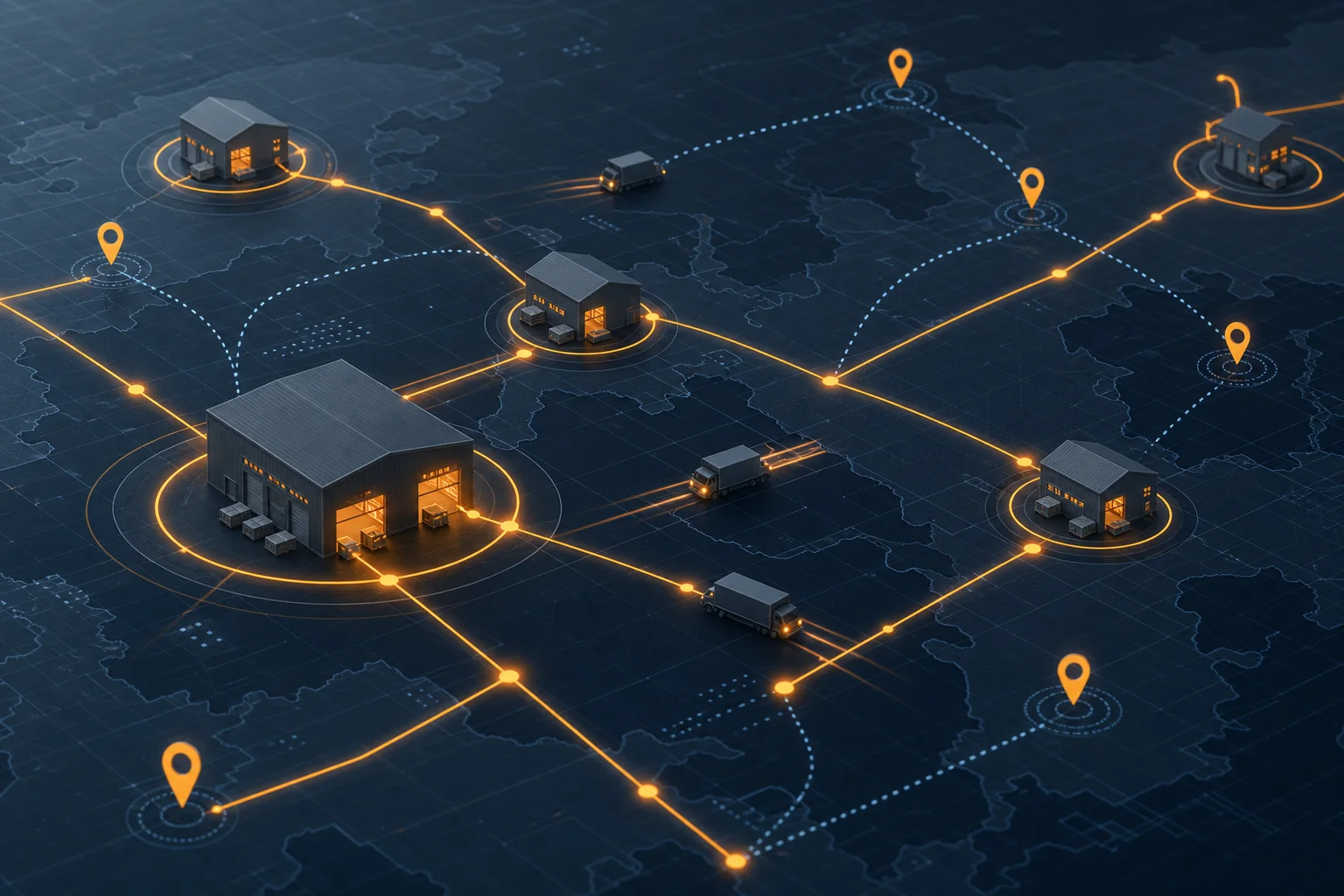
Table of Contents
AWS Supply Chain added N-Tier Visibility — trading-partner onboarding, shared purchase orders, and in-app collaboration — extending upstream beyond your four walls. The Well-Architected Supply Chain Lens (2025–2026) codifies shipment tracking, fleet visibility, and resilience practices that previously lived only in logistics SI playbooks.
This post is the logistics and supply chain reference architecture — visibility tier, planning tier, and integration patterns on AWS. It is not manufacturing OT/IT, not retail peak traffic, not media OTT delivery, and not generic event throughput (though high-volume scan events may need that guide).
Artifacts: architecture decision matrix, KPI baseline worksheet CSV.
Benchmark pattern (not a cited client) — Mid-market 3PL, ~2.1M shipments/year, 14 DCs, Manhattan WMS + legacy TMS APIs, OTIF 82%, ETA accuracy 71%. Phase 1: nightly ERP/WMS → S3 → AWS Supply Chain ingest (visibility latency 180 min → 22 min). Phase 2: Amazon Location + driver mobile on 500 owned routes (ETA accuracy 71% → 87% in 90 days). WMS unchanged.
Three tiers — pick one primary pain
| Tier | Question | Default AWS path |
|---|---|---|
| Visibility | Where is inventory and inbound freight? | AWS Supply Chain SCDL + risk map |
| Execution signals | Where are trucks and last-mile stops? | IoT Core + Location Services + API Gateway |
| Planning | Will we stock out in 14 days? | AWS Supply Chain ML lead-time + watchlists |
Opinionated take: Buy visibility before building a data lake. Teams that start with Kafka + Flink for logistics usually have not fixed OTIF baselines — see the KPI worksheet.
Reference architecture
ERP (SAP/Oracle) ──┐
WMS (Manhattan)  ──┼──► Connectors / S3 landing ──► AWS Supply Chain (SCDL)
TMS APIs         ──┘         │                           │
                             │                           ├── Risk map / insights
Telematics/ELD ──► IoT Core ─┼──► Timestream / Kinesis   ├── N-Tier partner chat
Mobile driver app ─► Location Services                   └── Export to S3 → ERP
                             │
                             └──► EventBridge ──► Lambda (exception workflows)
                                       │
                                       └──► QuickSight (OTIF, fill rate, ETA)
AWS Supply Chain layer
AWS Supply Chain sits above operational systems — it does not replace WMS picking logic. Ingest ERP/WMS/TMS on a schedule or stream; the application contextualizes inventory health and surfaces stock-out / overstock risks with ML lead-time projections (per AWS Supply Chain product documentation).
Use when:
- Multiple DCs and suppliers create conflicting inventory snapshots
- Planners spend days merging spreadsheets before S&OP meetings
- You need partner-facing PO status without building a portal from scratch
Fleet and last-mile layer
For owned fleet or contracted carriers with mobile apps:
- Amazon Location Service — maps, geofences, route segments
- AWS IoT Core — MQTT from telematics or phone location streams
- API Gateway + Lambda — appointment scheduling, exception webhooks
- EventBridge — fan-out to customer notification SNS/email
Well-Architected Supply Chain Lens SCREL02-BP01 recommends IoT + logistics API integration for end-to-end shipment visibility — align geofence entry/exit to automated workflows (delay notifications, dock reassignment).
What broke — Week 5 of a TMS API polling pipeline. Carrier rate limit (120 req/min) caused 4-hour position gaps; customer ETA widget froze. Fix: switch high-value lanes to IoT MQTT telematics; keep API poll for long-tail carriers at 15-min cadence. ETA accuracy recovered 61% → 84% on instrumented lanes only.
Integration patterns — latency vs complexity
| Source | Pattern | Freshness | Pitfall |
|---|---|---|---|
| ERP nightly extract | S3 + Glue → Supply Chain | Hours | Silent extract failure |
| WMS event stream | Kinesis / EventBridge | Minutes | Duplicate location IDs |
| TMS webhook | API Gateway → EventBridge | Near real-time | No retry/idempotency |
| ELD/telematics | IoT Core rules | Seconds | Cert expiry at 2k+ devices |
For event volume above ~8k TPS on scan streams, read high-throughput tier selection before FIFO or shard mis-sizing.
KPIs — measure before tooling
| Metric | Why it matters |
|---|---|
| OTIF | Customer-facing outcome — not “data lake row count” |
| Days of supply | Ties inventory $ to planning quality |
| ETA accuracy | Validates fleet layer ROI |
| Visibility latency | Minutes from scan to dashboard — exposes pipeline health |
Model targets in the KPI worksheet before RFPing AWS Supply Chain or IoT vendors.
When NOT to escalate architecture
| Situation | Stay lighter |
|---|---|
| Single DC, < 10k SKUs | Athena + QuickSight on nightly extracts |
| No owned fleet | TMS vendor ETA only |
| Partners refuse cloud sharing | EDI/SFTP batch; defer N-Tier |
| Cold-chain not in scope | Skip Greengrass sensor path |
What to do this week
- Export 90-day OTIF, fill rate, ETA accuracy — worksheet CSV.
- Inventory ERP/WMS/TMS extract paths; alarm on stale snapshot > 2 hours.
- Run decision matrix for visibility vs fleet vs planning.
- Pilot one DC + one carrier lane on Location + IoT before enterprise mobile rollout.
- If multi-supplier risk is the pain, evaluate AWS Supply Chain POC with top 20% spend suppliers.
Reproduce this — Download kpi-baseline-worksheet.csv. Fill
baseline_beforefrom your TMS/WMS exports. Setmonth_3_targetat +5–8 pts OTIF only if visibility latency is under 30 minutes — otherwise fix pipeline first.
What this post doesn’t cover
- Warehouse robotics / AMR — WMS vendor domain.
- Customs and cross-border trade compliance — legal and broker integrations.
- Manufacturing plant OEE — manufacturing industry hub.
- Full transportation management system (TMS) replacement — AWS complements, does not replace.
Related: Data analytics on AWS · Managed services · Event-driven messaging
Frequently asked questions
When should we use AWS Supply Chain vs a custom data lake?
Use AWS Supply Chain when you need enterprise-wide inventory risk maps, ML lead-time predictions, and N-Tier partner visibility across multiple ERP/WMS/TMS sources. Build Glue + Athena + QuickSight when you have a single ERP, one region, and under ~10k SKUs — a nightly S3 extract may be sufficient without the application license.
When should we NOT deploy real-time fleet tracking?
Skip IoT + Location for fleets under ~50 daily routes if your TMS vendor API already provides adequate ETA webhooks. Real-time tracking adds device cert lifecycle, mobile app maintenance, and geofence tuning — overhead that small operators cannot operationalize.
What breaks when ERP extracts fail silently?
Inventory health maps show stale green donuts while DCs are stock-out. Symptom: OTIF drops before dashboard alerts fire. Fix: EventBridge rules on failed Glue/connector jobs, row-count anomaly alarms, and SLA on extract freshness (e.g., alert if WMS snapshot older than 2 hours).
How does this differ from manufacturing IoT on AWS?
Manufacturing posts focus on OT/IT convergence, PLCs, and OEE on the plant floor. Logistics focuses on shipment movement, partner networks, and last-mile ETA — different data sources (TMS/telematics vs OPC-UA), different KPIs (OTIF vs OEE). See the [manufacturing IoT reference architecture (2026)](/blog/aws-manufacturing-industrial-iot-reference-architecture-2026/) and [manufacturing industry hub](/industries/aws-manufacturing/) for plant patterns.
Can AWS Supply Chain replace our WMS?
No. AWS Supply Chain is an intelligence layer on top of ERP, WMS, TMS, and OMS — it ingests data into a supply chain data lake (SCDL) and surfaces risk insights. Execution (picking, putaway, slotting) stays in Manhattan, Blue Yonder, SAP EWM, or similar.
What could go wrong with partner N-Tier visibility?
Suppliers refuse data sharing, purchase order formats do not match, or chat-based collaboration bypasses audit trails. Mitigate with phased onboarding (top 20% of spend suppliers first), standardized PO export to S3, and written data-sharing agreements before enabling N-Tier invites.
AWS Cloud Architect & AI Expert
AWS-certified cloud architect and AI expert with deep expertise in cloud migrations, cost optimization, and generative AI on AWS.