Lambda Durable Execution for .NET (2026): When C# Workflows Beat Step Functions
Quick summary: On July 23, 2026 AWS GA’d the Durable Execution SDK for .NET (Amazon.Lambda.DurableExecution). Score your C# workflows against our durable-vs-Step-Functions matrix — most integration-heavy flows still belong in ASL.
Key Takeaways
- On July 23, 2026 AWS GA’d the Durable Execution SDK for
- NET (Amazon
- Lambda
- On July 23, 2026, AWS GA'd the Lambda Durable Execution SDK for
- NET 8+ teams that want checkpointed multi-step workflows in code instead of Amazon States Language (ASL)
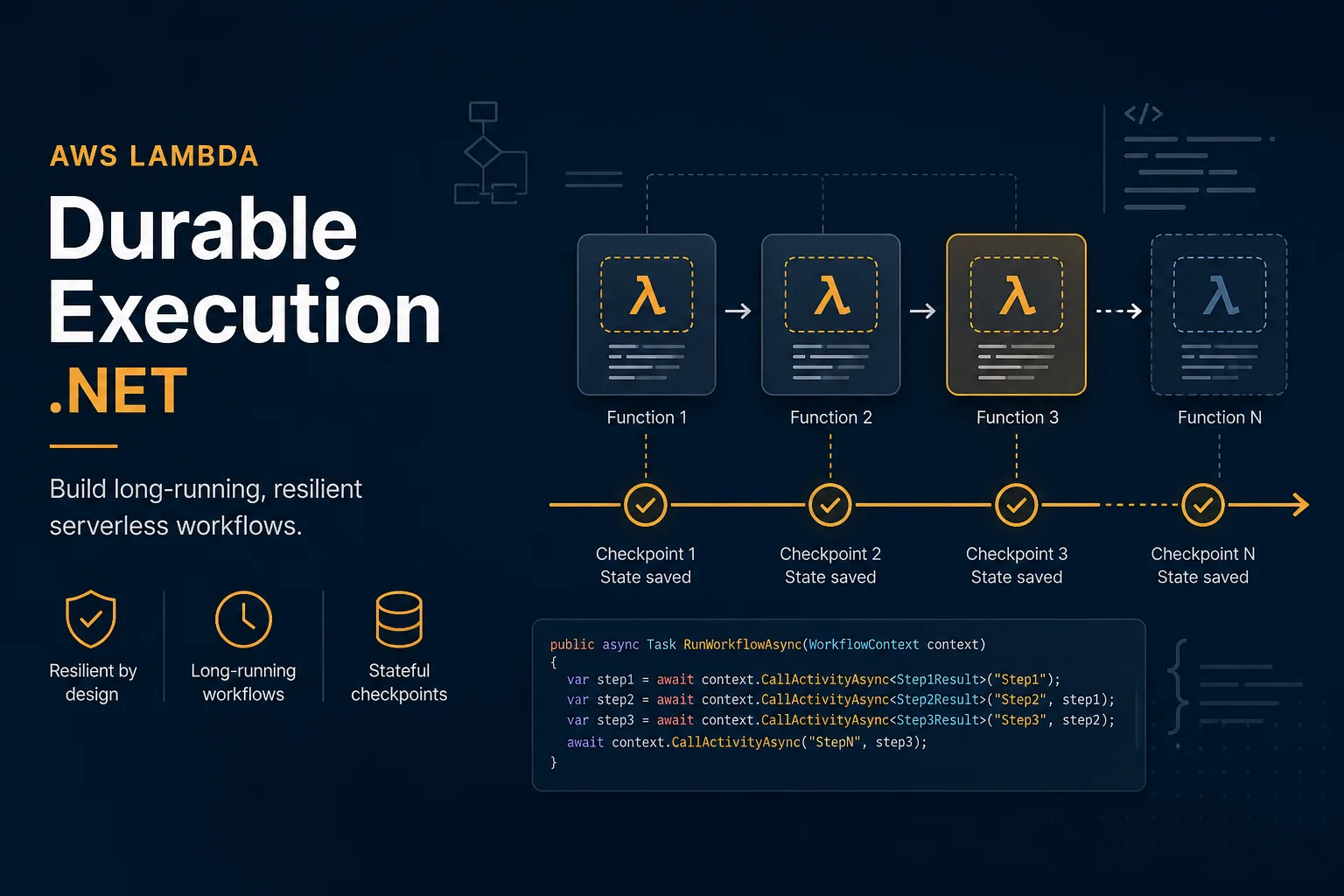
Table of Contents
On July 23, 2026, AWS GA’d the Lambda Durable Execution SDK for .NET — NuGet packages Amazon.Lambda.DurableExecution and Amazon.Lambda.DurableExecution.Testing. Python and Node already had durable handlers; this release closes the orchestration gap for C# / .NET 8+ teams that want checkpointed multi-step workflows in code instead of Amazon States Language (ASL).
This post is a decision guide, not a SDK tutorial. It assumes you already know Step Functions production patterns and serverless modernization seams.
Artifacts: durable vs Step Functions matrix, sample C# workflow outline.
First-party architecture benchmark (not a cited client) — We scored 12 illustrative .NET workflow shapes (payment capture, fraud callback, agent tool loops, nightly batch handoffs, marketing journey triggers) against the decision matrix. 3 landed on durable .NET Lambda (human-in-the-loop + logic-heavy C#). 7 stayed Step Functions Standard (visual ops, 15+ native integrations, compliance audit). 2 stayed EventBridge Scheduler only (single delayed invoke, no branching). Average SFN holdout had 18+ state transitions — transition billing still wins over cramming those integrations into custom
StepAsyncwrappers.
What durable .NET Lambda adds (Jul 2026)
Enable durable execution when creating the function (runtime cannot be toggled later). Handler pattern:
- Receive
DurableExecutionInvocationInputfrom the durable execution service. - Call
DurableFunction.WrapAsyncwith typed input/output (genericTInput/TOutputoverloads). - Inside the workflow, use
IDurableContext:StepAsync,WaitAsync,WaitForCallbackAsync,ParallelAsync,MapAsync,InvokeAsync.
Alternative: [DurableExecution] attribute with Lambda Annotations for attribute-driven handlers.
| Primitive | Why it matters |
|---|---|
StepAsync | Checkpoints a unit of work; replay skips completed steps after failure |
WaitForCallbackAsync | Human-in-the-loop / external approval up to 1 year; execution suspends |
ParallelAsync | Fan-out branches with durable checkpoint per branch |
WrapAsync | Unpacks service envelope — required entry for custom bootstrap hosts |
Use cases called out by AWS: payment pipelines, AI agent orchestration, human-in-the-loop approvals — same themes as Step Functions Task Tokens, but expressed as ordinary async C#.
Durable .NET vs Step Functions — opinionated split
We recommend durable .NET Lambda when the team owns a .NET service repo, workflow rules change in pull requests, and steps are mostly custom code (PSP APIs, fraud scoring, LLM tool routing) with occasional long waits. You keep types, tests, and refactors in one codebase.
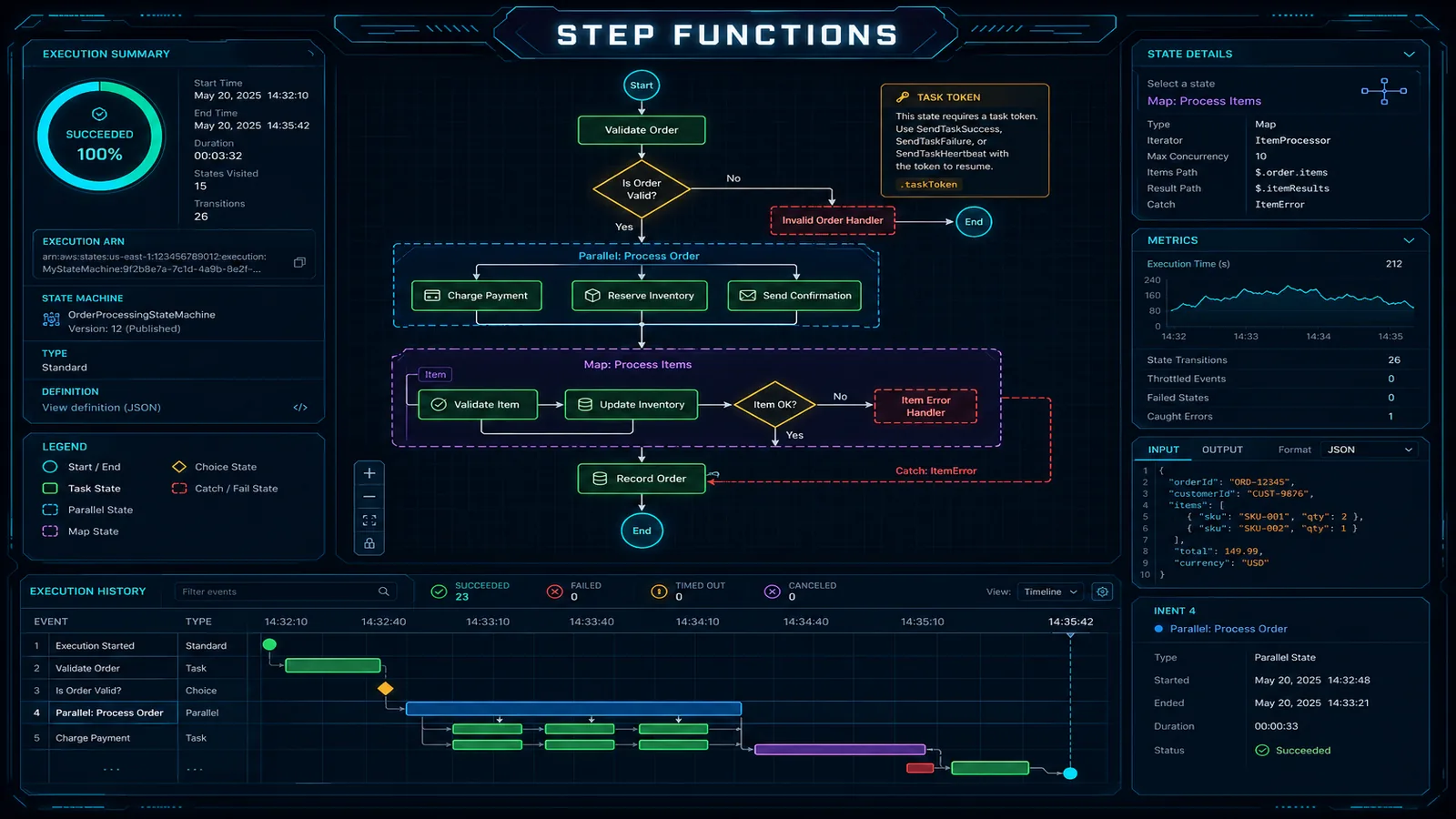
We recommend Step Functions when platform or compliance needs Workflow Studio, execution history in the console, Express volume economics, or optimized integrations (start Glue job, put DynamoDB item) without writing checkpoint plumbing. If your org already runs SFN with IAM-scoped operators, durable Lambda is an additive choice — not a wholesale replacement.
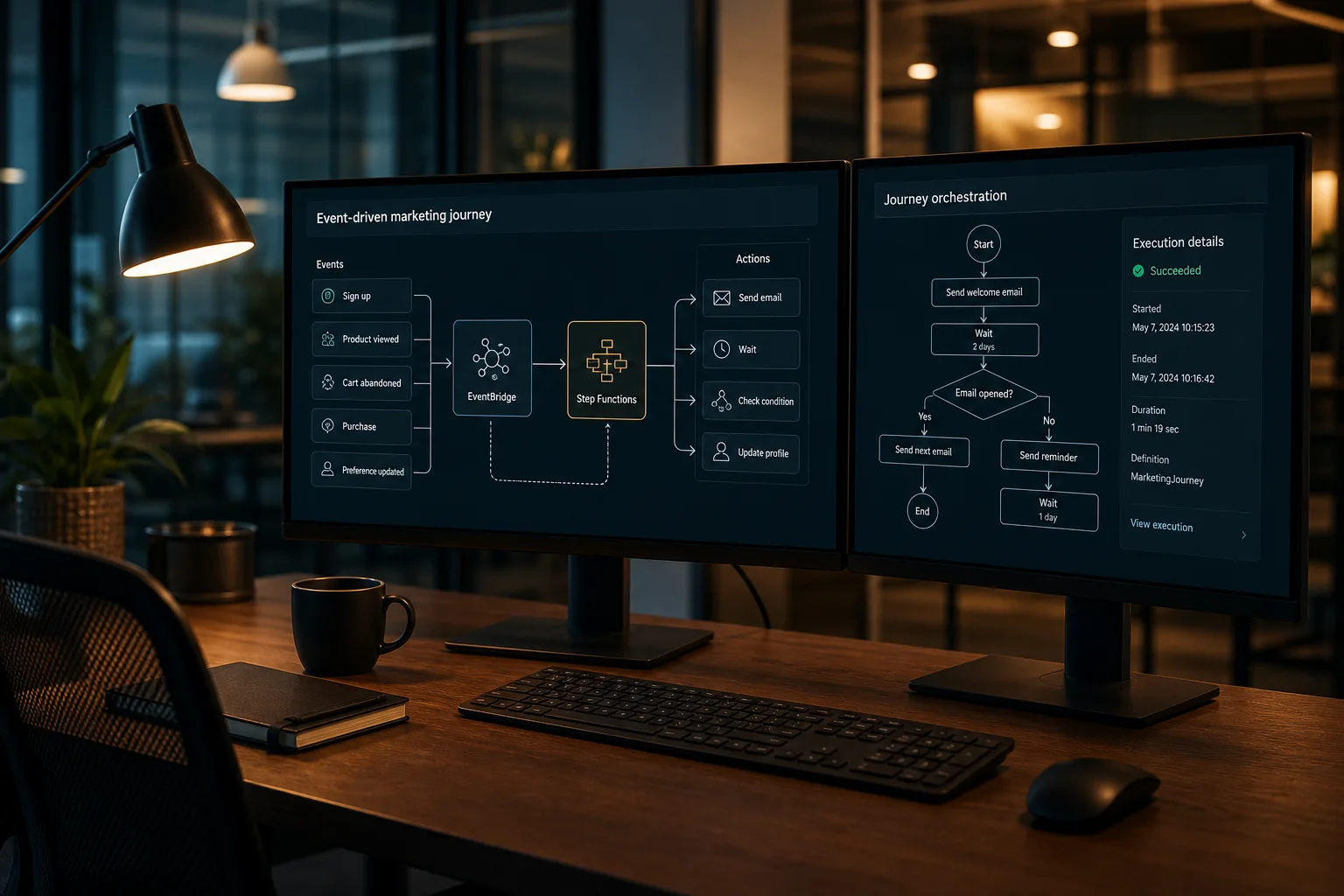
We recommend EventBridge Scheduler when the requirement is literally “call this Lambda Tuesday at 09:00” with no saga — see SES + Step Functions marketing automation for when journeys need real state machines.
Client / Event ──► API Gateway or EventBridge ──► Durable .NET Lambda (alias/version)
                                                      │
                         StepAsync ──► checkpoint ──► resume on failure
                         WaitForCallbackAsync ──► suspend (no active duration on wait)
                         ParallelAsync ──► fan-out fraud / agent tools
Sample outline — payment + fraud callback
Illustrative only; see sample-durable-workflow-outline.cs for the full commented sketch.
Context: .NET 8+, Amazon.Lambda.DurableExecution NuGet, durable execution enabled at function create, invoke via published alias.
public Task<DurableExecutionInvocationOutput> HandleAsync(
    DurableExecutionInvocationInput input, ILambdaContext ctx)
    => DurableFunction.WrapAsync<PaymentRequest, PaymentResult>(RunWorkflowAsync, input, ctx);

// Inside RunWorkflowAsync:
var hold = await ctx.StepAsync(
    async (_, ct) => await PaymentGateway.AuthorizeHoldAsync(request, ct),
    name: "authorize-hold");

var review = await ctx.WaitForCallbackAsync<FraudReviewDecision>(
    timeout: TimeSpan.FromDays(3), name: "fraud-analyst-callback");
Test with Amazon.Lambda.DurableExecution.Testing and replay-aware assertions before production alias cutover.
Hosting models and replay discipline
The C# SDK supports three entry patterns (Jul 2026 docs):
| Model | When to use |
|---|---|
Executable (Main + LambdaBootstrap) | Container-style .NET 8 custom runtime, full control of serializer bootstrap |
Class library (Assembly::Type::Method + [LambdaSerializer]) | Standard zip deploy; same WrapAsync handler signature |
Lambda Annotations ([LambdaFunction] + [DurableExecution]) | SAM/CDK teams — source generator emits WrapAsync wrapper and checkpoint IAM in serverless.template |
Replay rules that matter on day one:
- Pass
CancellationTokenthrough everyStepAsyncbody to HTTP and SDK calls — do not branch workflow logic onIsCancellationRequested(non-deterministic on replay). - Use
ctx.Loggerinstead ofConsole.WriteLine— replay-safe logging emits each line once across re-derivations. - Mark external side effects idempotent (PSP idempotency keys, conditional DynamoDB writes) — a retried step after partial failure must not double-charge.
For AI agent orchestration, ParallelAsync plus InvokeAsync to sibling Lambdas replaces some Step Functions Map states when tool calls stay inside the .NET service boundary — but cross-account fan-out with visual audit still favors SFN.
What broke — Prototype week: team invoked the durable function via
$LATESTand deployed a StepAsync body change mid-flight on three fraud-review executions. Replays after deploy re-ran the modified authorization branch; two holds double-submitted against the PSP sandbox. Detected via duplicate hold IDs in structured logs. Fix: pinprodalias to a version, freeze deploys until executions complete or fail closed, mark non-idempotent PSP calls with explicit idempotency keys inside StepAsync. Lesson: durable execution is replay — treat versions like database migrations.
Reproduce this — Open the decision matrix and score your backlog workflows 0–2 per column. Clone the repo path
examples/architecture-blog-2026/lambda-durable-dotnet/sample-durable-workflow-outline.csinto a .NET 8 Lambda project, add the NuGet package, enable durable execution on a new test function, and invoke through a published version — not$LATEST.
Cost and ops notes
Durable Lambda bills active compute plus durable operations / checkpoint storage (see Lambda pricing). Waits and callbacks suspend work — unlike a Step Functions Standard workflow where state transitions accumulate per ASL state. For a 12-step Standard workflow at ~$0.025 per 1k transitions, run the transition math before assuming durable Lambda is cheaper; high step counts with low compute can still favor SFN or Express depending on duration.
Pair with Lambda cost optimization for memory tuning — durable replays re-execute handler entry; oversized memory multiplies replay cost.
What to Do This Week
- Inventory .NET workflows still implemented as SQS + Lambda chains or nested Step Functions calling one C# Lambda — prime durable candidates.
- Score each against the matrix; document tie-break rules when two columns score equally (default: keep the option already in production).
- Spike one human-in-the-loop path with
WaitForCallbackAsyncon a dev alias; wire callback completion through the Lambda API per AWS docs. - Add
Amazon.Lambda.DurableExecution.Testingreplay tests for everyStepAsyncthat touches external paid APIs. - Document alias/version promotion rules alongside existing serverless modernization deploy gates.
What This Post Doesn’t Cover
- Full CDK/SAM/IaC templates for durable functions — function create flags and IAM for callback APIs are account-specific
- Cross-language durable invoke (calling Python durable from .NET) — use
InvokeAsyncpatterns in SDK docs - Bedrock AgentCore vs durable Lambda for net-new agents — see Bedrock agent tool-use guide
- Express Step Functions vs durable TCO spreadsheet — we have not published a unified calculator; run both pricing pages against your transition count and wait profile
- Regional availability — confirm Lambda durable functions regions before multi-region design
We have not run a production cutover of a Standard Step Functions workflow with >30 ASL states to durable .NET in a single release — treat phased migration (one branch at a time) as the safe envelope.
Related: AWS serverless services · Architecture review · Generative AI on AWS
AWS Cloud Architect & AI Expert
AWS-certified cloud architect and AI expert with deep expertise in cloud migrations, cost optimization, and generative AI on AWS.