Which FinOps Platform Fits on AWS — and Who Implements It
Quick summary: CloudZero, Vantage, Finout, nOps, ProsperOps, and Kubecost on AWS — platform selection guide plus who implements tagging, allocation, and architecture savings.
Key Takeaways
- CloudZero, Vantage, Finout, nOps, ProsperOps, and Kubecost on AWS — platform selection guide plus who implements tagging, allocation, and architecture savings
- 0 export and tag policies are trustworthy
- This hub helps AWS teams select the right tool and close the implementation gap when dashboards outpace architecture changes
- Implementation pairing: Tagging strategy, Cost Categories, CUR 2
- 0 pipeline, cost pitfalls remediation
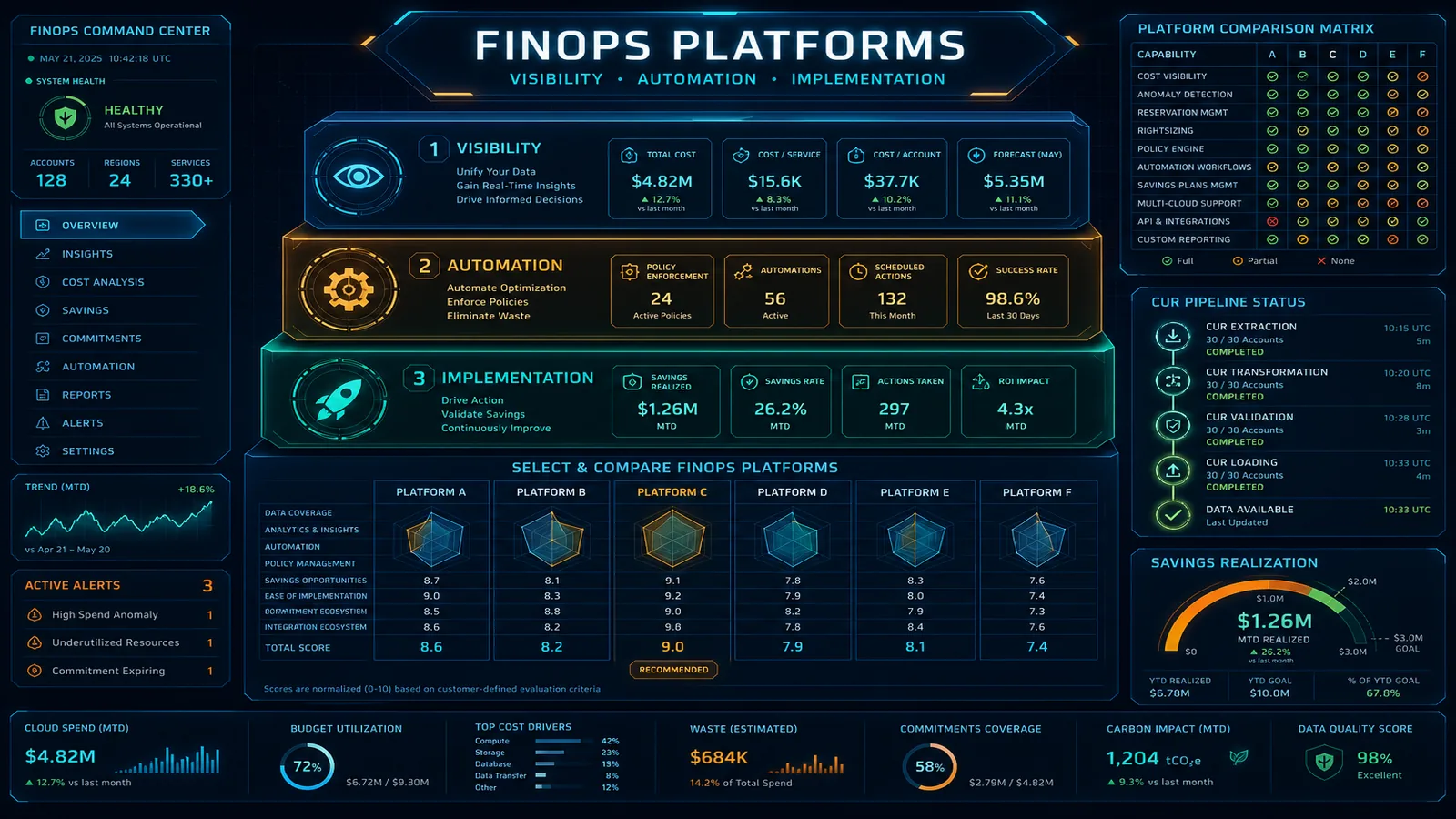
Table of Contents
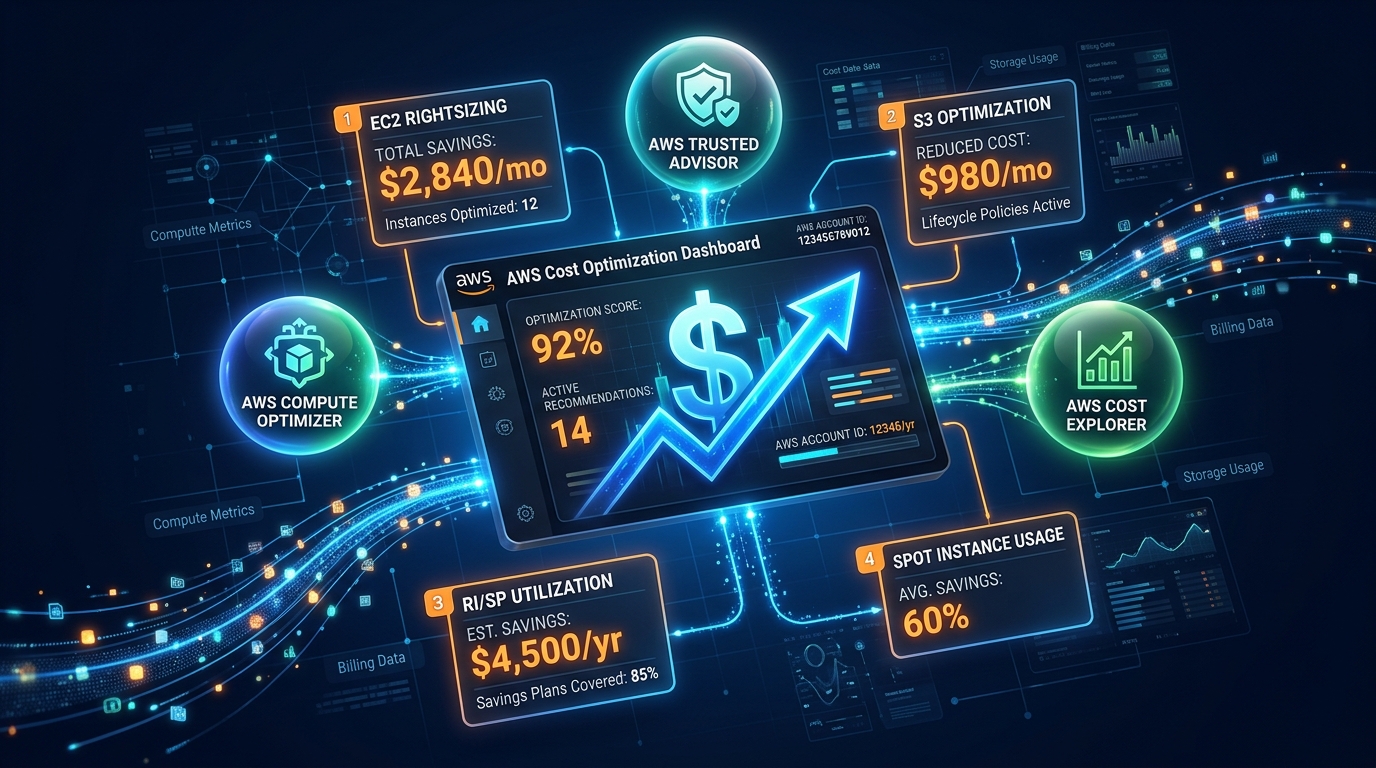
As of June 2026, AWS Cost Optimization Hub consolidates waste and rightsizing recommendations across EC2, Lambda, EBS, RDS, and other services directly in-console — before you buy a third-party FinOps subscription, confirm your CUR 2.0 export and tag policies are trustworthy.
A typical engagement shape we see: a B2B SaaS on AWS, 8–15 linked accounts, $60k–$150k/mo spend, FinOps platform subscribed for 6+ months, allocation gaps visible in dashboards but engineering backlog unchanged. The missing layer is not another tool — it is architecture execution.
FinOps platforms excel at cost visibility, allocation, and commitment automation. They do not delete NAT Gateways, fix cross-AZ topology, or deploy the tagging strategy that makes unit economics trustworthy.
This hub helps AWS teams select the right tool and close the implementation gap when dashboards outpace architecture changes.
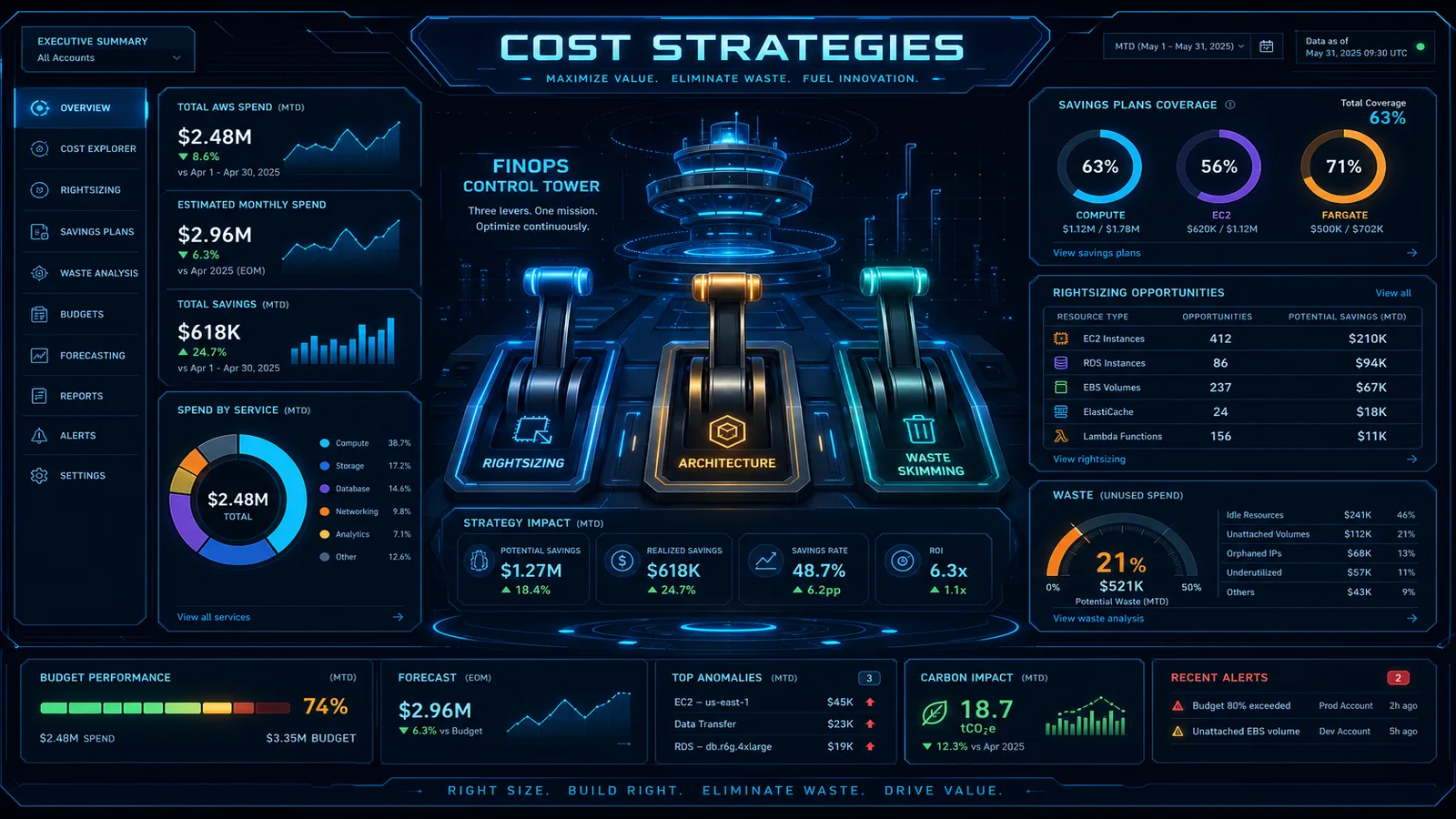
The Three-Layer FinOps Stack
| Layer | Examples | What it delivers |
|---|---|---|
| Visibility | Vantage, CloudZero, AWS Cost Explorer + CUR | Where spend goes |
| Automation | nOps, ProsperOps, Zesty, Spot Eco | RI/SP purchases, recommendations |
| Implementation | FactualMinds | Architecture fixes, tagging ops model, realized savings |
Core message: Dashboards don’t delete NAT Gateways. We implement the architecture changes your FinOps platform recommends.
Platform Selection Guide
Vantage — multi-cloud cost management
Does well: Fast setup, free tier, provider integrations, team dashboards.
Stall point: Teams outgrow visibility without allocation discipline or architecture changes.
Implementation pairing: Tagging strategy, Cost Categories, CUR 2.0 pipeline, cost pitfalls remediation.
CloudZero — cost intelligence for engineering
Does well: Unit economics, Kubernetes cost dimensions, engineering-friendly views.
Stall point: Dimensions require accurate tags and consistent service attribution — garbage in, garbage out.
Implementation pairing: Tag policies (Organizations), split cost allocation for EKS, Bedrock cost attribution.
Finout — allocation and FinOps analytics
Does well: Multi-cloud allocation, custom business metrics, FinOps Foundation alignment.
Stall point: Custom metrics need CUR enrichment and stable resource naming.
Implementation pairing: CUR Athena/Glue pipeline, allocation rules workshop, showback model.
nOps — AWS-native cost optimization
Does well: AWS-focused recommendations, EKS optimization, commitment management, ShareSave.
Stall point: Recommendations queue without engineering capacity to execute architecture changes.
Implementation pairing: nOps vs AWS native FinOps comparison, rightsizing execution, VPC endpoint rollout.
ProsperOps — Savings Plans automation
Does well: Automated SP portfolio management, risk-adjusted commitment strategy.
Stall point: Autopilot without baseline modeling can over- or under-commit.
Implementation pairing: ProsperOps implementation guide — baseline workshop before automation.
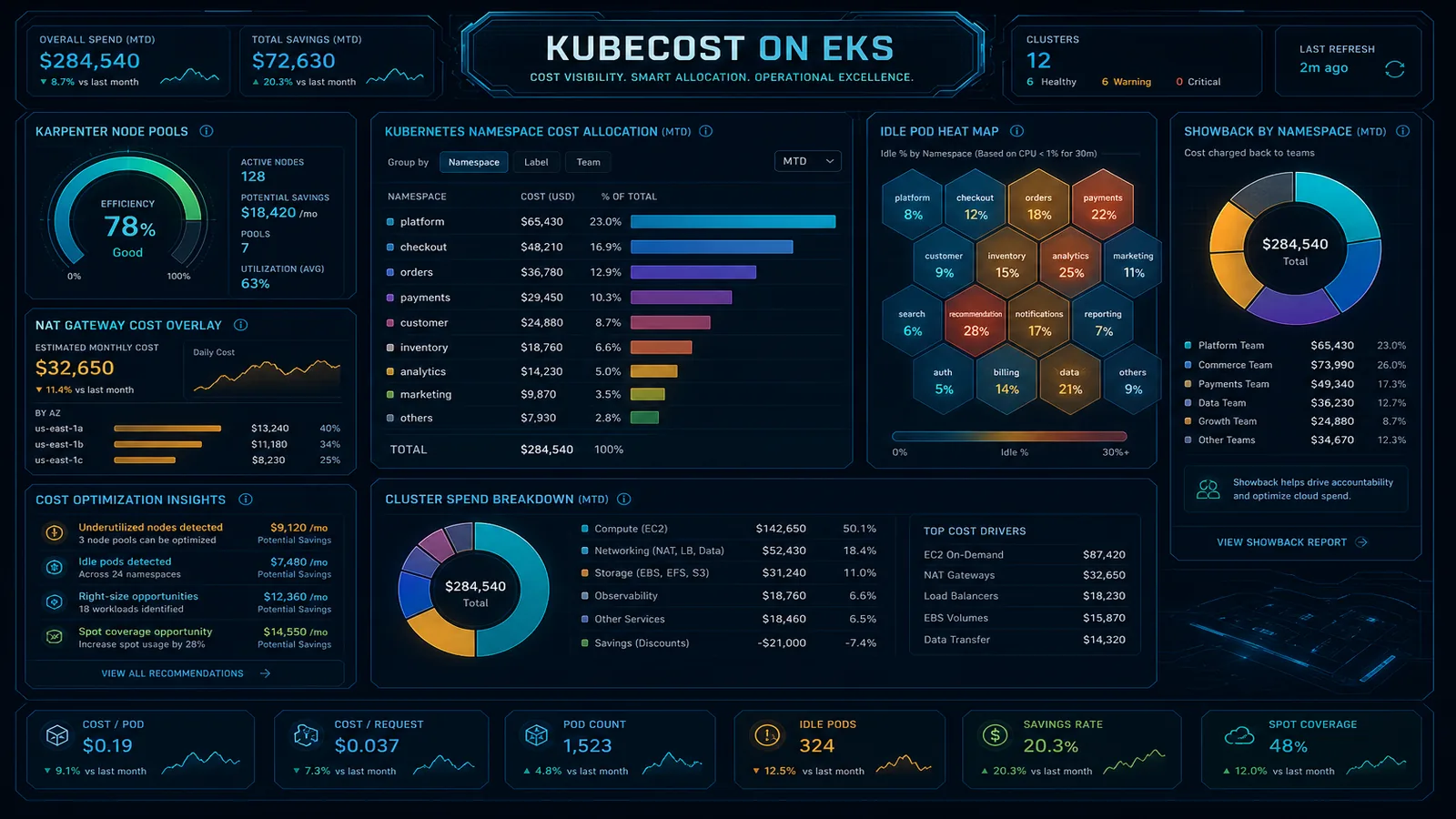
Kubecost — Kubernetes cost optimization
Does well: Pod/namespace cost allocation, showback/chargeback for EKS.
Stall point: Attribution visible but cluster still over-provisioned; no Karpenter/topology fixes.
Implementation pairing: Kubecost + EKS optimization.
CloudBurn — open-source cost policy engine
Does well: IaC policy checks and live AWS scanning for cost guardrails.
Stall point: Policies find violations; remediation still needs IaC changes.
Implementation pairing: Policy-as-code in CI/CD + architecture sprint for recurring violations.
When You Need Implementation Help (Not Another Tool)
| Signal | Action |
|---|---|
| Cost Explorer flat despite FinOps SaaS subscription | Architecture audit — NAT, cross-AZ, logging, idle resources |
| Allocation accuracy below 80% | Tagging operating model + Cost Categories |
| SP/RI coverage wrong after growth or architecture change | Commitment strategy workshop before re-enabling autopilot |
| FinOps dashboard unused by engineering | FinOps Foundation Build — rituals, dashboards, accountability |
| EKS cost up, Kubecost shows “efficient” namespaces | Cluster rightsizing, Karpenter, topology-aware routing |
FactualMinds FinOps Foundation Build (4–8 weeks)
Fixed-scope deliverables:
- CUR 2.0 pipeline and Cost Categories
- Tag policies and allocation accuracy target (typically 85%+)
- Quarterly optimization cadence wired to cost pitfalls playbook
- Top 5 architecture fixes with measured savings
- Handoff to your FinOps platform (Vantage, CloudZero, nOps, etc.)
We configure your platform — we don’t replace it.
What to Do This Week
- Audit your CUR pipeline — confirm CUR 2.0 export to S3 and Athena/Glue connectivity before evaluating SaaS.
- Pick one platform category — visibility, automation, or Kubernetes allocation; don’t buy three tools solving the same layer.
- Schedule a baseline review — if allocation is below 80%, fix tags before enabling autopilot on ProsperOps or nOps ShareSave.
What This Post Doesn’t Cover
Vendor pricing negotiations, multi-cloud FinOps for Azure/GCP-heavy estates, and Bedrock token economics — see our FinOps tools vs consulting comparison for the platform-vs-execution frame.
Related Reading
AWS Cloud Architect & AI Expert
AWS-certified cloud architect and AI expert with deep expertise in cloud migrations, cost optimization, and generative AI on AWS.