AWS Cost Updates, Week of October 23, 2026: 8 Launches Ranked by Bill Impact
Quick summary: Eight AWS launches from October 14–20, 2026, ranked by what they change on the bill. ECS Gateway puts 25 services on one ALB (~$394/mo less in us-east-1 hourly charges); two others are not cost launches at all.
Key Takeaways
- Eight AWS launches from October 14–20, 2026, ranked by what they change on the bill
- ECS Gateway puts 25 services on one ALB (~$394/mo less in us-east-1 hourly charges); two others are not cost launches at all
- Between October 14 and October 20, 2026, AWS shipped eight launches that the r/aws "AWS Cost Updates - 2026-10-23" thread grouped as cost changes
- We read each AWS announcement and its documentation, then ranked the eight by how much they change a monthly bill
- Source note: every figure below comes from an AWS What's New post, AWS documentation, or an AWS pricing page, linked inline and checked on October 24, 2026
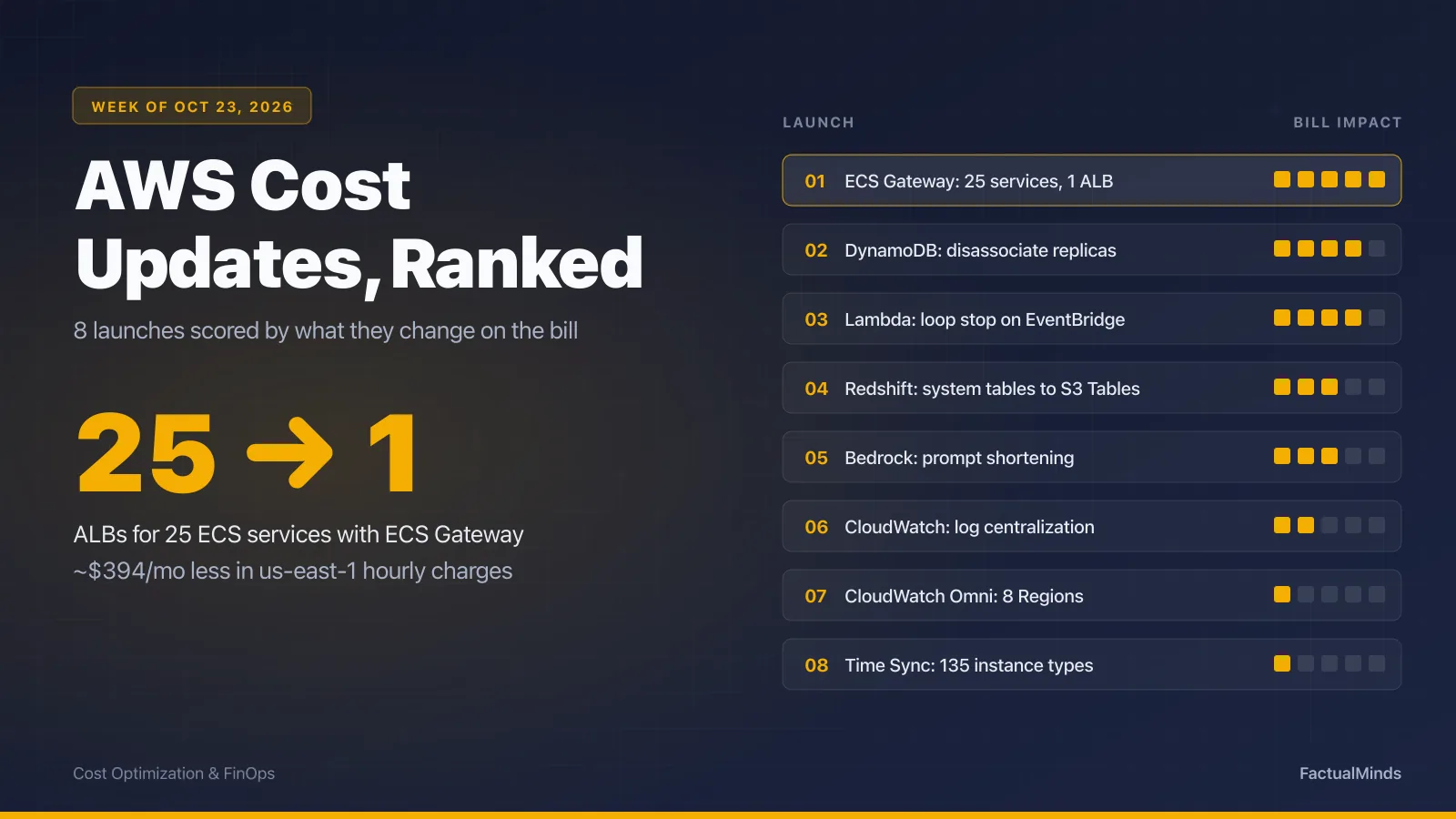
Table of Contents
Between October 14 and October 20, 2026, AWS shipped eight launches that the r/aws “AWS Cost Updates - 2026-10-23” thread grouped as cost changes. We read each AWS announcement and its documentation, then ranked the eight by how much they change a monthly bill. The biggest single number: Amazon ECS Gateway puts up to 25 ECS services on one Application Load Balancer, which is about $394/month less in us-east-1 hourly charges for a team running 25 services on dedicated ALBs.
Two of the eight are not cost launches, and three are smaller or narrower than the thread’s one-line summaries suggest. The corrections are listed near the end.
Source note: every figure below comes from an AWS What’s New post, AWS documentation, or an AWS pricing page, linked inline and checked on October 24, 2026. The dollar math uses us-east-1 list prices. None of it comes from a client engagement.
The Ranking
| # | Launch | Date | Who saves | Bill effect |
|---|---|---|---|---|
| 1 | ECS Gateway: up to 25 services per ALB | Oct 20 | Teams with one ALB per ECS service | ~$16.43/mo hourly charge removed per ALB retired |
| 2 | DynamoDB global tables: disassociate a replica | Oct 20 | Teams with replicas they no longer need | Replica bills as a single-Region table |
| 3 | Lambda loop detection for EventBridge custom buses | Oct 14 | Everyone on EventBridge custom buses | Caps a runaway loop at ~16 invocations |
| 4 | Redshift system tables to S3 Tables (4 more Regions) | Oct 15 | Teams running custom log-export jobs | Writes free; pay S3 Tables storage + queries |
| 5 | Bedrock prompt shortening | Oct 20 | Teams with long, reused prompt templates | Fewer input tokens per call, after an offline job |
| 6 | CloudWatch log centralization (GovCloud + 13 Regions) | Oct 16 | Multi-account orgs in those Regions | First copy free, extra copies $0.05/GB |
| 7 | CloudWatch Omni (8 more Regions) | Oct 19 | Nobody directly | New paid product |
| 8 | Time Sync on 135 more EC2 instance types | Oct 15 | Nobody directly | No pricing component |
We ranked by recurring dollars first, then by how many AWS accounts the change applies to. A launch that removes a fixed hourly charge beats one that trims a variable charge, and both beat one that guards against a rare event. Loop detection ranks third despite saving nothing on a normal month, because the month it fires is the month that matters.
1. ECS Gateway: 25 Services, One Load Balancer
Why it matters: an ALB bills an hourly charge whether it serves one request or a million. Teams that give every ECS service its own ALB pay that charge once per service.
Amazon ECS Gateway (October 20, 2026) is a managed ingress layer for standard ECS services. Per the ECS Gateway documentation, it creates one shared ALB, listener, and load balancer security group, plus a per-service ACM certificate, DNS hostname (<unique-id>.ecs.<region>.on.aws), listener rule, target group, and service security group. “Up to 25 services share one Application Load Balancer.” The gateway itself has no charge; you pay for the ALB, CloudWatch, and data transfer it provisions.
The math at us-east-1 list prices (ELB pricing: $0.0225 per ALB-hour, $0.008 per LCU-hour):
| Setup | ALBs | Hourly charge (730 h) | LCU charge |
|---|---|---|---|
| 25 services, dedicated ALBs | 25 | 25 × $16.43 = $410.63/mo | Per ALB, on its busiest dimension |
| 25 services, ECS Gateway | 1 | $16.43/mo | One ALB, on the combined traffic |
| Difference | ~$394/mo, ~$4,730/yr | Depends on traffic (see below) |
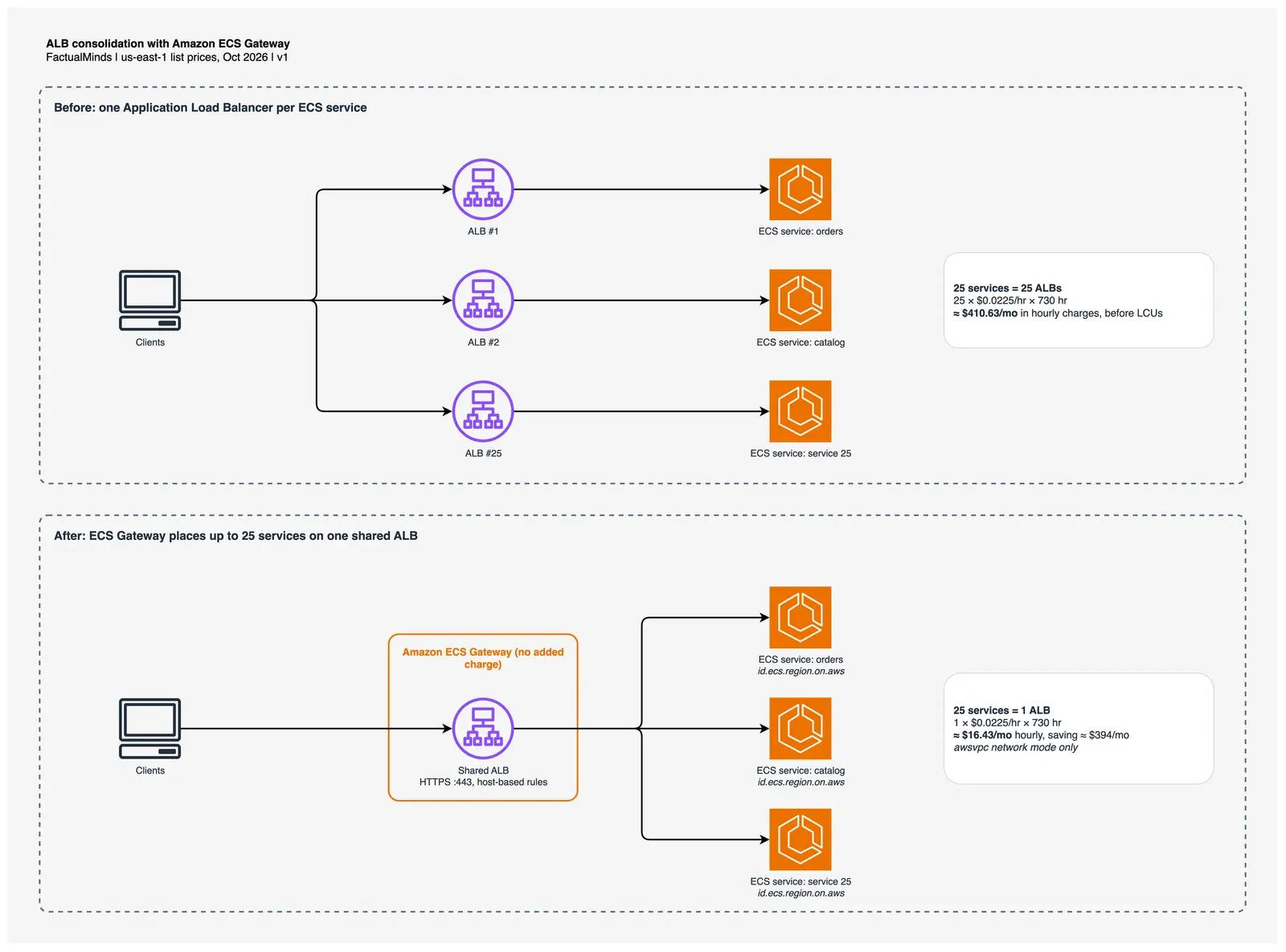
Figure: one ALB per service (top) versus ECS Gateway with host-based rules on a shared ALB (bottom). Open the draw.io source.
The catch is rule evaluations. An LCU covers 1,000 rule evaluations per second, and the first 10 processed rules per request are free. Twenty-five services on one ALB means 25 host rules. If an average request is checked against all 25 before it matches, that is 15 billable rule evaluations per request. At a sustained 100 requests/second that adds 1.5 LCU per hour, about $8.76/month. At 1,000 requests/second it adds about $87.60/month. ALB bills only the highest of its four LCU dimensions, so this matters only when rule evaluations exceed processed bytes and connections. For most fleets of small internal services, the hourly savings win by a wide margin. For one high-traffic edge ALB, model it first in our ELB pricing calculator.
How it differs from ECS Express Mode. We covered ECS Express Mode in June, which also shares an ALB across up to 25 services. The gateway docs state that “a gateway does not work with Express Mode services.” ECS Gateway brings ALB sharing to the standard ECS services most teams already run. Per the launch blog, an existing service with its own load balancer can move incrementally by calling UpdateService to add a gateway connector.
When not to use it:
- The service does not use the
awsvpcnetwork mode (bridge and host mode are out). - The service needs a listener other than HTTPS on port 443.
- The gateway and cluster are in different accounts.
- You need more ALBs than your
maxAlbCountallows. The launch blog says ECS creates a new ALB when existing ones are full, up tomaxAlbCount(default 10), and the deployment fails past that limit.
Action: run the audit script to count ALBs that front exactly one ECS service. Each one you retire removes $16.43/month in us-east-1.
2. DynamoDB: Disassociate a Global Table Replica, Keep the Data
Why it matters: each replica in a DynamoDB global table bills for its own storage and for replicated writes. Until October 20, 2026, removing a Region from a global table meant deleting that replica and its data.
Disassociation stops replication to and from one replica and leaves it as a single-Region table with the same name, ARN, data, indexes, Streams, TTL, backups, encryption, billing mode, and table class. Per the documentation, “the table is billed as a single-Region table” from then on. With three or more replicas the rest stay a global table. With two, both become single-Region tables.
Useful cases: a Region you added for a migration and never removed, a disaster-recovery replica your RTO no longer requires, or a regional data-residency copy that should stop receiving writes from elsewhere.
AWS CLI v2, from the DynamoDB documentation. Protection is on by default, so turn it off first, then disassociate:
aws dynamodb update-table --table-name Music --region us-west-2 \
  --no-disassociation-protection-enabled

aws dynamodb update-table --table-name Music --region us-west-2 \
  --replica-updates '[{"Disassociate":{"RegionName":"us-west-2","DisassociationMode":"WAIT_FOR_REPLICATION"}}]'
The catch: it is one-way. You cannot reattach the table to the global table it left. It works only for multi-Region eventual consistency (MREC) tables on version 2019.11.21, not MRSC or legacy 2017.11.29 tables. A replica must be ACTIVE, and one that served as the source for a new replica in the last 24 hours cannot be disassociated. Estimate the before and after with the DynamoDB pricing calculator, and read our DynamoDB pricing breakdown for how replicated writes are billed.
3. Lambda Recursive Loop Detection Now Covers EventBridge Custom Buses
Why it matters: a Lambda function that writes an event back to the bus that triggers it will invoke itself until something stops it. Each invocation bills, and so does each event.
As of October 14, 2026, Lambda’s loop detection covers EventBridge custom event buses in every commercial Region where they are available. It is on by default and needs no configuration. Per the Lambda documentation, “if your function is invoked approximately 16 times in the same chain of requests, then Lambda automatically stops the next function invocation.” The stopped event goes to your dead-letter queue or on-failure destination if one is configured, and an AWS Health Dashboard notification follows. The RecursiveInvocationsDropped metric counts the drops.
Supported loop paths now include SQS, S3, SNS, EventBridge custom buses, and Lambda itself.
What this does not catch — the Lambda docs are explicit: “When another AWS service such as Amazon DynamoDB forms part of the loop, Lambda can’t currently detect and stop it.” A function that writes to a DynamoDB table whose Stream triggers the same function still loops without a limit. Detection also requires a supported AWS SDK version in the function. Keep Cost Anomaly Detection and a concurrency limit on any function that writes to its own trigger source.
Action: check which functions have opted out. Default is Terminate; any function set to Allow has loop protection turned off.
AWS CLI v2. Replace the function name:
aws lambda get-function-recursion-config --function-name order-events-handler
# {"RecursiveLoop": "Terminate"}
4. Redshift System Tables Kept Past 7 Days, Without a Pipeline
Why it matters: Redshift SYS_* views keep about 7 days of history. Teams that need query history for chargeback, audit, or performance trends have built their own export jobs, and those jobs cost compute and maintenance.
Long-term retention to Amazon S3 Tables (in Apache Iceberg format) reached four more Regions on October 15, 2026: Asia Pacific (New Zealand), Canada West (Calgary), and both AWS GovCloud (US) Regions. The Redshift documentation lists about 40 SYS_* views you can publish, including SYS_QUERY_HISTORY, SYS_QUERY_TEXT, and SYS_CONNECTION_LOG.
AWS CLI v2, provisioned RA3 cluster, from the Redshift documentation:
aws redshift enable-logging --cluster-identifier my-redshift-cluster \
  --log-destination-type s3table --log-exports all --s3-table-granularity account
Cost: “Writing system table data to S3 Tables is free.” You pay S3 Tables storage and maintenance (the S3 pricing page lists $0.0265 per GB-month for the first 50 TB in US West (Oregon)) and the engine that reads it, such as Athena or Redshift. The catch: Redshift sets no retention policy, so data is kept indefinitely until you add an S3 Tables record expiration policy. Set one on day one, or this item slowly grows instead of shrinking. Sizing help: Redshift Serverless vs provisioned and the Redshift pricing calculator.
5. Bedrock Prompt Shortening: Opt-In and Offline
Why it matters: input tokens are billed on every call. A shorter system prompt reused across millions of calls is a permanent discount.
Prompt shortening (October 20, 2026) is an option inside Bedrock Advanced Prompt Optimization, which runs as a job that rewrites your prompt templates. Per the documentation, it is off by default. You enable it per template with "shortenPrompt": true inside optimizationConfig in the input JSONL. The optimized prompt is returned only if it is shorter and scores at least as high on your evaluation; otherwise you get the original back with a compressionRatio of 1.0. AWS’s example: a compression ratio of 0.7 means 30% fewer tokens. That is an example, not a typical result.
Cost: the optimization job is billed as on-demand standard-tier tokens, per the Bedrock pricing page. The documentation lists the limits as “no exact token budget,” “no per-section compression control,” and “short prompts may not compress.” It pays off for long system prompts on high-volume paths. Price your current input tokens in the Bedrock token cost calculator before running the job, and see our Bedrock token budget guide, which covers prompt caching, a larger lever for repeated prefixes.
6. CloudWatch Log Centralization Reaches GovCloud and 13 More Regions
Why it matters: multi-account organizations often copy logs into one account with subscription filters and Firehose, and they pay for that pipeline.
As of October 16, 2026, CloudWatch log centralization is available in AWS GovCloud (US-East and US-West) and 13 more commercial Regions, including Africa (Cape Town), Asia Pacific (Hyderabad, Jakarta, Malaysia, Melbourne), Europe (Milan, Spain, Zurich), Israel (Tel Aviv), and Middle East (Bahrain, UAE). The announcement states that “customers can centralize one copy of logs for free; additional copies are charged at $0.05/GB.” If you run a custom log-copy pipeline in one of these Regions, compare its monthly cost with one free native copy. More on CloudWatch line items: CloudWatch pricing breakdown.
7 and 8. Not Cost Launches
CloudWatch Omni reached eight more Regions on October 19, 2026: Canada (Central), Mumbai, Singapore, Sydney, Tokyo, Frankfurt, London, and São Paulo. It is a paid product. The Omni pricing page lists $0.50 per GB to ingest application logs in US East (N. Virginia) and $1,000 in free credits for 30 days. It may save engineering time; it adds a line to the bill.
Amazon Time Sync now offers microsecond-accurate time on 135 more EC2 instance types across 12 families (C8a, C8i, M8i, R8a, X8i, C9g, M9g, and others), enabled through a Precision Time Placement Group. It matters for trading, distributed databases, and log ordering. It has no pricing component.
Where the Reddit Summary Overstates
The thread is a useful weekly digest, and its one-liners compress some details too far:
- “Bedrock now shrinks your text prompts automatically.” It does not touch live requests. It is an opt-in setting in an offline optimization job that rewrites templates, and the job bills tokens.
- “Lambda… stops them before you get a huge surprise bill.” It stops loops through SQS, S3, SNS, EventBridge custom buses, and Lambda. Loops through DynamoDB Streams still run.
- “Up to 25 ECS services can share a single load balancer.” True for
awsvpcservices on HTTPS 443 in the same account, and not for Express Mode services, which already shared ALBs. - “You stop paying for cross-region copying.” Correct, and it cannot be undone. MREC tables only.
- “Redshift keeps system logs longer without custom code.” Correct for the four new Regions, and storage is billed with no expiry unless you set one.
- CloudWatch Omni and Time Sync appear in a cost list but do not reduce costs.
Reproduce the Audit
Reproduce this — download
cost-audit.sh(README), then runREGION=us-east-1 ./cost-audit.sh. It needs AWS CLI v2,jq, and bash 4 or later, and it uses only List, Describe, and Get calls. Expected output: a list of ALBs with the number of ECS target groups each serves and an estimated monthly hourly charge for the single-service ones, any Lambda functions withRecursiveLoop=Allow, and each DynamoDB global table with its replica Regions.
The script prices ALBs at ALB_HOURLY=0.0225. Set that variable for Regions other than us-east-1.
What to Do This Week
- Run the audit script in each production Region. It takes a few minutes and tells you which of items 1–3 apply.
- Pick one low-traffic
awsvpcservice behind its own ALB and move it to ECS Gateway withUpdateService. Watch the old ALB’s request count reach zero, then delete it. - Find any Lambda function set to
Allowand confirm someone chose that on purpose. - List global table replicas and ask the owning team whether each Region is still required for latency or recovery. Disassociate only after that conversation, because it is permanent.
- If you export Redshift system tables with a custom job in one of the four new Regions, switch to S3 Tables and set an expiration policy the same day.
If you want help sizing these changes across a multi-account organization, our FinOps consulting team runs this kind of review.
What This Post Doesn’t Cover
- Other Regions’ prices. All dollar math uses us-east-1 (ALB) and US West (Oregon) (S3 Tables) list prices on October 24, 2026. Check your Region.
- Savings Plans, Reserved capacity, and EDP discounts. None of these launches interact with commitments, but your effective rates may differ from list.
- DynamoDB replicated-write math for your table. It depends on write volume, item size, and capacity mode. Use the calculator linked above.
- ECS Gateway migration details such as DNS cutover from existing custom domains and certificate handling for your own hostnames.
- Launches from the same week that were not in the thread, such as other Bedrock model and Guardrails updates.
Frequently asked questions
Which of the October 2026 AWS cost launches saves the most money?
Does Amazon Bedrock now shorten my prompts automatically on every request?
Do I need to turn on Lambda recursive loop detection for EventBridge custom buses?
When should I NOT move services onto ECS Gateway?
What could go wrong when I disassociate a DynamoDB global table replica?
Is Redshift long-term system table retention free?
Are CloudWatch Omni and the Time Sync expansion cost savings?
How do I find which of these launches apply to my account?

AWS Cloud Architect & AI Expert
AWS-certified cloud architect and AI expert with deep expertise in cloud migrations, cost optimization, and generative AI on AWS.