Continuous Compliance Automation on AWS (2026): Config Conformance Packs, SSM Auto-Remediation, and Audit Manager — Past Security Hub
Quick summary: Security Hub detects control failures. It is not the compliance pipeline — and treating it as one is why teams still scramble for evidence at audit time. The four jobs are distinct: AWS Config detects drift, conformance packs deploy rules org-wide as immutable bundles, SSM Automation remediates the safe class, and evidence accrues via conformance-pack exports plus Security Hub control status (Audit Manager only if you onboarded before it closed to new customers on 30 April 2026). Here is the tool-per-job matrix, a conformance pack with auto-remediation, and the auto-remediation gotcha to design around.
Key Takeaways
- A continuous compliance pipeline has four distinct jobs, each owned by a different AWS service, and the mistake is collapsing them into "we have Security Hub on
- Benchmark pattern (not a cited client) — A composite ~30-account org passing point-in-time audits but re-finding the same S3 public-access and unencrypted-EBS drift every quarter, then hand-fixing it
- The four jobs (and the service that actually does each) Run the decision matrix; the short version: 1
- 2
- 3
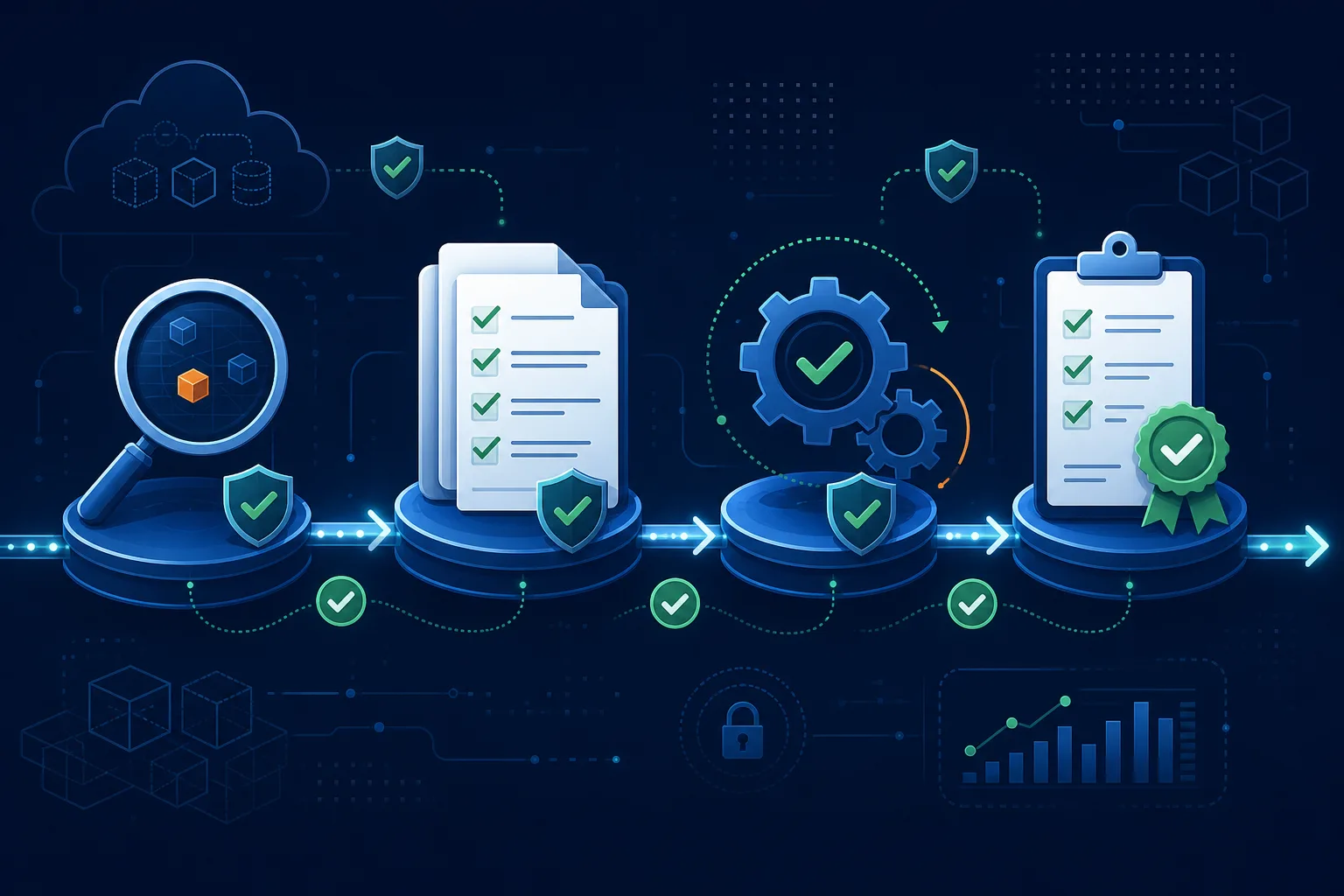
Table of Contents
Security Hub finds the misconfiguration. It does not deploy your rule baseline across 30 accounts, fix the resource, or assemble the evidence package an auditor asks for — and treating it as if it does is why teams still spend the week before an audit taking screenshots. A continuous compliance pipeline has four distinct jobs, each owned by a different AWS service, and the mistake is collapsing them into “we have Security Hub on.” As of June 2026 the building blocks are mature: AWS Config conformance packs (immutable, org-deployable rule bundles), Systems Manager Automation for remediation, and an evidence layer that depends on when you started — conformance-pack exports + Security Hub control status + CloudTrail Lake or Security Lake for new orgs (AWS closed Audit Manager to new customers on 30 April 2026; existing customers keep their support window). This post maps the jobs to the tools and shows where automation helps — and where it causes the outage.
This is for security and platform engineers who already run Security Hub and want a pipeline, not more dashboards. We ship a tool-per-job decision matrix and a Config conformance pack with SSM auto-remediation.
Benchmark pattern (not a cited client) — A composite ~30-account org passing point-in-time audits but re-finding the same S3 public-access and unencrypted-EBS drift every quarter, then hand-fixing it. Representative shape, not a billed result: replacing per-account hand-managed rules with one conformance pack deployed org-wide via Quick Setup, plus auto-remediation on the safe subset (S3 Block Public Access, EBS encryption-by-default), turns “re-discover and hand-fix every quarter” into “drift is fixed within a remediation cycle, and exported Config compliance state plus Security Hub control status is already in the evidence store.” The value is eliminating the recurring manual sweep and the pre-audit scramble — not a headline percentage.
The four jobs (and the service that actually does each)
Run the decision matrix; the short version:
1. Detect drift → AWS Config rules (+ Security Hub to aggregate/score)
Config continuously evaluates resources against rules and marks them compliant/non-compliant; Security Hub aggregates findings and scores you against standards. Detection only — neither fixes anything.
2. Deploy rules at scale → Config conformance packs
Package rules + remediation into an immutable YAML bundle and deploy per-account/Region or org-wide via Systems Manager Quick Setup or StackSets. You stop babysitting individual rules per account. Immutability is the point — to change a rule, you redeploy the pack.
3. Remediate the safe class → SSM Automation wired to Config rules
Associate an SSM Automation document with a Config rule and set Automatic: true with retries. Good first candidates are reversible, low-blast-radius fixes: S3 Block Public Access, EBS encryption-by-default, a missing required tag.
4. Prove it → Config + Security Hub evidence (or Audit Manager if already onboarded)
Default for new orgs (post–30 April 2026): export Config conformance-pack compliance state, capture Security Hub control status against your enabled standards, and query CloudTrail Lake or Security Lake for auditable activity — the same technical evidence auditors ask for, without starting on a closed product. If you already run Audit Manager: keep assessments running through your support window; it maps evidence to framework controls (GDPR, HIPAA, PCI DSS, and custom) across accounts via Organizations, with cryptographically verifiable reports and reviewer delegation. Honest limit: neither path assesses whether you are compliant — they collect evidence. They kill the manual scramble; they don’t replace the auditor. Full pipeline context: security & compliance hub.
Opinionated take: deploy a conformance pack detect-only first, confirm the findings are real for your environment, and only then enable remediation on the safe subset. Shipping a 200-rule pack with auto-remediation on across prod on day one is how a “compliance improvement” becomes an outage.
What broke — A team enabled auto-remediation on a security-group rule (close overly-permissive ingress) across all accounts at once. The remediation was technically correct, but one “overly permissive” rule was a deliberately broad ingress an internal data pipeline relied on; the auto-fix closed it and the pipeline started failing health checks. Compounding it, AWS Config auto-remediation runs off periodic snapshots, so a couple of fixes also fired against already-remediated groups due to stale evaluation data, muddying the timeline. Detected via the pipeline’s own alarms, not the compliance tooling. The fix: move network-reachability remediations to human-approved (surface + propose, don’t auto-apply), keep auto-remediation for the reversible class, and make every remediation document idempotent. Automate the boring; gate the risky.
What to do this week
- List your recurring compliance findings (the drift you re-find every quarter). That list is your conformance-pack scope.
- Deploy a detect-only conformance pack for the top offenders (start with the S3 example) to one OU.
- Enable auto-remediation on the safe subset only (encryption, public-access blocks, missing tags). Make the documents idempotent.
- If you’re audited against a framework, wire the evidence store now — conformance-pack exports + Security Hub control status + Lake queries for new orgs; keep Audit Manager assessments running only if you onboarded before 30 April 2026.
- Route compliance findings to a hardening backlog, not the pager — keep paging for incident response.
What this post doesn’t cover
- Security Hub setup and standards selection — see Security Hub compliance monitoring.
- Specific framework implementations — see ISO 27001, PCI DSS, and NIST CSF 2.0.
- Active-threat response (this is configuration hygiene, not incidents) — see incident response runbooks.
- Exact managed-rule identifiers, framework availability, and pricing — confirm in the AWS Config, Audit Manager, and Security Hub docs; specifics here are the mid-2026 model.
Related: Security Hub compliance monitoring · Incident response runbooks · CloudTrail production setup · ISO 27001 on AWS · Cloud compliance services · AWS cloud security
If you only do one thing: Take the misconfiguration you re-discover and hand-fix every quarter, put it in a detect-only conformance pack, and enable auto-remediation only once you’ve confirmed the fix is reversible and idempotent. That single loop is the difference between compliance theater and continuous compliance.
Related reading
- AWS KMS Encryption Architecture (2026): The Per-Tenant CMK Trap, the 10,000 req/s Shared Quota, and When AWS-Owned Keys Win
- AWS Resource Hardening Quick Wins: DMS, OpenSearch, SageMaker, and Lambda Runtimes
- How to Protect AWS Infrastructure from Cost-Based Attacks
Frequently asked questions
Isn't Security Hub enough for compliance on AWS?
What is an AWS Config conformance pack?
How does AWS Config auto-remediation work, and what is the gotcha?
What does AWS Audit Manager do that Config and Security Hub do not?
When should we NOT auto-remediate a compliance finding?
How do continuous compliance and incident response relate?

Agentic AI & Cloud Security
Works on making teams more productive with agentic AI. Writes the FactualMinds guides on AWS security and compliance: identity, threat detection, data protection, and audit readiness, the controls AI agents need before they touch production systems.