AWS CloudFront vs Cloudflare: Which CDN for Your Enterprise?
Quick summary: July 2026: CloudFront (750+ POPs, Origin Shield, Functions vs Lambda@Edge) vs Cloudflare (proxy + unmetered egress) — decide with a worksheet, not a stale POP count slide.
Key Takeaways
- July 2026: CloudFront (750+ POPs, Origin Shield, Functions vs Lambda@Edge) vs Cloudflare (proxy + unmetered egress) — decide with a worksheet, not a stale POP count slide
- AWS CloudFront and Cloudflare excel in different scenarios — AWS-native edge vs vendor-agnostic reverse proxy
- As of July 19, 2026, re-quote both vendors before multi-year ROI
- AWS markets CloudFront at 750+ POPs in 100+ cities across 50+ countries, plus regional edge caches and embedded POPs (CloudFront features)
- CloudFront is a CDN service within the AWS ecosystem
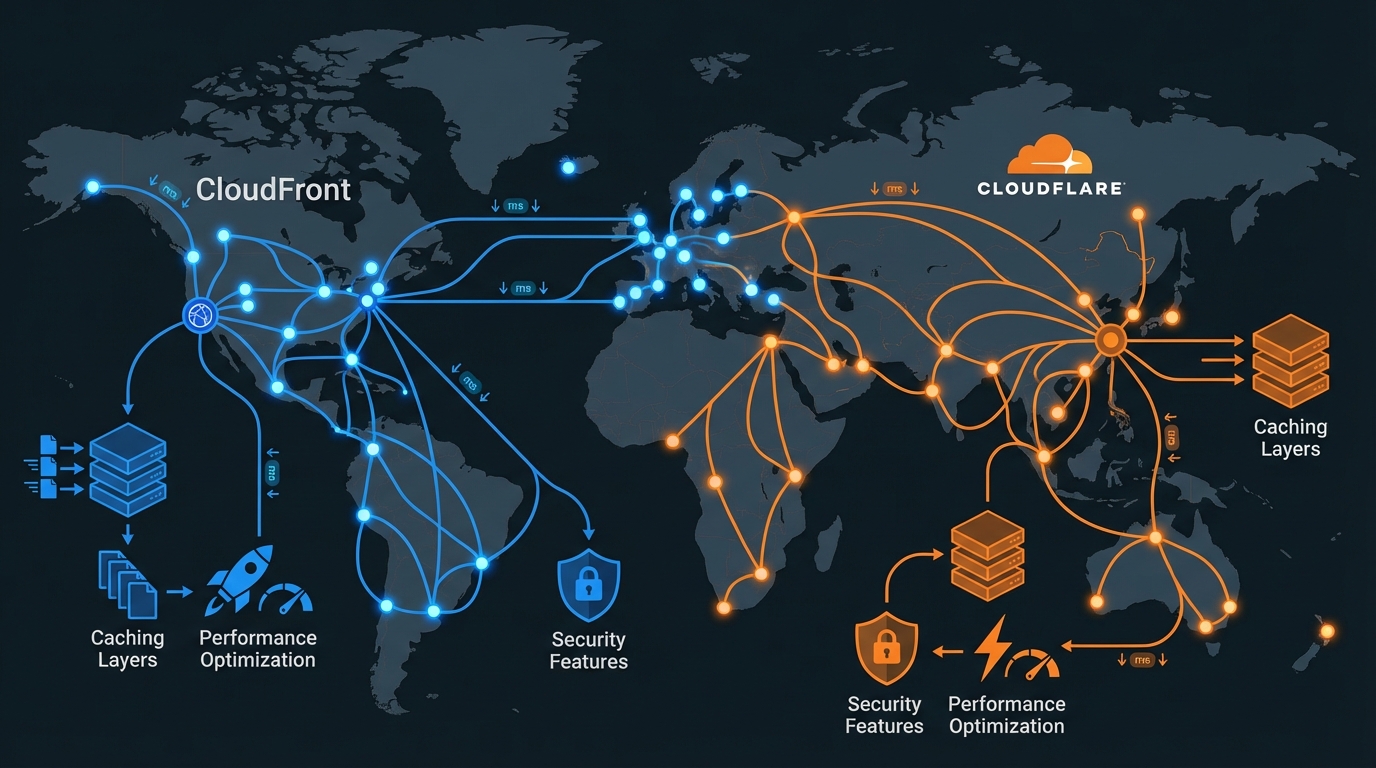
Table of Contents
Choosing a CDN touches performance, security, cost, and ops. AWS CloudFront and Cloudflare excel in different scenarios — AWS-native edge vs vendor-agnostic reverse proxy.
As of July 19, 2026, re-quote both vendors before multi-year ROI. AWS markets CloudFront at 750+ POPs in 100+ cities across 50+ countries, plus regional edge caches and embedded POPs (CloudFront features). Cloudflare’s city/POP counts and plan bundling move independently — treat the tables below as directional.
Opinionated take — If origins and WAF/Shield already live on AWS, start with CloudFront (OAC, Origin Shield, CloudFront Functions for sub-ms edge logic; Lambda@Edge when you need origin events / SDK / longer runtimes). If you need unmetered egress economics or multi-cloud origins, Cloudflare usually wins TCO. Using both is defense-in-depth, not a default.
Reproduce this — Decision worksheet:
examples/architecture-blog-2026/cdn/cloudfront-vs-cloudflare-decision.md
Architecture Differences
Before comparing features, understand the fundamental architectural difference.
CloudFront is a CDN service within the AWS ecosystem. It is designed to work seamlessly with S3, ALB, EC2, Lambda@Edge, API Gateway, and other AWS services. Your origin infrastructure lives in AWS, and CloudFront extends it to the edge.
Cloudflare is a reverse proxy network that sits in front of your entire domain. It proxies all DNS, caches content, and provides security services at the network level. Your origin can be anywhere — AWS, GCP, Azure, on-premises, or another provider.
This distinction matters. CloudFront is best when your stack is on AWS. Cloudflare is best when you need a vendor-agnostic edge network or your infrastructure spans multiple providers.
Performance Comparison
Edge Network Size
| CDN | Edge footprint (verify current marketing) | Notes |
|---|---|---|
| CloudFront | 750+ POPs, 100+ cities, 50+ countries (+ RECs / embedded POPs) | Strong AWS backbone to regional origins |
| Cloudflare | Broad city coverage; plan-dependent features | Proxy model; count claims change by era |
CloudFront density is strong in major markets with AWS backbone paths to origins. Cloudflare often wins where you need broad proxy coverage or emerging-market PoPs without an AWS-only origin story — measure, do not argue POP tables.
For most enterprise use cases in North America and Europe, performance is comparable. For global audiences, especially in Africa, South America, and Southeast Asia, Cloudflare’s broader network may provide lower latency.
Cache Hit Ratios
CloudFront introduced Origin Shield — an additional caching layer between edge locations and your origin that acts as a centralized cache. This significantly improves cache hit ratios for content that is not frequently requested at any single edge location.
Cloudflare achieves similar results through its Tiered Caching feature (available on Business and Enterprise plans), which routes cache misses through regional data centers before going to your origin.
Dynamic Content
For dynamic (non-cacheable) content, both CDNs optimize the network path between the edge and your origin:
- CloudFront: Uses AWS’s private backbone network for connections to AWS origins, reducing latency and jitter compared to the public internet.
- Cloudflare: Uses Argo Smart Routing (paid add-on) to find the fastest path through Cloudflare’s network. This optimizes connections to any origin, not just those in a specific cloud.
Pricing Comparison
Pricing Note: Tables below are directional as of early 2026 drafts — re-verify CloudFront pricing and Cloudflare pricing before board slides (July 2026).
CDN pricing is notoriously complex. Here is a simplified comparison for common scenarios.
Data Transfer Pricing
| Region | CloudFront (per GB) | Cloudflare |
|---|---|---|
| North America | $0.085 | Included (unmetered) |
| Europe | $0.085 | Included (unmetered) |
| Asia | $0.110-0.140 | Included (unmetered) |
| South America | $0.110 | Included (unmetered) |
Cloudflare’s pricing model is fundamentally different — bandwidth is unmetered on all plans. You pay a flat monthly fee based on features (Free, Pro at $20/month, Business at $200/month, Enterprise at custom pricing), not per GB transferred.
For high-bandwidth workloads (media streaming, large file distribution, image-heavy sites), Cloudflare’s flat pricing is significantly cheaper. For low-bandwidth workloads with heavy compute at the edge, CloudFront may be more cost-effective.
CloudFront Cost Optimization
If you choose CloudFront, there are strategies to reduce costs:
- CloudFront Security Savings Bundle — Up to 30% discount with a 1-year commitment
- Origin Shield — Reduces origin requests (and origin compute costs) by consolidating cache fills
- Cache policies — Maximize cache hit ratios with well-tuned cache key policies
- Price class selection — Restrict edge locations to lower-cost regions if your audience is concentrated
We have helped clients reduce CloudFront costs by 30% through Savings Bundles and optimized image pipelines.
Security Features
DDoS Protection
| Feature | CloudFront | Cloudflare |
|---|---|---|
| Layer 3/4 DDoS | AWS Shield Standard (free) | Always-on (free) |
| Layer 7 DDoS | AWS Shield Advanced ($3,000/mo) | Pro plan ($20/mo) |
| WAF | AWS WAF (pay per rule/request) | Included (Pro+) |
| Bot management | AWS WAF Bot Control ($10/mo + per request) | Included (Business+) |
Cloudflare includes DDoS protection and basic WAF on all plans, making it significantly cheaper for security-focused deployments. AWS Shield Advanced adds DDoS cost protection (AWS credits for scaling costs during attacks) and 24/7 DDoS Response Team access, which is valuable for enterprise compliance requirements.
Web Application Firewall
AWS WAF is a standalone service that pairs with CloudFront. You define rules or use managed rule groups (AWS, third-party, or custom). Pricing is per web ACL, per rule, and per request evaluated. This gives you granular control but requires active management.
Cloudflare WAF is integrated into the platform with managed rulesets updated by Cloudflare’s threat intelligence team. Less configuration required, but also less granular control over rule behavior.
For organizations with strict security and compliance requirements, AWS WAF provides the audit trail, IAM integration, and custom rule flexibility that enterprise security teams need.
SSL/TLS
Both services provide free SSL certificates and support custom certificates:
- CloudFront: Uses ACM (AWS Certificate Manager) for free certificates. Supports custom certificates uploaded to IAM.
- Cloudflare: Provides Universal SSL automatically. Supports custom certificates on Business and Enterprise plans. Also offers full (strict) mode that encrypts traffic between Cloudflare and your origin.
Edge Compute
CloudFront Functions and Lambda@Edge
CloudFront offers two edge compute options:
- CloudFront Functions — Lightweight JavaScript functions that run on every request for simple transformations (URL rewrites, header manipulation, request routing). Sub-millisecond execution, very low cost.
- Lambda@Edge — Full Lambda functions that run at CloudFront edge locations. Support Node.js and Python. Can modify requests and responses at four lifecycle stages (viewer request, origin request, origin response, viewer response). More powerful but higher latency and cost.
Cloudflare Workers
Cloudflare Workers is a full serverless computing platform at the edge:
- Supports JavaScript, TypeScript, Python, Rust, and other languages via WebAssembly
- Workers KV — Global key-value storage at the edge
- Durable Objects — Stateful edge compute with strong consistency
- R2 — S3-compatible object storage with no egress fees
- D1 — SQLite database at the edge
Workers is a more mature and capable edge compute platform. If your use case requires significant logic at the edge (A/B testing, personalization, authentication, API routing), Cloudflare Workers is the stronger option.
If your edge compute needs are limited to simple request/response transformations and your backend is on AWS, CloudFront Functions + Lambda@Edge is sufficient and avoids introducing another vendor.
Integration Considerations
AWS-Native Stack
If your infrastructure is on AWS, CloudFront integrates seamlessly:
- S3 origins — Direct integration with Origin Access Control (OAC) for secure, private bucket access
- ALB/EC2 origins — Private origins through VPC connectivity
- API Gateway — Custom domain with CloudFront distribution for API acceleration
- CloudFront Functions — Sub-millisecond viewer-request/response logic (headers, JWT checks, redirects); millions of RPS class scale
- Lambda@Edge — Longer-running Node/Python, origin triggers, SDK/network access — pair with Functions, do not treat as mutually exclusive (edge function chooser)
- AWS WAF — Unified security management through AWS console
- CloudWatch — Native metrics, access logs, and real-time logs
- ACM — Free SSL certificates with automatic renewal
Multi-Cloud or Hybrid
If your infrastructure spans multiple clouds or includes on-premises servers, Cloudflare’s vendor-agnostic approach is advantageous:
- Proxies any origin regardless of hosting provider
- Consistent security policies across all origins
- Single DNS management for all domains
- Cloudflare Tunnel for secure origin connections without public IPs
When to Choose CloudFront
- Your infrastructure is primarily on AWS
- You need deep integration with S3, ALB, API Gateway, and Lambda
- You are already using AWS WAF and Shield for security
- You want a single vendor for infrastructure and CDN billing
- You need CloudFront-specific optimizations like Origin Shield, field-level encryption, or real-time logs to Kinesis
When to Choose Cloudflare
- You need a vendor-agnostic CDN that works with any origin
- Your bandwidth costs are high and you want unmetered pricing
- You need always-on DDoS protection without per-request WAF charges
- You want a mature edge compute platform (Workers) for complex edge logic
- Your infrastructure spans multiple cloud providers or includes on-premises
When to Use Both
Some organizations use both — Cloudflare in front of CloudFront. Cloudflare handles DNS, DDoS protection, and global load balancing, while CloudFront provides optimized delivery from AWS origins with Lambda@Edge compute. This is a valid pattern for enterprises that want defense in depth, but adds operational complexity.
What This Post Doesn’t Cover
- Fastly / Akamai / media-specific CDNs — different contract and packaging models.
- China / restricted Region delivery — separate compliance design.
- Live per-GB rate cards — always pull current vendor pricing.
What to Do This Week
- Fill the decision worksheet with origin map + bandwidth.
- Capture 7-day cache hit ratio and origin request rate on the current edge.
- If AWS-native: confirm OAC (not legacy OAI) and whether Functions vs Lambda@Edge fits the event.

AWS Cloud Architect & AI Expert
AWS-certified cloud architect and AI expert with deep expertise in cloud migrations, cost optimization, and generative AI on AWS.