Bedrock AgentCore vs Amazon Q: The Enterprise Decision Framework (2026)
Quick summary: First-party TCO benchmark (July 2026): 500-employee Quick Suite ~$3,580/mo vs AgentCore support agent ~$791/mo at 50K sessions. CTO framework for choosing managed assistants vs custom agent infrastructure on AWS.
Key Takeaways
- First-party TCO benchmark (July 2026): 500-employee Quick Suite ~$3,580/mo vs AgentCore support agent ~$791/mo at 50K sessions
- CTO framework for choosing managed assistants vs custom agent infrastructure on AWS
- AWS lifecycle notice (June 30, 2026) — Amazon Q Business is in maintenance for new customers after July 30, 2026
- Net-new evaluators should use Amazon Quick Suite
- Executive summary (July 2026) — AWS closed Amazon Q Business to new customers after July 31, 2026 and directs net-new buyers to Amazon Quick Suite
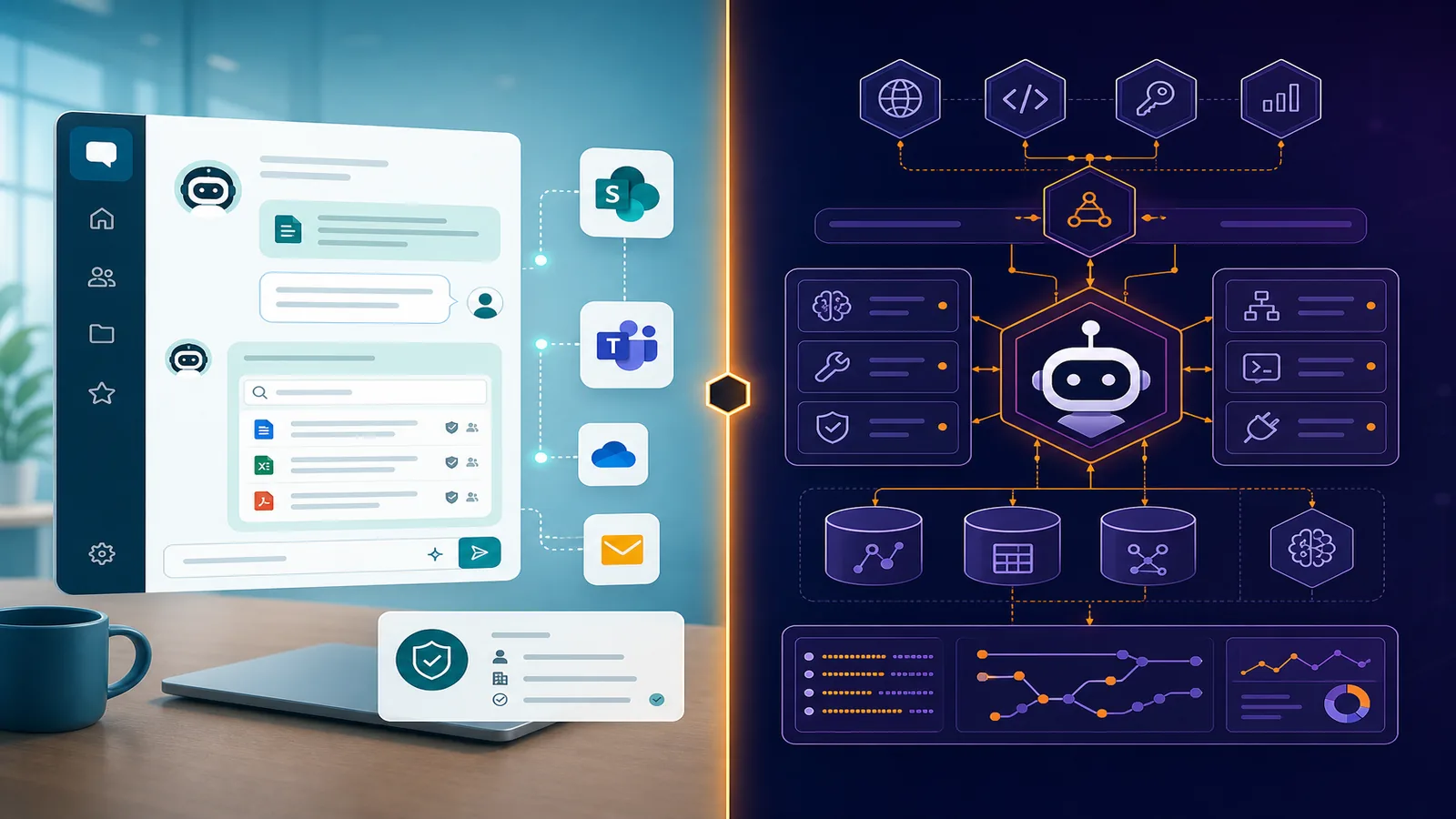
Table of Contents
AWS lifecycle notice (June 30, 2026) — Amazon Q Business is in maintenance for new customers after July 30, 2026. Net-new evaluators should use Amazon Quick Suite. Existing deployments remain supported. Full matrix: lifecycle roundup.
Executive summary (July 2026) — AWS closed Amazon Q Business to new customers after July 31, 2026 and directs net-new buyers to Amazon Quick Suite. Bedrock AgentCore reached GA on October 13, 2025 as modular agent infrastructure (Runtime, Memory, Gateway, Identity, Observability). They are not interchangeable: Quick Suite is a managed workforce AI platform; AgentCore is how you build and operate custom agents. Our first-party TCO benchmark: 500 employees + 25K documents → ~$3,580/month on Quick Suite vs 50K support sessions → ~$791/month on AgentCore (platform + model). Hybrid is the enterprise default at scale.
Enterprise teams evaluating AWS AI in July 2026 face a naming shift and a category split at the same time. Amazon Quick Suite subsumes the employee-assistant capabilities of Amazon Q Business while adding Quick Research, Quick Flows, and Quick Automate. Bedrock AgentCore sits one layer down — execution, memory, tools, and traces for agents you own. This guide is a decision framework for CTOs, CIOs, and architects: which to choose, why, what it costs, when to avoid it, and how it scales.
Why enterprises are standardizing on AWS AI platforms now
Three pressures converge in 2026:
Agentic AI moved from demo to procurement. Boards ask for autonomous workflows; security teams ask for CloudTrail, guardrails, and data residency. AWS offers a managed path (Quick Suite) and a builder path (AgentCore) inside the same compliance boundary many enterprises already audit.
Workforce assistants vs product agents. Employee Q&A over SharePoint is a different problem than a customer-facing support bot in your SaaS. Confusing the two drives either over-engineering (AgentCore for IT helpdesk) or under-engineering (Quick Suite embed on a viral marketing page).
Governance is non-negotiable. Regulated buyers need permission-aware retrieval, region pinning, and BAA-eligible services. Both Quick Suite lineage and AgentCore run in your AWS account with IAM and KMS controls — unlike third-party chat SaaS that processes data off-account.
What is Amazon Quick Suite (and where Amazon Q fits today)
Amazon Quick Suite is AWS’s agentic workspace (GA October 2025; product surface at aws.amazon.com/quick) — the evolution of Amazon Q Business plus QuickSight BI capabilities. AWS describes it as a single digital workspace where agents for Quick Index (enterprise search), Quick Research (multi-source analysis), Quick Flows / Quick Automate (workflow automation), and Quick Sight (governed BI) cooperate. Product history and deprecated predecessors: Amazon Quick Suite history.
Architecture (conceptual)
┌─────────────────────────────────────────────────────────────┐
│  Amazon Quick Suite (managed control plane)                 │
│  ┌──────────┐ ┌──────────┐ ┌──────────┐ ┌──────────────┐   │
│  │Quick     │ │Quick     │ │Quick     │ │Quick Sight   │   │
│  │Index     │ │Research  │ │Flows     │ │(BI / NLQ)    │   │
│  └────┬─────┘ └────┬─────┘ └────┬─────┘ └──────┬───────┘   │
│       └────────────┴────────────┴──────────────┘           │
│                         │                                   │
│              Enterprise Index (vector + ACL)                │
│                         │                                   │
│    Connectors: S3, SharePoint, Confluence, Salesforce, …   │
└─────────────────────────────────────────────────────────────┘
         ▲ SSO (IAM Identity Center / SAML IdP)
         ▼ End users: web, Teams, Slack, browser extension
Existing Amazon Q Business customers can continue on Q Business or attach existing indexes to Quick Suite. Net-new buyers after July 31, 2026 should evaluate Quick Suite per AWS documentation.
Core capabilities
| Capability | What it delivers |
|---|---|
| Permission-aware RAG | Answers inherit document ACLs from source systems |
| 40+ connectors | Prebuilt sync to SharePoint, Confluence, ServiceNow, S3, Salesforce, etc. |
| Quick Flows / Automate | No-code workflow automation (evolution of Q Apps) |
| Quick Research | Deep research with curated external sources |
| MCP support | Model Context Protocol for extending tool connectivity |
| Embeddable chat | ChatSync API and embedded widget for apps and public pages |
| Admin console | Non-developer setup; no vector DB to operate |
Licensing (July 2026, us-east-1)
| Tier | Price | Best for |
|---|---|---|
| Q Business Lite | $3/user/month | Read-heavy employee Q&A |
| Q Business Pro | $20/user/month | Q Apps/Flows, plugins, Q in QuickSight Reader Pro |
| Enterprise Index | $0.264/hour per unit | Production (3 AZ); ~20K docs or 200 MB text per unit |
| Consumption (embed) | $200 per 30K units | Anonymous/authenticated API; 2 units per ChatSync call |
Subscriptions deduplicate per user only within the same IAM Identity Center instance — a common FinOps trap for multi-IdP setups.
Limitations
- Not a white-label agent framework — UX is AWS-shaped (web, embed, integrations).
- Index runs 24/7; empty indexes still bill.
- Complex custom tool chains beyond plugins/Flows may hit ceiling — that is AgentCore territory.
- Amazon Q Developer ($19/user/month) is a separate product for IDE coding; see our Q vs Copilot comparison.
What is AWS Bedrock AgentCore
Amazon Bedrock AgentCore (GA October 13, 2025) is modular agent infrastructure: Runtime, Harness, Memory, Gateway, Identity, Browser, Code Interpreter, Policy, Observability, and Evaluations. Use any framework (LangGraph, CrewAI, Strands, OpenAI Agents SDK) and any model (Bedrock, OpenAI-compatible, Gemini).
Deep architecture: AgentCore production guide. Billing: 12-component pricing breakdown.
Two deployment paths
| Path | You write | AWS manages |
|---|---|---|
| Harness | Config (model, prompt, tools) | Agent loop, isolation, tool execution |
| Code-based Runtime | Python agent loop in your framework | Scale, session isolation, VPC, deploy |
Enterprise-relevant components
- Runtime — Serverless execution with session isolation (microVM); cold starts measured in seconds.
- Memory — Short-term session state + long-term cross-session store (bill separately; set TTL).
- Gateway — Governed tool access (APIs, Lambda, MCP servers) with auth and indexing fees.
- Identity — OAuth/API key brokering for user-scoped agent actions.
- Observability — CloudWatch traces; essential for audit and debugging non-deterministic failures.
Limitations
- You own UX, connector logic for non-Gateway sources, and operational runbooks.
- Platform fees stack on top of Bedrock inference — budget both.
- Browser and Code Interpreter enabled by default in some templates inflate bills.
What broke — A team enabled AgentCore Browser on every customer-support turn “for completeness.” At 50K sessions/month with 20-second browse steps, Runtime duration line items tripled before model tokens. Fix: restrict Browser to research intents; use Gateway to CRM APIs for ticket lookup instead.
The philosophical difference
| Dimension | Amazon Quick Suite | Bedrock AgentCore |
|---|---|---|
| Question it answers | “How do employees get permission-aware answers fast?” | “How do we run custom agents in production?” |
| Primary user | Employee, analyst, citizen automator | Platform engineer, AI team, product developer |
| UX ownership | AWS (chat, embed, Teams/Slack) | You (API, app, voice, etc.) |
| Economics | Per-seat + always-on index | Per-session consumption + tokens |
| Time to first value | Weeks (connectors + SSO) | Months (agent engineering maturity) |
| Customization ceiling | Flows, plugins, MCP | Full code, multi-agent, any protocol |
When one beats the other: If success means 2,000 employees asking HR policy questions with citations, choose Quick Suite. If success means 50,000 customers invoking an autonomous refund agent inside your app, choose AgentCore.
Feature comparison
| Dimension | Quick Suite | AgentCore |
|---|---|---|
| Purpose | Workforce AI + governed BI | Custom agent runtime |
| Target users | Business, IT admin | Engineers, architects |
| Custom AI agents | Flows/Automate (low-code) | Full code / Harness |
| Built-in knowledge | Enterprise Index | Bring Knowledge Bases or your RAG |
| Enterprise search | Native (Quick Index) | Via Gateway + your index |
| Workflow automation | Quick Flows | Your orchestration |
| Developer productivity | Q Developer (separate SKU) | AgentCore + Q Developer |
| Foundation model choice | AWS-managed selection | Any supported FM |
| Multi-agent | Quick Automate | Native patterns + A2A/MCP |
| Tool integration | Plugins, MCP | Gateway, inline tools, Lambda |
| API extensibility | ChatSync, embed | Full control plane + data plane APIs |
| AWS integration | Deep (connectors) | Deep (IAM, Lambda, any AWS API) |
| Third-party integration | 40+ connectors | Unlimited via Gateway |
| Identity | IAM Identity Center, SAML | Identity + your IdP upstream |
| Encryption | KMS, TLS | KMS, TLS, VPC |
| Compliance | HIPAA-eligible, SOC 2, etc. | Same Bedrock compliance scope |
| Auditability | CloudTrail, admin analytics | Step-level CloudWatch traces |
| Observability | Admin dashboards | CloudWatch + X-Ray |
| Deployment complexity | Low | Medium–high |
| Operational complexity | Index sync, subscriptions | Runtime, memory TTL, tool SLOs |
| Vendor lock-in | Connector + index migration | Framework-portable; AWS runtime coupling |
| Scalability | Seat + index units | Session horizontal scale |
| Cost optimization | Right-size index units, tier mix | Disable Browser/CI; Memory TTL; model choice |
Full scenario matrix: decision-matrix.md.
Budget and TCO analysis
All figures are first-party benchmarks (us-east-1, July 2026) from tco-worksheet.csv and repo pricing tools — not client engagements.
Scenario A — Internal knowledge (500 employees, 25K docs)
| Line item | Quick Suite |
|---|---|
| 400 Lite + 100 Pro subscriptions | $3,200/mo |
| 2 Enterprise Index units | $380/mo |
| Total | ~$3,580/mo |
Rebuilding the same scope on AgentCore requires connector engineering, ACL logic, and ongoing agent ops — platform-only estimate for equivalent query volume is not cheaper once engineering TCO is included.
Scenario B — Embedded product assistant (800 MAU, 2 queries/day)
| Platform | Monthly est. |
|---|---|
| Quick Suite (10 index units + consumption bundles) | ~$2,501 |
| AgentCore (Runtime + Memory + Haiku-like tokens) | ~$499 |
At moderate external volume, consumption economics can favor AgentCore. Quick Suite wins when you want zero backend team and authenticated employees — not anonymous MAU at scale.
Scenario C — Customer support (50K sessions/mo, 45s active, 3 turns)
| Line item | AgentCore |
|---|---|
| Platform (Runtime + Gateway + Memory) | ~$335/mo |
| Model inference (Haiku-like) | ~$456/mo |
| Total | ~$791/mo |
Quick Suite would bill seats, not sessions — wrong meter for external chat volume.
TCO beyond AWS list price
| Cost bucket | Quick Suite | AgentCore |
|---|---|---|
| Licensing | Predictable per user | N/A |
| Infrastructure | Index 24/7 | Runtime + Memory |
| Development | Admin + citizen dev | Agent engineers |
| Maintenance | Connector sync, ACL audits | Prompt/tool versioning, evals |
| Training | End-user enablement | Agent ops playbooks |
| Hidden | Idle index units; duplicate IdP charges | Memory without TTL; Browser on all turns |
Run model spend with our Bedrock token cost calculator.
Reproduce this — Download
tco-worksheet.csv. Adjust users, index units, and sessions; rates align withsrc/data/tools/amazon-q-pricing.tsandsrc/data/tools/bedrock-agentcore-pricing.ts(us-east-1, July 2026).
Recommendations by company size
| Size | Recommendation | Why | Risks | Ops effort |
|---|---|---|---|---|
| 1–10 | Quick Suite Lite + Starter index | Fastest path; no agent team | Outgrow Starter index quickly | Low |
| 10–50 | Quick Suite Pro for power users | Flows + plugins for ops | Index sizing | Low |
| 50–200 | Quick Suite; pilot AgentCore for one product agent | Split use cases early | Two platforms to govern | Medium |
| 200–500 | Hybrid default | Employees on Quick Suite; product on AgentCore | Duplicate data if unplanned | Medium |
| 500–2,000 | Hybrid + FinOps on index units | Seat + index dominate Quick bill | IdP deduplication | Medium |
| 2,000–10,000 | Hybrid; CCoE standards | Standardize connector patterns | AgentCore sprawl without platform team | High |
| 10,000+ | Hybrid + multi-account | Separate employee vs customer accounts | Cross-account identity | High |
Recommendations by revenue
| Revenue | Lean |
|---|---|
| Pre-revenue / <$1M | Quick Suite PoC OR AgentCore only if AI is the product |
| $1M–$10M | Quick Suite internal; AgentCore when shipping agent feature to customers |
| $10M–$100M | Hybrid; formal AI governance |
| $100M–$1B | Hybrid + dedicated platform engineering |
| $1B+ | Hybrid at scale; Quick Suite for workforce; AgentCore factory for product lines |
Security comparison
| Control | Quick Suite | AgentCore |
|---|---|---|
| IAM / SSO | IAM Identity Center, SAML IdPs | Identity component + upstream auth |
| Encryption | KMS at rest, TLS in transit | Same |
| Data isolation | Per-application index; ACL inheritance | Session microVM isolation |
| Private networking | VPC endpoints for AWS APIs | AgentCore VPC for Runtime |
| Compliance | HIPAA-eligible (BAA), SOC 2, ISO | Bedrock service scope |
| Audit logs | CloudTrail, admin analytics | Step-level agent traces |
| Least privilege | Connector-scoped roles | Per-tool IAM on Gateway |
| Multi-account | Landing zone per OU | Separate runtime accounts recommended |
| Guardrails | Bedrock Guardrails where integrated | Apply on model calls in agent loop |
| PII | Source ACLs + admin policies | Your redaction + Guardrails |
| Regulated industries | Strong for internal PHI/PII Q&A | Strong for controlled tool execution |
See HIPAA-compliant AI on Bedrock and Guardrails production setup.
Scalability
| Workload | Quick Suite | AgentCore |
|---|---|---|
| Small ( <100 users) | Excellent | Overkill unless product agent |
| Enterprise employees | Index units scale; watch cost | N/A for pure internal Q&A |
| Millions of external users | Consumption bundles expensive | Runtime horizontal scale |
| High request volume | Index + unit bundles | Runtime vCPU-hours |
| Multi-region | Regional index deployments | Regional Runtime deploy |
| DR | Enterprise Index (3 AZ) | Multi-region active/active (you design) |
| Latency | Chat-optimized | Cold start seconds; warm strategies needed |
Manageability
Quick Suite: IT/admin owns connectors, SSO groups, subscription tiers, index capacity. Monitoring = sync failures, query analytics, index storage.
AgentCore: Platform team owns deploy pipelines, memory retention, Gateway tool registry, eval suites, incident response for agent failures. Monitoring = CloudWatch traces, error rates per tool, token spend anomalies.
Change management: Quick Suite changes are admin-console; AgentCore changes are CI/CD with versioned prompts and canary deploys.
Maintenance costs
| Activity | Quick Suite | AgentCore |
|---|---|---|
| Development | Low after setup | Continuous (prompts, tools, evals) |
| Operations | Index sync, user lifecycle | Runtime scaling, memory compaction |
| Knowledge refresh | Connector schedules | KB re-index + Memory TTL |
| Security updates | AWS-managed platform | Agent IAM reviews, tool audits |
| Platform evolution | Quick Suite feature releases | AgentCore modular components GA/preview |
Long-term ownership: Quick Suite TCO rises linearly with headcount and index size; AgentCore TCO rises with sessions, tool complexity, and model choice.
Enterprise decision matrix
Twenty-plus scenarios with Quick Suite / AgentCore / Hybrid recommendations are in the downloadable decision matrix.
Examples:
- Internal IT helpdesk → Quick Suite
- Customer support API in SaaS → AgentCore
- Sales enablement + CRM → Quick Suite
- Multi-agent supply chain automation → AgentCore
- Software engineering → Q Developer (not either platform above)
Reference architecture patterns
Small SaaS (80 employees + customer chat)
Quick Suite for internal runbooks (80 Lite users, 1 Enterprise Index unit). AgentCore Runtime for customer widget (API Gateway → Runtime → Gateway → CRM Lambda). Shared org account; separate IAM roles.
Enterprise hybrid
Account A: Quick Suite for 5,000 employees, IAM Identity Center, Enterprise Index 50 units. Account B: AgentCore production for product agents, Guardrails, Observability. Account C: Sandbox AgentCore via agentcore CLI.
Healthcare (internal PHI Q&A)
Quick Suite with BAA-covered region, connector to encrypted S3 clinical policies — not ChatGPT SaaS. AgentCore only for non-PHI automation or de-identified pipelines.
Banking (employee + customer)
Quick Suite for policy/compliance docs (ACL inheritance). AgentCore for authenticated customer service with Policy component and human approval on transfer tools.
Manufacturing
Quick Suite on SOPs, safety PDFs, ERP connectors. AgentCore optional for equipment telemetry agents via IoT → Lambda → Gateway.
Developer platform
Q Developer Pro for all engineers; AgentCore for internal platform bot (runbooks, Terraform modules search via Gateway).
Customer support at scale
API Gateway + Cognito → AgentCore Runtime → Knowledge Base + ServiceNow Gateway. Quick Suite for agent assist (internal), not customer-facing.
Best practices
- Security: Fix source ACLs before connecting Quick Suite; scope AgentCore IAM per tool.
- Governance: CCoE defines when Flows vs AgentCore is mandatory.
- Cost: Right-size index units; set Memory TTL; disable Browser unless required.
- Multi-account: Employee AI vs customer AI in separate accounts.
- Observability: Enable AgentCore traces day one; monitor Quick connector sync failures.
- Responsible AI: Bedrock Guardrails on all customer-facing AgentCore paths.
Common mistakes
- AgentCore for internal wiki — six months rebuilding connectors Quick Suite includes.
- Quick Suite public embed at viral scale — consumption cliff; model AgentCore instead.
- Ignoring index idle cost — delete PoC indexes.
- AgentCore without evals — production incidents from prompt drift.
- Conflating Q Developer with AgentCore — different SKUs, different buyers.
- Duplicate RAG — Quick Index + Bedrock KB on same docs without strategy.
FactualMinds recommendation
Choose Amazon Quick Suite when:
- Users are employees or analysts with existing SSO.
- You need permission-aware enterprise search in weeks, not quarters.
- Success metrics are adoption, time-to-answer, and ticket deflection — not custom UX.
- FinOps prefers predictable per-seat budgets.
Choose Bedrock AgentCore when:
- The agent is part of your product or faces customers.
- You need custom orchestration, multi-agent systems, or regulated tool execution.
- Session volume makes seat economics irrelevant.
- You have (or will hire) agent platform engineering capacity.
Use both when:
- You are 200+ employees with a customer-facing AI feature — the pattern we see most often at scale.
Avoid both when:
- You only need single-turn Bedrock Converse API calls — invoke models directly.
- Requirements are generic chat without enterprise data — evaluate build vs buy outside AWS first.
For implementation support: AWS Bedrock consulting and Amazon Q for Business consulting.
Frequently asked questions
Is Quick Suite the same as QuickSight?
No. Quick Suite includes Quick Sight (BI) plus Index, Research, Flows, and Automate. This guide compares Quick Suite to AgentCore, not QuickSight alone.
Can I migrate Q Business indexes to Quick Suite?
AWS states existing indexes can be reused with Quick Suite for new agent capabilities. Confirm migration steps with AWS for your application ID and region.
Does AgentCore replace Bedrock Agents Classic (classic)?
AgentCore is the newer modular runtime layer. Classic Bedrock Agents API still exists; AgentCore adds production operations. See Agents vs Step Functions.
Which has better RAG?
Quick Suite ships managed RAG with connectors. AgentCore expects you to bring RAG (Bedrock Knowledge Bases or custom). For custom RAG pipelines see Bedrock Knowledge Bases guide.
Can AgentCore use MCP?
Yes. Runtime and Gateway support MCP servers; Quick Suite also advertises MCP for extensions.
How do I estimate AgentCore before building?
Use AgentCore pricing post and multiply model spend by 1.15× (lean) to 1.4× (full features).
Is Quick Suite available in GovCloud?
Verify current regional and compliance scope in AWS docs at implementation time — availability moves faster than blog posts.
What about Amazon Q in Connect?
Contact-center agent assist is a separate SKU (per-interaction pricing). Not covered in depth here.
Can I embed Quick Suite in my mobile app?
ChatSync API supports embedded experiences; consumption pricing applies. High volume → model AgentCore economics.
Does Quick Suite train on my data?
AWS states customer content is not used to improve models for other customers; confirm current terms for your contract.
How does AgentCore handle multi-tenant SaaS?
Design separate memory namespaces per tenant; use Identity for tenant-scoped credentials. See multi-tenant GenAI on Bedrock.
Which is faster to deploy?
Quick Suite: weeks. AgentCore MVP: weeks; production hardening: months.
Do I need Kubernetes for AgentCore?
No. Runtime is serverless. Bring containers only if Harness/custom image requires it.
Can Quick Suite call external APIs?
Plugins and MCP; complex chains may need AgentCore Gateway patterns.
How do I compare vs ChatGPT Enterprise?
See Q vs ChatGPT Enterprise CTO guide.
What models does Quick Suite use?
AWS-managed; you select allowed models in admin policies where exposed.
What models does AgentCore support?
Bedrock, OpenAI-compatible, Gemini, and others per AgentCore docs.
How do I set up Quick Suite connectors?
Start with SharePoint + S3 setup guide.
What is AgentCore Harness vs Runtime?
Harness = declarative single API agent loop. Runtime = deploy your framework code. Get started CLI.
Should startups default to AgentCore?
Only if the startup is an AI agent product. Otherwise Quick Suite Lite + Starter index for internal ops.
What to do this week
- Classify workloads — employee vs customer vs developer (three lanes).
- Run TCO — fill
tco-worksheet.csvwith your user and session counts. - Score scenarios — mark rows in decision-matrix.md.
- Audit ACLs — if choosing Quick Suite, fix SharePoint/Confluence permissions first.
- Pilot one path — 30-day Quick Suite PoC OR one AgentCore Runtime agent; not both unless hybrid is explicit.
- Book architecture review — contact FactualMinds for dual-track evaluation.
What this post doesn’t cover
- Amazon Q in Connect contact-center pricing and architecture.
- Quick Suite list pricing changes after July 2026 GA — verify before contract sign.
- Non-AWS assistants (ChatGPT Enterprise, Microsoft Copilot) beyond pointers to existing comparisons.
- Fine-grained regional availability for every AgentCore component — check AWS Region tables at deploy time.
- Hands-on Quick Suite admin console walkthrough — AWS console UX changes frequently.
Official references
- Amazon Quick Suite announcement
- What is Amazon Q Business
- Amazon Q Business pricing
- Amazon Q Developer
- What is Bedrock AgentCore
- AgentCore pricing
More questions
Is Amazon Q Business still available for new customers in July 2026?
Amazon Q Business stops accepting new customers after July 31, 2026. Net-new evaluators should plan on Amazon Quick Suite, which AWS positions as the next evolution of Q Business — unified research, BI, automation, and enterprise search. Existing Q Business customers remain supported and can reuse indexes with Quick Suite.
When should I choose Bedrock AgentCore over Amazon Quick Suite?
Choose AgentCore when the agent is customer-facing or embedded in your product, when you need custom orchestration (LangGraph, Strands, multi-agent), when tool execution must be versioned in Git and audited step-by-step, or when consumption-based economics beat per-seat licensing at high session volume. Quick Suite wins for employee-facing, permission-aware knowledge work with minimal engineering.
Can I use Quick Suite and AgentCore together?
Yes — and at scale this is often the right answer. Quick Suite (or Q Business) serves employees with governed connectors and SSO; AgentCore powers product features, customer support APIs, or platform automation. Shared identity via IAM Identity Center and shared data in S3/OpenSearch can reduce duplicate indexing if you design boundaries deliberately.
When should I NOT deploy AgentCore for an internal IT helpdesk?
If your goal is permission-aware answers over ServiceNow, Confluence, and SharePoint within 30–60 days and you have no dedicated agent engineering team, AgentCore is over-engineering. Quick Suite native connectors, ACL inheritance, and admin console beat a custom RAG stack on Runtime for this use case — unless you need tool write-back patterns Quick Flows cannot express.
When should I NOT use Quick Suite for customer support chat?
Anonymous or authenticated external users at high query volume can hit Quick Suite consumption pricing cliffs (units per ChatSync call). Custom branding, strict latency SLAs, and complex CRM tool chains usually require AgentCore Runtime with Gateway — or a hybrid where Quick Suite handles internal escalation docs and AgentCore handles the customer API.
How does AgentCore pricing compare to Quick Suite per-seat fees?
Quick Suite (Q Business pricing model) bills predictable per-user subscriptions ($3 Lite / $20 Pro per month in us-east-1, July 2026) plus 24/7 Enterprise Index units ($0.264/hour per unit). AgentCore bills consumption: Runtime vCPU/GB-seconds, Memory events, Gateway invocations, plus Bedrock model tokens. Internal 500-employee deployments often land $3K–$12K/mo on seats+index; a 50K-session/month support agent on AgentCore landed ~$791/mo in our first-party benchmark (platform + Haiku-like inference).
Does Amazon Q Developer replace Bedrock AgentCore?
No. Q Developer is an IDE-integrated coding assistant ($19/user/month Pro) for software engineers — it competes with GitHub Copilot, not AgentCore. AgentCore is runtime infrastructure for autonomous agents in production. Many enterprises buy both: Q Developer for engineering velocity, AgentCore for product agents, Quick Suite for workforce knowledge.
What could go wrong if we pick the wrong platform?
Common failures: (1) building AgentCore for internal wiki Q&A — six months of connector and ACL work Quick Suite includes; (2) embedding Quick Suite on a high-traffic public site — consumption bundles exceed AgentCore API economics; (3) enabling AgentCore Browser and Code Interpreter on every turn — platform fees dominate; (4) leaving Enterprise Index running empty — you pay $190+/month per unit 24/7 regardless of queries.
AWS Cloud Architect & AI Expert
AWS-certified cloud architect and AI expert with deep expertise in cloud migrations, cost optimization, and generative AI on AWS.