Amazon MQ Pricing: $700/Month Before Your First Message
Quick summary: Amazon MQ bills per broker instance hour — an mq.m5.large active/standby HA pair is ~$440/month before storage. Add EFS or EBS for the broker, and a typical production HA deployment lands at $700+/month with zero messages flowing. Use MQ only when AMQP, JMS, STOMP, MQTT, or OpenWire protocol compatibility is non-negotiable.
Key Takeaways
- Amazon MQ bills per broker instance hour — an mq
- m5
- large active/standby HA pair is ~$440/month before storage
- Add EFS or EBS for the broker, and a typical production HA deployment lands at $700+/month with zero messages flowing
- astro'; Amazon MQ is the AWS-managed message broker service running either ActiveMQ or RabbitMQ
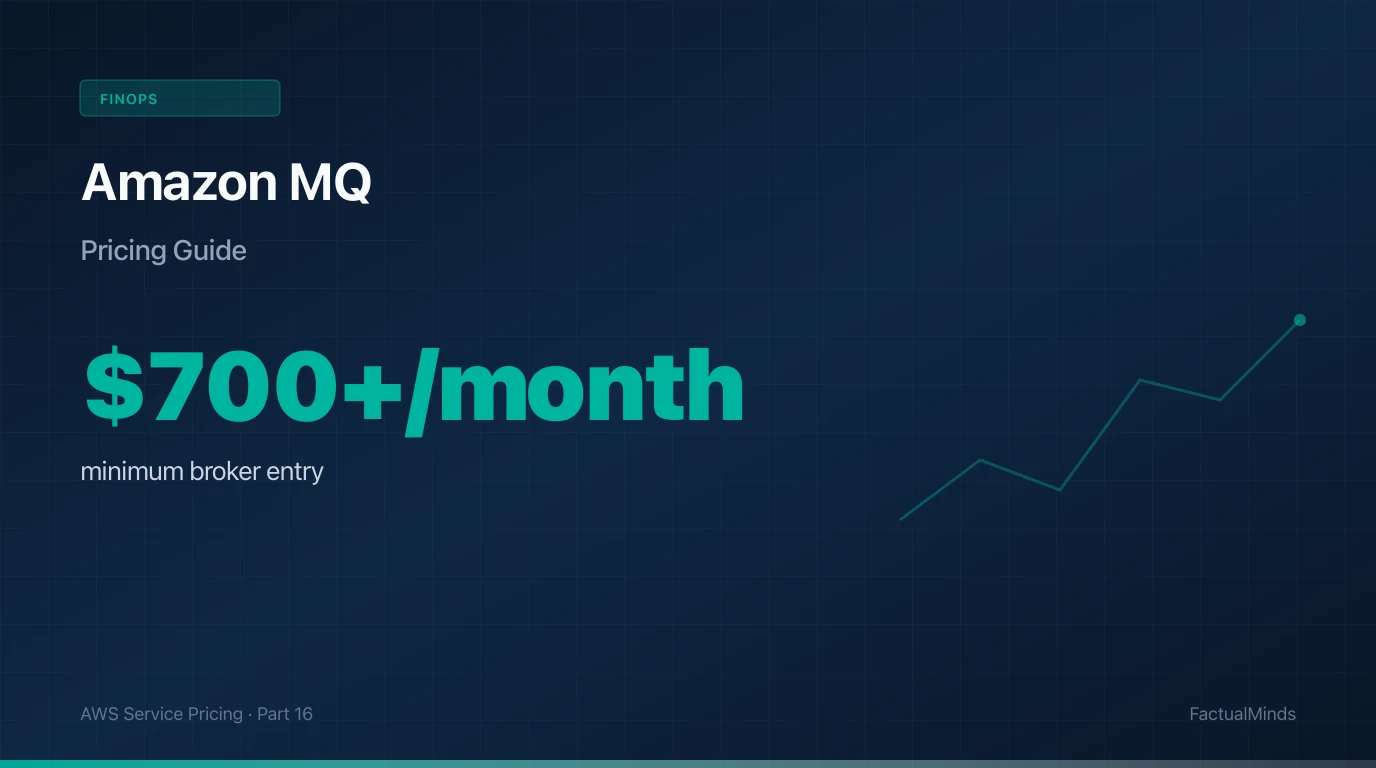
Table of Contents
Amazon MQ is the AWS-managed message broker service running either ActiveMQ or RabbitMQ. It is the most expensive entry point in the AWS messaging family by a wide margin — production-grade deployments start at roughly $700/month before a single message moves. The premium pays for protocol compatibility with AMQP, JMS, STOMP, MQTT, and OpenWire — protocols that SQS and SNS do not support. For applications that can speak the AWS-native messaging API, MQ is dramatically more expensive than the equivalent SQS setup; for applications locked to the broker protocols, MQ is the only managed option short of running your own broker on EC2.
Amazon MQ pricing bills broker instance hours, storage, and data transfer — with a high minimum entry point compared to SQS/SNS. In us-east-1 (June 2026), a single mq.t3.micro broker runs roughly $700+/month all-in. Most surprises come from running MQ for workloads that only need JMS semantics occasionally, not continuously.
| Broker | Approx. monthly | When justified |
|---|---|---|
| mq.t3.micro | ~$700+ | Legacy JMS requirement |
| mq.m5.large | ~$660/broker | Production RabbitMQ |
| Cluster (3 brokers) | 3× single | HA throughput need |
| SQS alternative | Pennies/M requests | New event-driven apps |
This post is the bill story. For the broader messaging-architecture decision — when MQ vs SQS vs SNS vs EventBridge vs Kafka — our reliable queue systems on AWS post covers the trade-offs.
The Five MQ Billing Dimensions
Amazon MQ pricing breakdown — us-east-1, June 2026
Prices in us-east-1
Broker instance hours dominate. Storage and data transfer are smaller but compound at production scale.
| Dimension | Unit price | Example workload | Monthly cost |
|---|---|---|---|
| mq.t3.micro single-AZ Dev only — no HA | $0.04 / hour | Development broker | $29 |
| mq.t3.micro active/standby HA Light production HA — limited throughput | $0.08 / hour | Smallest HA broker | $58 |
| mq.m5.large single-AZ No HA; not recommended for prod | $0.30 / hour | Single broker production | $220 |
| mq.m5.large active/standby HA Two brokers; minimum prod-grade | $0.60 / hour | Standard production HA | $440 |
| mq.m5.large RabbitMQ cluster RabbitMQ only; higher throughput / availability | $0.90 / hour | Three-broker cluster | $660 |
| mq.m5.xlarge active/standby 2× compute capacity of m5.large | $1.20 / hour | High-throughput HA broker | $880 |
| mq.m5.2xlarge active/standby 4× m5.large compute | $2.40 / hour | Largest active/standby HA | $1,750 |
| ActiveMQ storage (EFS) Same rate as EFS Standard | $0.30 / GB-month | 200 GB broker storage | $60 |
| RabbitMQ storage (EBS) 3× cheaper than ActiveMQ storage | $0.10 / GB-month | 200 GB broker storage | $20 |
| Data transfer out (internet) Use VPC endpoints to keep traffic in-region | Standard EC2 egress | Cross-region or external clients | Variable |
| Cross-region replication MQ has no native multi-region; build your own | Not native — DIY | Custom message-forwarding | N/A |
mq.t3.micro single-AZ
$29Dev only — no HA
- Unit price
- $0.04 / hour
- Example workload
- Development broker
mq.t3.micro active/standby HA
$58Light production HA — limited throughput
- Unit price
- $0.08 / hour
- Example workload
- Smallest HA broker
mq.m5.large single-AZ
$220No HA; not recommended for prod
- Unit price
- $0.30 / hour
- Example workload
- Single broker production
mq.m5.large active/standby HA
$440Two brokers; minimum prod-grade
- Unit price
- $0.60 / hour
- Example workload
- Standard production HA
mq.m5.large RabbitMQ cluster
$660RabbitMQ only; higher throughput / availability
- Unit price
- $0.90 / hour
- Example workload
- Three-broker cluster
mq.m5.xlarge active/standby
$8802× compute capacity of m5.large
- Unit price
- $1.20 / hour
- Example workload
- High-throughput HA broker
mq.m5.2xlarge active/standby
$1,7504× m5.large compute
- Unit price
- $2.40 / hour
- Example workload
- Largest active/standby HA
ActiveMQ storage (EFS)
$60Same rate as EFS Standard
- Unit price
- $0.30 / GB-month
- Example workload
- 200 GB broker storage
RabbitMQ storage (EBS)
$203× cheaper than ActiveMQ storage
- Unit price
- $0.10 / GB-month
- Example workload
- 200 GB broker storage
Data transfer out (internet)
VariableUse VPC endpoints to keep traffic in-region
- Unit price
- Standard EC2 egress
- Example workload
- Cross-region or external clients
Cross-region replication
N/AMQ has no native multi-region; build your own
- Unit price
- Not native — DIY
- Example workload
- Custom message-forwarding
The HA cost (2 brokers for active/standby) is the minimum operating posture for production. Single-AZ brokers are dev-only.
If you only audit one dimension first, ask whether the workload requires JMS/AMQP — SQS is orders of magnitude cheaper for new designs.
Why $700/Month Is the Realistic Production Entry Point
The math:
- mq.m5.large active/standby HA: $440/month (the smallest broker tier suitable for production HA)
- 200 GB ActiveMQ EFS storage: $60/month (or 200 GB RabbitMQ EBS: $20/month)
- Data transfer: $20–$50/month typical
- CloudWatch monitoring: $10–$30/month for standard alarms and dashboards
Total: ~$700/month for ActiveMQ HA, ~$520/month for RabbitMQ HA, before any message traffic. For workloads that only need a handful of messages per second, this is dramatically more expensive than the SQS equivalent (which would be measured in dollars per month for the same volume).
ActiveMQ vs RabbitMQ on MQ
Both run on Amazon MQ with the same per-broker-hour pricing. The differences:
ActiveMQ vs RabbitMQ on Amazon MQ
Prices in us-east-1
Same broker pricing; different protocol support, different storage backend, different deployment topologies.
| Dimension | Unit price | Example workload | Monthly cost |
|---|---|---|---|
| Storage backend RabbitMQ storage is 3× cheaper | EFS vs EBS | Per-broker storage | EFS $0.30 vs EBS $0.10 / GB-month |
| Protocols supported Broadest enterprise compatibility | Same broker price | JMS, OpenWire, STOMP, AMQP, MQTT | ActiveMQ: 5 protocols |
| Protocols supported Native RabbitMQ client compatibility | Same broker price | AMQP 0-9-1 | RabbitMQ: 1 native protocol |
| HA topology Failover-based; standby waits to take over | Active/standby (2 brokers) | Both options support | Same per-broker price × 2 |
| Cluster topology Higher throughput; not available for ActiveMQ | 3-broker cluster | RabbitMQ only | $660/mo (m5.large × 3) |
| Performance ActiveMQ wins on protocol compatibility | Same broker price | Throughput per dollar | RabbitMQ typically wins on throughput |
Storage backend
EFS $0.30 vs EBS $0.10 / GB-monthRabbitMQ storage is 3× cheaper
- Unit price
- EFS vs EBS
- Example workload
- Per-broker storage
Protocols supported
ActiveMQ: 5 protocolsBroadest enterprise compatibility
- Unit price
- Same broker price
- Example workload
- JMS, OpenWire, STOMP, AMQP, MQTT
Protocols supported
RabbitMQ: 1 native protocolNative RabbitMQ client compatibility
- Unit price
- Same broker price
- Example workload
- AMQP 0-9-1
HA topology
Same per-broker price × 2Failover-based; standby waits to take over
- Unit price
- Active/standby (2 brokers)
- Example workload
- Both options support
Cluster topology
$660/mo (m5.large × 3)Higher throughput; not available for ActiveMQ
- Unit price
- 3-broker cluster
- Example workload
- RabbitMQ only
Performance
RabbitMQ typically wins on throughputActiveMQ wins on protocol compatibility
- Unit price
- Same broker price
- Example workload
- Throughput per dollar
If you don't have an existing JMS dependency, RabbitMQ is usually the right choice on MQ — cheaper storage and better per-dollar throughput.
The Real Comparison: MQ vs SQS vs Self-Managed RabbitMQ
For a workload that needs message queuing, the three managed/quasi-managed options on AWS produce dramatically different bills:
Same workload across MQ, SQS, and self-managed RabbitMQ — 100M messages/month
Prices in us-east-1
Same throughput; different operational model and protocol support.
| Dimension | Unit price | Example workload | Monthly cost |
|---|---|---|---|
| Amazon MQ — RabbitMQ HA Native AMQP support; HA posture | Broker hours + storage | mq.m5.large active/standby | ~$480/mo |
| Amazon MQ — ActiveMQ HA JMS + multi-protocol support | Broker hours + EFS | Same broker tier | ~$520/mo |
| Amazon SQS Standard 85% cheaper than MQ | $0.40/M requests | 100M messages = ~200M requests | ~$80/mo |
| Amazon SQS FIFO Still 80% cheaper than MQ HA | $0.50/M requests | With ordering guarantees | ~$100/mo |
| Self-managed RabbitMQ on EC2 You own broker patching and recovery | EC2 + EBS | 3× t3.large + storage | ~$200/mo + ops |
Amazon MQ — RabbitMQ HA
~$480/moNative AMQP support; HA posture
- Unit price
- Broker hours + storage
- Example workload
- mq.m5.large active/standby
Amazon MQ — ActiveMQ HA
~$520/moJMS + multi-protocol support
- Unit price
- Broker hours + EFS
- Example workload
- Same broker tier
Amazon SQS Standard
~$80/mo85% cheaper than MQ
- Unit price
- $0.40/M requests
- Example workload
- 100M messages = ~200M requests
Amazon SQS FIFO
~$100/moStill 80% cheaper than MQ HA
- Unit price
- $0.50/M requests
- Example workload
- With ordering guarantees
Self-managed RabbitMQ on EC2
~$200/mo + opsYou own broker patching and recovery
- Unit price
- EC2 + EBS
- Example workload
- 3× t3.large + storage
SQS is dramatically cheaper for the same throughput. MQ's value is exclusively protocol compatibility for applications that cannot move off AMQP/JMS/STOMP.
When MQ Is the Right Answer
Amazon MQ when AMQP/JMS/STOMP/MQTT/OpenWire compatibility is non-negotiable; SQS for new application development; self-managed RabbitMQ for cost sensitivity with operational capacity.
Use when
- Legacy Java enterprise applications using JMS that would require rewrite to migrate to SQS
- Integration with vendor systems requiring AMQP (RabbitMQ-compatible) clients
- IoT platforms standardized on MQTT with broker requirements
- Real-time messaging requiring STOMP — financial trading systems, real-time collaboration
- Migrations from on-premises ActiveMQ or RabbitMQ where preserving the protocol simplifies the migration
Avoid when
- New application development — choose SQS for queues and EventBridge for events
- Workloads that can use the AWS SDK — the MQ premium is wasted
- Cost-sensitive workloads with operational capacity to manage their own broker — self-managed RabbitMQ on EC2 is meaningfully cheaper
- Streaming use cases requiring replay or consumer-group semantics — MSK or Kinesis is the right primitive
- Workloads with idle periods — MQ bills per broker-hour regardless of traffic
MQ exists for one reason: protocol compatibility. If protocol compatibility isn't load-bearing, the bill is dramatically lower with SQS.
A 30-Day MQ Bill Cleanup Plan
Week 1 — Broker inventory. List every MQ broker via aws mq list-brokers. Identify brokers whose source applications have been retired or deprecated. Delete the unused brokers.
Week 2 — Right-size active brokers. Review CloudWatch metrics for each broker (CPU utilization, memory, message throughput). Downsize over-provisioned brokers; the broker tier change requires brief downtime but the per-hour cost drops immediately.
Week 3 — Storage audit. For ActiveMQ brokers, audit EFS storage usage. Implement message-retention policies that delete old messages from queues. For RabbitMQ, audit EBS storage and apply queue TTL policies.
Week 4 — Migration evaluation. For each remaining MQ workload, evaluate whether the protocol dependency is genuinely load-bearing. Document workloads where migration to SQS could happen if the cost savings justify the rewrite.
More in This Series
Part of the AWS Service Pricing series (June 2026).
- Previous: Part 15
- Next: Part 17
- Browse all: Cost Optimization & FinOps category
What This Post Doesn’t Cover
- Migration from on-premises ActiveMQ / RabbitMQ to Amazon MQ — operational migration patterns covered in our messaging migration content.
- MSK (Managed Kafka) pricing in depth — different primitive (streaming vs messaging); covered in a separate streaming-platform post.
- Self-managed RabbitMQ HA architecture on EC2 — covered in our messaging architecture content for teams choosing this path.
- MQ Connector / federation patterns — covered in messaging-architecture content; usually not bill-relevant.
If You Only Do One Thing This Week
Audit your MQ brokers for active usage. Run aws mq list-brokers and for each broker check CloudWatch SystemActiveConnections and MessagesEnqueued over the last 30 days. Any broker with sustained low or zero traffic is a candidate for deletion or downsizing. Brokers tend to outlive the applications they serve; an audit twice a year catches the orphans before they accumulate.
For the broader messaging-architecture decision — when MQ vs SQS vs Kafka — the reliable queue systems guide covers the trade-offs and the patterns for migrating between primitives when the workload outgrows the original choice.
AWS Cloud Architect & AI Expert
AWS-certified cloud architect and AI expert with deep expertise in cloud migrations, cost optimization, and generative AI on AWS.