Amazon ElastiCache Pricing: Node Hours, Serverless ECPU, and the Replica Multiplier (2026)
Quick summary: ElastiCache bills node-hours for Redis/Valkey clusters and ECPUs for Serverless. A cache.r7g.large with two replicas is 3× the primary node cost before data transfer. Serverless wins below ~$800/mo steady cache spend; provisioned nodes win above it.
Key Takeaways
- ElastiCache bills node-hours for Redis/Valkey clusters and ECPUs for Serverless
- r7g
- large with two replicas is 3× the primary node cost before data transfer
- Serverless wins below ~$800/mo steady cache spend; provisioned nodes win above it
- astro'; June 2026 ElastiCache list pricing in us-east-1 puts cache
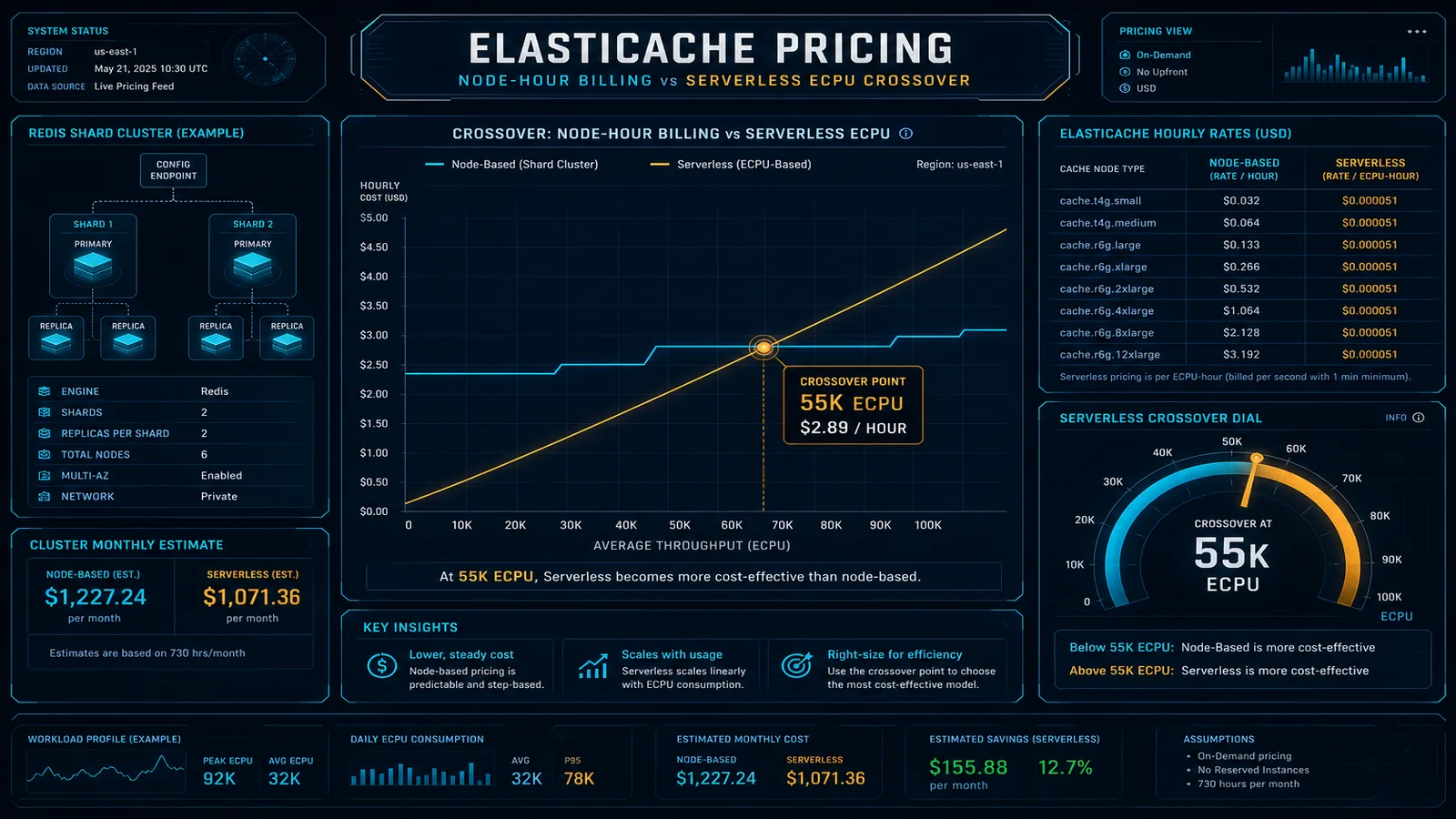
Table of Contents
June 2026 ElastiCache list pricing in us-east-1 puts cache.r7g.large at roughly $0.226/hr (~$165/mo per node). A primary plus two read replicas is ~$495/mo before snapshot storage and cross-AZ transfer — a pattern we see copied from RDS Multi-AZ habits that doubles cache cost without doubling hit rate.
Engagement shape
A subscription analytics SaaS (~$9k/mo ElastiCache, Redis cluster mode) ran three shards × 2 replicas each for HA — six nodes serving 12% average CPU. Rightsizing to cache.r7g.medium and dropping one replica per shard (with Multi-AZ on primary only) saved $2,400/mo with no p99 regression on cache hits.
Opinionated take
We recommend provisioned r7g with Valkey for production caches above $1k/mo with predictable traffic; Serverless for new services with unknown cardinality. Replicas exist for read scaling and failover — not as a default triple multiplier.
If you only do one thing this week
Open ElastiCache CPUUtilization for each node. If max CPU < 25% for 14 days, downsize one class and load-test. Model node count in the ElastiCache pricing calculator.
More in This Series
Part of the AWS Service Pricing series (June 2026).
- Previous: Part 24
- Next: Part 26
- Browse all: Cost Optimization & FinOps category
- Caching patterns: ElastiCache Redis strategies for production
AWS Cloud Architect & AI Expert
AWS-certified cloud architect and AI expert with deep expertise in cloud migrations, cost optimization, and generative AI on AWS.