Amazon EC2 On-Demand Pricing: Instance Families, Regional Multipliers, and the Graviton Crossover (2026)
Quick summary: EC2 On-Demand is a matrix of family, size, OS, tenancy, and region. In us-east-1 (June 2026) a m7g.large Linux runs $0.0816/hr vs a g5.xlarge GPU at $1.006/hr. Graviton5 M9g/C9g now GA for new fleets.
Key Takeaways
- EC2 On-Demand is a matrix of family, size, OS, tenancy, and region
- In us-east-1 (June 2026) a m7g
- large Linux runs $0
- 0816/hr vs a g5
- xlarge GPU at $1
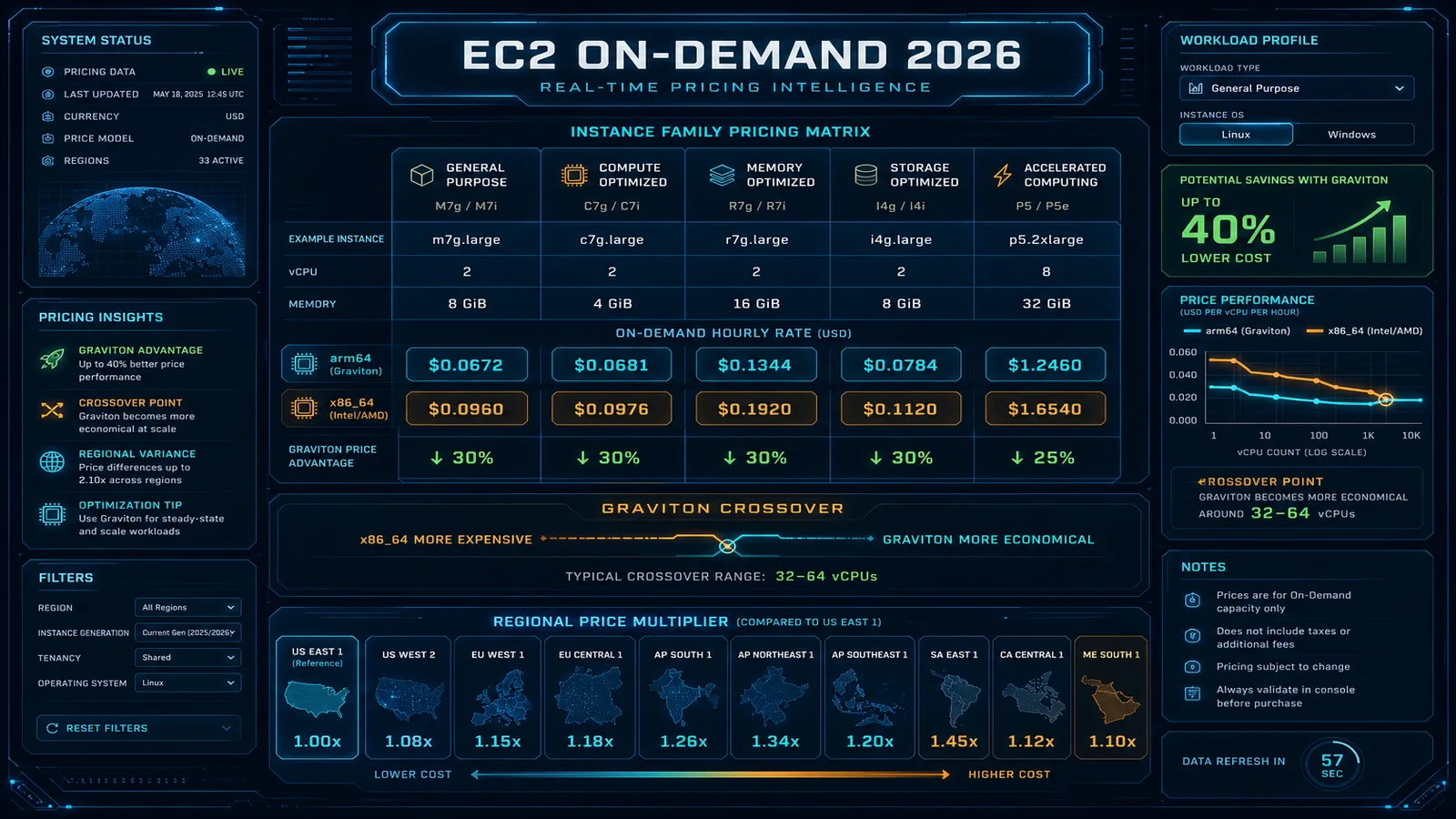
Table of Contents
On June 17, 2026, AWS lists more than 750 EC2 instance SKUs across general-purpose, compute-optimized, memory-optimized, storage-optimized, and accelerated families. The On-Demand rate card is the baseline every Savings Plan and Reserved Instance discount is measured against — and the line item most teams oversize because they copy the instance type from a three-year-old architecture diagram.
Amazon EC2 On-Demand pricing bills per instance-second (60-second minimum) by family, size, OS, and region. In us-east-1 (June 2026), Linux
m7g.largeis $0.0816/hr. Most waste is wrong family — not wrong discount instrument.
Engagement shape
A logistics SaaS (~$38k/mo AWS, 120 EC2 instances across dev/staging/prod) ran primarily on m5.xlarge because that was the 2022 default. Compute Optimizer (32-day lookback, June 2026) recommended m7g.large for 68% of instances — same memory, half the vCPU headroom still above p95 CPU. Modeled savings: $4,100/mo On-Demand before any Savings Plan. Migration took two sprint cycles; one legacy PDF renderer stayed on x86.
The five billing dimensions
EC2 On-Demand — us-east-1, June 2026
Prices in us-east-1
| Dimension | Unit price | Example workload | Monthly cost |
|---|---|---|---|
| Instance hour | Family-dependent | ||
| Windows license | +~40–60% | ||
| Dedicated tenancy | Per-host surcharge | ||
| Regional multiplier | 0.85×–1.25× | ||
| EBS + transfer | Separate lines |
Instance hour
- Unit price
- Family-dependent
- Example workload
Windows license
- Unit price
- +~40–60%
- Example workload
Dedicated tenancy
- Unit price
- Per-host surcharge
- Example workload
Regional multiplier
- Unit price
- 0.85×–1.25×
- Example workload
EBS + transfer
- Unit price
- Separate lines
- Example workload
Family selection beats size selection
We recommend family first, size second: pick m vs c vs r from workload shape (balanced vs CPU-heavy vs memory-heavy), then right-size within the family using Compute Optimizer or CloudWatch p95 CPU/memory over 14 days. For new Graviton capacity in GA Regions (us-east-1, us-east-2, us-west-2, eu-central-1), prefer M9g for balanced fleets and C9g (or C9gd with local NVMe) for CPU-bound work — Graviton5 GA June 2026; see the M9g field guide and C8g→C9g canary checklist. Keep m8g/c8g where RI or Savings Plan lock-in still applies. The Graviton crossover vs x86 remains roughly 20–40% better price-performance when the stack is arm64-ready.
| Mistake | Typical cost impact |
|---|---|
| GPU family for CPU-only API | 5–10× hourly rate |
r family for stateless API | 30–50% overspend |
| x86 when arm64-compatible | 20–40% missed savings |
| Single-AZ oversized staging | 100% waste on idle hours |
New — June 18, 2026: EC2 G7 is generally available (NVIDIA RTX PRO 4500 Blackwell, up to 8 GPUs / 32 GB each, up to 4.6× AI inference vs G6) in US East (Ohio) and US West (Oregon), on On-Demand, Savings Plans, and Spot. It does not change the rule above — a GPU family still costs 5–10× a CPU-only instance, so reserve G7 for inference, rendering, or accelerated pipelines, not general APIs.
If you only do one thing this week
Export Compute Optimizer EC2 rightsizing recommendations for your top 10 instances by spend. For the full 32-day lookback playbook, see AWS Rightsizing with Compute Optimizer (2026). For any recommendation with <5% performance risk and >$200/mo savings, schedule a change window — start with non-production accounts.
Reproducible artifact: model hourly rates in our EC2 pricing calculator and compare On-Demand vs Spot vs 1-year Reserved for your target instance type.
More in This Series
Part of the AWS Service Pricing series (June 2026).
- Previous: Part 23
- Next: Part 25
- Browse all: Cost Optimization & FinOps category
- FinOps pillar: FinOps on AWS complete guide
AWS Cloud Architect & AI Expert
AWS-certified cloud architect and AI expert with deep expertise in cloud migrations, cost optimization, and generative AI on AWS.