Connect Outbound (Oct 2026): Native Campaigns vs Acqueon
Quick summary: As of October 28, 2026, native Amazon Connect outbound campaigns bill voice at $0.045 per minute and offer 4 dial modes. Acqueon's AWS Marketplace listing starts at $195,000 for 12 months. Here is how to choose, and how to test.
Key Takeaways
- As of October 28, 2026, native Amazon Connect outbound campaigns bill voice at $0.045 per minute and offer 4 dial modes
- Acqueon's AWS Marketplace listing starts at $195,000 for 12 months
- Acqueon's AWS Marketplace listing, which is the only dialer price we found published for Connect, starts at $195,000 for 12 months
- Search Console shows one Connect query with measurable demand on this site: "acqueon amazon connect
- This post compares what AWS documents for native campaigns with what Acqueon says about itself, and gives you a way to test both
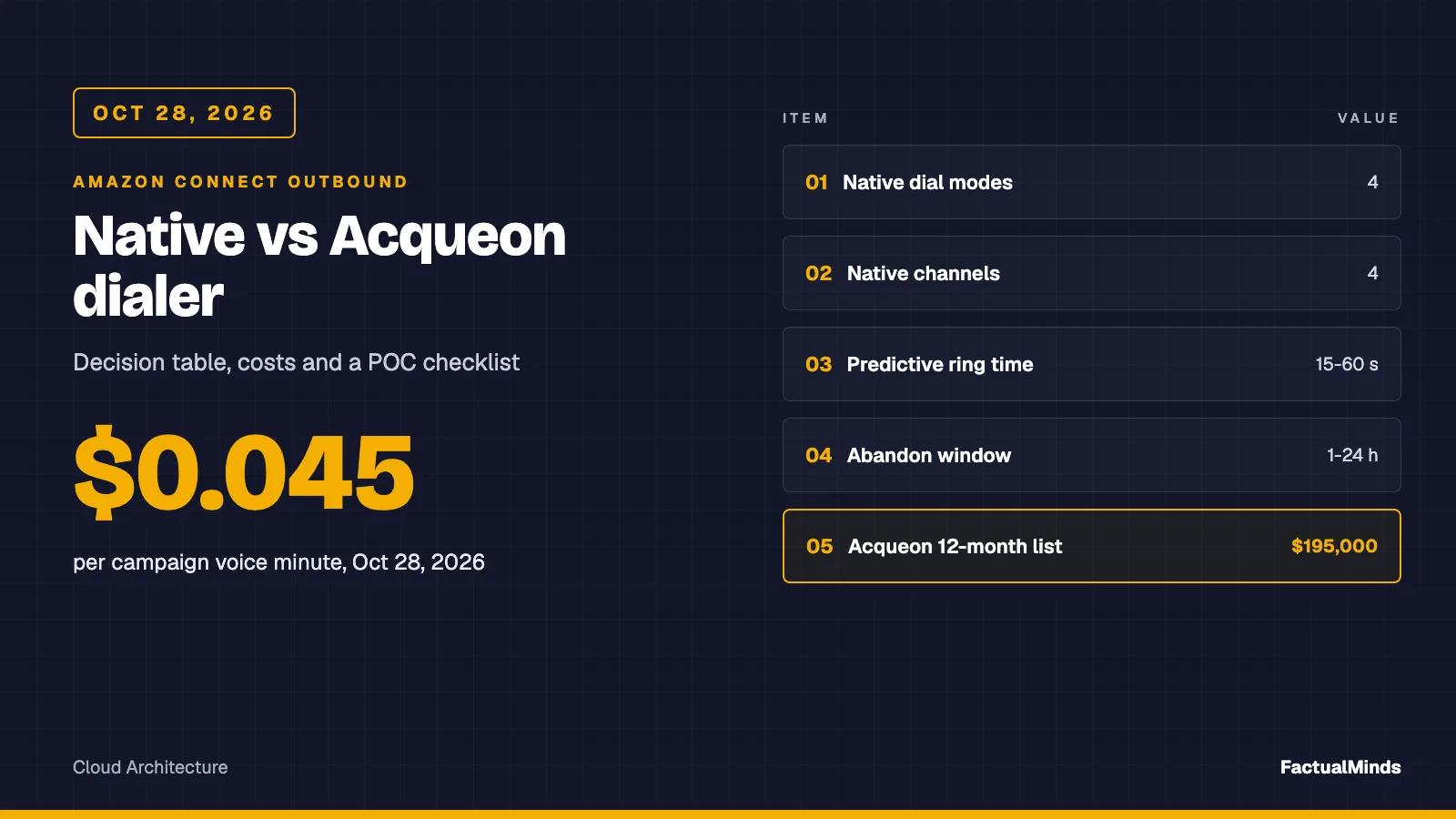
Table of Contents
As of October 28, 2026, native Amazon Connect outbound campaigns bill voice at $0.045 per minute and offer 4 dial modes. Acqueon’s AWS Marketplace listing, which is the only dialer price we found published for Connect, starts at $195,000 for 12 months. That gap says little on its own: the two are priced on different bases and cover different scope, so measure both.
Search Console shows one Connect query with measurable demand on this site: “acqueon amazon connect.” This post compares what AWS documents for native campaigns with what Acqueon says about itself, and gives you a way to test both.
FactualMinds is an AWS Select Tier Services Partner. We have no partnership with Acqueon, no Acqueon deployments, and no outbound-dialer case studies. Every Acqueon statement below is Acqueon’s or AWS’s, quoted as a claim to validate, not as our finding. The hub page Amazon Connect consulting has the short FAQ on this. For segments as audiences, see Customer Profiles in Connect.
This is not legal advice. Calling-hour rules, consent, do-not-call scrubbing and abandonment limits are obligations of the business that places the calls. A dialer, native or third-party, gives you controls. It does not make a campaign compliant.
Decision table: native or third-party
Labels: native is built into Connect, third-party is a vendor product, custom engineering is code you write.
| Criterion | Native Connect outbound campaigns | Acqueon (third-party, per Acqueon’s listing and docs) |
|---|---|---|
| Dial modes | Predictive, progressive, preview, agentless (AWS features page) | Listing describes preview, progressive and predictive. Ask about agentless in writing. |
| Channels | Agent-assisted voice, automated voice, SMS, email, WhatsApp (admin guide) | Listing describes voice, 2-way messaging and email. Other Acqueon materials mention more. Confirm the contract scope. |
| Answering machine detection | Check call progress flow block, ML-based (admin guide) | Listing mentions a call progress analysis engine. No accuracy figures found. |
| Audience source | Customer Profiles segments, or Host external campaign | Listing mentions a built-in CDP. Ask how it syncs with your CRM. |
| Compliance controls | Time windows, recipient-local time zones, per-recipient and instance-wide limits | Listing sells an “Advanced compliance package” at $35,000 per year. Contents are not detailed on the page. |
| Delivery | Part of your Connect instance | SaaS, deployed on AWS, with Acqueon’s own agent desktop (listing) |
| Pricing | Published per-minute and per-message rates | Published annual Marketplace contract, with overage |
If every row you care about is in the left column, start there.
What native outbound campaigns do (October 2026)
The feature was formerly called high-volume outbound communications. The admin guide describes two builders. The Visual Journey Builder designs multi-channel, multi-step journeys. The Guided Campaign Builder creates a single-channel campaign. The API namespace is connect-outbound-campaigns-v2. AWS now names the service Amazon Connect Customer in its docs. The console and APIs are the same.
Dial modes. AWS describes four. Predictive paces calls on predicted agent availability and is meant for high-volume work where talk time matters most. Progressive does not dial until an agent is available, for when reach matters more than talk time. Preview shows agents customer context before they place the call. Agentless sends voice notifications with no agent.
Channels. Four: voice (agent-assisted or automated), SMS, email, and WhatsApp. WhatsApp needs your WhatsApp Business Account tagged AmazonConnectEnabled: True.
Audience. You pick a Customer Profiles segment. Managed campaigns use classic segments, not Spark SQL segments. Voice campaigns can sort a segment by up to 10 profile attributes, and the sort applies to voice only.
Before the first call. The default service quota for concurrent campaign calls is 0, so you request an increase before anything dials. You also create a dedicated campaign queue and a published flow with a Check call progress block. Campaign calls reach only supported countries, and the source number must be in the same country as the destination. Outside the US, UK and Japan, check that your number is campaign-capable. Australia and New Zealand need a dedicated number.
Pacing and abandonment (predictive). Maximum ring time is 15 to 60 seconds. Dialing capacity allocation is 1 to 100 percent and agent allocation is 1 to 200 percent. With abandonment controls on, you set a target rate, a connection threshold of at least 1 second, and a measurement window of 1 to 24 hours. When the target is hit, the dialer switches to progressive to bring the rate back down.
Limits and time windows. Per campaign you cap communications per recipient over a time frame. A voicemail still counts, and AWS says it errs toward over-counting. An instance-wide total limit applies across campaigns, with an Ignore total limits option for critical campaigns. The total count is eventually accurate, not instant, so two campaigns hitting one recipient at once can both pass. Active communication time is set per channel and per day of week, in one standard time zone or the recipient’s local zone. Local zone is inferred from address or phone area code. A recipient whose zone cannot be determined is dropped (status DROPPED_MISSING_TIMEZONE).
Two traps in the builder. First, AWS states that settings cannot be changed after you publish, and a stopped campaign cannot be resumed. Second, by default you get one reattempt unless you configure engagement preferences and load data into Customer Profiles.
Do-not-call. AWS’s outbound product FAQ says campaigns support do-not-call lists and quiet-time controls. The guided-builder pages we read describe no registry integration. An older AWS best-practices page suggests a Lambda function that runs an external DNC check before dialling in a journey. Treat registry scrubbing as yours until you have tested it on your own suppression rows. The artifact has that test.
Reproduce this. The outbound dialer POC folder holds a 10-test plan and a weighted scoring sheet. Run
node --testthere to check that the sheet’s weights sum to 100 and no score is pre-filled. It does not call Connect or any vendor, and we have not run this POC on a live queue.
When native is enough
Native tends to fit when:
- The audience already lives in, or can load into, Customer Profiles segments.
- You need appointment reminders, payment notices or delivery updates (agentless voice, SMS, email, WhatsApp) more than high-volume sales dialling.
- Agents are already on Connect and you want inbound and outbound in one queue, routing and reporting model.
- Your compliance owner can express the rules as time windows, per-recipient limits, and an external suppression check you build.
For preview mode, the guided builder asks you to set the profile ID as the default search key so the agent workspace opens the right customer. Use the documented attribute:
{
  "profileSearchKey": "_profileId",
  "profileSearchValue": "$.Attributes.connect_customer-profile_profile-id"
}
Context: this is the AWS-documented flow setting for preview dialling. For agentless flows, AWS says to fetch profile data with a Customer Profiles block using that same attribute, not a Lambda. Details are in the agent workspace post.
When teams look at a third-party dialer
These are reasons teams commonly give. They are vendor-side claims or buyer preferences, not findings, and each belongs in your POC.
- A list or lead-management model that lives outside Connect and cannot be modelled as profile segments.
- A required feature the native builder does not show, such as a specific compliance package, lead filtering or a dialing rule you must have. Name it and ask the vendor to demo it on your data.
- An existing contract and agent desktop that you do not want to retrain.
Acqueon is not the only name. On AWS Marketplace we saw listings for an Amazon Connect Outbound Dialer from Concentrix (listed as professional services, preview, progressive and predictive modes, custom pricing) and an Intelligent Outbound Dialer by Bricom (professional services, predictive and progressive, custom pricing). We have tested neither. Listings change.
What Acqueon says about itself
Labelled as vendor and AWS statements, read on October 28, 2026.
- Ownership. Acqueon’s former site now redirects to a Five9 page that states “Acqueon is now officially part of Five9” and describes it as an independent business unit. Ask what that means for your contract and support.
- Product. The AWS Marketplace listing calls Acqueon Engagement “an Omnichannel Campaign Management solution for Amazon Connect” with a built-in CDP, a dialer and an agent desktop. Delivery is SaaS deployed on AWS, and the listing notes additional AWS infrastructure costs may apply.
- History. AWS published an Acqueon integration in August 2018, describing an outbound voice dialer platform with “real-time lead filtering, segmentation, prioritization, and scheduling.”
- Price, as listed for a 12-month contract: Acqueon Engagement $195,000 (6.5 million dialer minutes and 8.5 million desktop minutes, overage $0.018 per unit), Acqueon Desktop $85,000, Compliance $35,000, CRM plugins $12,000, IVR throttling $84,000, Digital Platform $2,000 per 200,000 transactions. Longer terms are advertised at up to 10 percent (24 months) and up to 6 percent (36 months) off. The listing does not state a version or date, and these may be negotiated or stale.
- Setup, per Acqueon’s documentation. You supply your Connect instance URL and ID, Region, and a role ARN the Acqueon Workspace server uses to connect, with an optional external ID. You allowlist the Acqueon Workspace domain on Connect, and import or edit an outbound whisper flow so it sets a
recordingattribute. The dialer data services connect by websocket.
We did not find an independent comparison, and we do not make one. Nothing above shows that either option reaches more customers or abandons fewer calls.
Architecture of each
Native. Segment (Customer Profiles) selects recipients at the campaign start time. The campaign applies time-zone, communication-limit and entry-limit rules, then dials from your claimed or ported number. Answered calls hit your flow, where Check call progress branches on person, machine or not detected, and Transfer to queue hands live answers to an agent. Dispositions land in campaign metrics and the data lake.
Third-party (Acqueon, per its docs). Your list and campaign rules sit in the vendor’s SaaS. Its server assumes an IAM role in your account to place calls and control agents on your Connect instance. Agents work in the vendor’s desktop. Your flows carry small changes the vendor needs. So you own two systems: Connect (flows, queues, numbers, quota) and the vendor (lists, rules, desktop).
The practical difference is where the compliance rules live. A third-party dialer keeps them in the vendor product, so verify they match what your instance actually dials.
Costs, published only
As of October 28, 2026, from the AWS pricing page and appendix:
| Item | Published price |
|---|---|
| Outbound campaign voice | $0.045 per minute (instead of the $0.038 standard voice rate) |
| SMS and other messaging (WhatsApp included in the appendix definition) | $0.014 per message, plus carrier delivery |
| $0.080 per email | |
| Telephony | Extra, by country and Region |
For US telephony AWS’s own pricing example uses $0.0048 per outbound minute and $0.0022 per inbound minute in US West (Oregon). Treat those as that example’s figures and check your Region.
A modelled sizing, not a client: 100,000 campaign voice minutes in a month is $4,500 at $0.045, and about $480 more if the outbound telephony rate is $0.0048. For Acqueon, the Marketplace table above is all that is public. It bundles dialer and desktop minutes, so we do not divide it into a per-minute rate. What is unstated is whether Connect voice and telephony charges still apply under an Acqueon campaign. Ask for a quote that includes both bills.
Compliance stays with the business
Under shared responsibility, AWS gives you controls and you decide the rules. Check with counsel on:
- Consent. What consent you hold per list and per channel, and where it is recorded.
- Calling hours. Which windows apply per recipient location. Native campaigns evaluate windows in a standard or recipient-local zone, and drop recipients when the zone is unknown.
- Do-not-call. Which internal and national lists you must scrub before dialling, and who owns that job.
- Abandonment. What counts as an abandoned call and over what period. AWS’s controls take a threshold and a window and say to consult your compliance team.
- Caller ID and ring time. AWS notes some regions require a minimum ring time, such as 15 seconds, and a caller ID matching a number in your inventory.
Failure modes
- Abandoned and silent calls under predictive. The dialer dials ahead. With too few free agents, answered calls wait. AWS’s guidance is to staff enough agents, keep after-call work short, and remove blocks between Check call progress and Transfer to queue. Test with a realistic agent count. AWS recommends testing at scale, since connection latency can be high on a handful of calls.
- AMD errors. AWS says 40 to 60 percent of consumer calls go to voicemail. It lists false negatives on a short “Hello” and false positives on long live greetings, an added delay, and no support for multi-level PBX voicemail. Detection can also fail a legal test in some jurisdictions. Label real calls and count.
- List hygiene. Recipients with invalid endpoints are dropped. Missing time zones are dropped. Shared and stale numbers still get called. A dialer speeds up a bad list.
- Over-contact. The instance-wide limit is eventually consistent, so two campaigns can both pass one recipient.
What could break. Modelled, not an incident. A team runs predictive with abandonment controls and an 8-agent pool. After lunch, 3 agents go to after-call work, the dialer holds its pace, and answered calls queue. The dashboard shows a reduced rate, but the team never computed the rate from raw exports against their jurisdiction’s definition. Detection: compare dashboard to your own export in the POC. Fix: set the target and window from your compliance owner’s definition, and keep a progressive fallback.
Migration and POC checklist
- Write down jurisdictions, consent per list and who signs off. Do this before any vendor call.
- Build a pilot list of 2,000 or more permitted numbers with 50 deliberately bad rows.
- Raise the Connect concurrent-call quota above its default of 0 early. It takes a support ticket.
- Run the same 10 tests on each candidate. Hand-label at least 200 answered calls for AMD.
- Compute abandon rate yourself from raw events.
- Collect full price in writing, with both Connect and vendor bills.
- Score with the template and record the decision.
When not to run outbound at all
- You have no documented consent for the list.
- You cannot scrub against internal and national do-not-call lists.
- Most of your outreach would be marketing to people who never opted in. A better dialer will not change that.
- You cannot staff the pool. Use agentless or progressive.
- Event-driven mass notifications to several thousand customers, such as weather warnings, need pre-authorization through an AWS Support ticket.
Recommendation
Run the native pilot first. If it covers your modes, channels, audience source and compliance controls, you avoid a second vendor, a second desktop and a second set of rules. The trade-off: you build suppression checks and reporting joins yourself, and you carry the AMD and abandonment tuning. Take a third-party dialer into the POC only for a named feature you can write down and test. A vendor’s brochure claim is not a requirement.
What to do this week
- Write your consent, calling-hour, DNC and abandonment rules with your compliance owner.
- Request the concurrent campaign calls quota increase on a non-production instance.
- Build the 2,000-row pilot list, including 50 bad rows.
- Copy the scoring sheet and agree the weights before you see any demo.
- Send the six written questions in the README to any third-party vendor.
Need help structuring the POC or the Connect side? FactualMinds is an AWS Select Tier Services Partner. Start at Amazon Connect consulting or contact us.
What this post doesn’t cover
- Legal advice. TCPA, consent, calling-hour and DNC rules differ by country and state. Ask counsel.
- Measured results. We have run no dialer POC and publish no abandon, AMD or contact-rate figures.
- Acqueon beyond its public pages. We did not use the product, and pricing may be negotiated.
- Other vendors in depth. Concentrix and Bricom are mentioned only as listings.
- Journey Builder design, API automation, and AI agents placing calls.
- Pricing in your Region or country. Check the pricing page and telephony rates.
Related reading
- Amazon Connect Consulting
- Connect AI agents for FAQs and self-service
- Custom agent UI and Customer Profiles
- Connect evaluation form checks
Frequently asked questions
Can native Amazon Connect outbound campaigns replace a third-party dialer?
Does FactualMinds have a partnership or deployments with Acqueon?
What does native outbound cost on Amazon Connect?
Is answering machine detection reliable enough to leave voicemails automatically?
What could go wrong with predictive dialling?
When should we not run outbound campaigns at all?
Do other dialers list an Amazon Connect integration?
What should a proof of concept measure?

AWS Cloud Architect & AI Expert
AWS-certified cloud architect and AI expert with deep expertise in cloud migrations, cost optimization, and generative AI on AWS.