Amazon Connect Agentic Voice: One Voice, and Where the Call Actually Breaks
Quick summary: On 20 November 2026 AWS published the agentic voice configuration. The best-practices page says 50+ locales. End-of-turn confidence defaults to 0.7, and the silence fallback is 640 ms. Set the same voice on every spoken block before you tune the model.
Key Takeaways
- On 20 November 2026 AWS published the agentic voice configuration
- End-of-turn confidence defaults to 0.7, and the silence fallback is 640 ms
- On 20 November 2026, AWS published agentic voices in Amazon Connect Customer: one voice provider for the greeting, the bot, and the close
- Short answer: Set Amazon Connect agentic voice on every spoken block, then fix turn-taking before you change the model
- End-of-turn confidence defaults to 0.7
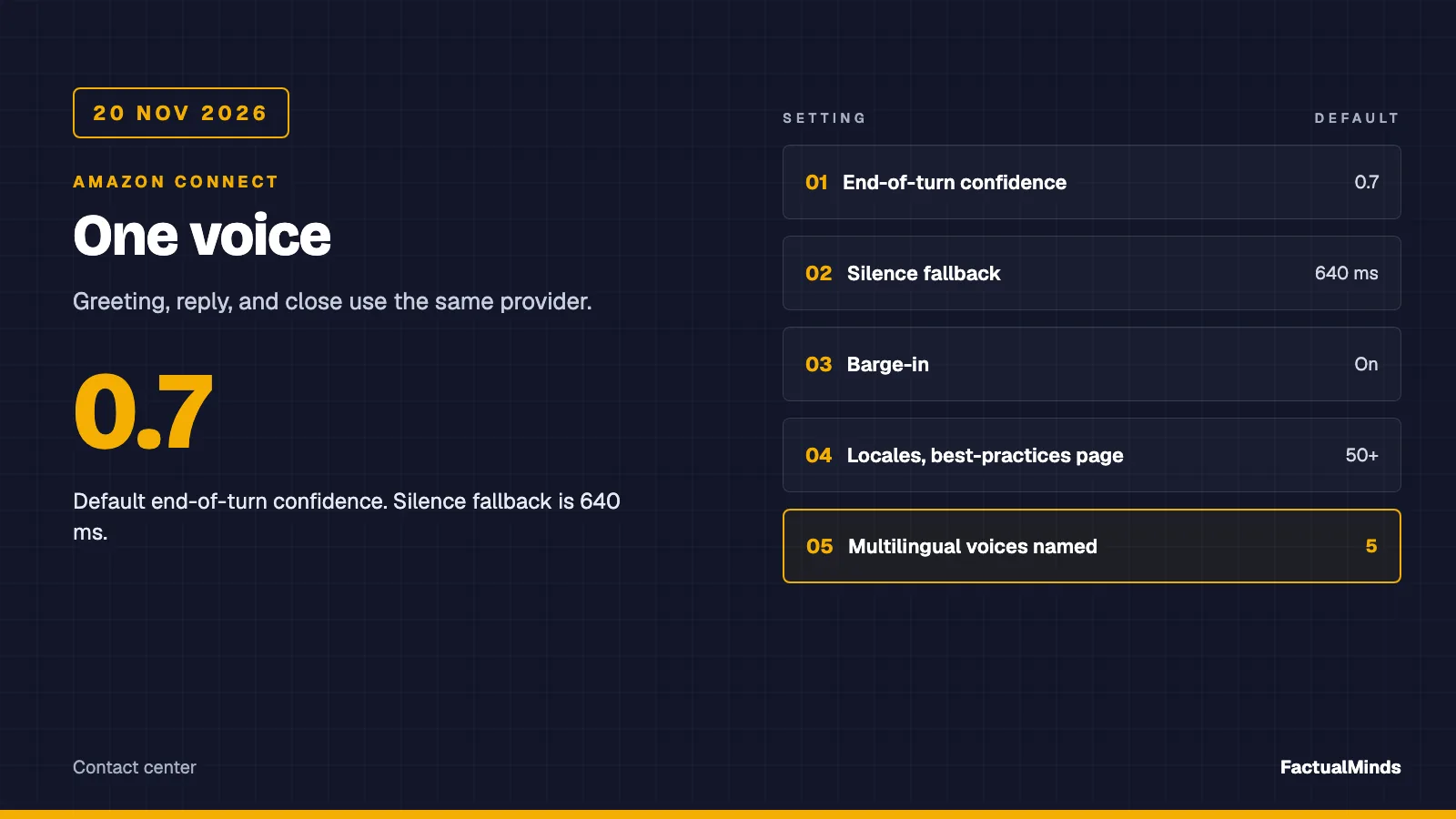
Table of Contents
On 20 November 2026, AWS published agentic voices in Amazon Connect Customer: one voice provider for the greeting, the bot, and the close. The best-practices page says the engine covers 50+ locales. We did not recount the supported-languages table row by row.
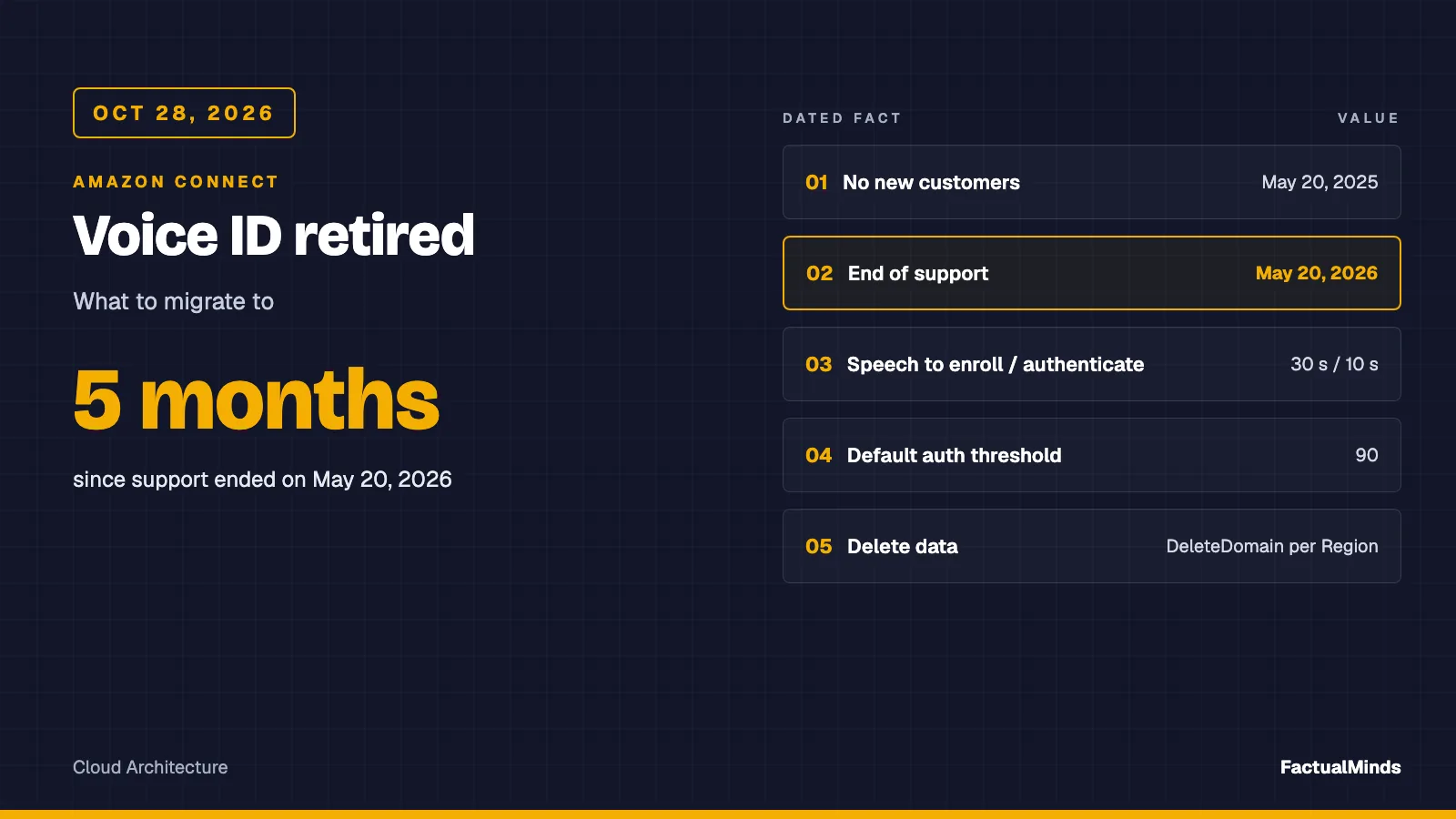
This is not Voice ID. Voice ID stopped on 20 May 2026. Agentic voice does not authenticate the caller. The FAQ self-service post still owns the three tiers of what the agent is allowed to do. This page owns how the call sounds.
Ears, brain, and mouth
AWS’s frame is the useful one. Ears convert speech to text and decide the caller has finished. The brain writes the reply. The mouth speaks it. A wrong answer is the brain. A cutoff is the ears. A robotic or mismatched voice is the mouth. Blaming the model for a cutoff sends the team into prompt edits that cannot change turn detection.
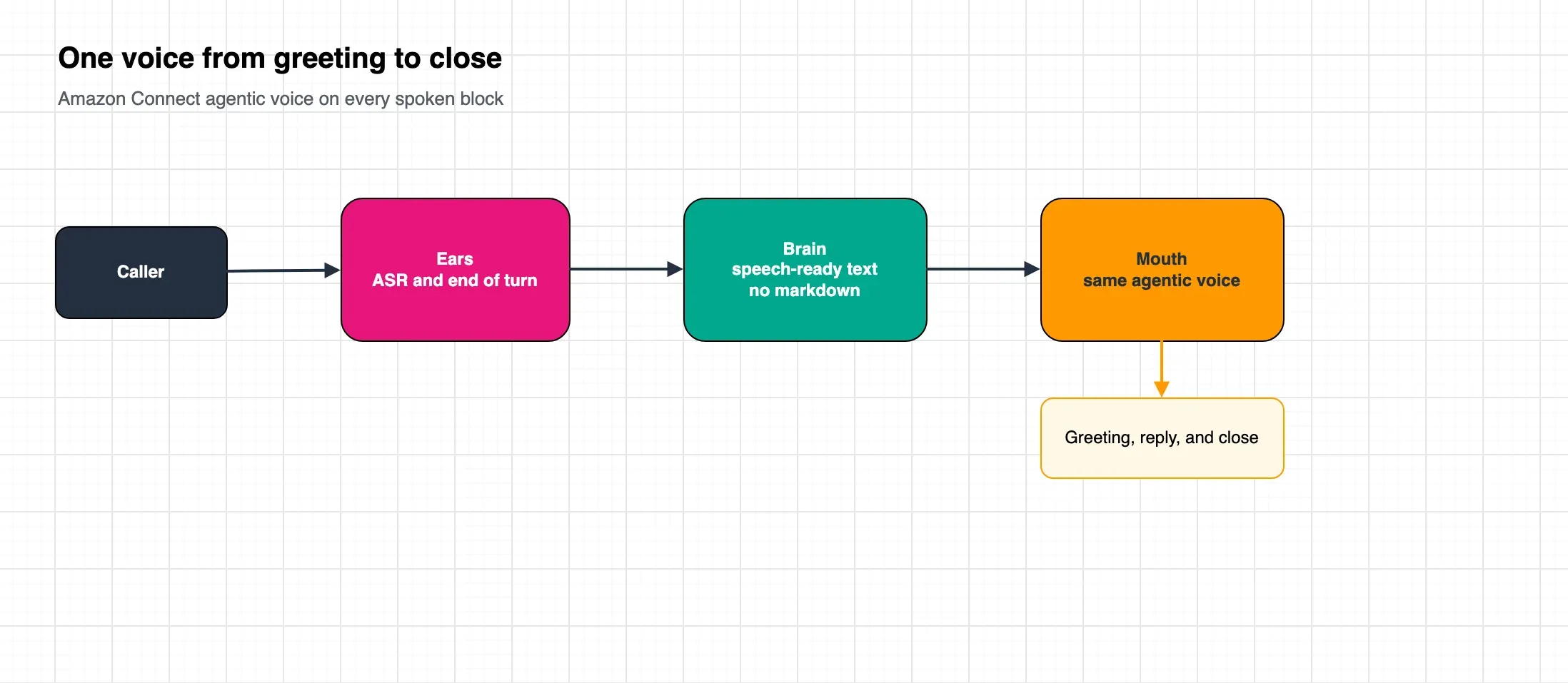
Figure: one voice identity. Greeting, reply, and close use Amazon Connect agentic voice. The defaults in the notes are from the admin guide, not a call we recorded. Open the draw.io source.
| What the caller says | Look here | What to change |
|---|---|---|
| It cuts me off | Ears | Raise end-of-turn confidence or the voice end timeout |
| It waits too long after a short answer | Ears | Lower the silence timeout on that step only |
| The answer is wrong | Brain | Prompt or knowledge, on the FAQ post |
| It reads asterisks or a bullet list | Brain | Speech-output rules in the prompt |
| The greeting is a different person | Mouth | Same voice provider on every spoken block |
| It cannot follow the caller’s language | Mouth | A multilingual voice, plus language hints if recognition is biased at the bot locale |
The Agentic CX block can set the speech recognition engine to Amazon Connect agentic voice (the recommended default), Amazon Transcribe, or speech-to-speech. Speech-to-speech skips the text step. This post is the text path: ears, a written reply, one voice. Do not mix those engines inside one explanation of “the voice.”
Where to set it
Two surfaces, and they are not interchangeable.
Bot flows. In the bot’s speech configuration, set the voice provider to Amazon Connect agentic voice and the speech model preference to Advanced. Turn-taking is a Lex session attribute. Scope it to the slot that needs it. The account-number slot can wait longer. The yes/no slot should not inherit that wait.
Agentic CX designer. The Agentic CX block’s speech recognition engine, and each node’s speech settings: allow interruption, voice start timeout, voice end timeout. The attribute names in the table above are the bot path. Do not paste them into a designer node and expect the same control.
Set Voice. Choose Amazon Connect agentic voice, then the language, then the voice. Preview it. Publish the flow. The configuration guide says this provider is the default for Amazon Connect Customer. A flow that still sets a Polly neural voice on the greeting and agentic voice on the bot is the mismatch.
We recommend that order. The trade-off is that you stop mixing Polly generative voices into the same conversation for “a warmer greeting.” If the legal line must be a specific recording, play the file. Do not solve it with a second synthesized voice.
Speech the mouth can say
The best-practices page says ordinary sentences are normalized: 12% is read as “twelve percent,” and a written email address is read with “at” and “dot.” Markdown is not. The engine will try to speak the asterisks. A tag it cannot parse is spoken, including the tag text. There is no silent drop.
The prompt block and the tag table are in speech-ready-prompt.md. The tags the guide names:
<speed ratio="0.85"/>— rate from 0.6 to 1.5, default 1.0. Set it back to 1.0 after a disclosure.<volume ratio="0.5"/>— 0.5 to 2.0, default 1.0.<break time="500ms"/>— use punctuation first. A break is for a silence you can measure.<spell>AB12CD</spell>— order ids and confirmation codes. Phone numbers already have a written form the engine paces. Do not spell a phone number unless you have heard the written form fail.<emotion value="content"/>— beta. The page lists neutral, angry, excited, content, sad, and scared. Its worked example usessympathetic. Do not put an emotion tag on a line the words do not support.[laughter]— not on a complaint, a payment, or a claim.
For a line that takes English and Spanish, use one of Katie, Blake, Brooke, Ronald, or Gemma, and add language-handling rules to the prompt. Recognition is biased toward the bot locale until you set x-amz-lex:audio:locale-override with no :intent:slot suffix. A suffix is ignored and the bias stays. List at most 10 codes, most likely language first, and include the bot locale’s language if callers still use it. Thai and Tagalog are the guide’s examples of languages outside that multilingual list: a separate bot locale and a locale-specific voice, not a hint on Katie.
What to do this week
- Play the greeting and the first bot reply on a non-production number. If the speaker changes, fix Set Voice before any prompt edit.
- Copy the prompt block into the generative journey prompt. Remove markdown from one live prompt and call it again.
- On the slot where callers read an order id, raise the end timeout. Leave every other slot on the defaults.
- Turn barge-in off only on the disclosure block. Confirm a caller can still interrupt “anything else?”
- If the line is multilingual, pick one voice from the five and set locale hints without a suffix. Confirm the Set Voice language matches the Lex bot locale. A mismatch makes Get Customer Input take the error branch.
Design of the queues and the security profiles stays on Amazon Connect consulting.
What this post doesn’t cover
- Whether the agent may look up an order or issue a refund. That is the three-tier FAQ post.
- Caller authentication. Voice ID is end of support. This voice does not replace it.
- A recount of every locale, a Region list for agentic voice, or a price. The best-practices page states 50+ locales. The configuration guide we read does not state a Region list or a per-minute voice premium. Check the pricing page before you budget.
- Speech-to-speech as a configuration. It is a different engine on the Agentic CX block.
- A contact center we ran. The order-status failure above is a modeled path through the admin guide, not a FactualMinds engagement.
Sources
- AWS Contact Center Blog, 20 November 2026, Agentic voices in Amazon Connect Customer
- Agentic voice configuration guide
- Agentic voice best practices
- Agentic CX block
- Set voice
Frequently asked questions
When should we not disable barge-in?
What could go wrong if the greeting and the bot use different voices?
Is this Amazon Connect Voice ID?
Do we have to wrap every sentence in a speech tag?
Which number should we change when the bot cuts the caller off?

AWS Cloud Architect & AI Expert
AWS-certified cloud architect and AI expert with deep expertise in cloud migrations, cost optimization, and generative AI on AWS.