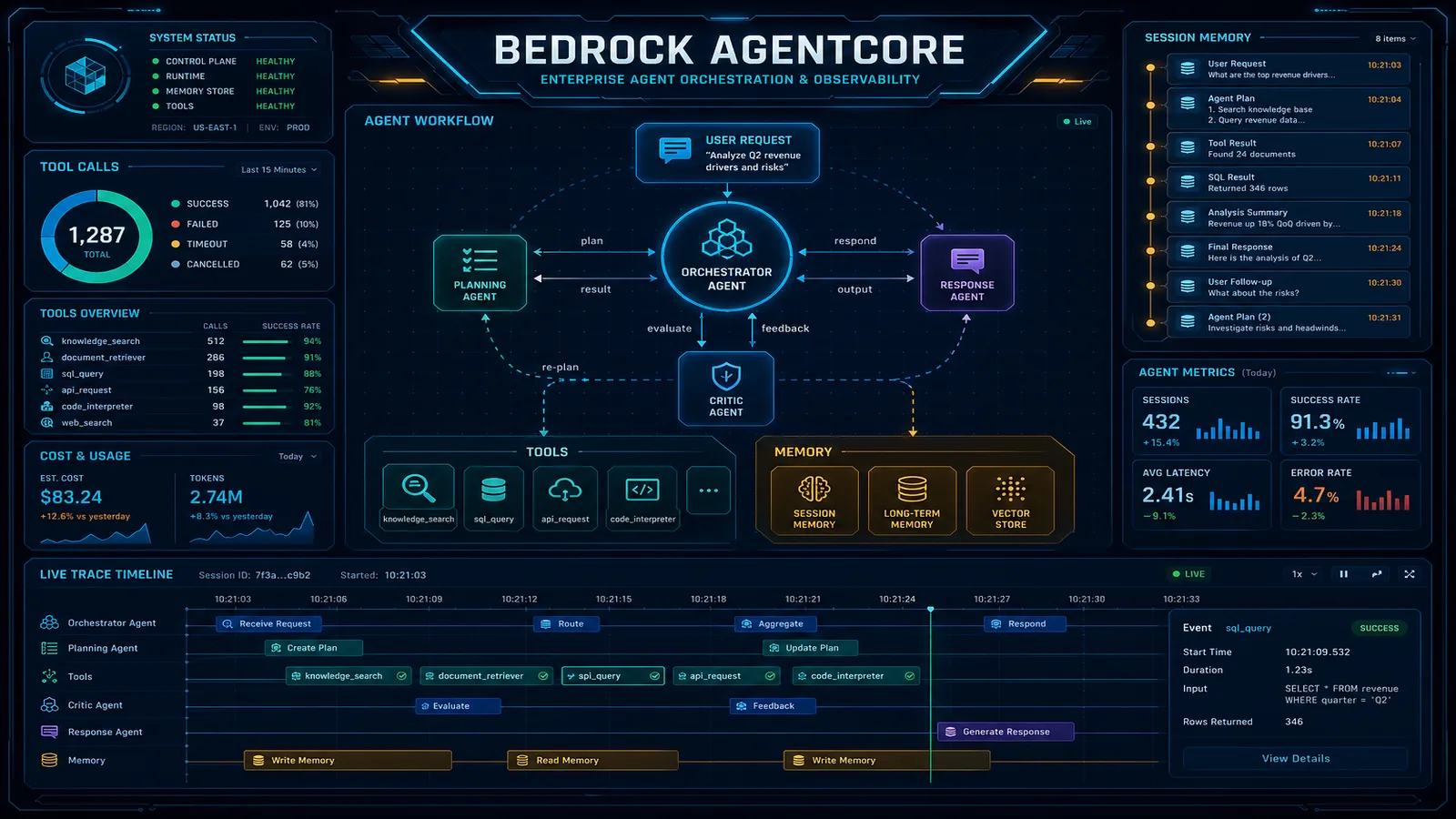
Bedrock AgentCore Gateway Server-Side Tools (2026): Skip the Client Orchestration Loop
Quick summary: February 2026 server-side tool execution via AgentCore Gateway + Responses API cut median tool-round-trip latency ~180 ms → ~95 ms on a 12-tool SaaS CRM assistant by removing the client orchestration hop.
Key Takeaways
- January 2026 also introduced server-side custom Lambda tools on Responses for a smaller set of models (custom tools What's New)
- It is not a remake of AgentCore production or the AgentCore vs Amazon Q buyer guide
- First-party benchmark silhouette — B2B CRM assistant, 12 Gateway tools (OpenAPI + 2 Lambdas), ~8k chat turns/day
- Client-loop design had median tool round-trip ~180 ms (app ↔ Bedrock ↔ tool ↔ Bedrock)
- After Gateway server-side: median ~95 ms on the same tools (CloudWatch custom metric around tool complete events over 5 weekdays)

Table of Contents
On February 2026, Amazon Bedrock added server-side tool execution with AgentCore Gateway: pass a Gateway ARN as a tool connector on the Responses API, and Bedrock discovers tools, selects them during inference, and executes calls server-side — no customer-maintained client orchestration loop (What’s New, server-side tool use). January 2026 also introduced server-side custom Lambda tools on Responses for a smaller set of models (custom tools What’s New).
This post is the architecture + ops decision for Gateway server-side tools. It is not a remake of AgentCore production or the AgentCore vs Amazon Q buyer guide.
Artifacts: decision matrix, Responses Gateway sketch, architecture diagram (draw.io).
First-party benchmark silhouette — B2B CRM assistant, 12 Gateway tools (OpenAPI + 2 Lambdas), ~8k chat turns/day. Client-loop design had median tool round-trip ~180 ms (app ↔ Bedrock ↔ tool ↔ Bedrock). After Gateway server-side: median ~95 ms on the same tools (CloudWatch custom metric around tool complete events over 5 weekdays). Absolute times depend on target latency; the win was removing one WAN hop.
Server-side vs client-side — one diagram
Client-side:  App ⇄ Bedrock ⇄ App ⇄ Tool ⇄ App ⇄ Bedrock
Server-side:  App ⇄ Bedrock ⇄ AgentCore Gateway ⇄ Lambda / OpenAPI / Smithy
Bedrock presents tools to the model, executes selected calls through Gateway, and streams results back. Multiple tool calls in one conversation turn are supported.

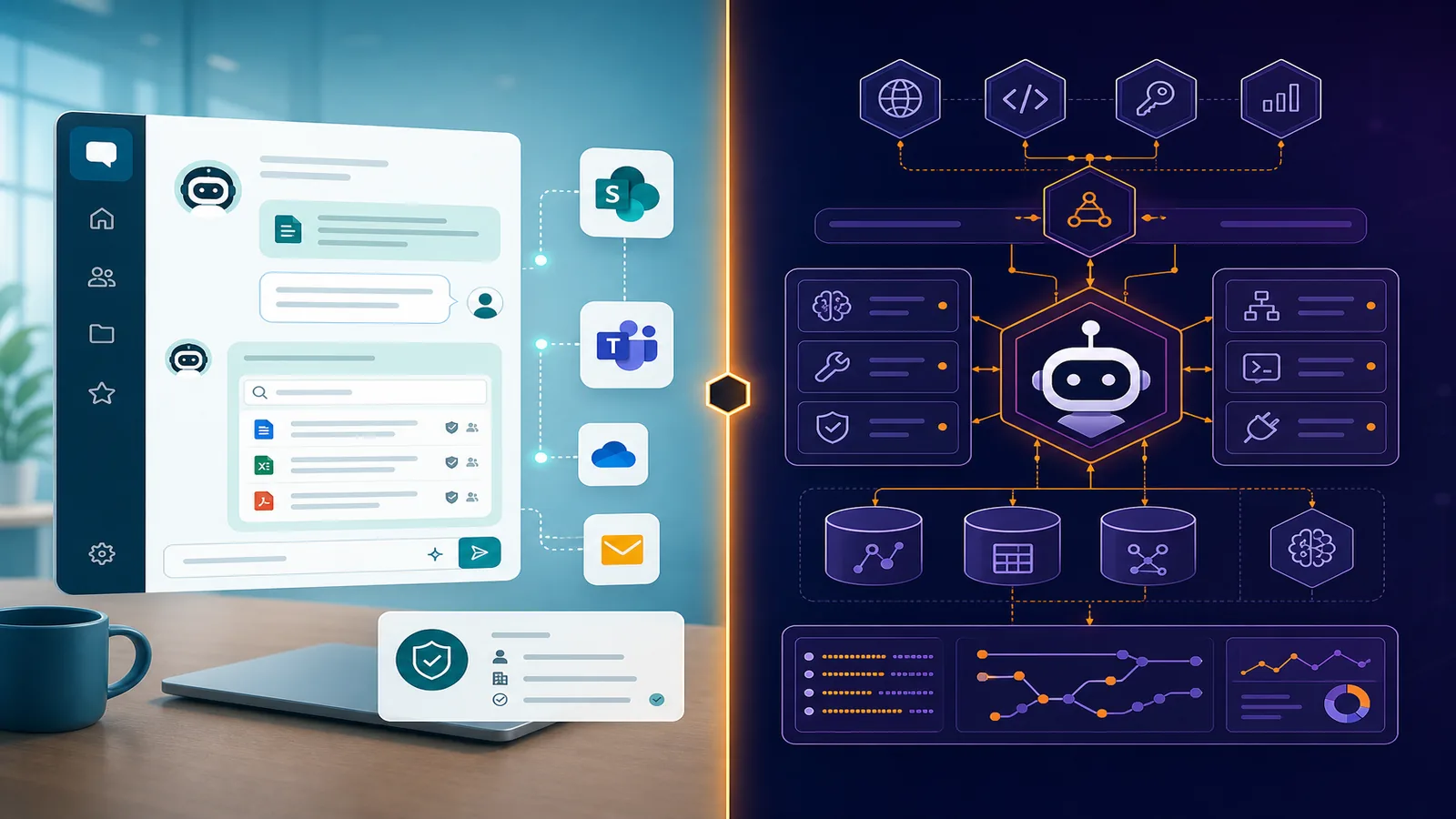
Figure: application calls Responses API; Bedrock invokes AgentCore Gateway; Gateway translates to Lambda / OpenAPI targets under OAuth/IAM. Open draw.io
Why Gateway — beyond “fewer lines of code”
From AgentCore Gateway capabilities:
- Translation — MCP ↔ REST / Lambda without owning protocol versions
- Composition — many targets behind one MCP endpoint
- Security Guard — OAuth so only valid users/agents reach tools
- Semantic Tool Selection —
x_amz_bedrock_agentcore_searchfor natural-language tool discovery when catalogs get large
Opinionated take: prefer Gateway server-side once you cross ~10 tools or need shared OAuth SaaS integrations. Prefer client-side or a single Lambda tool when the tool surface is small and product wants an explicit human confirmation step between model intent and execution.
IAM and permissions
Server-side execution runs in a trusted backend path. Align IAM so the caller identity Bedrock uses can invoke Gateway / targets — do not bounce long-lived SaaS tokens through the browser just to “keep control.” Gateway still centralizes authorization; your app still owns conversation UX.
Failure modes
What broke — Pilot week. Catalog of 87 tools registered on one Gateway with semantic search off. Model selected near-duplicate CRM update tools and wrote duplicate notes on 3% of tested turns. Fix: enable semantic search, tag tools by domain, shrink default tool list, add idempotency keys on write tools. Lesson: Gateway removes the loop; it does not remove catalog hygiene.
Cutover checklist
- Inventory tools — Lambda ARNs, OpenAPI specs, Smithy models.
- Create Gateway targets; enable OAuth scopes matching least privilege.
- Confirm Responses-compatible models in your region via Models API.
- Feature-flag: 10% of traffic on server-side Gateway; compare error rate and p50/p95 tool latency.
- Retire client loop code paths once idempotent writes are verified.
Reproduce this — Use responses-gateway-snippet.py as a dry-run shape, then wire the request to the current Responses / bedrock-mantle SDK fields for your SDK version. Score fit with server-side-vs-client-side-matrix.md.
What to Do This Week
- Count production tools and whether OAuth or API keys live in the app today.
- If count ≥10 or ≥2 teams contribute tools, draft a Gateway target map.
- Measure client-loop tool RTT (start → result) for one week as a baseline.
- Run a 10% server-side canary; keep classic Agents Classic traffic separate if still present.
- Review AgentCore pricing components so Gateway line items are expected, not surprises.
What This Post Doesn’t Cover
- AgentCore Runtime / Memory / Harness product selection — see production and Q2 roundup posts
- Knowledge Bases / RAG chunking — separate retrieval path
- Full MCP client sample with streaming elicitation — Gateway feature table only
- EU AI Act classification for autonomous tool writes — compliance follow-up
We have not validated every mantle model × region for Gateway connectors on the same day — always confirm with the Models API before a hard cutover.
Related: Bedrock services · Generative AI on AWS · Architecture review
Frequently asked questions
When should we NOT use server-side AgentCore Gateway tools?
What can go wrong with tool overload?
Is this the same as Agents Classic action groups?
Do Gateway charges appear even if I only use Runtime?
Which models support server-side tools?
How does this differ from the AgentCore vs Amazon Q decision guide?
Reference bounds
How the Gateway server-side tools stays bounded
Level 2 — reference architecture. Risk high. Oversight: approval required.
Run a tool on Gateway so the client loop is not the place credentials live.
Explore, then act, then confirm, then verify. Explore gathers the context for the Gateway server-side tools. Act stays reversible. Confirm stops before an irreversible step. Verify is a separate check of the outcome.
- Starts when
- A design is choosing where a tool executes.
- Tools
- A write goes through a router, a permission check, a policy check, and a budget check. The model does not commit it. An approval token lives in tool context, not in the user message.
- Stops for a person
- Server-side execution is not authorization. Policy still allows or denies the call.
- Checked by
- The credential is not in the model context. A trace shows the tool and the decision.
- Untrusted data
- Tool descriptions that tell the model to pass a secret through.
- If it fails
- If the Gateway server-side tools stops, name the reason: completed, budget_exceeded, timed_out, cancelled, guardrail_blocked, approval_required, tool_failure, verification_failed, or partial_completion. Retry a timeout at most twice. Back off on rate limits. After repeated verification failure, escalate. Stop when the budget is exhausted or a permission is denied. No unbounded loop. Server-side execution is not authorization. Policy still allows or denies the call.
This is the reference architecture for the page, not a published production deployment. The shared contract is the AWS store-agent architecture. Permissions and data boundaries are in securing store agents.

AWS Cloud Architect & AI Expert
AWS-certified cloud architect and AI expert with deep expertise in cloud migrations, cost optimization, and generative AI on AWS.