Stop Asking Dashboards Questions: Let AI Agents Monitor Your Store (2026)
Quick summary: Someone logs into Looker at 8:12 because something felt off. Pick one signal domain. Detect in code. Cap the live page list. The daily brief stays at five — this is always-on.
Key Takeaways
- Someone logs into Looker at 8:12 because something felt off
- Thursday at 8:12, someone logs into Looker
- This is series part 53: business signals → AI monitoring → problem detection → investigation → recommendation → human or bounded automation
- It is not a remake of the daily operations brief — that artifact is a scheduled JSON with a cap of five
- After July 30, 2026, net-new monitors should not start on Agents Classic
Table of Contents
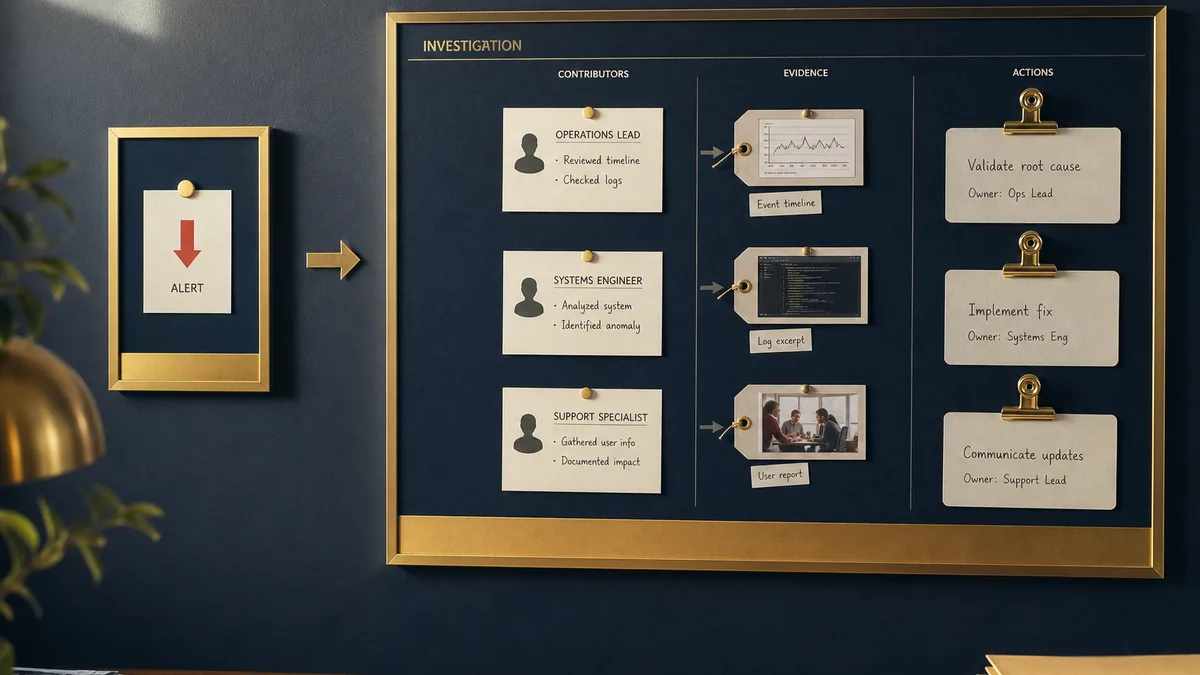
Thursday at 8:12, someone logs into Looker. Revenue felt soft. The tile still says green. Ads on an out-of-stock SKU kept spending until someone noticed.
This is series part 53: business signals → AI monitoring → problem detection → investigation → recommendation → human or bounded automation. It is not a remake of the daily operations brief — that artifact is a scheduled JSON with a cap of five. This catalog is always-on. Demo SKUs and thresholds below are fixtures. They are not a FactualMinds store KPI. After July 30, 2026, net-new monitors should not start on Agents Classic.
The job. Write the detector in code. Let the agent investigate and recommend after the rule fires.
This week. Pick one signal domain — usually advertised ATP=0 or exception queue depth. Cap the live page list.
A person still signs. Pause ads, send POs, refunds, and live price changes.
Skip it when you have no named signal tools, no thresholds you own, and no human queue for pages that fire.
Our take: put detection in code, then let the agent investigate and recommend. Trade-off: novel questions wait until you add a tool. You keep invented causality and dashboard-as-job out of the live channel.
Copy the signal catalog — Open
store-monitoring-signal-catalog.md. Replace example signals with your tools and thresholds. Do not submit the demo Detect column as an SLA. Series folder:ecommerce-ai-agents-series/.
FactualMinds is an AWS Select Tier Services Partner. We help merchants sequence agents — we do not sell a guaranteed conversion lift from a monitor.
Conversational “why did this move?” still belongs in store intelligence. Evidence-shaped pages belong in alerts. The always-on “what needs a human now?” surface is the control tower.
Reactive vs proactive
| Model | Who starts | What fires | Failure mode |
|---|---|---|---|
| Reactive | A human opens a dashboard | Curiosity, a Slack rumor, a weekly meeting | The stockout on an advertised SKU waited until someone logged in |
| Proactive | A named signal | Threshold, join, webhook, queue depth | You page on noise if you skip the cap |
Ads keep spending on ATP=0; refund clusters become chargeback week; a conversion dip gets a story no system measured. The dashboard did not fail. The operating model failed — attention arrived after the join was already true.
Business Signals → AI Monitoring → Problem Detection → Investigation → Recommendation → Human / Automationflowchart LR
Signals[BusinessSignals]
Monitor[AIMonitoring]
Detect[ProblemDetection]
Investigate[Investigation]
Recommend[Recommendation]
Human[HumanOrBoundedAuto]
Signals --> Monitor
Monitor --> Detect
Detect --> Investigate
Investigate --> Recommend
Recommend --> HumanSignal catalog (name tools; replace thresholds)
From store-monitoring-signal-catalog.md. Every row needs a Detect that is not a prompt.
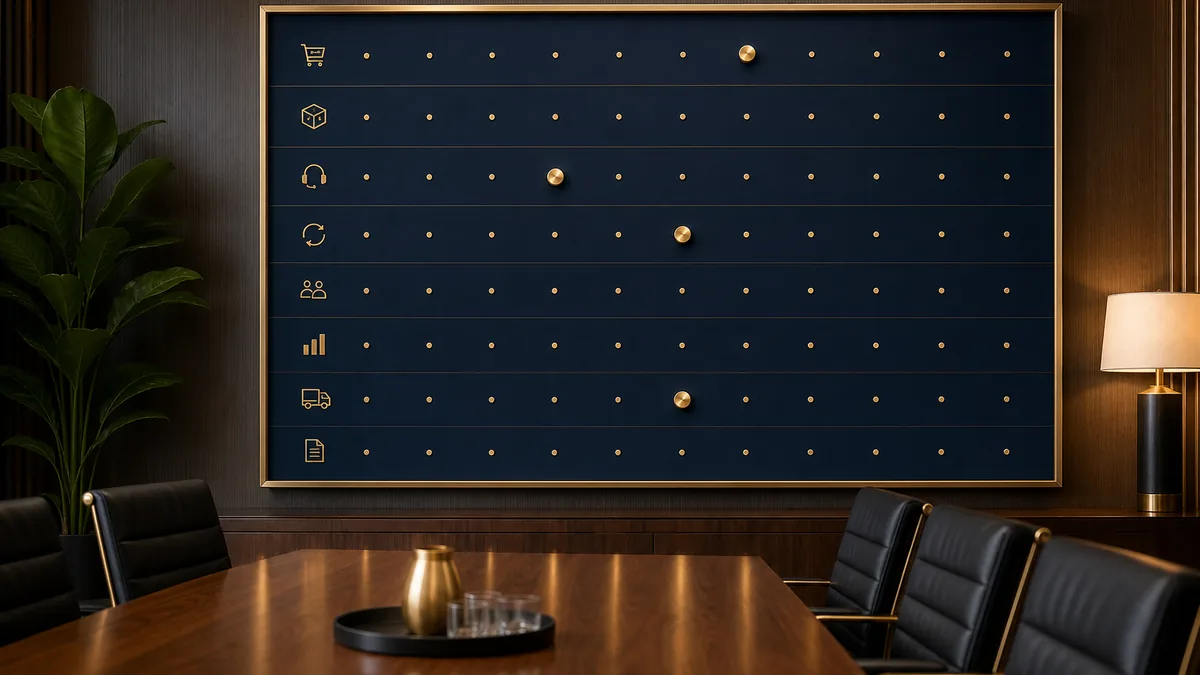
| Domain | Example signal | Detect (code) | Investigate (agent) |
|---|---|---|---|
| Sales | Revenue vs trailing 7d | Threshold on salesByPeriod | RCA hops if you have the tools — root cause |
| Orders | Exception queue depth | Count | Exception pattern |
| Inventory | ATP=0 on an advertised SKU | Join ads + ATP; pin asOf | Confirm inventory tool; recommend pause — do not auto-pause |
| Customers | Duplicate create spike | Rule | Data quality, not an account write |
| Support | Tag volume spike | Count | Theme — not invented UX |
| Returns | RMA rate vs baseline | Rate + minimum n | Refund matrix / quality |
| Marketing | Spend with ATP=0 | Join | Pause recommend |
| Fulfillment | SLA breach | WMS/3PL event | Exception agent |
Cap pages to humans. Overflow is a watch list. The catalog is not permission to staff eight chatbots.
Baymard 70.22% cart abandonment (50 studies, updated Sep 22, 2025) is industry context. It is not a Detect rule for your conversion tile. If the monitor cites abandonment without a funnel tool, that is a failed eval — same rule as the daily brief.
Always-on is not the 8 a.m. brief
Keep the two jobs separate in week one.
| Job | Cadence | Output | Cap |
|---|---|---|---|
| Daily operations agent | Scheduled invoke | JSON brief, evidence_tool on each row | 5 priorities |
| This monitor | Event / threshold | Detect → investigate → recommend | Live page list; overflow watch |
| Analytics agent | Human asks | Answer + evidence | Tool catalog, not SQL |
| Control tower | Always-on rank | “What requires human attention now?” | Example: 7 on the now list |
Merging them is how you get twenty “P1” Slack messages and a brief that reads like a webhook dump. The daily schema lives in operations-daily-brief-schema.md. Do not copy it here and call it monitoring.
Detection stays in systems of record
The agent starts after the code fires.
| Allowed detector | Not a detector |
|---|---|
| OMS exception webhook | “Does this order look weird?” |
| ATP join against advertised SKUs | Model confidence on a chart screenshot |
| Support tag count vs your baseline | Sentiment of the last five tickets |
| WMS SLA event | A human “feeling” the warehouse is slow |
If you cannot name the tool and the comparison window, you do not have a signal. You have a dashboard question. Write the rule. Then invoke Harness.
Inventory joins must carry asOf. An ATP=0 that is a reservation bug is a different investigation than a true stockout. The monitor confirms with getInventory; it does not freeze the storefront.
Investigation is named tools, then a recommendation
Same evidence contract as the rest of the series: evidence_tool + evidence_ref on every finding. If a hop has no tool, it is an unknown, not a story. That is the alert schema and the RCA playbook, reused — not a second narrative engine.
Week-one autonomy:
| After investigate | Default |
|---|---|
| Draft a PO, pause-ad recommendation, QA ticket text | Recommend / Draft |
| Notify ops channel with evidence | Allowed if the schema rejects rows without tools |
createPurchaseOrder, live price, payment capture, account write | Veto — HITL |
For your technical lead
On June 17, 2026, Amazon Bedrock AgentCore Harness reached general availability — a config-driven loop on the same platform as Runtime, Memory, Gateway, Identity, and Policy (What’s New). Agents Classic is in maintenance for new customers after July 30, 2026. Net-new monitoring agents should use Bedrock AgentCore. Full matrix: lifecycle roundup.
First-party signals we reuse (not eCommerce outcomes) — Gateway server-side tools cut median tool round-trip ~180 ms → ~95 ms on a B2B CRM assistant (12 tools, ~8k turns/day) — Gateway post. Platform TCO silhouette: support-style AgentCore at 50K sessions/mo ~$791/mo platform + model (decision guide). Always-on investigate hops are session time + tokens; model them on the AgentCore pricing calculator before you page on every inventory tick. Treat ~$791/mo as a platform cost floor to plan against, not as savings the monitor will produce.
Use Harness (GA June 17, 2026) for a thin monitor: signal catalog, read tools, JSON recommendation. Use Runtime plus Strands when this layer fans out to exception and RCA specialists with hop caps.
| Piece | Role here |
|---|---|
| Gateway | Named reads: salesByPeriod, getInventory, queue depth, tag counts, ads-vs-ATP |
| Policy (Cedar) | Default-deny writes. LOG_ONLY then ENFORCE if you later attach pause or ticket tools |
| Identity | Associate tokens for the page channel. Shopper JWTs DENY every monitor write |
| Memory | Signal-id scoped; do not store PII from a duplicate-customer spike |
| Observability | Page rate, watch-list size, missing evidence_tool, unexpected tool pairs |
There is no native Shopify AgentCore connector. Shopify Admin, a warehouse, or a custom OMS are your OpenAPI or MCP targets. Browser off. A monitor that screenshots Admin will burn Runtime-shaped minutes for four GETs.
Gateway ~180 → ~95 ms is tool RTT on a CRM canary. Absolute latency here is OMS + ads + WMS. Use the canary to decide Gateway placement, not to SLA a 3PL.
Eval the monitor the same way you eval the brief: goldens that require evidence_tool, fail cases for Baymard-as-cause, twenty-P1 dumps, and PII in a duplicate-customer spike. Gateway traces are the evidence that Detect stayed in code.
What broke — First always-on sample treated every
salesByPerioddip as a page. The instruction said “alert if anything important moves.” A fixture 1.8 percent AOV wiggle on a long-tail category and a support tag spike of four tickets both landed in the live channel by 09:10. Detection: page count plus missingevidence_toolon half the payloads (eval suite). Fix: blast-radius rank; cap the live list; minimum n for tag and RMA signals; overflow → watch; requireasOfon ATP joins. Lesson: a monitor without a cap is a dashboard that texts you.
A related failure: detection left in the prompt (“watch the store”). OMS already had an exception code. The model invented a delay the carrier never sent. Fix: webhook first, agent second.
What to do this week
- Clone
store-monitoring-signal-catalog.md. Replace demo signals with your tools. - Pick one domain for week one — usually advertised ATP=0 or exception queue depth. Not eight.
- Write the detector in code (threshold, join, webhook). Do not ask the model to notice.
- Name read tools only. Browser off. Cedar default-deny writes.
- Require
evidence_tool+evidence_ref. Unknowns stay unknowns. - Cap the live page list. Overflow is watch. Do not merge with the daily brief.
- Run
monday-checklist.md. - Model invoke volume on the AgentCore pricing calculator.
- Architecture conversation: contact us. Retail context: Amazon Bedrock, AWS for retail / eCommerce.
If you only do one thing: stop making a human the detector. Write the rule. Then staff the investigate step.
What this post doesn’t cover
- The 8 a.m. five-priority JSON brief — daily operations agent
- Pull Q&A (“why did apparel drop?”) — analytics agent
- The reusable exception loop — exception agent
- Evidence-shaped alert payloads — business alerts
- The strategic “now” ranking surface — control tower
- A guaranteed hours-saved or GMV figure from a named client
- PCI-scoped payment automation
- A native Shopify AgentCore connector (does not exist)
FAQ
When should you NOT build an AI store monitoring agent?
Skip it when you have no named signal tools, no thresholds you are willing to own, and no human queue for the pages that fire. A model watching Slack is not monitoring. Also skip it if a scheduled daily brief already answers the same five questions and nobody will look at an always-on channel.
What could go wrong if the monitor pages on every metric wiggle?
The channel dies by lunch. Rank by blast radius, not model confidence. Cap the live page list. Overflow is a watch list. A 2 percent AOV wiggle on a long-tail category is not a page.
How is this different from the daily operations brief?
The daily brief is a scheduled JSON push that answers what needs my attention today, capped at five. This post is always-on signals that detect, investigate, and recommend when a rule fires. Do not merge them in week one or the 8 a.m. Slack becomes a chat log of every webhook.
What could go wrong if detection is left to the model?
You miss holds the OMS already coded and invent holds the model feels. Detection stays deterministic: threshold, join, webhook, queue depth. The agent starts after the code fires. Prompt vigilance is not a detector.
Should the monitoring agent pause ads or send POs?
Not in week one. Recommend pause, draft PO, open a QA ticket. Writes stay on domain agents with Cedar and HITL. Mixing watch with purchase is how a monitor becomes an unattended merchandiser.
Harness or Runtime for always-on monitoring?
Harness is enough for a signal catalog, a handful of read tools, and an investigate-then-recommend loop. Use Runtime plus Strands when you fan out to exception, RCA, and alert specialists in one turn. Net-new builds use AgentCore, not Agents Classic after July 30, 2026.
Need a signal catalog without a fake SLA slide? Contact FactualMinds for an architecture conversation, or start from the 15 automations pillar.
Reference bounds
How the store monitoring stays bounded
Level 2 — reference architecture. Risk medium. Oversight: monitored.
Watch named store signals and open an alert with evidence when a threshold breaks.
Explore, then act, then confirm, then verify. Explore gathers the context for the store monitoring. Act stays reversible. Confirm stops before an irreversible step. Verify is a separate check of the outcome.
- Starts when
- A monitor schedule or a metric breach.
- Tools
- Reads only, through named tools. No shell, no unrestricted SQL, and no undeclared API.
- Stops for a person
- The alert does not remediate by writing orders, prices, or ads.
- Checked by
- The alert includes the metric, the window, and the threshold. No alert without them.
- Untrusted data
- Status pages and chat that tell the monitor to ignore a breach.
- If it fails
- If the store monitoring stops, name the reason: completed, budget_exceeded, timed_out, cancelled, guardrail_blocked, approval_required, tool_failure, verification_failed, or partial_completion. Retry a timeout at most twice. Back off on rate limits. After repeated verification failure, escalate. Stop when the budget is exhausted or a permission is denied. No unbounded loop. The alert does not remediate by writing orders, prices, or ads.
This is the reference architecture for the page, not a published production deployment. The shared contract is the AWS store-agent architecture. Permissions and data boundaries are in securing store agents. The commercial page is operations.

AWS Cloud Architect & AI Expert
AWS-certified cloud architect and AI expert with deep expertise in cloud migrations, cost optimization, and generative AI on AWS.