AI Agents for eCommerce Data Quality Monitoring (2026)
Quick summary: Price, stock, and customer records still drift after publish. Run 6 checks in a worker. The model investigates only if you add it.
Key Takeaways
- Run 6 checks in a worker
- After July 30, 2026, new agents should not start on the older Agents Classic product
- This is series part 47
- This is not a remake of catalog extract/publish (part 9)
- FactualMinds is an AWS Select Tier Services Partner
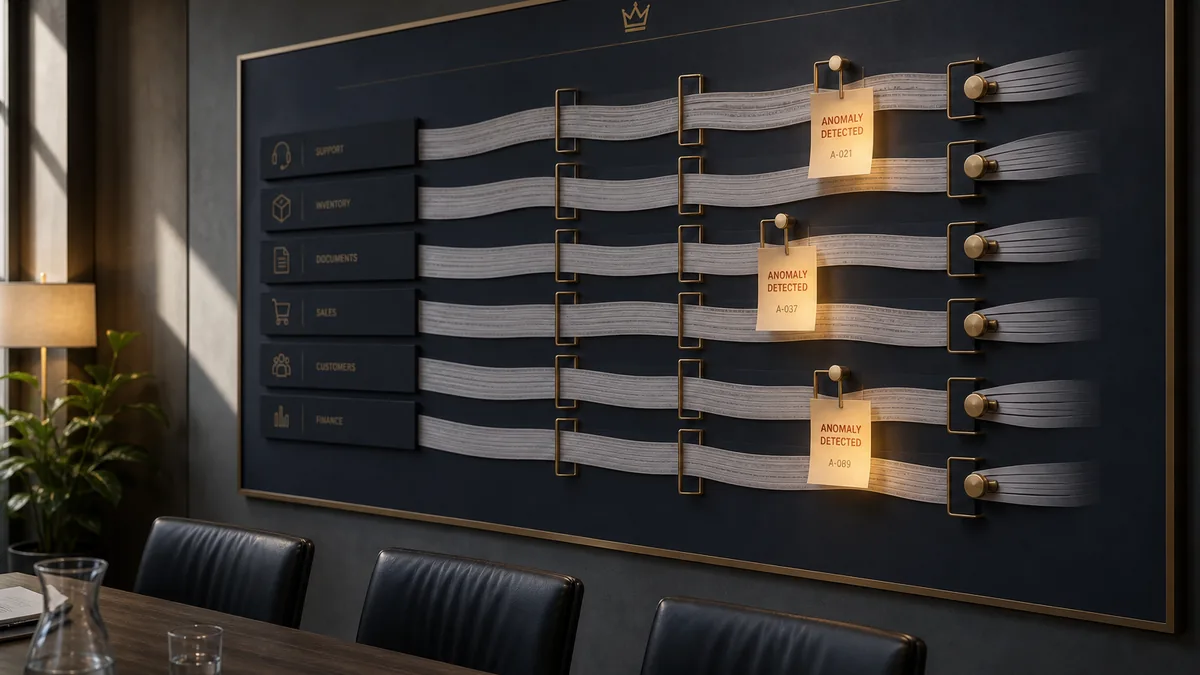
Table of Contents
Wednesday, ops notices the shelf price and the price service disagree. What can ship on a hero product jumped, and no receipt was posted. Two guest checkouts created two customer ids for the same email. Nobody asked a question. The data drifted while the catalog looked fine. After July 30, 2026, new agents should not start on the older Agents Classic product.
This is series part 47. Core idea: agents should monitor business data, not only answer questions. Deterministic validation detects. AI may investigate. This is not a remake of catalog extract/publish (part 9). Demo finding_ids in the artifact are fixtures. We do not invent a client defect-rate KPI.
The job. Watch live commerce streams — products, customers, prices, inventory, sync watermarks — and open findings when deterministic rules fail. Not “ask the bot if the catalog looks fine.”
This week. Implement six deterministic checks in a worker. Optional: a Harness loop that drafts an investigation with read tools only. No publish, merge, setPrice, or updateQuantity.
A person still signs. Publish, customer merge, live price changes, and ATP adjustments stay human-owned.
Skip it when you have no scanner in code, findings would auto-remediate, or the only monitor is a chat session asking “is everything OK?”
Our take: ship the rule table in code before you attach an investigator. Trade-off: fewer “smart” auto-fixes in week one. You stop publishing fiction and adjusting ATP because a prompt was confident.
Copy the monitor rules — Open
data-quality-monitor-rules.md. Replace thresholds with yours. Catalog publish gates remain incatalog-validation-rules.md. Folder:ecommerce-ai-agents-series/.
FactualMinds is an AWS Select Tier Services Partner. We help merchants split detect vs investigate — we do not sell a model as a validator.
The data agent answers a human question with joins. This post watches the same entities when nobody asked. If you only staff Q&A, drift lands in WISMO and RCA first — usually as a confident sentence with no finding_id.
Code detects, model investigates (maybe)
Monitors watch streams that already exist: PIM live SKUs, customer identity, price service, inventory ATP, sync watermarks. The data layer must expose asOf and join keys or the scanner pages ghosts.
flowchart LR
  streams[Business data streams]
  rules[Deterministic rules]
  findings[Finding queue]
  investigate[Optional AI investigation]
  human[Human action]
  streams --> rules
  rules --> findings
  findings --> investigate
  findings --> human
investigate --> human| Stage | Owner | Must not |
|---|---|---|
| Scan | Code / worker | Ask the model if GTIN is present |
| Finding | Schema with rule_id, evidence_tool | A Slack paragraph with no id |
| Investigate | Optional Harness with read tools | Auto-publish, merge, setPrice, updateQuantity |
| Act | Human or a different agent with Cedar + HITL | Monitor runtime as superuser |
Post 9 already fails a draft SKU before publish. Live drift still happens: a price service updates, the storefront cache does not; a receipt posts late and ATP jumps; two guest checkouts create two customer_ids. Answering “is the catalog OK?” in chat is not monitoring. RCA explains a revenue week; this post flags the record that would poison that week.
Six checks you encode (replace thresholds)
From data-quality-monitor-rules.md:
| Check | Deterministic rule | Agent may | Agent must not |
|---|---|---|---|
| Missing required attrs | required_attrs empty on live SKU | Draft enrichment | Auto-publish |
| Duplicate customers | Same email + different customer_id | Flag merge candidate | Merge accounts |
| Incorrect prices | Storefront price ≠ price service asOf | Open ticket | Execute live price |
| Inventory anomaly | ATP jump > N% with no receipt | Investigate receipts | Adjust ATP |
| Sync lag | asOf older than SLA | Page ops | Invent stock |
| Suspicious change | Price/cost change outside window + no PO | Risk flag | Accuse a person |
N% and SLA hours are your numbers. The blog will not pick them. Demo ids are fixtures — do not treat counts in a post as your backlog.
Output contract (one finding):
{
  "finding_id": "DQ-DEMO-001",
  "domain": "products",
  "rule_id": "required_attrs_empty",
  "severity": "high",
  "evidence_tool": "scanCatalogCompleteness",
  "evidence_ref": "sku:DEMO-SKU",
  "recommended_action": "draft_enrichment",
  "human_required": true
}
Assumed split:
# data-quality-monitor-rules.md
DETECT in code — required attrs, price equality, asOf SLA, duplicate email+id
INVESTIGATE optional — reads only
DENY publishProduct, mergeCustomers, setPrice, updateQuantity on the monitor harness
human_required true on suspicious_change and merge candidates
Exception-shaped work (holds, splits, warehouse misses) is a different playbook — order exceptions and, when it ships, the exception-agent pattern in this cluster. A DQ finding may open that queue. It does not cancel an order.
Finding lifecycle (so Slack does not become the system of record)
- Open — worker emits
finding_id,rule_id,severity,evidence_tool,evidence_ref. - Dedup — same
rule_id+evidence_refwithin the SLA window is one finding, not twelve pages. - Investigate (optional) — Harness with read tools: fetch receipt, compare price service
asOf, list sibling SKUs for a draft only. No publish. - Route — high severity pages ops; medium becomes a ticket; low is a daily digest cap (example: 5), same discipline as the ops brief.
- Close — human or the owning system (PIM publish, identity merge). The monitor harness does not close by writing commerce state.
Severity without blast radius is noise. A missing care attr on a live apparel SKU is high for shopping agents. A duplicate guest customer_id with no orders is medium until it hits checkout. Sync lag past SLA is high because every other agent will lie with in_stock.
Cadence is your ops choice: nightly catalog completeness, near-real-time price equality if you already have a stream, hourly asOf watermarks. Do not InvokeHarness once per SKU in a chat session to “feel real-time.” That is how you approach a support-shaped ~$791/mo floor without monitoring anything.
If RCA later asks why conversion dropped, a closed finding with evidence_ref on advertised SKU ATP is a hop — not a vibe.
Do not start with AWS
A quality program that begins with a hosted loop will skip the scanner and call the model 50K times.
| Piece | Job here |
|---|---|
| Rule worker | Detect; emit findings |
| Bedrock | Models + Guardrails for optional prose on an investigation — not the validator |
| Harness | CreateHarness / InvokeHarness on Runtime (GA June 17, 2026) for bounded investigate |
| Gateway + Cedar | Read tools for receipts, price service, catalog; deny writes |
| Strands 1.0 | Graph / Swarm / Workflow after export if you later fan specialists — not infra |
| Next.js | Finding inbox / HITL — not the runtime |
| Agents Classic | Wrong net-new path after July 30, 2026 |
There is no native Shopify AgentCore connector. Shopify Admin, PIM, and inventory APIs are OpenAPI you own. Do not Browser-scrape Admin as a monitor — you will page on UI lag and still miss asOf.
Memory, if used, stores finding_id and last scan watermark — not the full catalog blob. Knowledge Bases may hold the rule prose for investigators (“what missing care means on apparel”). They must not be the scanner. Observability: findings opened, duplicate suppressed, investigate turns, attempted DENY on write tools, tokens per investigation — not a vanity “AI quality score.”
For your technical lead
On June 17, 2026, Amazon Bedrock AgentCore Harness reached general availability (What’s New). A scheduled InvokeHarness can host an investigation loop. It must not replace the scanner. Agents Classic is in maintenance for new customers after July 30, 2026. Net-new agents should use Bedrock AgentCore. Full matrix: lifecycle roundup.
First-party signals we reuse (not store results) — Gateway server-side tools cut median tool round-trip ~180 ms → ~95 ms on a B2B CRM assistant (12 tools, ~8k turns/day) — Gateway post. Platform TCO silhouette: support-style AgentCore at 50K sessions/mo ~$791/mo platform + model (decision guide). Nightly scans should not be 50K chat sessions; model remaining interactive investigations on the AgentCore pricing calculator. Treat ~$791/mo as a platform cost floor to plan against, not as savings. Gateway ~180 → ~95 ms is the CRM canary, not PIM p95.
What broke — A “quality agent” used the same prompt as catalog draft (post 9) and was given
publishProduct“so monitors could heal the feed overnight.” The model filled empty care instructions from a similar live SKU and published. Detection: Observability showedpublishProductwithscanCatalogCompletenessnever emittinghuman_required; validation worker was skipped because the monitor was treated as the gate. Fix: delete publish from the monitor catalog; deterministic scan only;createDraftstays on the merchandiser loop in post 9; findings are tickets. Lesson: monitoring is not auto-remediation.
A second failure: inventory anomaly rule called updateQuantity when receipts lagged by 20 minutes. ATP went to zero on an advertised SKU, then bounced. Fix: investigate receipts; page ops; never adjust ATP from this harness.
Gateway ~95 ms on the CRM canary is irrelevant to a 2 a.m. batch. Keep scans off the conversational session meter when you can. Interactive investigations are what you price on the calculator.
What to do this week
- Confirm data-layer
asOfand join keys exist for the domains you will scan. - Clone
data-quality-monitor-rules.md. Set your N% and SLA. - Implement six deterministic checks in a worker. Do not ask the model whether a required attr is empty.
- Keep PIM publish gates in
catalog-validation-rules.md/ post 9. Monitors do not publish. - Optional: Harness (GA June 17, 2026) with read-only investigate tools; Cedar DENY on writes. Not Classic after July 30, 2026.
- Schema:
finding_id,rule_id,evidence_tool,human_required. No personnel accusations. - Route warehouse/order breaks to exception handling — do not absorb them here.
- Price investigation sessions, not a scan-as-chat, on the AgentCore pricing calculator. Contact us with the rule table.
What this post doesn’t cover
- Join-key design — part 45
- PIM extract / merchandiser publish — part 9
- Cross-entity conversational joins — part 46
- “Why did revenue decline?” hops — part 48
- Order hold/split/cancel playbooks — order exceptions
- A FactualMinds client “findings closed per week” KPI — we are not inventing one
- Great Expectations / warehouse tests as a product comparison
- Auto-merge, auto-price, auto-ATP from monitors
FAQ
When should we NOT use an AI agent as the data-quality validator?
Never let the model be the gate for required fields, price equality, or asOf freshness. Those are code. Skip an investigation agent when you have no deterministic scanner, when findings would auto-publish or auto-adjust ATP, or when the only monitor is “ask the bot if the catalog looks fine.” Post 9 already owns PIM publish gates — do not remake extract/publish here.
What could go wrong if the model both detects and remediates?
It will “fix” a missing care instruction from a sibling SKU, merge two real customers, or write ATP because a jump “looked like a sync bug.” Detection without a human_required flag is how monitors become writers. Deterministic rules detect; the agent may draft an investigation; Cedar denies merge, publish, setPrice, and updateQuantity in week one.
How is this different from catalog management (post 9)?
Post 9 is how you produce catalog quality: extract, deterministic validate, merchandiser publish. This post is continuous monitoring across business data — products, customers, prices, inventory, sync lag — after records are live. Catalog publish gates stay in catalog-validation-rules.md. Monitors open findings; they do not press Publish.
What could go wrong if inventory anomaly investigation can call updateQuantity?
A false-positive jump (receipt not yet posted, location filter wrong) becomes a live ATP lie. The sample rule allows investigate receipts only. Adjust ATP is an inventory/exception write with HITL. Treat a monitor with updateQuantity as an unattended stock clerk.
Should monitors run in the same Harness as the data agent?
Prefer a scheduled InvokeHarness (or a worker that is not a chat session) for scans. Keep the conversational data agent on read tools for humans. Mixing “scan 50k SKUs” into a shopper or associate session blows token cost toward the ~$791/mo silhouette at 50K sessions without helping WISMO. Batch in a worker; page ops on severity.
Can the agent accuse a person of fraud or theft from a price change?
No. Suspicious change is a risk flag with evidence_tool, not a personnel finding. Fraud labels are not facts in listReturnsForOrder either. A human owns HR and loss-prevention language. The output schema sets human_required: true on those rows.
Need deterministic eCommerce data-quality monitors with optional investigation — not a model that publishes? Contact FactualMinds or start from Generative AI on AWS and AWS for retail / eCommerce.
Reference bounds
How the data quality monitor stays bounded
Level 2 — reference architecture. Risk medium. Oversight: monitored.
Raise data defects (missing keys, stale as-of, broken identifiers) with evidence.
Explore, then act, then confirm, then verify. Explore gathers the context for the data quality monitor. Act stays reversible. Confirm stops before an irreversible step. Verify is a separate check of the outcome.
- Starts when
- A scheduled data check, or a downstream agent failing on bad keys.
- Tools
- Reads only, through named tools. No shell, no unrestricted SQL, and no undeclared API.
- Stops for a person
- The monitor does not auto-correct production master data.
- Checked by
- Each defect cites the rule and the rows. A pass without a rule name does not count.
- Untrusted data
- Feeds that contain instructions to ignore the defect.
- If it fails
- If the data quality monitor stops, name the reason: completed, budget_exceeded, timed_out, cancelled, guardrail_blocked, approval_required, tool_failure, verification_failed, or partial_completion. Retry a timeout at most twice. Back off on rate limits. After repeated verification failure, escalate. Stop when the budget is exhausted or a permission is denied. No unbounded loop. The monitor does not auto-correct production master data.
This is the reference architecture for the page, not a published production deployment. The shared contract is the AWS store-agent architecture. Permissions and data boundaries are in securing store agents. The commercial page is knowledge.

AWS Cloud Architect & AI Expert
AWS-certified cloud architect and AI expert with deep expertise in cloud migrations, cost optimization, and generative AI on AWS.