7 Signs You Need an AWS Migration Strategy Partner
Quick summary: Seven signs your AWS migration needs a partner — stalled timelines, unknown inventory, DMS pain, compliance, surprise bills. July 2026 refresh with MAP/MGN/DMA checkpoints.
Key Takeaways
- Seven signs your AWS migration needs a partner — stalled timelines, unknown inventory, DMS pain, compliance, surprise bills
- July 2026 refresh with MAP/MGN/DMA checkpoints
- Engagement shape (anonymized): ~180-server mid-market estate, Q2 “done” target slipped to Q4 after discovery gaps and Oracle DMS lag; partner replan unlocked MAP credits and a phased wave cutover
- Here are seven signs an AWS migration partner is the cheaper path
- 1

Table of Contents
Migration runbooks are public. Shipping without blowing a budget cycle is not. As of July 2026, the usual stack is still Migration Hub + Application Discovery + MGN/DMS (plus EVS/native paths for VMware), with MAP funding for eligible programs — tools do not fix an under-resourced cutover.
Engagement shape (anonymized): ~180-server mid-market estate, Q2 “done” target slipped to Q4 after discovery gaps and Oracle DMS lag; partner replan unlocked MAP credits and a phased wave cutover.
Here are seven signs an AWS migration partner is the cheaper path.
1. Your Migration Timeline Keeps Slipping
You planned to be in the cloud by Q2. Now it is Q4 and you are still in the assessment phase. Timeline slippage is the most common symptom of an under-resourced migration.
Why it happens: Migration competes with day-to-day operations. Your best engineers are pulled between keeping the lights on and building the cloud foundation. Without dedicated focus, the migration becomes a side project that gets pushed every sprint.
What a partner brings: Dedicated migration engineers who do this full-time. They execute while your team keeps the business running. A scoped engagement with dedicated migration engineers usually outruns an internal side-project squeezed between ops — measure in waves completed per month, not slogans.
2. You Do Not Know What You Have
If you cannot produce a complete, accurate inventory of your servers, applications, databases, and their interdependencies within a day, you are not ready to migrate on your own.
Why it matters: Migration without a complete inventory leads to forgotten workloads, broken dependencies, and post-migration surprises. That legacy batch job nobody documented? It will fail silently after migration and you will not notice until month-end reporting breaks.
What a partner brings: Structured discovery using AWS Application Discovery Service, network traffic analysis, and stakeholder interviews. Results feed into AWS Migration Hub, which tracks every discovered asset and its migration status in a single dashboard across all migration tools and phases. Partners have done this hundreds of times and know where the undocumented systems hide — in closets, under desks, and in that one developer’s personal AWS account.
3. Your Team Lacks AWS Operational Experience
Knowing how to provision an EC2 instance is not the same as knowing how to design a production-ready VPC, configure cross-account IAM roles, set up monitoring that actually catches problems, or build CI/CD pipelines that deploy safely.
Why it matters: AWS has over 200 services. Choosing the right ones, configuring them correctly, and integrating them into a cohesive architecture requires experience that only comes from doing it repeatedly. Mistakes made during migration — overpermissive IAM roles, missing encryption, single-AZ deployments — become technical debt that is expensive to fix later.
What a partner brings: Engineers who build AWS environments professionally. They know the antipatterns because they have seen (and fixed) them at other organizations. They build your foundation right the first time.
4. You Have Complex Database Dependencies
Database migration is the hardest part of any cloud migration. If you are running Oracle, SQL Server, or PostgreSQL databases with hundreds of stored procedures, triggers, and cross-database dependencies, the migration complexity increases by an order of magnitude.
Why it matters: Database downtime during migration directly impacts revenue. Data integrity issues can be catastrophic. And heterogeneous migrations (e.g., Oracle to Aurora PostgreSQL) require schema conversion, application testing, and performance validation that most internal teams have never done.
What a partner brings: Experience with AWS Database Migration Service (DMS), Schema Conversion Tool (SCT), and the AWS Database Migration Accelerator (DMA) — a 2024 program that provides free expert guidance and tooling for Oracle and SQL Server to Aurora migrations. Partners know which stored procedures will not convert cleanly, which data types need special handling, and how to validate data integrity before cutover.
5. You Have Compliance Requirements
HIPAA, PCI DSS, SOC 2, FedRAMP (including FedRAMP High for government workloads) — if your migration needs to maintain compliance, the stakes are higher. A misconfigured Security Group, missing encryption, or incomplete audit trail can fail an audit and put your compliance certification at risk.
Why it matters: Compliance is not something you bolt on after migration. It needs to be designed into the architecture from the beginning — encryption, access controls, logging, and monitoring must be in place before workloads move.
What a partner brings: Pre-built compliance architectures that map AWS controls to regulatory frameworks. Partners have been through audits with other clients and know exactly what auditors look for. They build audit-ready environments that pass the first time.
6. Your AWS Costs Are Already Higher Than Expected
Some organizations start their migration, get a few workloads into AWS, and realize their AWS bill is already exceeding their on-premises costs. This is demoralizing and often leads to migration abandonment.
Why it happens: Lifting and shifting without optimization means you are running the same oversized infrastructure in the cloud at on-demand prices — the most expensive way to use AWS. Without right-sizing, Reserved Instances, and cost optimization strategies, cloud costs will exceed on-premises costs for the same workload.
What a partner brings: Cost modeling using AWS Migration Evaluator (the successor to TSO Logic) before a single server moves. Migration Evaluator analyzes your on-premises utilization and generates a projected cloud cost model so there are no surprises. Partners combine this with right-sizing recommendations and an RI/SP strategy implemented from day one — ensuring your cloud costs land below your on-premises costs from the start.
7. You Have Tried and Stalled
Perhaps the most telling sign: you started the migration internally, made some progress, hit obstacles, and now the project is stalled. Nobody wants to admit it, but the migration is effectively frozen.
Common stall points:
- VPN connectivity between on-premises and AWS is unreliable
- Database replication keeps falling behind or failing
- Application testing revealed unexpected compatibility issues
- The team that started the migration has moved on to other projects
- Leadership lost confidence after a failed cutover attempt
What a partner brings: Fresh perspective on stalled migrations. Partners evaluate where you are, identify what went wrong, and build a revised plan to get back on track. Often, the hard work is already done — you just need experienced hands to get past the blocking issues.
When You Do Not Need a Partner
To be fair, not every migration needs external help. You probably can handle it internally if:
- You have 5 or fewer servers with simple architectures
- Your team has at least 2 engineers with production AWS experience
- You have no compliance requirements
- Your databases are small and use common engines (MySQL, PostgreSQL)
- You have flexible timelines with no hard deadlines
Choosing the Right Migration Partner
If you have decided you need help, look for:
- AWS Migration Competency — AWS’s specific validation for migration expertise, distinct from general APN membership. Competency partners have demonstrated migrations at scale and passed AWS technical validation
- Migration-specific experience — Ask for case studies and references from migrations similar to yours in scope, workload type, and compliance requirements
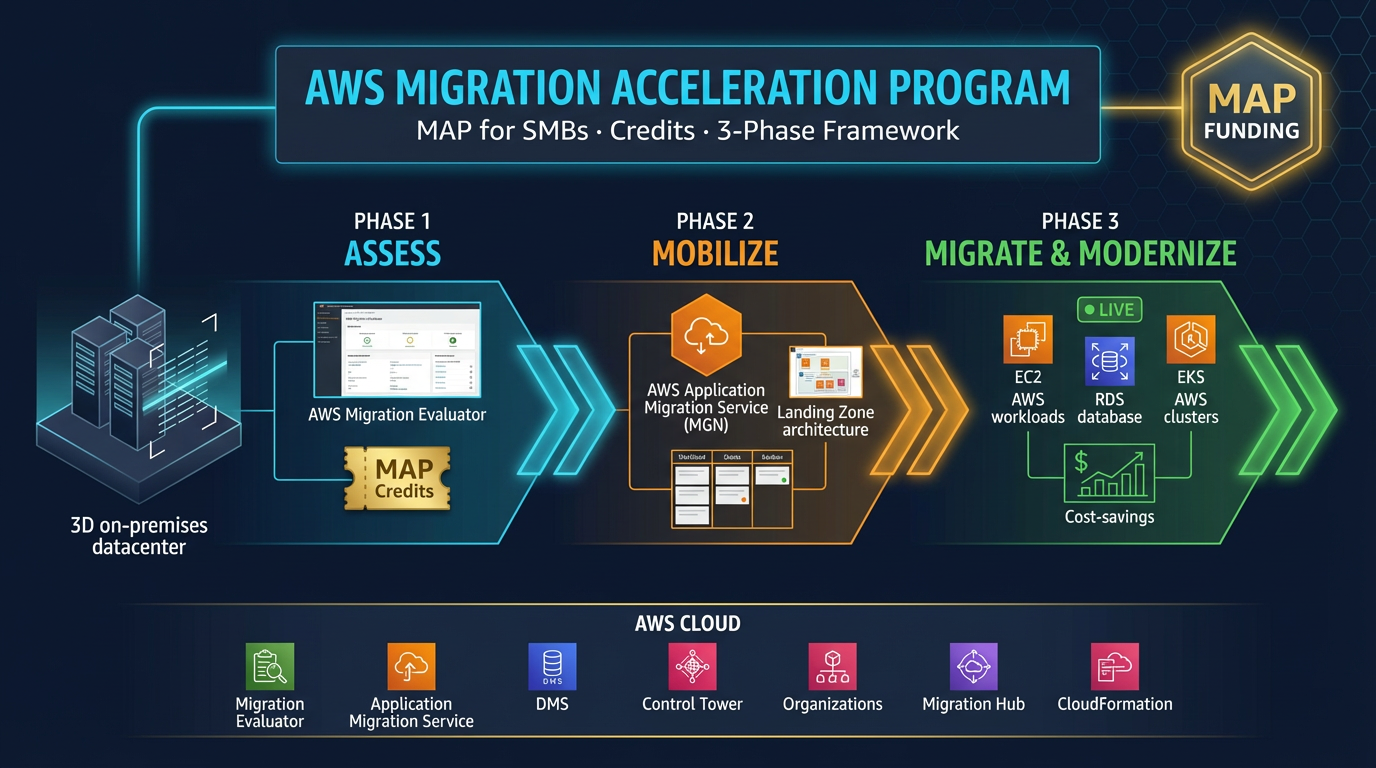
- Methodology — A structured approach aligned with AWS MAP (Migration Acceleration Program) rather than ad-hoc execution. MAP also unlocks AWS funding credits for eligible migrations
- Post-migration support — Migration is not done when the servers move. You need optimization, monitoring, and knowledge transfer
- Cultural fit — Your partner’s engineers will work closely with your team. Communication style and working practices matter
When this advice fails
- ≤5 simple servers, experienced AWS ops, no compliance clock — stay internal; buy architecture review hours if needed.
- You only need a lift-and-shift of identical VMs — MGN + a strong internal lead may be enough; still do Migration Evaluator first.
- Leadership will not fund cutover windows — a partner cannot invent change control.
What this post doesn’t cover
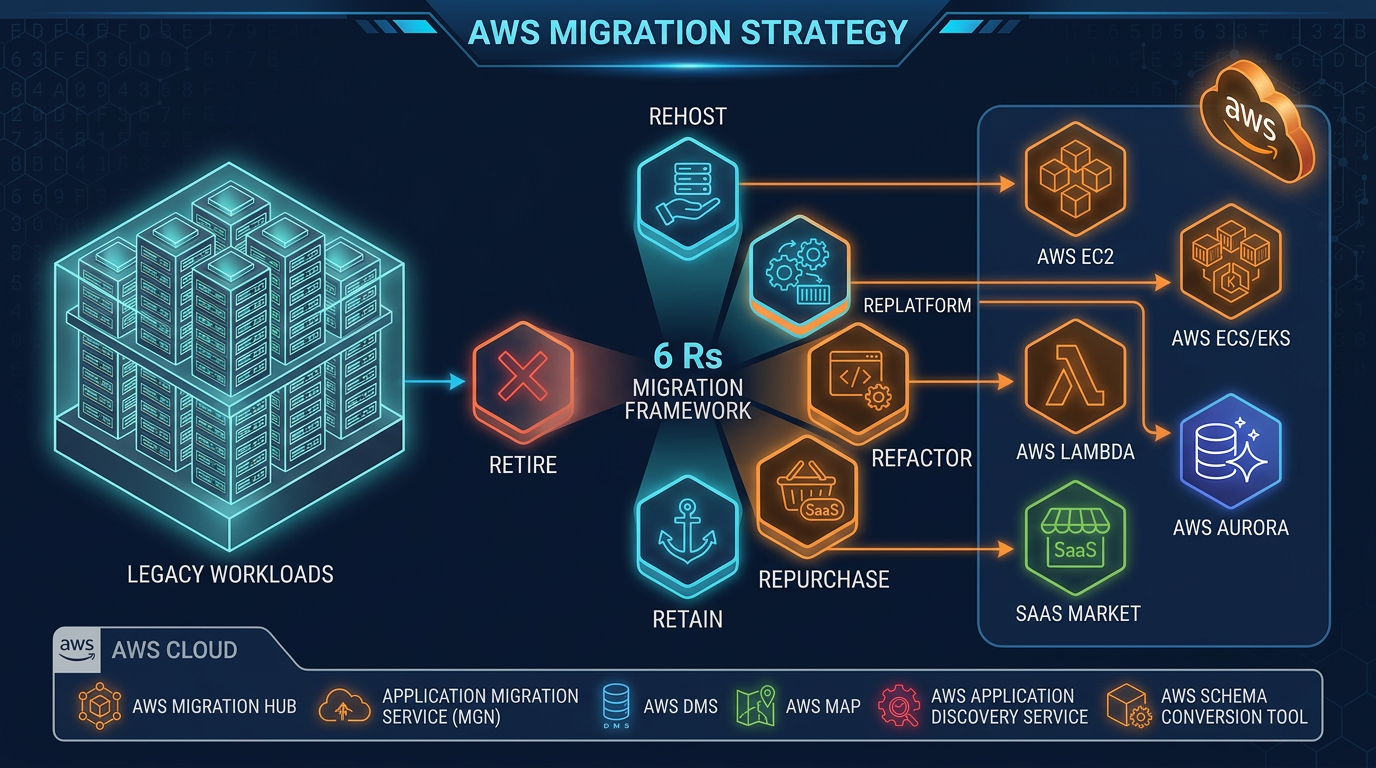
Detailed 6R scoring worksheets — see migration strategy and MAP SMB guide.
What to do Monday morning
- Can you export a complete inventory + dependencies in one day? If not, start discovery (ADS / Migration Hub).
- Run Migration Evaluator before the next wave; kill surprise bills early.
- List stall risks: DMS lag, VPN, compliance gaps, oracle/SQL Server SCT pain.
- Check MAP eligibility with your AWS account team / partner.
- Decide partner vs internal using the “When you do not need a partner” bar above.
- Book a migration readiness assessment or start at AWS Cloud Migration Services.
Frequently asked questions
When do you not need an AWS migration partner?
What is the strongest sign the migration is under-resourced?
Can a partner invent a cutover window?
Does MAP membership mean we should hire immediately?

AWS Cloud Architect & AI Expert
AWS-certified cloud architect and AI expert with deep expertise in cloud migrations, cost optimization, and generative AI on AWS.